

Mastering the Mic in Korea: How to Handle Audio Glitches Like a K-Drama CEO 🎤
Hello there! It’s your Daily Hangul Editor.
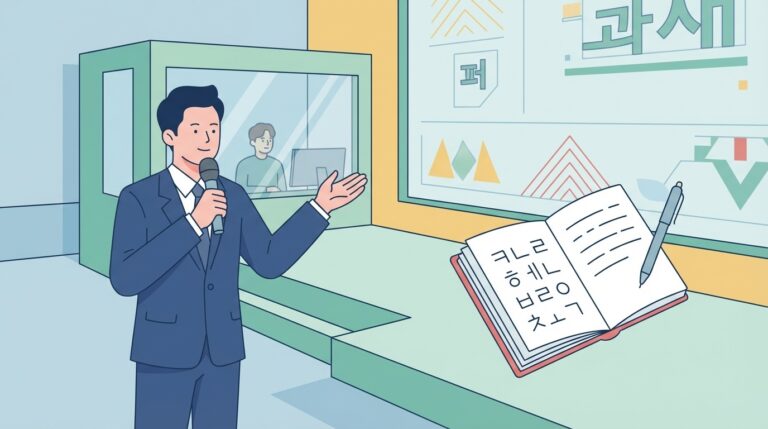
Picture this: You are the protagonist of a hit K-Drama. You step onto the grand stage of the COEX Auditorium in Gangnam. Hundreds of industry professionals are waiting for your keynote presentation. You adjust your suit, take a deep breath, and lean into the microphone.
“안녕하십니까…”
SCREEEEEECH! 🔊⚡
A deafening, high-pitched howl rips through the speakers. The audience winces. The dramatic K-Drama OST abruptly stops. In this split second, the room’s nunchi (눈치) shifts entirely to you. Do you freeze? Do you awkwardly tap the mic? Or do you smoothly address the sound booth with a flawless, C2-level Korean phrase that makes you look like an absolute seasoned professional?
If you are aiming for advanced fluency (C2), you know that textbook Korean won’t save you here. Textbooks teach you how to say “The sound is loud” (소리가 큽니다). But in the real world of Korean business and public speaking, directly pointing out a flaw can cause the staff to lose face (체면). Today, we are going to dive deep into the subtle, high-level art of managing microphone howling and volume control with grace, wit, and perfect Korean pragmatics.
Everything in this guide is based on real-life scenarios my advanced students and I have faced. Let’s turn that audio disaster into your shining moment!
Phase 2: Core Expressions Deep Dive 🌊
Here are the absolute essential C2-level phrases you need when the tech goes wrong.
1. “마이크 하울링이 약간 있는데, 볼륨 좀 낮춰주시겠습니까?”
- Pronunciation: [maikeu haulling-i yakgan inneunde, bollyum jom natchwojusigetseumnikka?]
- Meaning: (Literal) There is a little bit of mic howling, could you lower the volume please? / (Real nuance) The mic is screeching, please fix the volume ASAP, but I’m saying it nicely.
- K-Culture Moment: You’ll hear this exactly like this at corporate seminars or even K-Pop press conferences. The speaker maintains a calm smile while looking toward the sound director (음향 감독님).
- Editor’s Insight: The genius of this phrase lies in the word 약간 (a little bit). Even if the howling is ear-shattering, a high-level Korean speaker will downplay it by saying “there is a slight howling.” This prevents the sound engineer from feeling publicly humiliated. It’s the ultimate verbal cushion.
- Situation Spectrum:
[🚫 절대 금지] ———— [⚠️ 주의] ———— [✅ 자유롭게]
- Casual with friends: 🚫 (Too formal)
- Semi-formal/Colleagues: ⚠️ (A bit stiff)
- Formal/Public Speaking: ✅ (Perfectly polite and professional)
- 🤔 Think About It: Why do Koreans often use “약간” (a little) or “좀” (a little/please) even when a problem is severe? How does indirectness relate to the concept of saving face in Korean society?
2. “맨 뒤에 계신 분들도 제 목소리 잘 들리시나요?”
- Pronunciation: [maen dwie gyesin bundeul-do je moksori jal deullisinayo?]
- Meaning: (Literal) Can the people in the very back hear my voice well? / (Real nuance) Let’s do a quick mic check, but I’m framing it as caring about the audience.
- K-Culture Moment: K-Pop idols use a variation of this all the time at concerts: “2층, 3층 잘 들려요?!” (2nd floor, 3rd floor, can you hear me?!). In a business setting, it shows you are a considerate leader who cares about every single attendee.
- Editor’s Insight: This phrase does double duty. It checks if the volume is adequate without directly asking the tech staff “Is the volume okay?” while simultaneously engaging the audience and breaking the ice.
- Situation Spectrum:
[🚫 절대 금지] ———— [⚠️ 주의] ———— [✅ 자유롭게]
- Casual with friends: 🚫 (Unnecessary)
- Semi-formal/Colleagues: ✅
- Formal/Public Speaking: ✅
- 🤔 Think About It: Notice the honorific “계신” (honorific of 있다, to be). Even when addressing a nameless crowd, Korean grammar requires elevating the audience. Does your language have a way to elevate a crowd?
3. “소리가 살짝 찢어지는 것 같은데, 에코 좀 줄여주시겠어요?”
- Pronunciation: [soriga saljjak jjijeojineun geot gateunde, eko jom juryeojusigesseoyo?]
- Meaning: (Literal) It seems like the sound is tearing slightly, could you reduce the echo a bit? / (Real nuance) The audio is clipping/distorted, turn down the reverb.
- K-Culture Moment: This is the ultimate “Insider (인싸)” phrase. If you go to a Noraebang (Karaoke) with your Korean coworkers and the mic sounds awful, casually dropping this phrase will make them look at you with deep respect. You sound like a music producer.
- Editor’s Insight: “소리가 찢어지다” literally translates to “the sound is tearing.” It’s the native way to describe audio clipping or distortion. Notice we soften it again with “~것 같은데” (it seems like) instead of stating it as a hard fact.
- Situation Spectrum:
[🚫 절대 금지] ———— [⚠️ 주의] ———— [✅ 자유롭게]
- Casual with friends: ✅ (Drop the honorifics: 에코 좀 줄여줘)
- Semi-formal/Noraebang: ✅
- Formal/Public Speaking: ⚠️ (A bit too technical/casual for a very formal corporate stage, better suited for rehearsals or less formal events)
Phase 3: Textbook vs Real Life 📖🗣️
Let’s compare what you studied with what you’ll actually hear on the ground.
| 상황 (Situation) | 📖 교과서 한국어 (Textbook) | 🗣️ 진짜 한국어 (Real Life) | 💡 왜 다를까? (Why the difference?) |
|---|---|---|---|
| Mic feedback is hurting ears | 마이크 소리가 너무 큽니다. (The mic sound is too loud.) | 앗, 하울링이 좀 있네요. (Oops, there’s a bit of howling.) | Koreans prefer to name the technical issue (하울링) rather than blame the volume (소리), and use “앗” to make it sound like a shared, accidental discovery. |
| Checking volume | 제 목소리가 들립니까? (Can you hear my voice?) | 뒤에 잘 들리시나요? (Can you hear well in the back?) | Shortened for efficiency, focused on the audience’s comfort rather than the speaker’s projection. |
| Taking a moment to fix it | 기계를 고치겠습니다. 기다려 주세요. (I will fix the machine. Please wait.) | 잠시 오디오 점검하고 가겠습니다. (I’ll briefly check the audio before proceeding.) | “고치다” implies something is broken. “점검하다” (inspect/check) sounds much more professional and routine. |
Bottom Note for C2 Learners: Avoid using overly blunt statements like “소리 줄여주세요” (Turn down the sound) on a professional stage. It sounds like an order given to a subordinate, which can ruin the professional mood. Use indirect requests.
Phase 4: Cultural Deep Dive 🤿
4-1. Non-verbal Communication: The Art of the “Eye Smile” and “Nod”
When the mic screeches, never glare at the sound booth. In Korean professional culture, publicly showing annoyance is considered a lack of emotional control. Instead, employ the business smile. Make brief eye contact with the sound engineer, gesture subtly with an open palm toward the mic (never point with one finger), and when they fix it, give a very slight, acknowledging nod. This shows supreme nunchi and class.
4-2. K-Culture Connection: The K-Pop Sound Check
If you’ve ever watched behind-the-scenes footage of K-Pop idols (like BTS or BLACKPINK) during concert rehearsals, you’ll see a masterclass in this specific Korean.
Idols wear in-ear monitors, and communicating with the Eumhyang Gamdongnim (음향 감독님 – Sound Director) is a crucial skill. You’ll hear them say:
“감독님, 제 인이어 엠알(MR) 볼륨 살짝만 올려주실 수 있나요?” (Director, could you raise the MR volume in my in-ear just a little bit?)
Critical Viewpoint: Notice how even global superstars use high-level politeness (-아/어 주실 수 있나요) and softening words (살짝 – slightly) when speaking to the staff. In Korea, regardless of your star power or corporate rank, respecting the technicians and crew is a vital sign of good character (인성).
Phase 5: Immersive Roleplay Scenario 🎭
Scenario A: The High-Stakes Pitch
Setting: Friday morning, 10:00 AM. A sleek conference room in Yeouido. You are presenting a major marketing pitch to potential Korean investors. You step up to the podium.
Characters:
– YOU (The Reader): A confident, advanced Korean speaker trying to secure funding.
– Director Park (박 이사): The stern-looking investor sitting in the front row.
– Staff (스태프): The anxious venue technician at the back.
(Dialogue Begins)
YOU: (Tapping the mic lightly) 아, 아. 안녕하십니까. 오늘 발표를 맡은…
(Ah, ah. Annyeonghasimnikka. Oneul balpyoreul mateun…)
[Ah, ah. Hello. I am in charge of today’s presentation…]
(🔊 SCCHHREEEEEEK! A massive howling sound echoes through the room.)
Director Park: (Frowns and covers his ears) 으악, 소리가 왜 이래?
(Uak, soriga wae irae?)
[Ugh, what’s wrong with the sound?]
Staff: (Panicking from the booth) 죄송합니다! 잠시만요!
(Joesonghamnida! Jamsimanyo!)
[I’m sorry! Just a moment!]
YOU: (Smiling calmly) 네, 괜찮습니다. ______________
(Ne, gwaenchanseumnida. ______________)
[Yes, it’s fine. ______________]
🔀 Your Turn! How should you respond to keep the room calm and show your C2 fluency?
- A) “마이크가 고장 났습니다. 빨리 고쳐주세요.” (The mic is broken. Please fix it quickly.)
- B) “감독님, 마이크 하울링이 좀 있는데, 볼륨 살짝만 조절해 주시겠습니까?” (Director, there’s a bit of mic howling, could you adjust the volume slightly?)
- C) “아우 깜짝이야! 귀 떨어질 뻔했네요!” (Oh my gosh! My ears almost fell off!)
✅ Best Choice: B — It acknowledges the issue without blaming, uses professional titles (감독님 – even if they are just staff, elevating them works well), and requests adjustment politely.
⚠️ Choice A Analysis: Way too blunt and accusatory.
⚠️ Choice C Analysis: Funny, but too casual for a pitch to investors. Better suited for a comedy club or a very close team meeting.
(Dialogue Continues based on Choice B)
Staff: (Looking relieved) 네, 볼륨 조금 낮췄습니다. 이제 괜찮으신가요?
(Ne, bollyum jogeum natchwotseumnida. Ije gwaenchaneusingayo?)
[Yes, I’ve lowered the volume a bit. Is it okay now?]
YOU: 네, 아주 좋습니다. 감사합니다. (Looking at the audience) 맨 뒤에 계신 박 이사님, 제 목소리 잘 들리시나요?
(Ne, aju joseumnida. Gamsahamnida. Maen dwie gyesin Bak isanim, je moksori jal deullisinayo?)
[Yes, it’s perfectly fine. Thank you. Director Park in the back, can you hear my voice well?]
Director Park: (Nodding, impressed by your smooth recovery) 네, 아주 잘 들립니다. 시작하시죠.
(Ne, aju jal deullimnida. Sijakhasijyo.)
[Yes, I hear you very well. Please begin.]
Scenario B: The Noraebang Afterparty (Bonus)
Setting: After a successful pitch, you are at a Noraebang in Hongdae with your team.
Colleague: 자, 이제 노래 한 곡 뽑으시죠! (Hands you the mic)
[Now, pick a song and sing!]
YOU: (You sing the first line, but the echo makes you sound like you are in a grand canyon)
아… 저기요, 이거 소리가 살짝 찢어지는데 에코 좀 줄여주실 수 있어요?
[Ah… excuse me, the sound is clipping a bit, could you turn down the echo?]
Colleague: (Laughs) 와, 한국인인 줄 알았어요! 에코 빼드릴게요!
[Wow, I thought you were Korean! I’ll take the echo out for you!]
Phase 6: 10-Second Shadowing Drill ⏱️
Let’s practice the flow. Pay attention to the pauses (/) and the emotion tags!
- 🎤 Professional & Polite:
😊 감독님, / 마이크 하울링이 / 살~짝 있는데, / 볼륨 좀 / 낮춰주시겠습니까?
(Gamdongnim, / maikeu haulling-i / sal~jjak inneunde, / bollyum jom / natchwojusigetseumnikka?) -
🎤 Caring & Engaging:
😊 맨 뒤에 / 계신 분들도 / 제 목소리 / 잘 들리시나요?
(Maen dwie / gyesin bundeul-do / je moksori / jal deullisinayo?)
Phase 7: K-Culture Glossary (Mini Dictionary) 📚
| 한국어 (Korean) | Romanization | English | Contextual Meaning |
|---|---|---|---|
| 하울링 | haulling | Howling/Feedback | The screeching noise from a mic. A must-know Konglish term for events. |
| 음향 감독님 | eumhyang gamdongnim | Sound Director | Polite title for the person running the sound board. Call them this to get the best service! |
| 마이크를 넘기다 | maikeureul neomgida | Pass the mic | Used metaphorically and literally when giving the floor to the next speaker. |
| 찢어지다 | jjijeojida | To tear (clipping) | Used to describe audio that is too loud and distorted. |
| 눈치 | nunchi | Nunchi | The ability to read the room. Fixing a mic issue smoothly shows high nunchi. |
Phase 8: Traveler’s Survival Kit 🧳
Even if you aren’t presenting at a corporate seminar, you will definitely interact with microphones or speakers in Korea—especially at Noraebangs (Karaoke rooms) or language exchange meetups!
🆘 Survival Phrases for the Noraebang/Meetup
– 🇰🇷 “에코 좀 빼주세요.” (eko jom ppaejuseyo.)
– 🗣️ Pronunciation: [eh-ko jom ppae-ju-se-yo]
– 📍 Where to use: Noraebang, when your voice sounds too muffled.
– 💡 Pro Tip: Look for the remote control on the table. The buttons are usually labeled에코(Echo) and마이크 음량(Mic Volume). You can adjust it yourself!📌 Editor’s Travel Note
If you are renting a space for a meetup in Korea (like at a Study Room or Party Room), you often have to set up the PA system yourself. If the mic squeals, remember: don’t point the mic head directly at the speakers! Koreans will jokingly say “마이크가 스피커랑 뽀뽀하려고 하네” (The mic is trying to kiss the speaker).
Phase 9: Think Deeper — Language & Power 🧠
🧠 Think Deeper:
The way Koreans handle public speaking glitches perfectly illustrates the intersection of Language, Power, and Kibun (기분 – mood/face). Even if you are the CEO and the person making the mistake is a junior technician, publicly reprimanding them with direct language (“Turn it down!”) makes you look like a bad leader who disrupts the harmony of the room. By using high honorifics (-시겠습니까) and downplaying the problem (약간 – a little), the speaker flexes their true power: the ability to maintain grace, protect the dignity of subordinates, and keep the audience comfortable. True authority in Korea doesn’t shout; it speaks softly and politely.💬 Your Turn: In your home culture, if a technician makes a loud mistake during your presentation, what is the culturally appropriate way to handle it? Do you use humor, direct instructions, or ignore it? Let me know in the comments!
Phase 10: FAQ & Troubleshooting 🛠️
Q: Can I just say “마이크 안 돼요” (The mic doesn’t work)?
A: You can, but it’s very blunt and unhelpful. It’s better to specify the issue. Is it off? (“마이크가 꺼진 것 같습니다”), or is it screeching? (“하울링이 있습니다”).
Q: Should I tap the mic to test it?
A: In Korea (and globally among audio pros), blowing into the mic or violently tapping it is a big no-no. It damages the equipment. Say “아, 아, 마이크 테스트” (Ah, ah, mic test) or simply “하나, 둘, 셋” (One, two, three) instead.
❌ Common Mistake: Saying “시끄러워요!” (It’s noisy!) when the mic feedbacks.
✅ Do This Instead: Say “소리가 너무 크게 울립니다” (The sound is echoing too loudly). “시끄러워요” sounds like a complaint a child makes, whereas “울립니다” is an objective, professional observation.
Phase 11: Wrap-up & Action Items 🎬
One-Liner Summary: When the mic acts up, use softening words like “살짝” (slightly) and polite requests to fix the issue without making anyone lose face!
Your Action Missions for Today:
– 🥉 Bronze (Solo): Stand in front of a mirror, hold an imaginary mic, and say “마이크 하울링이 약간 있는데…” with a professional, calm smile.
– 🥈 Silver (Online): Post your favorite K-Drama presentation scene in a Korean learning forum, and write what you would say if the mic suddenly broke.
– 🥇 Gold (Real World): Next time you are at a Noraebang with Korean friends, casually ask the staff or your friends, “에코 좀 살짝 줄여주실 수 있나요?” Watch their jaws drop at your native-like fluency!
🎤 Special K-Culture Mission:
Go to YouTube and search for “아이돌 음향 사고 대처” (Idol audio accident handling). Watch how K-Pop stars smoothly keep singing or politely signal the tech booth when their mic dies or howls.
What’s your worst public speaking nightmare? Have you ever had a tech glitch ruin your flow? Share your stories below!
Phase 12: Interactive Challenge 🏆
1. Situational Judgment:
You are giving a toast at a formal Korean wedding. The mic volume is so low that the back row is yelling “안 들려요!” (We can’t hear you!). What is the MOST appropriate C2-level response?
– A) 마이크 소리 좀 키워! (Turn up the mic sound!)
– B) 뒤에 계신 분들, 제 목소리 잘 안 들리시나요? 볼륨 조금만 높여주시면 감사하겠습니다.
– C) 아오, 마이크 진짜 구리네요. (Wow, this mic really sucks.)
2. Fill in the Blank:
The sound is severely distorted. You want to sound like an industry insider.
“소리가 좀 __________ 것 같은데, 확인 부탁드립니다.”
(Hint: Tearing)
3. True or False – K-Culture Edition:
It is considered confident and professional in Korea to loudly point out the sound engineer’s mistake so the audience knows it wasn’t your fault. (T / F)
👉 Click to see the answers!
1. B – It engages the audience politely and makes a gentle request to the staff. A is too rude, C is too casual/slangy.
2. 찢어지는 (jjijeojineun) – The native expression for audio clipping.
3. False – Publicly shaming the staff ruins the ‘Kibun’ (mood/face) of the room and makes you look arrogant. Always handle it smoothly and indirectly!
Frequently Asked Questions (FAQ)
Q: What does ""마이크 하울링이 약간 있는데, 볼륨 좀 낮춰주시겠습니까?"" mean in Korean and how do you pronounce it?
A: In Korean, ""마이크 하울링이 약간 있는데, 볼륨 좀 낮춰주시겠습니까?"" is pronounced [maikeu haulling-i yakgan inneunde, bollyum jom natchwojusigetseumnikka?] and means: (Literal) There is a little bit of mic howling, could you lower the volume please? / (Real nuance) The mic is screeching, please fix the volume ASAP, but I'm saying it nicely.
Q: What does ""맨 뒤에 계신 분들도 제 목소리 잘 들리시나요?"" mean in Korean and how do you pronounce it?
A: In Korean, ""맨 뒤에 계신 분들도 제 목소리 잘 들리시나요?"" is pronounced [maen dwie gyesin bundeul-do je moksori jal deullisinayo?] and means: (Literal) Can the people in the very back hear my voice well? / (Real nuance) Let's do a quick mic check, but I'm framing it as caring about the audience.
Q: What does ""소리가 살짝 찢어지는 것 같은데, 에코 좀 줄여주시겠어요?"" mean in Korean and how do you pronounce it?
A: In Korean, ""소리가 살짝 찢어지는 것 같은데, 에코 좀 줄여주시겠어요?"" is pronounced [soriga saljjak jjijeojineun geot gateunde, eko jom juryeojusigesseoyo?] and means: (Literal) It seems like the sound is tearing slightly, could you reduce the echo a bit? / (Real nuance) The audio is clipping/distorted, turn down the reverb.







