

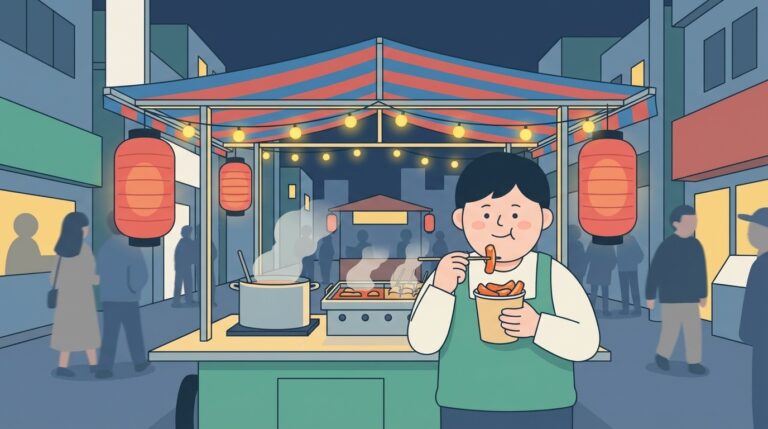
Eating Korean Street Food Like a Local: The Paper Cup Secret!
Phase 1: Immersive Hook — Step into the Scene
Hello! I’m the Senior Editor at Daily Hangul.
Picture this: You are watching your favorite K-Drama. The main characters are walking down a chilly street at night. Suddenly, they stop at a glowing red tent (Pojangmacha). They don’t sit down for a fancy meal. Instead, they stand there, laughing, eating bright red Tteokbokki out of a small paper cup using a wooden skewer, and blowing on hot Odeng (fish cake) soup in another cup.
Have you ever wanted to do exactly that?
When you visit Myeongdong or Hongdae, the street food stalls are amazing, but they can be intimidating. If you just say “Give me this,” they might pack it in a sealed plastic container for you to take home. But what if you want to eat it right there, soaking in the vibe, just like in the dramas?
The secret lies in knowing how to ask for the legendary “Paper Cup (종이컵)”. Today, we are going to learn the essential A2-level survival phrases to help you eat Korean street food like a true local.
(Transparency note: This guide is based on real struggles my foreign students faced when trying to navigate Korean street food markets!)
Phase 2: Deep Dive into Core Expressions
Let’s master the magic words that will unlock the ultimate K-Food experience.
1. 컵에 담아주세요 (Please put it in a cup)
- Pronunciation: keobe damajuseyo [Sounds like: cub-eh dah-mah-joo-seh-yo]
- Meaning:
- Literal: Please put it in a cup.
- Real Nuance: I want to eat this right now as street food, so please serve it in a paper cup.
- K-Culture Moment: You’re at a bustling market. If you order Tteokbokki, the vendor might assume you want to take it to your hotel. Saying this phrase tells them you want the classic “Cup-bokki” (컵볶이) experience—eating while standing or walking!
- Editor’s Insight: This phrase is incredibly useful. 담다 (damda) means “to put into.” It sounds polite and natural. Don’t worry about being perfectly formal; street vendors appreciate clear, polite requests.
- Situation Spectrum:
[🚫 절대 금지] ———— [⚠️ 주의] ———— [✅ 자유롭게]
- Friendly Street Vendor (Casual/Semi-formal): ✅
- Fancy Restaurant (Formal): 🚫 (You wouldn’t ask a Michelin chef to put your steak in a paper cup!)
- 🤔 Think About It: In Korea, paper cups aren’t just for water. They are the ultimate versatile vessel for street food. Why do you think Korean street culture relies so heavily on disposable cups rather than plates?
2. 국물 좀 주시겠어요? (Can I have some soup?)
- Pronunciation: gungmul jom jusigesseoyo? [Sounds like: goong-mool johm joo-she-gess-uh-yo]
- Meaning:
- Literal: Would you give me a little soup?
- Real Nuance: Can I please have a paper cup filled with that delicious, warm fish cake broth?
- K-Culture Moment: In winter, Koreans survive the freezing wind by drinking Odeng (fish cake) broth out of paper cups. The best part? At most stalls, the broth is absolutely FREE if you buy something else!
- Editor’s Insight: 국물 (gungmul) means broth/soup. The word 좀 (jom) means “a little,” but Koreans use it to soften a request, making it sound much more polite.
- Situation Spectrum:
[🚫 절대 금지] ———— [⚠️ 주의] ———— [✅ 자유롭게]
- Street Food Stall: ✅
- Convenience Store: 🚫 (They don’t have free soup!)
- 🤔 Think About It: Korean meals almost always include a soup or broth. This love for warm liquids even extends to standing on the street! Does your culture have a “comfort drink” for cold days?
3. 가면서 먹을게요 (I’ll eat it as I go)
- Pronunciation: gamyeonseo meogeulgeyo [Sounds like: gah-myun-suh mug-eul-geh-yo]
- Meaning:
- Literal: I will eat while going.
- Real Nuance: I’m not taking this home. I’m going to eat it right here/while walking. Please prep it for immediate eating (usually with skewers in a paper cup).
- K-Culture Moment: This is the ultimate “Insider” phrase. It immediately signals to the vendor that you know the drill.
- Editor’s Insight: By saying this, the vendor won’t bother sealing the bag. They’ll hand you the food ready to eat, often with a tissue wrapped around the bottom of the cup if it’s hot.
- Situation Spectrum:
[🚫 절대 금지] ———— [⚠️ 주의] ———— [✅ 자유롭게]
- Casual Market Stall: ✅
Phase 3: Textbook vs Real Life
Let’s look at why sounding like a textbook might cause confusion at a food stall.
| Situation | 📖 Textbook Korean | 🗣️ Real-Life Korean | 💡 Why is it different? |
|---|---|---|---|
| Telling them you won’t take it home | “포장하지 않겠습니다.” (I will not package it.) | “가면서 먹을게요.” (I’ll eat it as I go.) | Textbooks focus on formal business settings; street stalls use practical, action-oriented phrases. |
| Asking for it in a cup | “이것을 종이컵에 넣어 주십시오.” (Please insert this into a paper cup.) | “컵에 담아주세요~” (Put it in a cup, please~) | Street talk is all about speed and friendliness. Long formal sentences sound robotic here. |
| Asking the price | “이것은 얼마입니까?” (How much is this?) | “사장님, 이거 얼마예요?” (Boss, how much is this?) | Adding “Sajangnim” (Boss/Owner) builds instant rapport (정) with the vendor. |
Bottom Note: At an A2 level, you don’t need complicated grammar. Adding “~주세요” (juseyo – please give me) to a noun is your best friend!
Phase 4: Cultural Deep Dive — The Magic of the Paper Cup
4-1. Non-verbal Communication: The “Two-Handed Cup Grab”
When the vendor hands you that hot paper cup of Tteokbokki, don’t just grab it with one hand while looking away! In Korea, giving and receiving things (especially food and money) with two hands is a sign of respect. Even a slight bow of the head with a smile will make the Sajangnim love you. Also, use your Nunchi (눈치): if the stall is super crowded, eat quickly and step slightly to the side to let others order!
4-2. K-Food Connection: Why Paper Cups?
Why does Korean street food rely so heavily on paper cups? It’s all about Pali-Pali (빨리빨리 – hurry hurry) Culture and convenience. Paper cups insulate your hands from hot food, they catch the dripping spicy sauce, and they are perfect for walking.
Plus, it reflects the Korean culture of sharing! It’s very common for friends to buy one paper cup of street food and ask the vendor for “꼬치 두 개 (kkochi du gae – two skewers)” so they can share it from the same cup. This sharing of food from a single container is a core part of Korean Jeong (정 – affection/bonding).
Phase 5: Immersive Roleplay Scenario
Setting: Friday night, 8:00 PM. The bustling Gwangjang Market. Steam is rising from the stalls. You smell the spicy gochujang and sweet soy sauce. You want to eat some Tteokbokki while looking around the market.
Characters:
– YOU: A hungry traveler exploring Seoul.
– 사장님 (Sajangnim): A friendly middle-aged vendor wearing an apron, rapidly stirring the red Tteokbokki.
Dialogue:
사장님: 어서 오세요! 떡볶이 줄까요?
(eoseo oseyo! tteokbokki julkkayo?)
[Welcome! Shall I give you some Tteokbokki?]
YOU: 네! 떡볶이 1인분 주세요.
(ne! tteokbokki il-inbun juseyo.)
[Yes! One portion of Tteokbokki, please.]
사장님: 네~ 포장해 줄까요?
(ne~ pojanghae julkkayo?)
[Okay~ Shall I pack it to-go?]
(🎭 Stage Direction: The vendor reaches for a plastic bag…)
🔀 Your Turn! How should you respond to eat it right away?
– A) “아니요, 포장하지 마세요.” (No, do not pack it.)
– B) “컵에 담아주세요. 가면서 먹을게요!” (Please put it in a cup. I’ll eat as I go!)
– C) “저기요! 컵!” (Excuse me! Cup!)✅ Best Choice: B — It perfectly explains exactly what you want in a friendly way.
⚠️ Choice A Analysis: It sounds a bit cold and aggressive.
⚠️ Choice C Analysis: Too blunt. It sounds demanding rather than polite.
(Continuing with Choice B…)
YOU: 컵에 담아주세요. 가면서 먹을게요!
(keobe damajuseyo. gamyeonseo meogeulgeyo!)
[Please put it in a cup. I’ll eat as I go!]
사장님: 아, 네! 컵에 줄게요. 꼬치 몇 개 줄까요?
(a, ne! keobe julgeyo. kkochi myeot gae julkkayo?)
[Ah, okay! I’ll put it in a cup. How many skewers should I give you?]
YOU: 꼬치 두 개 주세요.
(kkochi du gae juseyo.)
[Two skewers, please.]
사장님: 자, 여기 있어요. 맛있게 먹어요!
(ja, yeogi isseoyo. masitge meogeoyo!)
[Here you go. Enjoy your meal!]
YOU: 감사합니다! 아, 사장님…
(gamsahamnida! a, sajangnim…)
[Thank you! Ah, boss…]
YOU: 국물 좀 마셔도 돼요?
(gungmul jom masyeodo dwaeyo?)
[Can I drink some soup?]
사장님: 그럼요! 저기 옆에 종이컵 있어요. 직접 떠서 드세요~
(geureomyo! jeogi yeope jong-ikeop isseoyo. jikjeop tteoseo deuseyo~)
[Of course! There are paper cups over there. Serve yourself~]
YOU: 우와, 감사합니다! (Takes a sip) 대박!
(uwa, gamsahamnida! … daebak!)
[Wow, thank you! … Awesome!]
Phase 6: 10-Second Shadowing Drill
Let’s practice the flow and intonation! Follow the emotion tags and pause at the slashes /.
😊 사장님, / 이거 / 컵에 / 담아주세요~
(sajangnim, / igeo / keobe / damajuseyo~)
[Boss, please put this in a cup~]
🥺 꼬치 / 하나만 / 더 / 주세요!
(kkochi / hanaman / deo / juseyo!)
[Just one more skewer, please!]
Phase 7: K-Culture Glossary (Mini Dictionary)
| 한국어 (Korean) | Romanization | English | Cultural Context |
|---|---|---|---|
| 포장마차 | pojangmacha | Street food tent | Literally “covered wagon.” The iconic late-night street food stalls seen in K-Dramas. |
| 종이컵 | jong-ikeop | Paper cup | The holy grail of street food containers. Used for food, soup, and drinks! |
| 꼬치 | kkochi | Skewer | The wooden stick used as a utensil for street food. Think of it as a Korean street fork. |
| 컵볶이 | keopbokki | Cup-bokki | Tteokbokki served in a paper cup. A nostalgic after-school snack for Korean students. |
| 사장님 | sajangnim | Boss / Owner | The safest, most polite way to address a vendor or restaurant worker. |
Phase 8: Traveler’s Survival Kit
If you forget everything else, just screenshot this card for your trip to Korea!
🆘 Survival Phrases for Street Food
– 🇰🇷 “이거 얼마예요?” (igeo eolmayeyo?) = How much is this?
– 🇰🇷 “이거 한 개 주세요.” (igeo han gae juseyo.) = Please give me one of these.
– 🇰🇷 “계좌이체 되나요?” (gyejwa-iche doenayo?) = Can I do a bank transfer?📍 Where to use: Gwangjang Market, Myeongdong street stalls, any food truck.
💡 Pro Tip: Point to what you want while saying “이거 (igeo – this)”! It’s perfectly fine if you don’t know the exact name of the food.📌 Editor’s Travel Note
– Cash vs Card: While Korea is a “card heaven,” many street stalls still prefer cash or local bank transfers. Always carry about 10,000 to 20,000 KRW in cash just for street food!
– Trash Etiquette: Korea doesn’t have many public trash cans. What do you do with your empty paper cup and sticky skewer? Take it back to the stall where you bought it! The vendor will happily throw it away for you. Don’t leave it on the street!
Phase 9: Think Deeper — “One Step Further”
Food & Identity: The Culture of Sharing (정)
🧠 Think Deeper:
In many Western cultures, people order their own individual portions of food. However, in Korea, street food is meant to be shared. When you ask a vendor for food in a paper cup and request two or three skewers (kkochi), you are partaking in the culture of Jeong (정). Eating out of the same small cup breaks down personal boundaries and builds closeness. It’s not just about saving money or using fewer cups; it’s a subconscious way of saying, “We are close enough to share this small space.”💬 Your Turn: How does your culture view sharing food from the same container? Let me know in the comments!
Phase 10: FAQ & Troubleshooting
Q: Is it okay to drink the Odeng soup straight from the cup?
Yes! That is exactly what the paper cup is for. You don’t need a spoon. Just hold it with two hands to keep your hands warm and sip it like a cup of coffee!
Q: Do I need to leave a tip for the street vendor?
Absolutely not. Korea has a strict no-tipping culture. If you leave money behind, the vendor might chase you down the street thinking you forgot your change!
❌ Common Mistake #1: Calling the vendor “아저씨 (Ahjussi – middle-aged man)” or “아줌마 (Ajumma – middle-aged woman)” loudly.
✅ Do this instead: Call them “사장님 (Sajangnim – Boss)”. It shows much more respect and will often get you a bigger portion or a brighter smile!
Phase 11: Wrap-up & Action Items
One-Liner Summary: To eat Korean street food like a local, just ask for it in a cup: “컵에 담아주세요 (keobe damajuseyo)!”
Action Mission:
– 🥉 Bronze (Solo): Stand in front of a mirror, hold an imaginary cup, and say “사장님, 컵에 담아주세요!” 3 times.
– 🥈 Silver (Online): Go to your favorite language learning app or forum and teach someone the word Keopbokki (컵볶이).
– 🥇 Gold (Real Life): Next time you are in Korea or at a local Korean market, order street food and ask for it in a cup to eat as you go!
🎥 K-Culture Mission: Watch an episode of a K-Drama today. I guarantee you will spot a scene where characters are eating street food. Look closely—are they eating out of a paper cup? Count how many skewers they use!
Phase 12: Interactive Quiz — Challenge Yourself!
1. Situational Judgment: You bought some hot Tteokbokki. You want to eat it right now while walking through Myeongdong. What should you say?
– A) 포장해 주세요 (Pack it, please)
– B) 컵에 담아주세요 (Put it in a cup, please)
– C) 메뉴판 주세요 (Menu, please)
2. Fill in the Blank:
Vendor: “포장해 드릴까요?” (Shall I pack it for you?)
You: “아니요, ______ 먹을게요.” (No, I’ll eat as I go.)
– A) 자면서 (While sleeping)
– B) 가면서 (While going/walking)
– C) 울면서 (While crying)
3. True or False – K-Culture Edition:
– If you buy street food, you can usually drink the fish cake (Odeng) soup for free from a paper cup. (T / F)
(Answers below)
Click to reveal answers!
- B – “컵에 담아주세요” is the perfect phrase for this!
- B – “가면서 먹을게요” means “I’ll eat it as I go.”
- True – Odeng soup is the ultimate free Korean street food perk!
Frequently Asked Questions (FAQ)
Q: What does "컵에 담아주세요 (Please put it in a cup)" mean in Korean and how do you pronounce it?
A: In Korean, "컵에 담아주세요 (Please put it in a cup)" is pronounced [keobe damajuseyo [Sounds like: cub-eh dah-mah-joo-seh-yo] and means: Literal: Please put it in a cup.
Q: What does "국물 좀 주시겠어요? (Can I have some soup?)" mean in Korean and how do you pronounce it?
A: In Korean, "국물 좀 주시겠어요? (Can I have some soup?)" is pronounced [gungmul jom jusigesseoyo? [Sounds like: goong-mool johm joo-she-gess-uh-yo] and means: Literal: Would you give me a little soup?
Q: What does "가면서 먹을게요 (I'll eat it as I go)" mean in Korean and how do you pronounce it?
A: In Korean, "가면서 먹을게요 (I'll eat it as I go)" is pronounced [gamyeonseo meogeulgeyo [Sounds like: gah-myun-suh mug-eul-geh-yo] and means: Literal: I will eat while going.







