

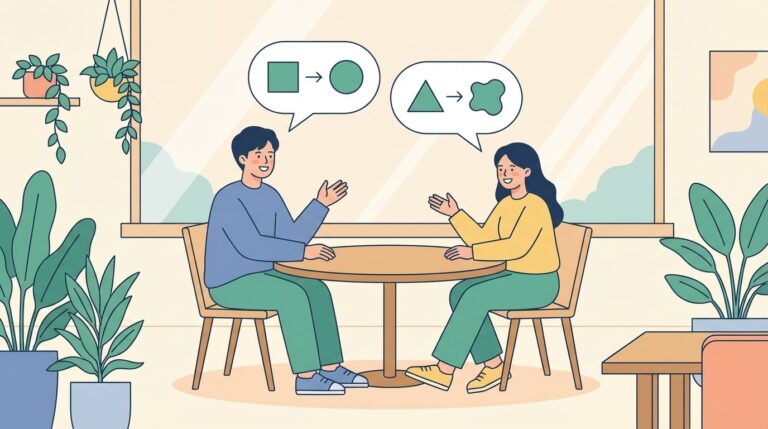
Phase 1: Immersive Hook (Are You Really Who You Think You Are?)
Hello! I’m the Daily Hangul Editor.
Picture this: You’re sitting in a trendy, industrial-chic cafe in Seongsu-dong. You’ve just met a Korean friend of a friend. You’re bracing yourself for the usual questions about your job or where you’re from. But instead, they lean in, eyes sparkling, and ask: “MBTI가 어떻게 되세요?” (What’s your MBTI?)
You confidently say, “I’m an INFP!” But then, you realize… lately, you’ve been leading all the meetings at work and organizing weekend trips. You don’t feel like a pure INFP anymore. You took the test again last night, and guess what? The result changed.
In Korea, MBTI isn’t just a quirky internet quiz; it’s the ultimate social lubricant. It replaces zodiac signs, blood types, and sometimes even formal introductions. But what happens when your test result changes? Can an Introvert magically become an Extrovert?
Today, we’re going to learn exactly how to talk about your shifting personality in Korean. Knowing these expressions won’t just help you survive a conversation—it will make you an absolute insider. Let’s dive in!
(Note: This lesson is based on real questions from our B1 learners who were suddenly bombarded with MBTI questions at Korean networking events!)
Phase 2: Deep Dive into Key Expressions
Let’s look at the top 3 ways Koreans explain that their MBTI has changed.
1. 저 MBTI 바뀌었어요. (My MBTI changed.)
- Pronunciation: jeo em-bi-ti-ai bakkwieosseoyo.
(Sound analogy: “bakkwieo” sounds a bit like “bah-kwee-uh”. It requires a quick lip movement!) - Meaning: Literal: My MBTI changed. / Real Nuance: “I took the test again, and I’m a new person now!”
- K-Culture Moment: Imagine sitting in a circle at a college MT (Membership Training) or a company dinner. Someone assumes you are quiet because you’re an ‘I’. You drop this line, and suddenly, everyone is eager to hear your “character development” arc.
- Editor’s Insight: This is a fantastic conversation starter. The verb 바뀌다 (to change) is used passively here, implying the test result shifted, rather than you forcing the change.
- Situation Spectrum:
[🚫 절대 금지] ———— [⚠️ 주의] ———— [✅ 자유롭게]- Casual with friends: ✅
- Co-workers (Semi-formal): ✅
- CEO/Elderly (Formal): ⚠️ (They might not know what MBTI is!)
- 🤔 Think About It: Why do we say the MBTI changed, rather than my personality changed? How does leaning on a test result make it easier to talk about ourselves?
2. 원래는 [INFP]였는데, 지금은 [ENFP]예요. (I used to be [INFP], but now I’m [ENFP].)
- Pronunciation: wollaeneun [INFP]yeonneunde, jigeumeun [ENFP]yeyo.
- Meaning: Highlighting the contrast between your past and present self.
- K-Culture Moment: K-Pop idols use this exact sentence structure ALL the time on platforms like Weverse or during live streams to update fans on their personal growth.
- Editor’s Insight: The magic word here is 원래 (originally/used to be). It’s incredibly common in daily Korean to contrast how things started versus how they are going.
- Situation Spectrum:
[🚫 절대 금지] ———— [⚠️ 주의] ———— [✅ 자유롭게]- Casual with friends: ✅
- Co-workers (Semi-formal): ✅
- Formal: ⚠️
- 🤔 Think About It: Does your language have a simple, built-in grammar structure like “~였는데, ~예요” to show contrast so smoothly?
3. 저 ‘사회적 E’예요. (I’m a ‘Social E’.)
- Pronunciation: jeo sahoejeok i-yeyo.
(Sound analogy: “sahoejeok” sounds like “sah-hweh-juck”.) - Meaning: Literal: I’m a social Extrovert. / Real Nuance: “I’m actually a hardcore Introvert, but I fake being an Extrovert to survive in society/at work.”
- K-Culture Moment: This is a peak modern Korean slang term. When you go to a networking event and an incredibly energetic host suddenly sighs and says, “I need to go home, my social battery is dead,” they are a ‘사회적 E’.
- Editor’s Insight: This isn’t about the test result changing permanently; it’s about context. Koreans highly value adapting to the group’s mood (눈치), so “faking” an MBTI for harmony is a recognized skill!
- Situation Spectrum:
[🚫 절대 금지] ———— [⚠️ 주의] ———— [✅ 자유롭게]- Casual with friends: ✅
- Co-workers (Semi-formal): ✅ (Great for team bonding!)
- Boss (Formal): 🚫 (Might sound slightly unprofessional)
Phase 3: Textbook vs. Real Life
| 상황 (Situation) | 📖 교과서 한국어 (Textbook) | 🗣️ 진짜 한국어 (Real Life) | 💡 왜 다를까? (Why the difference?) |
|---|---|---|---|
| Explaining a change | 제 성격이 변했습니다. (My personality has changed.) | 저 MBTI 바뀌었어요! (My MBTI changed!) | Koreans prefer discussing personality through the objective lens of MBTI letters. |
| Being shy but acting outgoing | 저는 내성적이지만 외향적으로 행동합니다. | 저 완전 ‘사회적 E’잖아요. (I’m a total ‘Social E’.) | We love creating punchy compound words (Social + E) for efficiency and wit. |
| Saying it depends | 상황에 따라 다릅니다. | 일할 때는 J가 돼요. (I become a J when working.) | Context is everything in Korea; assigning an MBTI letter to a specific context (like work) is highly relatable. |
Editor’s Note: At the B1 level, you know enough grammar to make complex sentences. But sometimes, sounding fluent means using simpler, culturally loaded phrases like “일할 때는 J가 돼요” instead of “직장에서는 계획적으로 행동합니다.”
Phase 4: Cultural Deep Dive
4-1. Non-verbal Communication: The “MBTI Nod”
When someone guesses your MBTI correctly, or when you explain your MBTI changed because of a specific hardship (e.g., “I became a ‘T’ after working in customer service”), the listener shouldn’t just sit still. You must employ the intense Korean nod and say, “아~ 맞아요, 맞아요!” (Ah~ right, right!) or “완전 공감!” (Totally relate!). It shows active listening, a crucial part of Nunchi (눈치).
4-2. K-Culture Connection: The “Over-Immersion” (과몰입)
In the K-Pop world, idols taking and retaking the MBTI test is a massive content genre. Fans create entire YouTube compilations analyzing whether an idol’s test result changing from ENFP to INFJ is accurate based on their recent behavior.
Similarly, in K-Dramas, character profiles released by broadcasting stations now officially include the character’s MBTI. If a character starts as a cold, calculating CEO (INTJ) but softens up after falling in love, fans will jokingly comment, “His test result definitely changed to F (Feeling)!”
Critical View: While this is fun, it also highlights a societal pressure to fit neatly into one of 16 boxes. If you don’t fit? Well, you just say your “result changed” or you have a “workplace MBTI”!
Phase 5: Immersive Roleplay
Scenario A: The Team Dinner (회식)
- Setting: Friday night, 7 PM. A smoky, bustling Samgyeopsal (pork belly) restaurant near Gangnam Station. Green Soju bottles line the table. You are out with your Korean team for a welcome dinner.
- Characters:
- YOU: A foreign employee in Korea, trying to bond with the team.
- Minsu (32): Your friendly, slightly loud Korean coworker who loves grilling the meat.
Minsu: 야, 오늘 고기는 제가 쏠게요! 많이 드세요.
(Ya, oneul gogineun jaega ssolgeyo! Mani deuseyo.)
(Hey, meat is on me today! Eat up.)
(🎭 Stage Direction: Minsu grabs the tongs and starts aggressively flipping the pork belly)
YOU: 우와, 감사합니다! 잘 먹겠습니다.
(Uwa, gamsahamnida! Jal meokgetseumnida.)
(Wow, thank you! I will eat well.)
Minsu: 그나저나, OO씨는 MBTI가 뭐예요? 저번에 I라고 했었나?
(Geunajeona, OO-ssineun em-bi-ti-ai-ga mwoyeyo? Jeobeone I-rago haesseonna?)
(By the way, what’s your MBTI? Did you say you were an I last time?)
YOU: 네, 원래는 I였는데…
(Ne, wollaeneun I-yeonneunde…)
(Yes, originally I was an I, but…)
Minsu: 였는데? 지금은 바뀌었어요?
(yeonneunde? jigeumeun bakkwieosseoyo?)
(Used to be? Did it change now?)
YOU: 네, 다시 검사해 보니까 E로 나왔어요!
(Ne, dasi geomsahe bonikka E-ro nawasseoyo!)
(Yes, I took the test again and got an E!)
Minsu: 오! 진짜요? 한국 와서 성격이 외향적으로 변했나 보다!
(O! Jinjjayo? Hanguk waseo seonggyeogi oehyangjeogeuro byeonhaenna boda!)
(Oh! Really? Your personality must have become more outgoing after coming to Korea!)
🔀 Your Turn! How do you reply?
* A) 네, 제 성격이 변했습니다. (Yes, my personality has changed.)
* B) 아뇨, 그냥 ‘사회적 E’가 된 것 같아요. (No, I think I just became a ‘Social E’.)
* C) MBTI는 가짜 과학이에요. (MBTI is fake science.)✅ Best Choice: B.
Why? It shows you understand Korean internet slang and work culture! It implies you are working hard to be outgoing for the team. Minsu will definitely laugh and pour you a drink.
⚠️ Choice C Warning: Even if you believe this (and you might be right!), saying it at a party kills the mood. Remember, MBTI is a game here, not a medical diagnosis!
Minsu: 아하하! 사회적 E! 완전 공감해요. 저도 일할 때는 완벽한 J가 되거든요.
(Ahaha! Sahoejeok E! Wanjeon gonggamhaeyo. Jeodo ilhal ttaeneun wanbyeokan J-ga doegeodeunyo.)
(Ahaha! Social E! Totally relate. I also become a perfect J when I work.)
Phase 6: 10-Second Shadowing Drill
Speak out loud with the right emotion and rhythm! Follow the slashes for pauses.
- 😊 밝게 (Brightly):
원래는 / I였는데, / 일하면서 / E로 바뀌었어요!
(wollaeneun / I-yeonneunde, / ilhamyeonseo / E-ro bakkwieosseoyo!) -
😤 단호하게 (Firmly/Jokingly):
저 원래 P인데, / 여행 갈 때는 / 완벽한 J예요.
(jeo wollae P-inde, / yeohaeng gal ttaeneun / wanbyeokan J-yeyo.)
Phase 7: K-Culture Glossary (Mini Dictionary)
| 한국어 (Korean) | Romanization | English | Cultural Context |
|---|---|---|---|
| 과몰입 | gwamorip | Over-immersion | Being too obsessed with something (like MBTI), analyzing every action through its lens. |
| 사회적 | sahoejeok | Social | Used to describe adopting a trait purely for societal survival (e.g., 사회적 E). |
| 팩폭 | paekpok | Fact-bomb | Often associated with ‘T’ (Thinking) types who give blunt, logical advice instead of emotional comfort. |
| 낯을 가리다 | nacheul garida | To be shy with strangers | A common excuse ‘I’ (Introvert) types use when meeting new people. |
| 원래 | wollae | Originally / By nature | A crucial word used to explain how you used to be before a change occurred. |
Phase 8: Traveler’s Survival Kit
Even if you’re just visiting Korea for a week, staying at a guesthouse or joining a day-tour means you will meet Koreans. And they will ask about your MBTI to break the ice.
🆘 Survival Phrases for Meeting New People
1. 🇰🇷 “MBTI가 어떻게 되세요?” (em-bi-ti-ai-ga eotteoke doeseyo?)
* 🗣️ Meaning: What is your MBTI?
* 📍 Where to use: Guesthouses, language exchanges, cafes.
2. 🇰🇷 “저 I라서 좀 낯가려요.” (jeo I-raseo jom natgaryeoyo.)
* 🗣️ Meaning: I’m an ‘I’, so I’m a bit shy around strangers.
* 📍 Where to use: When you want to excuse yourself for being quiet initially.
3. 🇰🇷 “검사 다시 해보세요!” (geomsa dasi haeboseyo!)
* 🗣️ Meaning: Try taking the test again!
* 📍 Where to use: When a friend acts completely different from their stated MBTI.📌 Editor’s Travel Note
* Ice breaking: In the West, asking “What do you do for a living?” is standard. In Korea, asking about MBTI is considered much less invasive and more fun for people in their 20s and 30s.
* When lost: If you ask for directions and the person gives you a highly detailed, step-by-step itinerary, you can jokingly think to yourself, “Ah, a true ‘J’ (Judging) type!”
Phase 9: Think Deeper — “A Step Further”
🧠 Media vs Reality: The Box of Belonging
Korea is historically a highly collectivist society where fitting into the group is paramount. However, younger generations (MZ generation) crave individuality.
So, why the obsession with MBTI, and why are people so eager to announce when their results change?
MBTI offers the perfect middle ground. It allows Koreans to express their unique individual traits (“I am an ENFP!”), but still places them neatly into one of 16 recognized categories, ensuring they still “belong” to a group. When someone says, “My MBTI changed to ‘T’ because work has been so tough,” they are using the test to safely express their stress and seek empathy, rather than just complaining directly.
💬 Your Turn: Does your culture have a popular personality test or method (like astrology) that people use to explain their behavior or changes in their lives? Let us know in the comments!
Phase 10: FAQ & Troubleshooting
Q: Is it okay to blame my mistakes on my MBTI?
A: Only as a joke! Saying “Sorry I’m late, I’m a ‘P’ (Perceiving)!” is funny among close friends but will get you in huge trouble with your boss or professor. Use it as an icebreaker, not an excuse.
Q: Can I ask an older person (like a taxi driver or older restaurant owner) their MBTI?
A: Probably not. MBTI is wildly popular among people under 40. Older generations might be confused and think you’re asking about a medical test!
❌ Common Mistake:
Foreign learners often translate “I am an INFP” directly to: “나는 INFP입니다.” (Too robotic!)
✅ Do This Instead:
Say, “저는 INFP예요.” (jeo-neun INFP-yeyo.) It sounds much more natural and conversational!
Phase 11: Wrap-up & Action Items
One-Liner Summary: Your personality in Korea isn’t set in stone; use “원래는 ~였는데 지금은 ~예요” to explain your MBTI evolution and become a true insider!
🚀 Action Missions:
* 🥉 Bronze (Solo): Look in the mirror and say, “저 MBTI 바뀌었어요” 3 times with a dramatic gasp.
* 🥈 Silver (Online): Go to a Korean language forum or your social media and post your current MBTI in Korean. (e.g., “원래는 I였는데 지금은 E예요.”)
* 🥇 Gold (Real World): Next time you meet a Korean speaker, ask them their MBTI and ask if it has ever changed!
🌟 K-Culture Mission:
Go to YouTube and search “[Your favorite K-Pop idol’s name] MBTI 바뀜” (MBTI changed). Watch how they explain their new personality type to their fans!
Phase 12: Interactive Quiz
Let’s test what you’ve learned!
1. Situational Judgment:
You are an Introvert (‘I’), but you just successfully hosted a massive party for your Korean friends. You are exhausted but proud. What is the best phrase to describe yourself right now?
* A) 저는 외향적인 사람입니다. (I am an extroverted person.)
* B) 저 완전 ‘사회적 E’였죠? (I was a total ‘Social E’, right?)
* C) 저는 MBTI가 없습니다. (I don’t have an MBTI.)
2. Fill in the Blank:
“________ P였는데, 요즘은 J로 바뀌었어요.”
(I ________ was a P, but lately it changed to a J.)
* Hint: It means ‘originally’ or ‘by nature’.
3. True or False – K-Culture Edition:
“In Korea, it is considered rude to ask someone in their 20s for their MBTI when you first meet them at a casual gathering.”
(Scroll down for answers!)
…
…
…
Answers:
1. B – Calling yourself a ‘Social E’ acknowledges your effort to be outgoing despite your true nature.
2. 원래 (wollae) / 원래는 (wollaeneun)
3. False (F) – It is actually one of the most common and polite ways to break the ice and avoid awkward silence!
Frequently Asked Questions (FAQ)
Q: What does "저 MBTI 바뀌었어요. (My MBTI changed.)" mean in Korean and how do you pronounce it?
A: In Korean, "저 MBTI 바뀌었어요. (My MBTI changed.)" is pronounced [jeo em-bi-ti-ai bakkwieosseoyo.] and means: Literal: My MBTI changed. / Real Nuance: "I took the test again, and I’m a new person now!"
Q: What does "원래는 [INFP]였는데, 지금은 [ENFP]예요. (I used to be [INFP], but now I'm [ENFP].)" mean in Korean and how do you pronounce it?
A: In Korean, "원래는 [INFP]였는데, 지금은 [ENFP]예요. (I used to be [INFP], but now I'm [ENFP].)" is pronounced [wollaeneun [INFP] and means: Highlighting the contrast between your past and present self.
Q: What does "저 '사회적 E'예요. (I'm a 'Social E'.)" mean in Korean and how do you pronounce it?
A: In Korean, "저 '사회적 E'예요. (I'm a 'Social E'.)" is pronounced [jeo sahoejeok i-yeyo.] and means: Literal: I'm a social Extrovert. / Real Nuance: "I'm actually a hardcore Introvert, but I fake being an Extrovert to survive in society/at work."







