

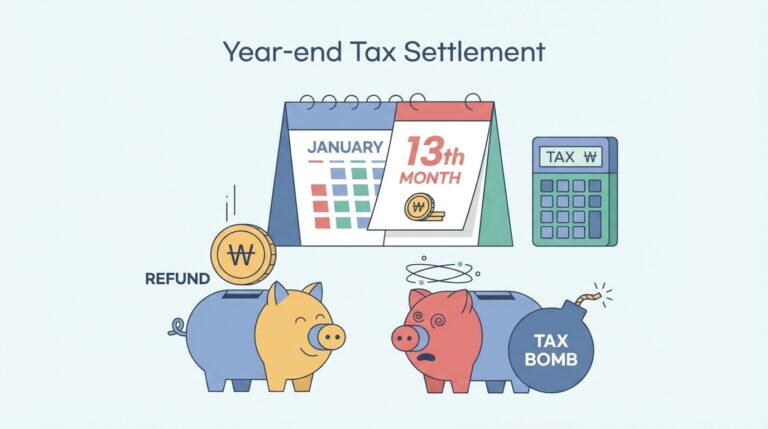
Phase 1: The “13th Month’s Salary” or a “Tax Bomb”? 💣
Greeting: 안녕하세요! This is your Daily Hangul Senior Editor.
Picture this: It’s mid-January in Seoul. The air is freezing, but inside your office, the heat is rising for a different reason. Your Korean colleagues are glued to their screens, clicking frantically on a site called “HomeTax.” The atmosphere is a mix of nervous anticipation and dread. In K-Dramas, you might see a scene where an office worker screams in joy, treating everyone to a beef dinner, or conversely, sits at a pojangmacha (street stall) sighing deeply over a bottle of soju.
What’s happening? It’s Yeonmal Jeongsan (연말정산) season—the Year-End Tax Settlement.
For Korean salary workers, this is the moment of truth. Depending on how well they managed their spending and documents, they will either receive a juicy refund—affectionately called “13월의 월급” (The 13th Month’s Salary)—or they will have to “토해내다” (cough up/spit out) extra taxes, known as a “세금 폭탄” (Tax Bomb).
As a C2 learner living or working in Korea, understanding this isn’t just about money; it’s about survival in the corporate ecosystem. If you don’t know the difference between Sodeuk Gongje and Saeaek Gongje, you’re leaving money on the table—and missing out on the hottest office gossip of the year.
Let’s crack the code of the Korean tax season.
Phase 2: Deep Dive into Financial Korean 💸
1. 소득 공제 (Sodeuk Gongje) vs. 세액 공제 (Saeaek Gongje)
- Pronunciation: [Sodeuk Gongje] / [Saeaek Gongje]
- Meaning:
- 소득 공제 (Income Deduction): Reduces the total amount of your income that is subject to tax. (Think: Shrinking the size of the pie).
- 세액 공제 (Tax Credit): Directly subtracts from the tax bill you owe. (Think: A discount coupon on the final receipt).
- K-Culture Moment: In the drama Misaeng (Incomplete Life), the meticulous preparation of receipts reflects the character’s desperation to maximize these deductions. It’s a battle of wits against the tax office.
- Editor’s Insight: Confusing these two is a rookie mistake. Koreans obsess over Check Cards (Debit Cards) because they offer a higher Sodeuk Gongje rate than Credit Cards. It’s a strategic game.
- Situation Spectrum:
[🚫 Casual Slang] ———— [⚠️ Semi-formal] ———— [✅ Formal/Professional]- These are strictly professional/financial terms (✅), but used casually when complaining about money.
- 🤔 Think About It: Why does the Korean government differentiate these so strictly? It reflects a policy to encourage specific economic behaviors (like using cash receipts to track the underground economy).
2. 현금 영수증 (Hyeongeum Yeongsujeung)
- Pronunciation: [Hyeongeum Yeongsujeung]
- Meaning: Cash Receipt (for tax deduction purposes).
- K-Culture Moment: You’re at a convenience store. The part-timer mumbles rapidly, “Are you doing a cash receipt?” (현금 영수증 하세요?). If you say yes, you type your phone number. This small habit accumulates into a massive deduction later.
- Editor’s Insight: If you pay cash and don’t ask for this, your Korean friends might look at you like you’re burning money. It’s almost a reflex action in Korea.
- Situation Spectrum:
[✅ Essential in Daily Life]
3. 토해내다 (Tohaenaeda)
- Pronunciation: [Tohaenaeda] + Sounds like retching
- Meaning: Literal: To vomit/throw up. / Figurative: To be forced to pay back money (specifically to the government or a company).
- K-Culture Moment: Post-settlement season lunch. A colleague looks depressed. “이번에 50만 원 토해내야 돼…” (I have to cough up 500,000 won this time…).
- Editor’s Insight: This is not a formal banking term, but it is the most real way to describe paying extra tax. It perfectly captures the visceral pain of losing money you thought was yours.
- Situation Spectrum:
[✅ Casual/Colleagues] ———— [⚠️ Boss] ———— [🚫 Official Documents]
Phase 3: Textbook vs. Real Life 🗣️
| Situation | 📖 Textbook Korean | 🗣️ Real Korean (Inssadeul) | 💡 Why the difference? |
|---|---|---|---|
| Getting a refund | 세금을 환급받았어요. (I received a tax refund.) | 13월의 월급 받았어! (I got the 13th month’s salary!) | Ideally, a refund feels like a bonus paycheck, highlighting the joy of unexpected liquidity. |
| Paying extra tax | 추가 납부세액이 발생했습니다. (Additional tax liability occurred.) | 완전 세금 폭탄 맞았어. (I got hit by a total tax bomb.) | “Bomb” emphasizes the shock and destructive nature of the bill on one’s wallet. |
| ** Asking for a receipt** | 영수증 발급해 주세요. (Please issue a receipt.) | 현영(현금영수증) 해주세요. (Please do ‘Hyeonyoung’.) | Koreans love abbreviating 4-syllable administrative terms to 2 syllables for efficiency. |
Phase 4: Cultural Deep Dive — The “Nunchi” of Money 🧐
4-1. The Silence of the Refund (Non-verbal)
If you check your payslip and see a massive refund, control your facial expression. In a team setting, someone next to you might be “coughing up” half their monthly salary. Celebrating too loudly is a failure of Nunchi. The standard protocol is a humble smile or a quiet “Thank goodness, I survived” (다행히 선방했네요).
4-2. K-Drama Connection: The “Treat” Culture
If a character in a drama suddenly invites everyone to a BBQ restaurant and orders Hanwoo (premium Korean beef), it’s often because they received a large Year-End Settlement refund. This connects to the communal culture: unexpected windfalls are meant to be shared, lest you bring bad luck (or envy).
🧠 Think Deeper (Critical Thinking):
Consumption vs. Saving: The Korean tax system heavily incentivizes spending (via credit/debit card deductions) over hiding cash under a mattress. How does this structure influence the high-consumption lifestyle often portrayed in K-Media? Does it force people to spend to save?
Phase 5: Immersive Roleplay — The Office Lunch 🥘
Setting: Late February. A Kimchi-jjigae restaurant near Gwanghwamun. The air is filled with the smell of boiling soup. You are with Manager Kim (40s) and Minji (20s).
Characters:
* YOU: A foreign team lead who has worked in Korea for 3 years.
* Manager Kim: Stressed because he supports a family (lots of spending, but complicated taxes).
* Minji: Smart spender, loves maximizing points and deductions.
Dialogue:
Manager Kim: (Sighing deeply) 하… 이번 달 카드 값 메꾸려면 적금 깨야겠어. 연말정산에서 80만 원이나 토해내라잖아. 🤯
(Ha… ibeon dal kadeu gap mekkuryeomyeon jeokgeum kkaeyagesseo. Yeonmaljeongsaneseo 80man wonina tohaenaerajana.)
(Sigh… I might have to break my savings to cover this month’s credit card bill. They’re telling me to cough up 800,000 won for the year-end settlement.)
Minji: 헐, 과장님… 부양가족 공제 제대로 넣으신 거 맞아요? 저는 이번에 안경 산 것까지 싹 긁어모아서 13월의 월급 두둑하게 챙겼는데. 😎
(Heol, Gwajangnim… buyang-gajok gongje jedaero neousin geo majayo? Jeoneun ibeon-e an-gyeong san geot-kkaji ssak geulgeo-moaseo 13-wol-ui wolgeup duduk-hage chaenggyeonneunde.)
(Whoa, Manager… did you put in your dependent deductions correctly? I scraped together everything, even my glasses purchase, and secured a fat 13th month’s salary.)
🔀 Decision Point: How do you respond to this contrast?
- A) “Wow, Minji, you are rich! Buy us coffee!” (Direct & expecting a treat)
- B) “Manager Kim, did you check the ‘HomeTax’ simplified service? Maybe you missed something.” (Helpful & Knowledgeable)
- C) “I also have to vomit money.” (Trying to use slang but getting it slightly wrong)
✅ Best Choice: B. Showing knowledge of “HomeTax” (홈택스) proves you are a C2-level pro who understands the system. It builds solidarity with the senior colleague.
⚠️ Choice A Analysis: It’s okay, but read the room. Manager Kim is suffering. Celebrating Minji’s win too loudly might annoy him.
Phase 6: 10-Second Shadowing Drill 🎧
Context: Checking your result on the tax website and realizing you don’t owe money.
😤 (Relieved exhale) 휴, 다행이다! / 이번에는 / 안 토해내고 / 환급받을 수 있겠어!
(Hyu, dahaeng-ida! / ibeon-eneun / an tohaenaego / hwangeup-badeul su itgesseo!)
Phew, what a relief! / This time / without coughing up money / I’ll be able to get a refund!
Phase 7: K-Culture Mini Dictionary 📖
| Korean | Romanization | Meaning | Context |
|---|---|---|---|
| 국세청 홈택스 | Guksecheong Hometax | National Tax Service HomeTax | The digital battleground where the settlement happens. |
| 부양가족 | Buyang-gajok | Dependents | The more family members you support, the bigger the deduction. “Do you have dependents?” is a common tax question. |
| 기부금 | Gibugeum | Donation | Donations to charity or religious orgs are major deduction items. |
| 총급여 | Chong-geupyeo | Total Salary | Your gross income before any deductions. |
Phase 8: Traveler’s & Expat’s Survival Kit 🧳
Even if you are a short-term traveler, knowing about receipts helps the Korean economy (and helps you look like a local). If you are an expat, this is mandatory.
🆘 Survival Expression: The “Cash Receipt” Combo
* 🇰🇷 “현금영수증 해주세요. (소득공제용으로요.)”
(Hyeongeum-yeongsujeung haejuseyo. Sodeuk-gongje-yong-euro-yo.)
* 🗣️ Meaning: “Please issue a cash receipt. (For income deduction purposes.)”
* 📍 Where: Cafes, Hair Salons, Clinics, Convenience Stores.
* 💡 Pro Tip: There are two types: “Income Deduction” (for workers) and “Expense Proof” (for business owners). Always say “Sodeuk Gongje” if you are an employee.
Phase 9: Think Deeper — “Transparent Society” 🧠
Language & Policy:
Korea has one of the most digitized tax systems in the world. The phrase “유리지갑” (Glass Wallet) is often used to describe salary workers. It means the government can see every single penny you earn and spend, like your wallet is made of glass. Unlike freelancers or business owners who might hide income, salary workers have zero secrets from the National Tax Service.
💬 Your Turn: Does your country have a “Glass Wallet” system, or is cash still king? How do you say “Tax Refund” in your language? Share in the comments!
Phase 10: FAQ & Troubleshooting 🛠️
- Q: Can foreigners actually get these deductions?
- A: YES! If you are a registered resident (ARC holder) earning a salary, you are subject to the exact same tax laws as Koreans. Do not ignore this! You can get refunds for rent, medical bills, and credit card usage.
- Q: Can I say “토해내다” to my boss?
- A: Maybe. It’s slang, but very common workplace slang. If you have a friendly relationship, it’s fine. If it’s a formal report to the CEO, use “추가 납부 (Additional Payment)”.
- ❌ Common Mistake: Thinking “Tax Free” (Duty-Free for tourists) is the same as “Tax Deduction” (Yeonmal Jeongsan).
- Clarification: Tax Free is immediate VAT refund for tourists. Yeonmal Jeongsan is an annual income tax adjustment for residents.
Phase 11: Wrap-up & Mission 🚀
One-Liner: Yeonmal Jeongsan is the annual battle where you fight for your “13th Month’s Salary” using receipts as your weapon.
Action Missions:
* 🥉 Bronze: Practice saying “현금영수증 해주세요” quickly five times.
* 🥈 Silver: Look at a Korean receipt. Find the words “부가세” (VAT) and “공급가액” (Supply Value).
* 🥇 Gold: (For Expats) Log into Hometax during the settlement period and try to view your simplified PDF report.
K-Culture Mission: Watch a clip of the drama “Chief Kim (김과장)”. It’s an office comedy centering on an accountant. Observe how they treat ledgers and money—it’s the soul of the company!
Phase 12: Quiz — Are you a Tax Pro? 📝
- Situational Judgment: Your colleague looks devastated after checking the Hometax website. What is the least appropriate thing to say?
- a) “아이고… 많이 나왔어요?” (Oh no… did a lot come out?)
- b) “오늘 점심은 제가 살게요.” (I’ll buy lunch today.)
- c) “저는 100만 원 환급받아요! 대박이죠?” (I’m getting 1 million won back! Amazing, right?)
- Vocabulary: Which word fits the blank? “Make sure to use your debit card to increase your [ ].”
- a) 부가가치세 (VAT)
- b) 소득 공제 (Income Deduction)
- c) 벌금 (Fine)
- True or False: “13월의 월급” implies that the government gives you a bonus regardless of your spending habits.
- (True / False)
(Answers: 1-c [Bad Nunchi], 2-b, 3-False [It’s a refund of your own overpaid tax])
Frequently Asked Questions (FAQ)
Q: What does "소득 공제 (Sodeuk Gongje) vs. 세액 공제 (Saeaek Gongje)" mean in Korean and how do you pronounce it?
A: In Korean, "소득 공제 (Sodeuk Gongje) vs. 세액 공제 (Saeaek Gongje)" is pronounced [Sodeuk Gongje] and means: 소득 공제 (Income Deduction): Reduces the total amount of your income that is subject to tax. (Think: Shrinking the size of the pie).
Q: What does "현금 영수증 (Hyeongeum Yeongsujeung)" mean in Korean and how do you pronounce it?
A: In Korean, "현금 영수증 (Hyeongeum Yeongsujeung)" is pronounced [Hyeongeum Yeongsujeung] and means: Cash Receipt (for tax deduction purposes).
Q: What does "토해내다 (Tohaenaeda)" mean in Korean and how do you pronounce it?
A: In Korean, "토해내다 (Tohaenaeda)" is pronounced [Tohaenaeda] and means: Literal: To vomit/throw up. / Figurative: To be forced to pay back money (specifically to the government or a company).







