

Phase 1: The Immersive Hook
Greeting: 안녕하세요! This is your Daily Hangul Editor, writing to you perhaps late at night while sipping decaf tea.
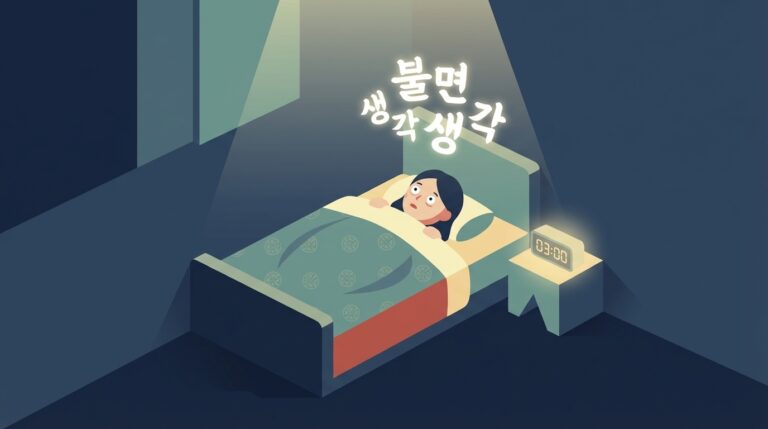
The Scene: You know that scene in almost every slice-of-life K-Drama? The protagonist is lying in bed, staring at the ceiling. They check their phone—it’s 3:00 AM. They toss, they turn, and finally, they sit up with a deep sigh, grabbing a glass of water. In the subtitles, it might just say “I can’t sleep.” But in Korean, the specific verb they mutter carries the weight of a thousand worries.
The ‘Why’: As a C1 learner, simply saying “잠이 안 와요” (Sleep doesn’t come) isn’t enough to express the agony of a sleepless night caused by stress or burnout. To get real advice from a pharmacist or deep empathy from a friend, you need to describe the texture of your insomnia.
Transparency: This guide combines medical vocabulary commonly used in daily life with the expressive language of mental struggle, curated from real conversations in Seoul’s clinics and cafes.
Phase 2: Deep Dive into Core Expressions
1. 잠을 설치다 (Jameul seolchida)
- Pronunciation: [Jameul seolchida] + Think of ‘seol’ like the sound of ‘sul’ in ‘sulk’.
- Meaning: Literal: To mess up/ruin sleep. Real Nuance: You slept, but it was fragmented, shallow, or uncomfortable. You woke up frequently or had bad dreams.
- K-Culture Moment: Picture a variety show where an idol appears with dark circles under their eyes. The MC asks, “Did you sleep well?” and they reply, “No, I was so nervous about the comeback stage that I completely ‘installed’ (ruined) my sleep.”
- Editor’s Insight: This is perfect for when you did sleep technically, but you feel wrecked. It implies the quality was poor due to external noise or internal stress.
- Situation Spectrum:
[🚫 Formal Speech/Report] ———— [✅ Colleagues/Friends] ———— [✅ Doctor] - 🤔 Think About It: The verb ‘설치다’ is also used when someone is acting rashly or interfering. Why do you think Korean equates ‘bad sleep’ with ‘acting rashly’? It suggests a lack of calmness required for rest.
2. 밤을 꼴딱 새우다 (Bameul kkolttak saeuda)
- Pronunciation: [Bameul kkolttak saeuda] + ‘Kkolttak’ sounds like a gulping sound or something passing over a peak quickly.
- Meaning: Literal: To stay up the night ‘gulpingly’. Real Nuance: To pull an all-nighter, often involuntarily. You stared at the clock until the sun came up.
- K-Culture Moment: Exam season scenes in dramas. Students at a ‘study cafe’ (dokseosil) with empty energy drink cans piled high. One says, “I stayed up all night again.”
- Editor’s Insight: The adverb ‘꼴딱’ (kkolttak) adds a vivid imagery of the night passing over a hill completely. It emphasizes the totality of the sleeplessness.
- Situation Spectrum:
[⚠️ Boss (Might sound unprofessional if frequent)] ———— [✅ Friends] ———— [✅ Doctor] - 🤔 Think About It: In many Western cultures, losing sleep is seen as unhealthy. In Korea’s rapid-growth era, this phrase was sometimes worn as a badge of honor (diligence). Is that shifting now with the ‘Wellness’ trend?
3. 가위눌리다 (Gawinullida)
- Pronunciation: [Gawinullida] + ‘Gawi’ usually means scissors, but here it refers to a nightmare spirit.
- Meaning: Literal: To be pressed by ‘Gawi’. Real Nuance: Sleep paralysis. The terrifying sensation of being awake but unable to move, often accompanied by hallucinations.
- K-Culture Moment: Horror movies or summer special episodes of talk shows where celebrities share “ghost stories.” They almost always start with, “I was so tired from the schedule that I got ‘Gawi-pressed’ in the hotel room…”
- Editor’s Insight: Even scientific-minded Koreans use this traditional term for sleep paralysis. It describes the physical sensation of heavy pressure on the chest.
- Situation Spectrum:
[🚫 Formal Presentation] ———— [✅ Casual Storytelling] ———— [✅ Medical Consultation] - 🤔 Think About It: Why does Korean culture personify sleep paralysis as an external force (Gawi) pressing down, rather than just a neurological glitch? It reflects a worldview where health is influenced by energy flows (Gi).
Phase 3: Textbook vs. Real Life
| Situation | 📖 Textbook Korean | 🗣️ Real Korean (C1 Level) | 💡 Why the difference? |
|---|---|---|---|
| Describing Insomnia | 불면증이 있어요. (I have insomnia.) | 생각이 꼬리에 꼬리를 물어서 잠이 안 와요. (Thoughts bite the tails of other thoughts…) | Koreans love idioms that describe the process of anxiety, not just the result. |
| Morning After | 피곤해요. (I am tired.) | 몸이 천근만근이에요. (My body weighs a thousand pounds.) | A hyperbolic idiom is the only way to truly express exhaustion in a high-stress society. |
| Taking Meds | 약을 먹고 자요. (I take medicine and sleep.) | 수면 유도제 없이는 잠을 못 자요. (I can’t sleep without sleep inducers.) | Precision matters. ‘Sleep inducers’ (OTC) are distinguished from ‘sleeping pills’ (prescription). |
Bottom Note: At the C1 level, avoid just saying “I’m tired.” Be specific about how the stress manifests physically.
Phase 4: Cultural Context — The Sleepless Society
4-1. Non-verbal Communication: The “Tired Face”
In Western business culture, you might try to hide exhaustion to look professional. In Korea, while you shouldn’t complain excessively to a boss, showing signs of hard work (slight fatigue) isn’t always negative—it can signal dedication. However, talking about mental reasons (depression/anxiety) is still somewhat taboo in older corporate generations. Read the room (Nunchi) before sharing why you couldn’t sleep.
4-2. K-Culture Connection: The Paradox of “Healing” & ASMR
Korea is one of the biggest consumers of ASMR content globally. Why? Because the society is incredibly loud and fast-paced (Balli-balli culture).
* K-pop V-Lives: You’ll often see idols doing late-night live streams, whispering to fans, saying “Jal-ja” (Sleep well). This parasocial bonding is a form of collective digital therapy for a sleepless generation.
* Food for Sleep: While Americans might drink warm milk, Koreans might seek out herbal teas or foods rich in magnesium, or conversely, eat spicy midnight snacks (Yasik) to “sweat out” the stress, which actually disrupts sleep—a common irony!
Phase 5: Immersive Roleplay Scenario
Setting: A quiet break room at your company in Seoul. It’s 2:00 PM, the post-lunch slump. You are holding an Iced Americano to stay awake.
Characters:
* YOU: A foreign team leader who has been stressed about a project deadline.
* Manager Choi (38): A capable, empathetic Korean colleague who notices you look rough.
Dialogue:
Manager Choi: (Looking at your dark circles) 팀장님, 안색이 안 좋으시네요. 어제 또 야근하셨어요? 😟
(Timjangnim, ansaegi an joeusineyo. Eoje tto yageunhasyeosseoyo?)
(Team Leader, your complexion isn’t good. Did you work late again yesterday?)
YOU: (Sighing and rubbing eyes) 네, 일도 일인데… 요즘 통 잠을 못 자겠어요. [ 1 ]
(Ne, ildo irinde… yojeum tong jameul mot jagesseoyo.)
(Yes, work is work, but… I haven’t been able to sleep at all lately.)
Manager Choi: 아이고, 저런… 스트레스 때문인가 봐요. 자려고 누우면 정신이 더 말똥말똥해지죠? 👀
(Aigo, jeoreon… seuteureuseu ttaemuninga bwayo. Jaryeogo nuumyeon jeongsini deo malttongmalttonghaejijyo?)
(Oh no… it must be stress. When you lie down, your mind gets wide awake, right?)
🔀 Decision Point: How do you describe your symptom?
- Option A: “네, 그냥 피곤해요.” (Generic/Simple)
- Option B: “맞아요. 몸은 피곤한데 뇌가 안 멈추는 느낌이에요. 새벽까지 뒤척이다가 겨우 나왔어요.” (Detailed/C1 Level)
- Option C: “네, 가위눌려서 무서웠어요.” (Specific/Personal)
✅ Best Choice: B
* Why: It perfectly describes the “tired body, active mind” syndrome of office burnout using the verb 뒤척이다 (to toss and turn). It builds rapport by sharing a relatable struggle.
* Analysis of C: “Sleep paralysis” might be too intense/TMI for a casual break room chat unless you are very close friends.
Manager Choi: 저도 그럴 때 있어요. 저는 그럴 때 따뜻한 대추차 마시고 유튜브로 빗소리 들으면서 자요. 한번 해보세요.
(Me too. When that happens, I drink warm jujube tea and listen to rain sounds on YouTube. Try it.)
Phase 6: 10-Second Shadowing Drill
Use this sentence to express frustration about your sleep quality.
Sentence:
“어제 / 생각할 게 너무 많아서 / 밤을 / 꼬박 / 새웠어요.” 😤
(Eoje / saenggakal ge neomu manaseo / bameul / kkobak / saewosseoyo.)
Guide:
* Emotion: 😤 Frustrated & Exhausted (Show that you tried to sleep but couldn’t).
* Intonation: Put a strong stress on ‘꼬박’ (kkobak) to emphasize the entirety of the night.
* Meaning: “Yesterday, I had so much to think about that I stayed up the entire night.”
Phase 7: K-Culture Mini Glossary
| Korean | Romanization | Meaning | Context |
|---|---|---|---|
| 꿀잠 | Kkul-jam | Honey Sleep | Slang for sleeping very sweetly/deeply. The ultimate goal. |
| 쪽잠 | Jjok-jam | Piece Sleep | Sleeping in brief snatches (e.g., on the bus, between meetings). |
| 화병 | Hwabyeong | Fire Illness | A culture-bound syndrome. Physical pain/insomnia caused by suppressed anger/stress. |
| 이불킥 | Ibul-kick | Blanket Kick | Kicking the blankets in bed because you remembered an embarrassing memory (keeping you awake). |
| 숙면 | Sungmyeon | Deep Sleep | The formal/medical term for good sleep quality. Used in ads or clinics. |
Phase 8: Traveler’s & Expat’s Survival Kit
Scenario: You need chemical help to sleep, but you don’t have a prescription. You are at a pharmacy (Yakguk).
🆘 Survival Expression: The Pharmacy Run
* YOU: “약사님, 시차 적응 때문에 잠이 안 와서요. 수면 유도제 있나요?”
* Pronunciation: Yaksanim, sicha jeogeung ttaemune jami an waseoyo. Sumyeon yudoje innayo?
* Translation: “Pharmacist, I can’t sleep because of jet lag. Do you have any sleep inducers?”
* 💡 Pro Tip: In Korea, Sleeping Pills (수면제) are strong prescription meds (like Zolpidem). Sleep Inducers (수면 유도제) are antihistamine-based OTC meds (like ZzzQuil). Make sure to ask for ‘Yudoje’ if you don’t have a doctor’s note.📌 Editor’s Health Note:
Korean pharmacies are great for minor ailments. If you say “stress,” they might give you “Woohwang Cheongsimwon” (우황청심원), a traditional herbal ball for calming nerves. It tastes distinct, but many Koreans swear by it for anxiety-induced insomnia!
Phase 9: Think Deeper — “The Sleepless Dragon”
Topic: Industrialization and the Badge of Busyness
In Korea, there’s a lingering historical sentiment that “sleeping is a luxury.” During the rapid industrialization period (The Miracle on the Han River), the national ethos was diligence. Even today, high school students hear the phrase “4당5락” (Sa-dang-o-rak: 4 hours sleep = pass, 5 hours sleep = fail).
However, this is clashing with the modern “Wellness” and “Work-Life Balance” (Worabel) movements. While older generations might brag about sleeping 4 hours, younger Koreans are increasingly valuing mental health care. Yet, the language reflects the old struggle—we don’t just “have” insomnia; we “fight” with it.
💬 Your Turn: In your culture, is saying “I only slept 3 hours” a complaint, or a humble brag about how hard-working you are?
Phase 10: FAQ & Troubleshooting
Q: Can I tell my boss I have insomnia?
A: Maybe. If you have a close relationship, yes. But be careful. If you say “I have insomnia” repeatedly, it might be interpreted as “I cannot manage my self-care/condition.” It’s better to frame it as “I’m recovering” rather than a chronic complaint, unless you are officially taking medical leave.
Q: Is it rude to sleep on public transport in Korea?
A: No! It is completely socially acceptable to sleep on the subway or bus. You will see suited businessmen and students passed out (sometimes drooling) because everyone understands the collective fatigue. Just don’t lean on the stranger’s shoulder next to you!
❌ Common Mistake #1: Confusing 수면제 (Prescription sleeping pill) with 수면 유도제 (OTC sleep aid). Asking for the former at a pharmacy will get you a rejection.
Phase 11: Wrap-up & Action Mission
One-Liner: Insomnia in Korean isn’t just about being awake; it’s about the struggle (설치다), the time passing (꼬박 새우다), and the mental pressure (가위눌리다).
Action Missions:
* 🥉 Bronze: Look in the mirror with a tired face and say: “아, 어제 잠을 설쳤어.”
* 🥈 Silver: Go to a Korean pharmacy (or simulate it) and practice asking for “Sumyeon yudoje” instead of just “medicine.”
* 🥇 Gold: Next time a Korean friend asks how you are, instead of “Fine,” try describing your sleep quality using one of today’s expressions (e.g., “요즘 생각이 많아서 잠을 좀 설치네.”).
K-Culture Mission: Watch a “Meokbang” (Eating show) or “Gongbang” (Study with me) video on YouTube tonight. Read the live chat comments. How many Koreans are saying “잠이 안 와요” (I can’t sleep)? You are not alone!
Phase 12: Interactive Quiz
- Situational Judgment: You are writing an email to a client explaining a delay. Which excuse is NOT professional?
- A) 몸살이 나서 병원에 다녀왔습니다. (I had body aches and went to the hospital.)
- B) 어제 가위눌려서 늦게 일어났습니다. (I had sleep paralysis so I woke up late.)
- C) 개인적인 사정이 있었습니다. (I had a personal matter.)
Answer: B. Sleep paralysis is too personal and sounds like a superstition/excuse in a formal business context.
- Fill in the Blank:
“커피를 너무 많이 마셨나 봐요. 눈이 ( ) 해서 잠이 안 와요.”- Hint: Describes eyes being wide open and alert.
Answer: 말똥말똥 (Malttong-malttong)
See you in the next lesson, and I hope you have a ‘Kkul-jam’ (Honey sleep) tonight!
Frequently Asked Questions (FAQ)
Q: What does "잠을 설치다 (Jameul seolchida)" mean in Korean and how do you pronounce it?
A: In Korean, "잠을 설치다 (Jameul seolchida)" is pronounced [Jameul seolchida] and means: Literal: To mess up/ruin sleep. Real Nuance: You slept, but it was fragmented, shallow, or uncomfortable. You woke up frequently or had bad dreams.
Q: What does "밤을 꼴딱 새우다 (Bameul kkolttak saeuda)" mean in Korean and how do you pronounce it?
A: In Korean, "밤을 꼴딱 새우다 (Bameul kkolttak saeuda)" is pronounced [Bameul kkolttak saeuda] and means: Literal: To stay up the night 'gulpingly'. Real Nuance: To pull an all-nighter, often involuntarily. You stared at the clock until the sun came up.
Q: What does "가위눌리다 (Gawinullida)" mean in Korean and how do you pronounce it?
A: In Korean, "가위눌리다 (Gawinullida)" is pronounced [Gawinullida] and means: Literal: To be pressed by 'Gawi'. Real Nuance: Sleep paralysis. The terrifying sensation of being awake but unable to move, often accompanied by hallucinations.







