

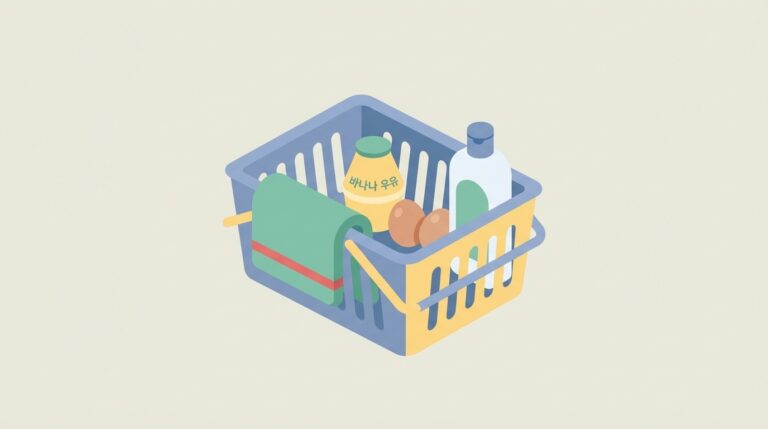
Phase 1: Immersive Hook
Hello! This is your Daily Hangul Editor. 👋
Imagine this: You’re watching your favorite K-Drama. The protagonist has just gone through a breakup or lost a job. Where do they go? They tie a towel on their head like a sheep (Yangmeori), crack a hard-boiled egg on their friend’s head, and sip on sweet iced rice punch (Sikhye). Yes, it’s the Jjimjilbang (Korean Sauna).
But here is the panic moment for many foreigners: You walk into the changing room, and while you are fumbling with your locker key, you notice every local Korean is carrying a colorful plastic basket filled with mysterious bottles and a rough-looking green towel. You look at your empty hands.
“Wait, was I supposed to bring my own soap? Do I have to buy shampoo? What is that green towel for?”
Don’t worry. Today, we aren’t just learning words; we are learning the art of the Korean Bath Basket. By the end of this lesson, you’ll walk into any sauna like a Gangnam local, fully equipped and confident. Let’s pack!
Phase 2: Deep Dive into Key Expressions
1. 챙기다 (Chaeng-gi-da)
- Pronunciation: [Chaeng-gi-da] (Sounds a bit like “Chang” + “Gi” + “Da”)
- Meaning:
- Literal: To pack / To take.
- Real Nuance: To take care of something/someone; to make sure you have what is necessary. It’s a very warm, active verb.
- K-Culture Moment: In K-Dramas, a mom hands a lunchbox to her son and says, “밥 잘 챙겨 먹어!” (Make sure you eat well/Take care of your meals!). In our context, it means packing your bath gear.
- Editor’s Insight: This word is the heart of Korean considerateness. If you say “목욕 용품 챙겼어요?” (Did you pack your bath items?), you are checking if they are prepared.
- Situation Spectrum:
[🚫 Formal Ban] ———— [⚠️ Caution] ———— [✅ Casual/Polite]- (It acts as a verb, so politeness depends on the ending like -yo or -nida.)
- 🤔 Think About It: In English, we “pack” luggage but “take care” of people. In Korean, 챙기다 covers both packing your shampoo AND taking care of your friend. What does this suggest about how Koreans view preparation and care?
2. 혹시… 있어요? (Hoksi… isseoyo?)
- Pronunciation: [Hok-shi… i-sseo-yo?]
- Meaning: Do you happen to have…?
- K-Culture Moment: You are at the sauna counter. You didn’t bring shampoo. You look at the staff with desperate eyes. “혹시… 샴푸 팔아요?” (Do you happen to sell shampoo?)
- Editor’s Insight: “Hoksi” is your magic shield. Direct questions can feel aggressive in Korean. Adding “Hoksi” (by chance) softens the blow and makes you sound polite and hesitant, which Koreans love.
- Situation Spectrum:
[🚫 Friends] ———— [⚠️ Strangers] ———— [✅ Service Staff]- Perfect for asking staff or strangers for help.
3. 때수건 (Ttae-su-geon)
- Pronunciation: [Ttae-su-geon] (The ‘Tt’ is a strong, tense sound, like holding your breath before spitting out the ‘T’.)
- Meaning: Exfoliating towel (Italy Towel).
- K-Culture Moment: The legendary green (or yellow) towel. It’s not just a washcloth; it’s a tool of rebirth. In movies, scrubbing each other’s backs with this is the ultimate sign of bonding between father and son, or close friends.
- Editor’s Insight: If you don’t have this, you aren’t really doing a Korean bath. You just “got wet.”
- 🤔 Think About It: Why is it called “Italy Towel” (이태리 타월)? Because the viscose fabric originally came from Italy, even though the scrubbing culture is 100% Korean.
Phase 3: Textbook vs. Real Life
| Situation | 📖 Textbook Korean | 🗣️ Real Korean (In the Locker Room) | 💡 Why the difference? |
|---|---|---|---|
| Checking items | 세면도구를 준비했습니까? (Did you prepare toiletries?) |
샴푸 챙겼어? (Did you pack shampoo?) |
“준비하다” sounds like preparing for a project. “챙기다” is for personal belongings. |
| Buying Items | 이것을 사고 싶습니다. (I want to buy this.) |
이거 하나 주세요. (Give me one of this.) |
Koreans value speed and efficiency. “Give me one” is standard, not rude. |
| Missing items | 비누가 없습니다. (There is no soap.) |
아, 비누 안 가져왔다. (Ah, I didn’t bring soap.) |
We focus on the action (bringing) rather than the state (existence). |
Bottom Note: At a B2 level, try to use specific nouns like 린스 (conditioner/rinse) and 바디워시 (body wash) instead of the generic 세면도구 (toiletries).
Phase 4: Cultural Deep Dive
4-1. Non-verbal Communication: The “Basket Spot”
In a local sauna, you might see baskets left unattended on seats in front of the showers. Warning: This is a territory mark. If you move someone’s basket, you might get a sharp look from an Ajumma (middle-aged woman). The rule is: Visual confirmation first. If a shower has a basket, it’s occupied, even if the person is in the sauna room.
4-2. K-Culture Connection: The “Jeong” of Scrubbing
In K-Dramas (like Reply 1988), you often see scenes where friends scrub each other’s backs. This is called 등 밀어주기 (scrubbing someone’s back).
* The Critical Perspective: Why do Koreans get naked and scrub each other? It’s about removing barriers—literally and metaphorically. The phrase “속을 터놓다” (to open one’s insides/heart) fits perfectly here. Being naked together (목욕탕 우정) means we have nothing to hide.
Phase 5: Immersive Roleplay Scenario
Setting: A Jjimjilbang counter in Hongdae. Saturday night. It’s busy. You need to buy entry tickets and single-use shampoo.
Characters:
* YOU: A tired traveler who needs a hot bath.
* Staff: A quick-talking Korean part-timer.
Dialogue:
Staff: 어서 오세요. 몇 분이세요? (Welcome. How many?)
YOU: 한 명이요. (Just one.)
Staff: 찜질까지 하실 거죠? 만 오천 원입니다. (You’re doing the sauna [dry room] too, right? 15,000 won.)
YOU: 네. 아, 저기… [Decision Point]
🔀 YOUR TURN! What do you ask next?
* A) 혹시 샴푸랑 린스 있어요? (Do you happen to have shampoo and conditioner?)
* B) 샴푸 주세요. (Give me shampoo.)
* C) 목욕 바구니 빌려주세요. (Please lend me a bath basket.)✅ Best Choice: A) “Hoksi…” is polite. Usually, they sell single-use packets (500-1000 KRW).
⚠️ Choice C Analysis: Most places do not lend baskets. You bring your own or carry items in your hands. Baskets are for regulars (monthly members).
(Roleplay continues if you chose A)
Staff: 네, 일회용품 자판기는 탈의실 안에 있어요. 아니면 여기서 드릴까요? (Yes, the vending machine is inside the locker room. Or should I give it to you here?)
YOU: 여기서 주세요. 때수건도 하나 챙겨 주세요. (Please give it to me here. Please pack/include an Italy towel too.)
Phase 6: 10-Second Shadowing Drill
Let’s practice the magic phrase for when you forget something.
- Emotion: Slightly apologetic but polite (😅).
- Guide: Pause at the
/marks.
“혹시 / 일회용 샴푸 / 살 수 있을까요?”
(Hok-shi / il-hoe-yong sham-pu / sal su i-sseul-kka-yo?)
Meaning: Do you happen to know if I can buy single-use shampoo?
Phase 7: K-Culture Glossary (Sauna Edition)
| Korean | Romanization | Meaning | Context |
|---|---|---|---|
| 양머리 | Yangmeori | Sheep Head | The towel folded into a sheep shape. Essential for cute selfies. |
| 식혜 | Sikhye | Rice Punch | Sweet, icy rice drink. The official hydration of saunas. |
| 맥반석 계란 | Maekbanseok Gyeran | Sauna Eggs | Brown, roasted eggs. Harder and nuttier than boiled eggs. |
| 탕 | Tang | Tub/Bath | 온탕 (Hot tub), 냉탕 (Cold tub). |
| 탈의실 | Taruisil | Locker Room | Where you get naked. No photos allowed here! |
Phase 8: Traveler’s Survival Kit
Packing for a Jjimjilbang? Here is your checklist.
🆘 Survival Phrases #1
* 🇰🇷 “수건 좀 더 주실 수 있어요?” (Sugeon jom deo jusil su isseoyo?)
* 🗣️ Pronunciation: [Su-geon jom deo ju-shil su i-sseo-yo?]
* 📍 Where: Counter or Locker Room.
* 💡 Pro Tip: Men usually get unlimited towels in the locker room. Women usually get exactly 2 towels at the counter. Don’t lose them!📌 Editor’s Travel Note
* Cash is King (inside): While entry is card-friendly, some old massage chairs or hairdryers (coin-operated) might need 1,000 KRW bills or coins. However, modern Jjimjilbangs use your locker key (RFID) to pay for food and snacks!
Phase 9: Think Deeper — “The Naked Truth”
Topic: Space and Intimacy in Korea
In Western cultures, nudity is often sexualized or strictly private. In Korea, the Jjimjilbang is a communal living room. You will see grandmothers scrubbing their daughters, friends chatting while naked, and colleagues washing up after work.
🧠 Think Deeper:
Why is communal bathing so natural in Korea? It stems from the concept of “skinship” and collective identity. Being physically close without barriers builds emotional intimacy. When everyone is naked, social status (job, expensive clothes) disappears. We are just humans soaking in hot water.💬 Your Turn: Does your culture have a space where strangers or friends get naked together (like hot springs or saunas)? How does it compare to the Korean experience?
Phase 10: FAQ & Troubleshooting
- Q: Can I wear a swimsuit in the bath area?
- A: NO. 🚫 Big mistake. You must be completely naked in the wet area (탕). Swimsuits are only for water parks. In the dry sauna area (Jjimjilbang), you wear the provided T-shirt and shorts.
- Q: What if I have tattoos?
- A: Traditionally, tattoos were associated with gangs. Nowadays, small fashion tattoos are fine. However, if you have full-body tattoos, some very old-school places might ask you to leave or cover up, but in major tourist areas (Seoul/Busan), it’s generally tolerated but stared at.
- ❌ Common Mistake: Bringing your phone into the wet bath area.
- ✅ Fix: Keep your phone in the locker. You can take it to the dry sauna area (upstairs/common area), but never in the shower room. It’s a privacy crime!
Phase 11: Wrap-up & Action Items
One-Liner Summary:
Pack your confidence (and some shampoo) using “챙기다” and always soften your requests with “혹시…”!
🚀 Action Mission:
* 🥉 Bronze: Look in your bathroom and name 3 items in Korean (샴푸, 비누, 수건).
* 🥈 Silver: Go to a Korean mart (or online) and buy an “Italy Towel” (이태리 타월). Keep it in your bathroom.
* 🥇 Gold: Visit a Jjimjilbang! Ask the staff, “혹시 식혜 있어요?” and enjoy the victory sip.
K-Culture Mission:
Watch a scene from the drama “My Love from the Star” or “Legend of the Blue Sea” where the characters stay in a sauna. Observe what they are eating and wearing on their heads!
Phase 12: Quiz — Interactive Challenge
- Situational Judgment: You are at the counter. You forgot to bring body wash. What is the most natural thing to say?
- A) 바디워시 내놔. (Hand over the body wash.)
- B) 혹시 바디워시 살 수 있나요? (Do you happen to sell body wash?)
- C) 바디워시가 없습니다. (Body wash does not exist.)
- True or False (K-Culture):
- “In Korea, it is polite to wear a swimsuit inside the hot tub to respect others.” ( T / F )
(Scroll down for answers)
.
.
.
.
Answers:
1. B (A is rude, C is a statement of fact, not a request.)
2. False (You must be naked! Wearing clothes is considered dirty.)
Frequently Asked Questions (FAQ)
Q: What does "챙기다 (Chaeng-gi-da)" mean in Korean and how do you pronounce it?
A: In Korean, "챙기다 (Chaeng-gi-da)" is pronounced [Chaeng-gi-da] and means: Literal: To pack / To take.
Q: What does "혹시... 있어요? (Hoksi... isseoyo?)" mean in Korean and how do you pronounce it?
A: In Korean, "혹시... 있어요? (Hoksi... isseoyo?)" is pronounced [Hok-shi... i-sseo-yo?] and means: Do you happen to have...?
Q: What does "때수건 (Ttae-su-geon)" mean in Korean and how do you pronounce it?
A: In Korean, "때수건 (Ttae-su-geon)" is pronounced [Ttae-su-geon] and means: Exfoliating towel (Italy Towel).







