

Phase 1: The Immersive Hook
Hello! This is your Daily Hangul Editor.
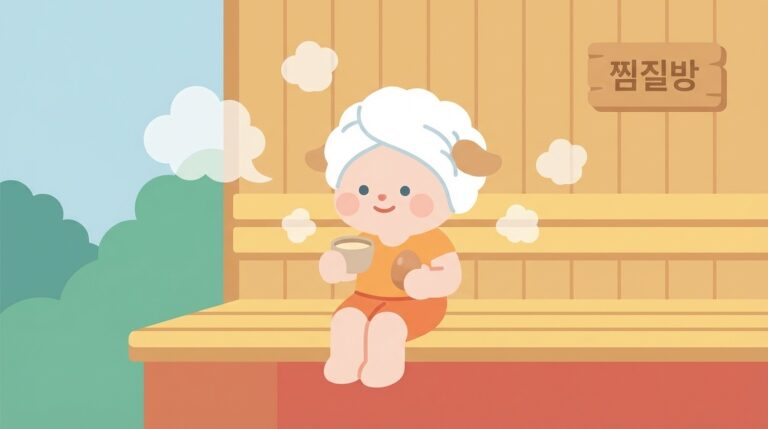
Imagine this K-Drama scene: The main characters are sitting on the floor in matching oversized t-shirts and shorts. They have white towels folded into two buns on their heads (looking like sheep). One character picks up a brown egg and cracks it on the other person’s head. Crack! Then they take a sip of a sweet, icy rice drink.
Does this sound familiar? You’ve just stepped into the world of the Jjimjilbang (찜질방).
For many foreigners, the Jjimjilbang is a mix of curiosity and fear. “Do I really have to be naked?” “Why is everyone sleeping on the floor?” But for Koreans, this is the ultimate family playground. It’s where we sweat out stress, bond with family, and eat delicious snacks.
Today, I’ll equip you with the real Korean you need to navigate this hot, steamy, and relaxing world like a pro. No more awkward staring at the snack bar menu!
Phase 2: Deep Dive — 3 Key Expressions
Here are the three expressions that will make you sound like a Jjimjilbang regular.
1. 아, 시원하다! (A, siwonhada!)
- Pronunciation: [Ah, she-won-ha-da] + [A deep sigh of relief]
- Meaning:
- Literal: It’s cool.
- Real Nuance: It feels refreshing / relieving.
- K-Culture Moment: You will hear older Korean men sitting in a boiling hot tub (40°C+) saying this. It is the ultimate Korean paradox. It means the heat is relaxing their stiff muscles.
- Editor’s Insight: Don’t use this when the weather is cold. Use this when you drink hot soup or enter a hot sauna. It expresses physical relief.
- Situation Spectrum:
[🚫 Formal Presentation] ———— [⚠️ With Boss] ———— [✅ Sauna/Casual]- 🤔 Think About It: Why do Koreans use the word “cool” for something hot? Is it about the temperature, or the feeling of stress leaving the body?
2. 식혜랑 계란 주세요. (Sikhye-rang gyeran juseyo.)
- Pronunciation: [Shik-hye-rang gye-ran ju-se-yo]
- Meaning: Please give me Sikhye (sweet rice punch) and eggs.
- K-Culture Moment: This is the “Popcorn and Coke” of the Jjimjilbang world. You cannot visit without eating this combo. In variety shows like Running Man, losing games often involves paying for these snacks.
- Editor’s Insight: The eggs are usually 맥반석 계란 (Maekbanseok gyeran)—stone-roasted eggs that are brown and chewy, not white boiled eggs.
- Situation Spectrum:
[✅ Snack Bar] ———— [✅ Restaurant] ———— [✅ Anywhere ordering food]3. 락커 키로 결제할게요. (Lak-keo ki-ro gyeol-je-hal-ge-yo.)
- Pronunciation: [Locker key-ro gyul-je-hal-ge-yo]
- Meaning: I will pay with my locker key.
- K-Culture Moment: In modern Jjimjilbangs, you don’t carry cash. You wear a wristband (key) that records everything you buy. It feels like “free money” until you have to pay the bill at the exit!
- Editor’s Insight: This phrase is essential because holding a wallet in a sauna suit is inconvenient (and pockets are small).
- Situation Spectrum:
[✅ Jjimjilbang] ———— [✅ Water Parks] ———— [🚫 Regular Shops]
Phase 3: Textbook vs. Real Korean
How does a learner speak vs. a local?
| Situation | 📖 Textbook Korean | 🗣️ Real Korean (In Context) | 💡 Why? |
|---|---|---|---|
| Checking the temp | 이 방은 온도가 몇 도입니까? (What is the temperature of this room?) | 여기 몇 도야? (Yeogi myeot do-ya?) | In a relaxed family setting, we drop formalities and get to the point. |
| Feeling hot | 저는 지금 너무 덥습니다. (I am very hot right now.) | 아, 쪄 죽겠다! (Ah, jjyeo juk-get-da!) | Literally “I’m steaming to death!” Koreans love dramatic exaggerations for feelings. |
| Asking for a refund | 돈을 돌려주실 수 있나요? (Can you return my money?) | 이거 취소해 주세요. (Igeo chwiso-hae juseyo.) | “Cancel this” is the most common way to undo a transaction at a counter. |
Bottom Note: “Jjyeo juk-get-da” (쪄 죽겠다) is very casual (Banmal). Use it only with close friends or family!
Phase 4: Cultural Deep Dive — The “Naked” Truth
4-1. Non-verbal Communication: The “Scrub” Gesture
If you see someone rubbing their arm vigorously with a colorful mitt, that’s Seshin (세신) or body scrubbing. It’s a huge part of the culture. If you want to ask your family member to scrub your back, you don’t just ask; you turn your back to them and hand them the towel. It’s a silent bond of trust.
4-2. K-Culture Connection: The “Lamb Head” (Yang-meori)
K-Drama Trope: In dramas like My Lovely Sam Soon or Secret Garden, characters often wear the towel folded like a sheep’s head.
* Why? It keeps your hair out of your face and prevents sweat from dripping into your eyes.
* Reality Check: Not everyone does this in real life anymore, but it’s a fun “must-do” for tourists and families on an outing. It’s an instant “I am relaxing” signal.
Phase 5: Immersive Roleplay Scenario
Setting: It’s Saturday afternoon at a large Jjimjilbang in Yongsan. The main hall is crowded. You are with your Korean friend, Min-ji (28, female, energetic).
Min-ji: 야, 찜질방 왔으면 식혜는 마셔야지! 내가 사올게.
(Ya, jjimjilbang wasseumyeon sikhye-neun masyeoyaji! Naega sa-ol-ge.)
“Hey, if we came to a Jjimjilbang, we have to drink Sikhye! I’ll go buy it.”
🎭 Stage Direction: Min-ji starts walking toward the snack bar (Maejeom).
🔀 Your Turn! How do you react?
- A) “아니야, 내 키로 해!” (Aniya, nae ki-ro hae!) – “No, use my key!”
- B) “그래, 고마워.” (Geurae, gomawo.) – “Okay, thanks.”
- C) “현금 여기 있어.” (Hyeongeum yeogi isseo.) – “Here is cash.”
✅ Best Choice: A
* Why? Offering to pay with your locker key (“Use my key!”) shows great manners and “Jeong” (affection). Even if she insists, offering once is the polite Korean way.
* ⚠️ Choice C Analysis: Most Jjimjilbang snack bars inside the locker area do not accept cash. It’s all electronic keys.
(Continuing with Choice A)
You: 아니야, 내 키로 해! 내가 쏠게. (No, use my key! I’ll treat you.)
Min-ji: 오~ 진짜? 그럼 나 구운 계란도 먹을래! (Oh~ really? Then I want roasted eggs too!)
Phase 6: 10-Second Shadowing Drill
Let’s practice the most satisfying sentence you can say after a hot sauna.
Emotion: Pure happiness and refreshment 😊
식혜가 / 머리가 띵할 정도로 / 시원해요!
(Sikhye-ga / meori-ga tting-hal jeong-do-ro / siwonhaeyo!)Translation: The Sikhye is / so cold that / my brain freezes!
Phase 7: K-Culture Mini Glossary
| Korean | Romanization | English | Context |
|---|---|---|---|
| 양머리 | Yang-meori | Lamb Head | The towel folding style that looks like sheep ears. |
| 불가마 | Bulgama | Fire Kiln | The extremely hot, oven-like sauna room. |
| 매점 | Maejeom | Snack Bar | The heart of the Jjimjilbang where you buy food. |
| 이태리 타올 | Italy Towel | Viscose Mitt | The rough, usually green/yellow towel used for scrubbing skin. (Not actually from Italy!) |
| 치맥 | Chimaek | Chicken & Beer | Many large Jjimjilbangs have cafeterias serving fried chicken and beer. |
Phase 8: Traveler’s Survival Kit (Jjimjilbang Edition)
Going to a Jjimjilbang can be confusing. Here are your survival tools.
🆘 Survival Phrases
– 🇰🇷 “수건 좀 더 주세요.” (Su-geon jom deo ju-se-yo)
– “Please give me more towels.” (Women usually get 2 towels at the counter; men often find them stacked in the locker room).
– 🇰🇷 “여기 자리 있어요?” (Yeogi jari isseoyo?)
– “Is this spot taken?” (Use this before lying down on a mat in the common hall).📌 Editor’s Travel Note
– The Key is God: Your locker key opens your shoe locker, your clothes locker, and pays for food. If you lose it, you pay a heavy fine (often around 10,000~20,000 KRW). Wear it tight!
– The Gender Split: The “Sauna” (bath) area is gender-segregated and you must be fully naked. The “Jjimjil” (common hall) is mixed-gender, and you must wear the provided t-shirt and shorts.
Phase 9: Think Deeper — “Siwonhada”
Language & Sensation:
Why does “Siwonhada” (시원하다) mean both “cool temperature” and “hot soup/hot bath relief”?
In Western cultures, relief is often associated with cooling down. In Korea, relief is associated with unblocking. When you eat hot spicy soup or sit in hot water, your blood circulates, you sweat, and your “blocked” energy is released. Koreans focus on the internal result (feeling unburdened), not just the external temperature.
💬 Your Turn: Does your language have a word that changes meaning depending on the context like “Siwonhada”? Tell us in the comments!
Phase 10: FAQ & Troubleshooting
- Q: Can I wear a swimsuit in the bath area?
- A: No. In the gender-segregated bath areas, everyone is naked. It’s a “No Judgment Zone.” Wearing a swimsuit is considered unhygienic there.
- Q: I have tattoos. Is it okay?
- A: Maybe. Historically, tattoos were associated with gangs. Nowadays, small fashion tattoos are fine. However, if you have full-body tattoos, some traditional places might deny entry or ask you to cover up in the common areas.
- Q: Can I bring my own food?
- A: Generally, No. Just like movie theaters, they make money from the Maejeom (snack bar). Water bottles are usually okay.
Phase 11: Wrap-up & Action Mission
One-Liner: To survive a Jjimjilbang, master the art of paying with your wristband and saying “Siwonhada” in the hottest room!
🔥 Action Missions:
– 🥉 Bronze: Search “How to make Korean Sheep Towel” on YouTube and try folding a towel at home.
– 🥈 Silver: Watch an episode of Running Man or a K-Drama set in a sauna and catch the word “Sikhye.”
– 🥇 Gold: Visit a Jjimjilbang (or a Korean spa in your country), order Sikhye, and make a Lamb Head!
Phase 12: Interactive Quiz
Situation: You are in the 60°C Salt Room. It is very hot. Your Korean friend asks, “Are you okay?”
Which response is the most natural and “Korean”?
- “Yes, the temperature is high.” (Formal & Dry)
- “Ah, siwonhada!” (Perfect Paradox)
- “Sikhye juseyo.” (Asking for juice suddenly)
Answer: 2. Even though it is hot, saying “Siwonhada” shows you are enjoying the detoxifying heat like a local!
Frequently Asked Questions (FAQ)
Q: What does "아, 시원하다! (A, siwonhada!)" mean in Korean and how do you pronounce it?
A: In Korean, "아, 시원하다! (A, siwonhada!)" is pronounced [Ah, she-won-ha-da] and means: Literal: It’s cool.
Q: What does "식혜랑 계란 주세요. (Sikhye-rang gyeran juseyo.)" mean in Korean and how do you pronounce it?
A: In Korean, "식혜랑 계란 주세요. (Sikhye-rang gyeran juseyo.)" is pronounced [Shik-hye-rang gye-ran ju-se-yo] and means: Please give me Sikhye (sweet rice punch) and eggs.
Q: What does "락커 키로 결제할게요. (Lak-keo ki-ro gyeol-je-hal-ge-yo.)" mean in Korean and how do you pronounce it?
A: In Korean, "락커 키로 결제할게요. (Lak-keo ki-ro gyeol-je-hal-ge-yo.)" is pronounced [Locker key-ro gyul-je-hal-ge-yo] and means: I will pay with my locker key.







