

Phase 1: The Immersive Hook
Annyeonghaseyo! This is your Daily Hangul Senior Editor.
Picture this: You are in the middle of Hongdae, the neon lights are flashing, and K-Pop is blasting from every clothing store. You reach into your pocket to grab your phone for a selfie, but… it’s gone. Or maybe you see a fight breaking out near a pojangmacha (street food tent) just like in an action K-Drama.
Your heart starts racing. You need help. You need the police. But in that moment of panic, your brain freezes. Do you shout “Help!” in English? Will anyone understand?
In K-Dramas, the hero always arrives just in time. In real life, you are the hero of your own story, but only if you know the magic words. Today, we aren’t just learning vocabulary; we are learning your safety net. Let’s learn how to ask for the police without losing your cool.
Phase 2: Deep Dive into Key Expressions
Here are the 3 essential phrases you need when adrenaline is high.
1. 경찰 불러 주세요 (Gyeong-chal bul-leo ju-se-yo)
- Pronunciation: [Gyeong-chal] + [bul-leo] + [ju-se-yo]
- Gyeong sounds like the ‘young’ in “youngster” but with a hard G.
- Chal sounds like “Charly”.
- Bul-leo sounds like “Blue” + “Law”.
- Meaning: Please call the police (for me).
- K-Culture Moment: You’ve seen this in thrillers like Voice or Signal. A witness hides behind a car and whispers this into their phone. It’s the universal cry for help.
- Editor’s Insight: The ending “-juseyo” means “please do for me.” Even in an emergency, Korean grammar prefers this polite structure. It implies, “I cannot do this alone, please do this favor for me.”
- Situation Spectrum:
[🚫 To a Dog] ———— [⚠️ To a Thief] ———— [✅ To a Passerby]- Note: Use this with anyone nearby who can help.
- 🤔 Think About It: Why do Koreans add “please” (juseyo) even when they are scared? It shows that social cooperation is essential in Korean culture, even in chaos.
2. 도와주세요! (Do-wa-ju-se-yo!)
- Pronunciation: [Do-wa] + [ju-se-yo]
- Do-wa sounds like “Dough” + “Wah”.
- Meaning: Please help me!
- K-Culture Moment: The classic cliffhanger ending. The protagonist is cornered, looks into the camera, and screams this.
- Editor’s Insight: This is your siren. If you can’t remember “police” (Gyeong-chal), just yell this. It covers everything from “I’m hurt” to “I’m lost.”
3. 여기 [Place]예요 (Yeo-gi [Place]-yeyo)
- Pronunciation: [Yeo-gi] … [ye-yo]
- Yeo-gi sounds like “Yogi” Bear.
- Meaning: Here is [Place]. / I am at [Place].
- Editor’s Insight: When you call 112, their first question is “Where are you?” You need to identify a landmark.
Phase 3: Textbook vs. Real Life
| Situation | 📖 Textbook Korean | 🗣️ Real Korean (Survival) | 💡 Why the difference? |
|---|---|---|---|
| Calling for help | 경찰서가 어디입니까? (Where is the police station?) | 도와주세요! (Help me!) | In an emergency, you don’t need directions; you need action. |
| Reporting a crime | 범죄를 신고하고 싶습니다. (I want to report a crime.) | 저기 싸움 났어요! (There is a fight over there!) | Natural Korean focuses on describing the situation rather than stating intent. |
Bottom Note: In a real emergency, grammar goes out the window. If you just shout “Police!” (Pol-li-seu!), young Koreans will understand you because of Konglish.
Phase 4: Cultural Deep Dive
4-1. Non-verbal: The “Urgent” Face
In Korea, Nunchi (reading the room) works both ways. If you approach someone smiling while asking for the police, they might think you are filming a YouTube prank. You must look distressed. Use hand gestures—pointing clearly at the trouble spot.
4-2. K-Drama Connection: The “Pachulso”
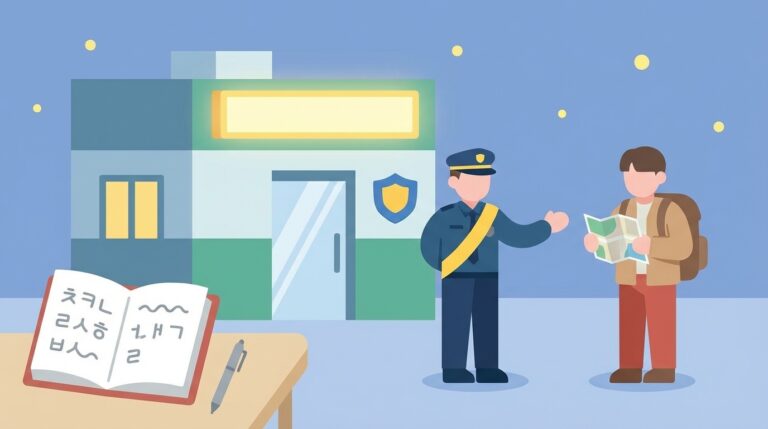
In dramas like When the Camellia Blooms, you see small neighborhood police stations called 파출소 (Pachulso) or 지구대 (Jigudae). unlike the scary, fortress-like police stations in some Western movies, these are community safety centers. They are often open, bright, and the officers are generally very helpful to lost tourists. Don’t be afraid to walk in!
Phase 5: Immersive Roleplay
Setting: It is 11:00 PM in a busy alley in Itaewon. You realize your wallet was stolen. You see a university student walking by.
Characters:
* YOU: A tourist in panic mode.
* Student: A helpful local carrying an iced Americano.
Dialogue:
YOU: (Running up to the student) 저기요! 도와주세요!
(Jeogiyo! Dowa-juseyo!)
(Excuse me! Please help me!)
Student: (Startled) 네? 무슨 일 있으세요?
(Ne? Museun il isseu-seyo?)
(Huh? Is something wrong?)
YOU: 지갑이 없어요. 경찰 불러 주세요!
(Jigabi eopseoyo. Gyeong-chal bul-leo ju-se-yo!)
(My wallet is gone. Please call the police!)
Student: 아, 진짜요? 잠시만요. (Dials 112)
(Ah, jinjja-yo? Jamsimanyo.)
(Ah, really? Just a moment.)
🔀 Decision Point: The police answer the phone. The student hands it to you.
- Choice A: Stay silent and panic.
- Choice B: Say “English please!” immediately.
- Choice C: Try to explain in broken Korean.
✅ Best Choice: B. Korean police (112) have a 3-way interpretation service for foreigners. Saying “English please” saves time.
⚠️ Choice C Analysis: Brave, but in an emergency, accuracy is key. Use your native language via the interpreter.
Phase 6: 10-Second Shadowing Drill
Practice this until it becomes muscle memory.
Prompt: You are flagging down a passing car or person.
Line: 😰 저기요! / 도와주세요! / 경찰 좀 / 불러 주세요!
Pronunciation: Jeogiyo! / Dowa-juseyo! / Gyeong-chal jom / bul-leo ju-se-yo!
Emotion: Urgent & Desperate (Don’t be shy!)
Phase 7: K-Culture Mini Glossary
| Korean | Romanization | Meaning | Context |
|---|---|---|---|
| 112 | Il-il-i | Police Number | The equivalent of 911 for Police. |
| 119 | Il-il-gu | Fire/Ambulance | Call this for medical emergencies. |
| 파출소 | Pachulso | Police Box | Small community police station. |
| 분실물 | Bunsilmul | Lost Property | You will hear this word if you lose your phone. |
| 신고 | Singo | Report | Reporting a crime or complaint. |
Phase 8: Traveler’s Survival Kit
🆘 Emergency Numbers in Korea
* Police: 112 (No area code needed)
* Fire / Ambulance: 119
* Tourist Helpline: 1330 (Available 24/7, supports English, helps with translation)📌 Editor’s Travel Note
If you lose your item in the subway, go to the “Lost and Found Center” (유실물 센터). Koreans are famously honest; many lost phones and wallets are actually turned in here! Don’t lose hope!
Phase 9: Think Deeper — “Why is it so safe?”
Topic: Social Trust & CCTV
You might notice people leaving laptops on cafe tables or packages sitting outside doors for hours. Korea has a high level of “social trust,” but it is also one of the most surveilled countries via CCTV. The “Black Box” (dashcam) culture means almost every car is a recording camera.
🧠 Think Deeper: Does this high-tech surveillance make people feel safer, or does it feel invasive? In Korea, most people view it as a necessary safety net. How does this compare to your country?
Phase 10: FAQ & Troubleshooting
Q: If I call 112, can I speak English?
A: YES! Shout “English please” or “Foreigner.” They will patch in a translator. Don’t hang up!
Q: Can I text 112?
A: Yes! If you are in a situation where you cannot speak (hiding), you can send an SMS to 112 describing your location.
❌ Common Mistake: Dialing 911 out of habit.
✅ Fix: Memorize 112. (Think: 1 mouth to speak, 1 nose to breathe, 2 eyes to see the police!)
Phase 11: Wrap-up & Mission
One-Liner Summary: In an emergency, forget grammar—just shout “Dowa-juseyo” or “Gyeong-chal bul-leo juseyo!”
Action Missions:
* 🥉 Bronze: Save “112” and “1330” in your contacts right now.
* 🥈 Silver: Practice shouting “Dowa-juseyo!” loudly when you are alone (don’t scare your neighbors!).
* 🥇 Gold: Locate the nearest Pachulso (Police box) on Naver Maps near your accommodation.
K-Culture Mission: Watch a clip of the drama Live (Netflix). It shows the real life of patrol officers in a Pachulso. Spot the scene where they help a drunk citizen!
Phase 12: Interactive Quiz
- Situation: You see a fire. Which number do you call?
- A) 112
- B) 119
- C) 1330
- True or False: You should look very polite and smile when asking for police help so you don’t offend anyone.
- (True / False)
- Fill in the blank: “My wallet is gone! ______ bul-leo juseyo!”
- (Hint: Police)
Answers:
1. B (119) – 112 is for police.
2. False – Use an urgent face! Nunchi is key.
3. Gyeong-chal
Frequently Asked Questions (FAQ)
Q: What does "경찰 불러 주세요 (Gyeong-chal bul-leo ju-se-yo)" mean in Korean and how do you pronounce it?
A: In Korean, "경찰 불러 주세요 (Gyeong-chal bul-leo ju-se-yo)" is pronounced [Gyeong-chal] and means: a key conversational Korean expression covered in this lesson.
Q: What does "도와주세요! (Do-wa-ju-se-yo!)" mean in Korean and how do you pronounce it?
A: In Korean, "도와주세요! (Do-wa-ju-se-yo!)" is pronounced [Do-wa] and means: a key conversational Korean expression covered in this lesson.
Q: What does "여기 [Place]예요 (Yeo-gi [Place]-yeyo)" mean in Korean and how do you pronounce it?
A: In Korean, "여기 [Place]예요 (Yeo-gi [Place]-yeyo)" is pronounced [Yeo-gi] and means: a key conversational Korean expression covered in this lesson.







