

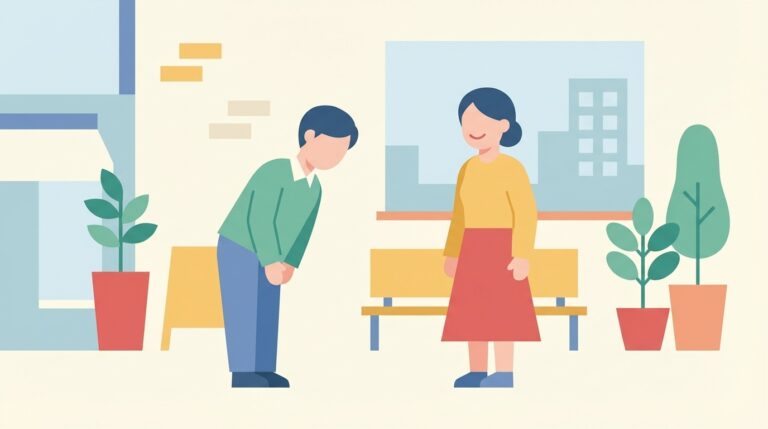
The “Magic Nod”: Why Koreans Bow (and You Should Too) 🙇♂️
Phase 1: The Hook — Why is Everyone Bending Over?
Greeting: 안녕하세요! (Hello!) It’s your Daily Hangul Senior Editor here.
The Scene: Picture this. You are watching your favorite K-Drama. The handsome CEO steps out of his luxury car. His secretary rushes over and bends their waist at a perfect 45-degree angle. Later, the CEO meets his childhood friend and just nods his head slightly.
Then, cut to an idol group on stage. They are practically folding themselves in half, heads touching their knees, shouting “Thank you!”
The ‘Why’: You might think, “Do I need a protractor to measure my angles in Korea?”
Don’t worry. In Korea, your body speaks as loudly as your mouth. If you say “Hello” while standing stiff as a board, you might accidentally look arrogant. But if you master the “Magic Nod,” you will instantly be treated like an insider. Let’s decode the secret language of the bow!
Phase 2: Deep Dive — The 3 Levels of the Bow
Here are the three most common ways to greet someone physically and verbally.
1. 안녕하세요 (Annyeonghaseyo)
- Pronunciation: [An-nyeong-ha-se-yo] -> Sounds like “An-young-ha-say-yo”
- Meaning: “Hello” (Formal/Polite)
- The Body Language: The Standard Bow (15° – 30°). Keep your back straight, hands at your sides (or gathered in front), and bend slightly from the waist.
- K-Culture Moment: Think of a K-Pop idol walking into a variety show studio. They bow to the hosts, the camera crew, and the other guests. It’s polite, respectful, and safe.
- Editor’s Insight: Eye contact is tricky! Unlike in the West, don’t lock eyes while bowing. Look at the person, then lower your eyes as you bow. It shows humility.
- Situation Spectrum:
[🚫 Friends] ———— [✅ Strangers/Coworkers] ———— [✅ Boss/Elders]- 🤔 Think About It: Why do you think lowering your head (exposing your neck) is a sign of respect? It’s a universal sign of trust!
2. 안녕 (Annyeong)
- Pronunciation: [An-nyeong] -> Sounds like “An-young”
- Meaning: “Hi” or “Bye” (Casual)
- The Body Language: The Head Nod or Little Wave. No waist bending required! Just a quick nod or a small wave of the hand.
- K-Culture Moment: In a high school drama, when the female lead sees her crush in the hallway. She gives a shy little wave and a quick nod.
- Editor’s Insight: ONLY use this with close friends or people younger than you. If you use this with a taxi driver or a shop owner, it’s considered rude!
- Situation Spectrum:
[✅ Friends] ———— [🚫 Strangers/Coworkers] ———— [🚫 Boss/Elders]- 🤔 Think About It: In English, “Hi” and “Hello” aren’t that different. Why is the gap between Annyeong and Annyeonghaseyo so huge in Korea?
3. 죄송합니다 (Joesonghamnida)
- Pronunciation: [Joe-song-ham-ni-da] -> Sounds like “Jay-song-ham-knee-da”
- Meaning: “I am sorry.”
- The Body Language: The Deep Bow (45° – 90°). The more sorry you are, the lower you go. Hold the bow for a second longer than a greeting.
- K-Culture Moment: The “Scandal Apology.” When a celebrity makes a mistake, they stand in front of the press and bow deeply for a long time. It signifies heavy regret.
- Editor’s Insight: Don’t just say the words. If you bump into someone on the subway, a quick bow speaks louder than the word itself.
- Situation Spectrum:
[⚠️ Friends] ———— [✅ Strangers] ———— [✅ Serious Situations]
Phase 3: Textbook vs. Real Life
| Situation | 📖 Textbook Korean | 🗣️ Real Korean (Street Smarts) | 💡 Why is it different? |
|---|---|---|---|
| Passing a coworker in the hall | “안녕하세요” + Bow | “Silent Nod” (Mokrye) | Saying hello 10 times a day is tiring! A nod is enough for the 2nd meeting. |
| Entering a convenience store | “안녕하세요” | “(Mumble) …seyo” | It happens so fast; people often slur the beginning and just keep the polite ending. |
| Meeting a close friend | “안녕!” | “Eye contact + Chin lift” | Real friends don’t need words. The chin lift says, “What’s up?” |
Bottom Note: As an A1 learner, stick to the Textbook version first. You earn the right to use the “Real Korean” version once you make local friends!
Phase 4: Cultural Deep Dive — The “Nunchi” of Bowing
4-1. Non-verbal: The Handshake Dilemma
In the West, you shake hands. In Korea, you bow. What happens when you do both?
– The Rule: Bow FIRST. If the other person (usually a senior or higher rank) extends their hand, then you shake it.
– The “Polite Hand”: When shaking hands, support your right elbow with your left hand. It looks like you are holding up your heavy, respectful arm!
4-2. K-Drama Connection: The “Seniority” Trope
You’ve seen this scene: A new employee enters the office. They bow to everyone. Then, the “Bad Senior” (Kkondae) ignores the bow.
– Reality Check: In real life, most Koreans will bow back or nod. If someone ignores your bow, it’s very rude (or they didn’t see you). Don’t worry, just keep being polite!
Phase 5: Immersive Roleplay — The Elevator Encounter
Setting: It’s 8:50 AM in a busy office building in Seoul. You are rushing to the elevator. The doors are closing. Suddenly, a hand stops the door. You jump in. Inside is Manager Kim, a senior at your company (50s, nice but formal).
YOU: (Out of breath) Oh, thank you!
Manager Kim: (Smiles) 출근해요? (Chul-geun-hae-yo? / Coming to work?)
🔀 Decision Point: How do you greet him?
- A) Wave your hand and say “Hi, Kim!”
- B) Bow your head slightly (15°) and say “안녕하세요 (Annyeonghaseyo).”
- C) Bow 90 degrees and shout “안녕하십니까! (Annyeonghasimnikka!)”
✅ Best Choice: B).
– Why: An elevator is a small space. A 90-degree bow (C) is too intense and you might hit your head! A wave (A) is too rude for a senior. A slight bow with a polite verbal greeting is perfect.
Manager Kim: 네, 좋은 아침이에요. (Ne, joeun achimieyo / Yes, good morning.)
(Stage Direction: The elevator opens. Manager Kim gestures for you to go first.)
YOU: 감사합니다 (Gamsahamnida) + (A quick nod as you exit).
Phase 6: 10-Second Shadowing Drill
Practice this motion. Stand up!
- Standard Greeting:
😊 안-녕-하-세-요 / (Bow)
(An-nyeong-ha-se-yo) - Apology:
🥺 죄-송-함-니-다 / (Deep Bow)
(Joe-song-ham-ni-da) - Casual/Cute:
😝 안-녕! / (Wave)
(An-nyeong!)
Phase 7: K-Culture Mini Glossary
| Korean | Romanization | Meaning | Context |
|---|---|---|---|
| 목례 | Mokrye | Neck Bow (Nod) | A silent, light bow used when passing someone you already greeted earlier. |
| 배꼽인사 | Baekkob-insa | Belly Button Bow | A very polite bow taught to children (hands on belly button). Often used by K-Pop idols. |
| 꼰대 | Kkondae | Boomer/Old School | An older person who forces strict hierarchy and bowing rules. |
Phase 8: Traveler’s Survival Kit
Walking into a shop or restaurant? Don’t freeze!
🆘 Survival Phrase #1
– 🇰🇷 “안녕하세요!” (Annyeonghaseyo!) + Small Nod
– 🗣️ Pronunciation: An-young-ha-say-yo
– 📍 Where: Entering ANY shop, restaurant, or convenience store.
– 💡 Pro Tip: If the shop owner ignores you, don’t be sad. They are busy! But you should still say it to be a “good foreigner.”📌 Editor’s Travel Note
– Eye Contact: If you bow while staring intensely into their eyes, it looks like a challenge! Soften your gaze.
– Hands: Don’t keep hands in your pockets while bowing. It’s considered very arrogant.
Phase 9: Think Deeper — Language & Body
Topic: The Weight of the Head
In many cultures, looking someone in the eye shows confidence. In traditional Korean culture, lowering your head shows trust. You are exposing your neck—a vulnerable spot—to the other person. It says, “I trust you not to hurt me, and I respect your status.”
🧠 Think Deeper:
Does your culture have a gesture that shows hierarchy? (Like standing up when someone enters a room?) How does it compare to the Korean bow?
Phase 10: FAQ & Troubleshooting
Q: Do I bow to my close Korean friends?
A: Usually, no. A wave or a high-five is fine. BUT, if you are meeting them for the first time in a while, or apologizing, a playful bow can be used.
Q: What about hugging?
A: ⚠️ Caution! Koreans are not big huggers with strangers. Don’t go for a hug unless they open their arms first. A bow is the safest bet.
❌ Common Mistake: Bowing while walking without stopping.
✅ Fix: It’s better to stop moving for just 0.5 seconds, bow, and then keep walking. It looks much more sincere.
Phase 11: Wrap-up & Mission
Summary: Korean greetings are a package deal: Words + Angle. The deeper the bow, the higher the respect.
🔥 Action Mission:
– 🥉 Bronze: Look in the mirror. Practice saying “Annyeonghaseyo” while bending 30 degrees. Check your hands (not in pockets!).
– 🥈 Silver: Watch a K-Drama episode. Count how many times people bow. Is it a nod? Or a 90-degree fold?
– 🥇 Gold: Go to a Korean restaurant or shop. Say “Annyeonghaseyo” with a confident nod to the staff. Watch them smile back!
Phase 12: Interactive Quiz
- Situation: You meet your boss’s boss in the hallway.
- A) High five
- B) “Annyeong!” and wave
- C) Stop, bow politely (30-45°), and say “Annyeonghaseyo.”
- True or False (K-Culture):
- You should stare straight into the other person’s eyes while bowing to show dominance. (T/F)
⬇️ Answers (Click to reveal)
!1. C (A and B will get you fired!)!<
!2. False (Look down slightly to show respect!)!<
Frequently Asked Questions (FAQ)
Q: What does "안녕하세요 (Annyeonghaseyo)" mean in Korean and how do you pronounce it?
A: In Korean, "안녕하세요 (Annyeonghaseyo)" is pronounced [An-nyeong-ha-se-yo] and means: "Hello" (Formal/Polite)
Q: What does "안녕 (Annyeong)" mean in Korean and how do you pronounce it?
A: In Korean, "안녕 (Annyeong)" is pronounced [An-nyeong] and means: "Hi" or "Bye" (Casual)
Q: What does "죄송합니다 (Joesonghamnida)" mean in Korean and how do you pronounce it?
A: In Korean, "죄송합니다 (Joesonghamnida)" is pronounced [Joe-song-ham-ni-da] and means: "I am sorry."







