

Hello! I am your Daily Hangul Editor.
Picture this: You just finished an amazing K-BBQ dinner in Myeongdong. Your stomach is full, the vibes are great, and you’re ready to head out. You sit at your table, make eye contact with the server, and do the international “scribbling in the air” gesture for the bill.
…But nothing happens. The server smiles back, bows slightly, and walks past you.
Wait, what did I do wrong?
If you’ve ever watched a K-Drama, you might notice that characters rarely sit at their tables waiting for a leather booklet with their receipt. The “paying culture” in Korea has its own unique rhythm, and if you don’t know it, you might be stuck at your table forever!
Today, we are going to learn exactly how to ask for the bill and pay at a Korean restaurant. As always, this guide is based on real struggles my beginner students have faced. Let’s dive in and make you look like a total local!
Phase 2: Deep Dive into Core Expressions
Let’s look at the absolute must-know phrases for settling your bill.
1. 계산해 주세요.
- Pronunciation: gyesanhae juseyo [gyeh-san-hae joo-seh-yo]
- Meaning: Please calculate it. (Real nuance: I’d like to pay / Bill, please.)
- K-Culture Moment: You will hear this at the front counter of almost every restaurant in Korea. When the main character in a drama grandly takes out their shiny black credit card to pay for the team dinner, this is the exact phrase they drop.
- Editor’s Insight: The word 계산 (gyesan) literally means “calculation” or “math.” So you are asking them to do the math for your meal. It’s polite, standard, and works 100% of the time.
- Situation Spectrum:
[🚫 절대 금지] ———— [⚠️ 주의] ———— [✅ 자유롭게]
- Close Friends (Casual): ⚠️ (Friends usually just say “계산할게” – I will pay)
- Coworkers (Semi-formal): ✅
- Staff/Elders (Formal): ✅
- 🤔 Think About It: Why do Koreans say “Please calculate” instead of “Bring me the bill”? It reflects the fact that in Korea, you usually go to the cashier, so the staff isn’t “bringing” you a piece of paper; they are punching your table number into the register right then and there.
2. 영수증 버려주세요.
- Pronunciation: yeongsujeung beoryeojuseyo [young-soo-jeung buh-ryuh-joo-seh-yo]
- Meaning: Please throw away the receipt.
- K-Culture Moment: If you go to a convenience store or a cafe, the staff will rapidly mumble something that sounds like “Yeongsujeong-hashigessuhyo?” They are asking if you want the receipt.
- Editor’s Insight: Koreans love efficiency, and most people track expenses on their banking apps. Saying this immediately after handing over your card saves everyone time. You’ll instantly look like someone who has lived in Seoul for years!
- Situation Spectrum:
[🚫 절대 금지] ———— [⚠️ 주의] ———— [✅ 자유롭게]
- Close Friends (Casual): 🚫 (You don’t say this to friends)
- Cashier/Staff (Formal): ✅
- 🤔 Think About It: Does your home country still print receipts for every small coffee purchase? Korea is highly digitized, so refusing paper receipts is actually encouraged for the environment!
3. 저기요!
- Pronunciation: jeogiyo [juh-gee-yo]
- Meaning: Over there! (Real nuance: Excuse me!)
- K-Culture Moment: Picture a loud, bustling Pojangmacha (street tent bar). A customer raises their hand high and yells “Jeogiyo!” to order another bottle of Soju.
- Editor’s Insight: Do NOT translate “Excuse me” to “실례합니다” (sillyehamnida) in a restaurant. That sounds like you are apologizing for bumping into someone. “저기요” is the magical word to get a server’s attention.
- Situation Spectrum:
[🚫 절대 금지] ———— [⚠️ 주의] ———— [✅ 자유롭게]
- Getting staff’s attention: ✅
- Calling your boss/elder: 🚫 (Never call an older person ‘jeogiyo’)
- 🤔 Think About It: Why do we say “Over there” to call someone? It’s a way to draw attention to your location without using a direct, potentially rude “Hey you.”
Phase 3: Textbook vs Real Life
| Situation | 📖 Textbook Korean | 🗣️ Real Korean | 💡 Why is it different? |
|---|---|---|---|
| Calling the waiter | 실례합니다. (Excuse me.) | 저기요! or 사장님! (Excuse me / Boss!) | ‘실례합니다’ is too formal for restaurants. Calling the staff ‘Boss’ (Sajangnim) is friendly and respectful. |
| Asking for the bill at the table | 계산서 주시겠습니까? (May I have the bill?) | (Just walking to the counter with your wallet) | Korean restaurants rarely bring the bill to your table. You pay on your way out! |
| Offering to pay | 제가 계산하겠습니다. (I will calculate it.) | 내가 쏠게! (I’ll shoot/treat!) | ‘쏘다’ (to shoot) is a very common slang meaning ‘to treat someone to a meal.’ |
Bottom Note for A2 Learners: If you forget everything else, just remember the word “계산” (gyesan). Pointing to your card and saying “gyesan” will get the job done anywhere!
Phase 4: Cultural Deep Dive
4-1. Non-verbal Communication: The Two-Handed Rule
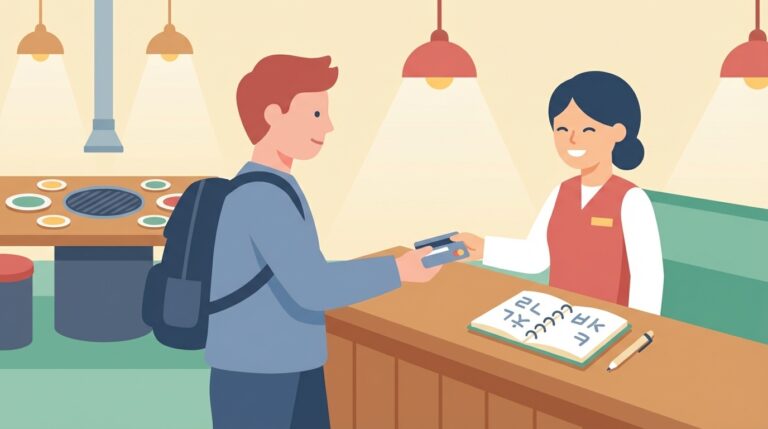
When you finally get to the counter to pay, how you hand your credit card over matters! In Korea, handing things over with one hand (especially your left hand) can be seen as slightly disrespectful.
* Pro Tip: Use your right hand to give the card, and lightly touch your right elbow or forearm with your left hand. It’s a subtle sign of respect that cashiers will highly appreciate!
4-2. K-Food Connection: The Call Bell (콜벨) & The Counter
Let’s clear up the biggest restaurant mystery for travelers. In Western countries, asking for the bill at the table is the norm. In Korea, you eat, you stand up, and you pay at the door.
Also, look at your table. Do you see a little electronic button? That is the “Call Bell.” Press it, and a “DING-DONG” sound will echo through the restaurant. The server will come right to you. No need to wave awkwardly!
Phase 5: Immersive Roleplay
Scenario A: The K-BBQ Showdown
Setting: Friday night, 7 PM. A smoky K-BBQ spot near Gangnam Station. Soju bottles line the table. You are out with your Korean coworker, Minsu.
Characters:
– YOU: A foreigner on your first business trip to Korea.
– Minsu (32): Your friendly Korean coworker who just grilled all the meat.
Minsu: 배부르죠? 오늘 고기는 제가 쏠게요! 🥩
(baebureujyo? oneul gogineun jega ssolgeyo!)
[You’re full, right? I’ll treat you to the meat today!]
(🎭 Stage Direction: Minsu grabs his wallet and stands up quickly.)
YOU: 아, 아니에요! 제가 낼게요.
(a, anieyo! jega naelgeyo.)
[Ah, no! I will pay.]
Minsu: 에이~ 한국에 오셨는데 제가 사야죠! 가요.
(ei~ hanguge osyeonneunde jega sayajyo! gayo.)
[Hey~ You came to Korea, I have to buy! Let’s go.]
(🎭 Stage Direction: Minsu starts walking to the counter. The cashier is waiting.)
🔀 Your Turn! How should you respond?
– A) “그래요? 그럼 돈 낼게요.” (Really? Then I will pay money.)
– B) “아… 정말요? 그럼 잘 먹겠습니다!” (Ah… really? Then I will eat well/Thank you for the meal!)
– C) “대박! 민수 짱!” (Daebak! Minsu is the best!)✅ Best Choice: B — In Korea, it’s polite to offer to pay once (the “bill dance”). But if the older person or host insists, the best response is to accept graciously with “잘 먹겠습니다” (jal meokgetseumnida – I will eat well).
⚠️ Choice C Analysis: “Daebak” is fun, but a bit too casual for a coworker setting unless you are extremely close.
Scenario B: Bonus K-Culture Scenario (The Cafe Split)
You are at an aesthetic cafe in Hongdae with a language exchange partner.
Friend: 우리 각자 계산할까?
(uri gakja gyesanhalkka?)
[Shall we pay separately?]
YOU: 네, 따로 계산해 주세요.
(ne, ttaro gyesanhae juseyo.)
[Yes, please calculate separately.]
(This is how you do the “Dutch Pay” in Korea!)
Phase 6: 10-Second Shadowing Drill
Let’s practice the rhythm! Read these out loud, pausing at the / marks.
- 😤 (Loudly, in a busy restaurant)
저기요! / 여기 / 계산해 주세요!
(jeogiyo! / yeogi / gyesanhae juseyo!) -
😊 (Politely to the cashier)
영수증은 / 버려주세요.
(yeongsujeungeun / beoryeojuseyo.) -
🥺 (Appreciatively, when someone treats you)
감사합니다! / 잘 / 먹겠습니다!
(gamsahamnida! / jal / meokgetseumnida!)
Phase 7: K-Culture Glossary
| 한국어 (Korean) | Romanization | English | Cultural Context |
|---|---|---|---|
| 눈치 | nunchi | Social awareness / reading the room | You need quick nunchi to know when someone is secretly trying to pay the bill! |
| 회식 | hoesik | Company dinner | A core part of Korean work culture. The boss usually pays the bill here. |
| 쏘다 | ssoda | To treat / to pay for | Literally means “to shoot.” Used when someone generously buys a meal. |
| 더치페이 | deochipei | Dutch pay / splitting the bill | Very common among younger Koreans and friends today. |
| 사장님 | sajangnim | Boss / Owner | A polite and flattering way to call the restaurant staff, even if they aren’t the actual owner! |
Phase 8: Traveler’s Survival Kit
Are you packing your bags for Seoul? Save these cards to your phone!
🆘 Survival Phrase #1: Can I use a card?
– 🇰🇷 “카드 돼요?” (kadeu dwaeyo?)
– 📍 Where to use: Small markets, food stalls, underground shopping malls.
– 💡 Pro Tip: Korea is practically a cashless society. 99% of places accept cards, but street food vendors might prefer cash or bank transfers.🆘 Survival Phrase #2: We will pay separately.
– 🇰🇷 “따로 계산할게요.” (ttaro gyesanhalgeyo.)
– 📍 Where to use: Cafes, casual restaurants with friends.
– 💡 Pro Tip: When you say this, the cashier will take your cards one by one. Just tell them what you ate!📌 Editor’s Travel Note
– TIPPING: Do not tip! There is absolutely zero tipping culture in Korea. If you leave money on the table, the staff will run down the street to return your “forgotten” change.
– PAYING: Remember, grab your belongings and walk to the “카운터” (Counter) near the exit to pay.
Phase 9: Think Deeper — “A Step Further”
Food, Identity, and the Battle of the Bill
🧠 Think Deeper:
If you observe Koreans at a restaurant counter, you might see them lightly fighting, pushing each other’s credit cards away. Why do they do this? In Korea, food is deeply tied to 정 (Jeong), a complex concept of affection, compassion, and community bonding. Paying for someone’s meal is a tangible way of showing Jeong. Splitting the bill perfectly to the last cent was historically seen as a bit “cold” or distant among close friends or family. While younger generations prefer “Dutch Pay” for convenience, the “I’ll treat you today, you buy coffee next time” culture is still the heartbeat of Korean relationships.💬 Your Turn: How does paying the bill work in your culture? Is it strictly split, or do people take turns treating each other? Let us know in the comments!
Phase 10: Troubleshooting (FAQ & Common Mistakes)
Q: Can I use “저기요” (Jeogiyo) to my boss or teacher?
A: NO. “Jeogiyo” is only used to call a stranger’s attention (like a waiter or someone who dropped their wallet). Calling your boss “Jeogiyo” is extremely rude!
Q: What if the restaurant is huge and I can’t find the counter?
A: Just ask any staff member: “계산 어디서 해요?” (Where do I pay?). They will point you to the exit.
❌ Common Mistake #1: Leaving a 15% tip on the table.
✅ Do this instead: Pick up your belongings, take your bill to the front, pay exactly what is owed, and say “잘 먹었습니다!” (I ate well!). That is the best tip you can give.
Phase 11: Wrap-up & Action Items
One-Liner Summary: Don’t wait at the table—walk to the counter and confidently say “계산해 주세요” (Please calculate)!
Action Mission:
– 🥉 Bronze: Say “계산해 주세요” out loud 3 times right now.
– 🥈 Silver: Next time you are at a cafe in your own country, imagine you are in Korea and whisper “영수증 버려주세요” as you pay.
– 🥇 Gold: Actually go to a Korean restaurant, find the call bell, and pay at the counter like a local!
K-Culture Mission:
Watch one episode of your favorite K-Drama today. Look for the scene where the characters are eating. Who pays? Do they argue over the bill? Did they pay at the table or the counter?
Phase 12: Interactive Quiz
Test your Korean survival skills!
1. You are at a busy Korean BBQ place and need to order more water. What should you shout?
A) 실례합니다! (Excuse me!)
B) 저기요! (Over here!)
C) 계산해 주세요! (Bill please!)
2. True or False: If the service was fantastic, you should leave a 10% tip on the table.
– True / False
3. Fill in the blank:
You want to pay for your friend. You say: “오늘 밥은 내가 _____!” (I’ll _____ the food today!)
A) 계산해
B) 쏠게
C) 버려
(Scroll down for answers!)
.
.
.
Answers:
1. B (A is too formal, C is for paying).
2. False (No tipping in Korea! They might think you forgot your money).
3. B (내가 쏠게 = I’ll treat/shoot).
Frequently Asked Questions (FAQ)
Q: What does "계산해 주세요." mean in Korean and how do you pronounce it?
A: In Korean, "계산해 주세요." is pronounced [gyesanhae juseyo [gyeh-san-hae joo-seh-yo] and means: Please calculate it. (Real nuance: I'd like to pay / Bill, please.)
Q: What does "영수증 버려주세요." mean in Korean and how do you pronounce it?
A: In Korean, "영수증 버려주세요." is pronounced [yeongsujeung beoryeojuseyo [young-soo-jeung buh-ryuh-joo-seh-yo] and means: Please throw away the receipt.
Q: What does "저기요!" mean in Korean and how do you pronounce it?
A: In Korean, "저기요!" is pronounced [jeogiyo [juh-gee-yo] and means: Over there! (Real nuance: Excuse me!)







