

Phase 1: 공감 — 몰입형 오프닝 (Immersive Hook)
Hello there! I’m the Lead Editor of Daily Hangul, your veteran tutor and local cultural navigator in Seoul.
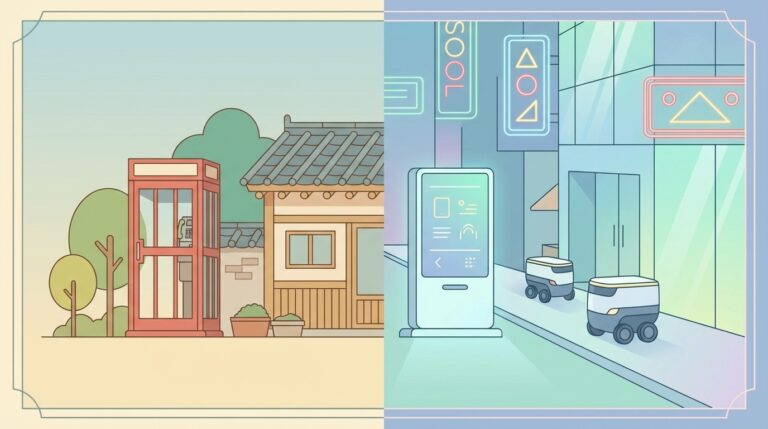
Imagine this: You’re watching a K-Drama like Reply 1988 (응답하라 1988). The characters are gathering around a bulky TV, sharing snacks with neighbors, and using rotary phones. Fast forward to today—you step off the plane in Seoul, and robots are serving your coffee while your groceries arrive at your door before you even wake up.
The contrast between Korea’s past and present is nothing short of a time-travel movie! Because Korea developed so rapidly, you’ll constantly hear Koreans comparing “how things used to be” with “how things are now.” If you want to join these conversations and sound like a true insider (인싸) rather than a textbook, you need to know how to express this contrast naturally.
Today, we’re diving into the B1 level expressions you need to talk about comparing past and present lifestyles. This guide is based on real questions from my students who were confused when their Korean friends suddenly started talking about “horses and lattes” (Don’t worry, we’ll get to that!). Let’s jump in!
Phase 2: 핵심 표현 심층 분석 (Deep Dive)
1. 예전에는 ~았/었는데, 요즘은 ~아/어요
- Pronunciation: yejeon-eneun [A]nneunde, yojeum-eun [B]ayo. (ye-juhn-eh-neun… yo-jeum-eun…)
- Meaning: In the past it was [A], but these days it is [B].
- K-Culture Moment: You’ll hear this at cafes when friends are reminiscing. “예전에는 아메리카노 못 마셨는데, 요즘은 매일 마셔요” (I couldn’t drink Americano in the past, but these days I drink it every day). It’s the ultimate structure to highlight personal or societal changes.
- Editor’s Insight: The magic here is the particle 은/는 attached to ‘예전’ and ‘요즘’. It emphasizes the contrast. It’s not just “in the past” and “now,” it’s “Unlike the past, nowadays…”
- Situation Spectrum:
[🚫 절대 금지] ———— [⚠️ 주의] ———— [✅ 자유롭게]- Casual (Friends): ✅
- Semi-formal (Coworkers): ✅
- Formal (Bosses/Elders): ✅ (Just make sure the verb endings are polite!)
- 🤔 Think About It: Why do Koreans talk about “요즘” (these days) so much? In a fast-paced society where trends change weekly, “these days” is a vital concept. How fast do trends change in your country?
2. 세상 참 좋아졌어요
- Pronunciation: sesang cham joajyeosseoyo. (seh-sang cham jo-ah-jeot-suh-yo)
- Meaning: The world has gotten so much better. (Literal: The world truly became good.)
- K-Culture Moment: An older taxi driver using a brand-new GPS app, or a 30-something office worker receiving a “Rocket Delivery” (same-day shipping) package at 11 PM. They’ll shake their head with a smile and say this.
- Editor’s Insight: This phrase captures the awe of Korea’s rapid technological advancement. It gives off a slightly “wise, experienced” vibe, but even young people use it playfully when a new, convenient app comes out.
- Situation Spectrum:
[🚫 절대 금지] ———— [⚠️ 주의] ———— [✅ 자유롭게]- Casual (Friends): ✅
- Semi-formal (Coworkers): ✅
- Formal (Bosses/Elders): ✅ (Great for agreeing with elders!)
- 🤔 Think About It: “좋아지다” (to become good) shows a change in state. Does your native language have a specific verb form just to show that something became something else?
3. 라떼는 말이야 (Latte is horse…)
- Pronunciation: ratteneun mariya (la-tteh-neun mah-ri-yah)
- Meaning: Back in my day… / When I was your age…
- K-Culture Moment: A boss at a company dinner (회식) starts a sentence with “나 때는 말이야…” (Na-ttae-neun mariya = Back in my day). The younger staff mentally roll their eyes. To mock this, the internet changed “나 때는” (Na-ttae-neun) to “라떼는” (Latte-neun, like the coffee) because they sound similar! Literally translated, it means “Latte is a horse” (말 = horse/speech).
- Editor’s Insight: This is top-tier slang. Use it to be playfully dramatic about the past. “라떼는 말이야, 스마트폰이 없었어!” (Back in my day, we didn’t have smartphones!)
- Situation Spectrum:
[🚫 절대 금지] ———— [⚠️ 주의] ———— [✅ 자유롭게]- Casual (Friends): ✅
- Semi-formal (Coworkers of similar age): ⚠️
- Formal (Bosses/Elders): 🚫 (Never say this to your boss!)
- 🤔 Think About It: Humor is a great way to deal with social friction. How does this pun reflect the younger generation’s attempt to cope with the strict hierarchy of the workplace?
Phase 3: 교과서 vs 진짜 한국어 (Textbook vs Real Life)
Let’s see how textbook Korean transforms on the bustling streets of Seoul.
| 상황 (Situation) | 📖 교과서 한국어 | 🗣️ 진짜 한국어 | 💡 왜 다를까? (Why the difference?) |
|---|---|---|---|
| 과거를 회상할 때 (Reminiscing) | 과거에는 대중교통이 불편했습니다. (Public transport was inconvenient in the past.) | 옛날엔 버스 타기 진짜 빡셌는데. (Taking the bus back then was super intense.) | ‘과거’ is formal. ‘옛날’ is conversational. ‘빡세다’ is common slang for ‘tough/hard’. |
| 변화에 놀랄 때 (Surprised by change) | 최근 기술이 많이 발전했어요. (Recent technology has developed a lot.) | 와, 세상 진짜 좋아졌다. 배달이 벌써 와? (Wow, the world got so good. The delivery is already here?) | Koreans express technological awe through everyday lifestyle improvements, not academic words. |
| 꼰대 상사를 흉내낼 때 (Mocking older generations) | 제가 어렸을 때는 말입니다… (When I was young…) | 라떼는 말이야~ ☕🐎 (Latte is horse~) | Wordplay softens the rigidity of corporate culture! |
Bottom Note: Stick to “옛날에는 ~았/었는데” for most daily situations. It’s safe, natural, and instantly makes you sound like a B1+ speaker!
Phase 4: 문화적 맥락 — K-Culture 딥다이브
4-1. 비언어적 요소 (Non-verbal Communication)
When Koreans talk about the past, there is an invisible art to it.
– The Nostalgic Sigh: When saying “옛날에는 좋았는데…” (It was nice back then…), it’s almost mandatory to let out a small, warm sigh and look off into the distance.
– Nunchi (눈치) with Elders: If an older person starts talking about how hard their lifestyle used to be, your job is to listen and react with “아, 정말요?” (Oh, really?) or “고생 많으셨네요” (You went through a lot). Never interrupt with “But my generation has it hard too!”
4-2. K-Travel & K-Food: The Kiosk Revolution
If you travel to Korea today, the biggest lifestyle shock compared to just 5 years ago is how you order food. Gone are the days of shouting “사장님~” (Boss!) to order at a fast-food joint. Now, you are greeted by a giant digital screen: The Kiosk (키오스크).
Even Koreans complain about this change! You’ll often hear people in line saying, “옛날에는 그냥 말로 주문했는데, 요즘은 다 키오스크라서 너무 복잡해요” (In the past we just ordered by speaking, but nowadays it’s all kiosks so it’s too complicated). Knowing how to talk about this exact change will make you instantly relatable to locals!
Phase 5: 실전 롤플레이 시나리오 (Immersive Roleplay)
시나리오 A: The Kiosk Crisis
- Setting: A busy Saturday afternoon in Hongdae. You and your Korean friend, Minsu, just entered a popular burger shop. There are no cashiers, only three towering digital kiosks. The line behind you is growing.
- Characters:
- YOU (The Reader): A B1 Korean learner, hungry but intimidated by the Korean UI on the screen.
- Minsu (28): Your Korean friend. Helpful, but slightly impatient because he’s starving.
Minsu: 아, 또 키오스크네. 나 이거 진짜 귀찮은데.
(Ah, tto kioseukeune. Na igeo jinjja gwichaneunde.)
[Ugh, another kiosk. I really find these annoying.]
(🎭 Stage Direction: Minsu sighs and taps the screen aggressively)
YOU: 나도. 옛날에는 그냥 직원한테 말로 주문했는데.
(Nado. Yejeon-eneun geunyang jigwon-hante mallo jumunhaenneunde.)
[Me too. In the past, we just ordered by speaking to the staff.]
Minsu: 내 말이! 요즘은 옵션 고를 게 너무 많아. 양파 빼기, 소스 추가…
(Nae mari! Yojeum-eun opsyeon goreul ge neomu mana. Yangpa ppaegi, soseu chuga…)
[Tell me about it! These days there are too many options to choose from. Remove onions, add sauce…]
YOU: 그래도 한국 배달이나 포장 시스템은 진짜 빠른 것 같아.
(Geuraedo hanguk baedarina pojang siseutem-eun jinjja ppareun geot gata.)
[Still, I think Korea’s delivery and takeout systems are really fast.]
Minsu: 그건 인정. 옛날엔 전화로 주소 다 불렀는데, 이젠 터치 한 번이면 되니까.
(Geugeon injeong. Yejeon-en jeonhwaro juso da bulleonneunde, ijen teochi han beon-imyeon doenikka.)
[I admit that. In the past we had to read out our address over the phone, but now it just takes one touch.]
🔀 당신의 차례! 어떻게 대답할까요? (Your Turn! How will you respond?)
– A) 맞아요. 기술이 참 많이 발전했습니다. (Textbook safe)
– B) 세상 참 좋아졌어~ 라떼는 말이야~ ☕ (Playful & culturally rich)
– C) 야, 빨리빨리 주문해! 뒤에 사람 많아! (Very direct, slightly risky)✅ Best Choice: B — Why? You are talking to a friend! Using “세상 참 좋아졌어” combined with the slang “라떼는 말이야” perfectly highlights your understanding of Korean modern culture. Minsu will definitely laugh out loud.
⚠️ Choice A Analysis: Too formal for a close friend.
⚠️ Choice C Analysis: While “Pali-pali” is very Korean, yelling at your friend might make them panic in front of the machine!
Phase 6: 10초 섀도잉 드릴 (Shadowing Drill)
Let’s practice the rhythm! Pay attention to the pauses (/) and the emotion tags.
👴 (Nostalgically)
라떼는 / 말이야~~~ / (Latte-neun / mariya~~~ /)
버스 요금이 / 오백 원이었어! (Beoseu yogeum-i / obaek won-ieosseo!)
[Back in my day~~~ / the bus fare was / 500 won!]
😲 (Amazed)
옛날에는 / 다 손으로 썼는데, / (Yejeon-eneun / da soneuro sseonneunde, /)
요즘은 / 세상 참 / 좋아졌네요! (Yojeum-eun / sesang cham / joajyeonneyo!)
[In the past / we wrote everything by hand, but / these days / the world has gotten so much / better!]
Phase 7: K-Culture 미니 사전 (K-Culture Glossary)
| 한국어 | Romanization | English | 맥락 설명 (Context) |
|---|---|---|---|
| 레트로 | reteuro | Retro | Huge trend in Korea right now. Cafes and shops mimicking the 1980s-90s lifestyle. |
| 키오스크 | kioseukeu | Kiosk | The digital ordering screens that replaced human cashiers in most fast-food and cafe chains. |
| 꼰대 | kkondae | Boomer / Bossy elder | An older person who forces their outdated views on younger people. (Origin of the ‘Latte’ joke). |
| 삐삐 | ppippi | Pager | Often referenced in K-Dramas like Reply 1994. The ultimate symbol of “the past” in Korea. |
| 배달앱 | baedar-aep | Delivery App | Apps like Baemin or Yogiyo that revolutionized how Koreans eat today. |
Phase 8: 여행자 서바이벌 키트 (Traveler’s Survival Kit)
Since Korea’s lifestyle has modernized so fast, travelers often get caught off guard by the changes. Here is how to survive modern Korea!
🆘 서바이벌 표현 #1: The Kiosk Helper
– 🇰🇷 “이거 어떻게 하는지 아세요?” (Igeo eotteoke haneunji aseyo?)
– 🗣️ Sound guide: Ee-guh uh-dduh-keh ha-neun-ji ah-seh-yo?
– 📍 Where to use: In front of a Kiosk, subway ticket machine, or self-checkout.
– 💡 Pro Tip: If you are totally lost at a kiosk, find an employee and say “주문 좀 도와주시겠어요?” (Could you help me order?). They will usually step in!📌 Editor’s Travel Note: Past vs Present Cash Culture
– Past: You needed cash for street food, small shops, and taxis.
– Present: Korea is essentially a cashless society. You can buy a 1,000 KRW pack of gum with a credit card. In fact, some buses in Seoul now say “현금 없는 버스” (Cashless Bus). Always have a T-Money card or an international credit card handy!
Phase 9: 비판적 사고 코너 — “한 발 더 깊이” (Think Deeper)
언어와 권력 (Language & Power): The Generation Gap
Korea experienced the “Miracle on the Han River,” transforming from a war-torn country to a tech powerhouse in just a few decades. This rapid change means that someone in their 60s grew up in a completely different universe than someone in their 20s. The older generation feels proud of building the country through sheer grit, leading them to say, “When I was your age…” (나 때는 말이야).
However, the MZ generation faces completely new modern struggles—like fierce job markets and sky-high housing prices. By turning “나 때는” into “라떼는” (Latte), the younger generation found a humorous, non-confrontational way to reject outdated hierarchies. Language here isn’t just words; it’s a tool for cultural self-defense.
💬 Your Turn:
How fast did your country change? Is there a similar phrase to “Back in my day” that older people use? Share it in the comments!
Phase 10: FAQ & 오해 방지 (Troubleshooting)
Q: Can I use “예전에는” and “과거에는” interchangeably?
– Technically yes, but context matters! “과거” sounds very academic, like you’re talking about historical events (The Joseon Dynasty). “예전” or “옛날” is much better for personal lifestyles (e.g., “I used to hate vegetables”).
Q: I want to say “I used to be a student.” Do I use ~았/었는데?
– Yes! “예전에는 학생이었는데, 지금은 직장인이에요.” (I was a student in the past, but now I’m an office worker.)
❌ 흔한 실수 (Common Mistake): Forgetting the contrast particles!
Foreigners often say: “예전에 운동했어요. 지금 안 해요.” (I exercised in the past. Now I don’t.)
✅ 이렇게 하세요 (Do it like this): Add 은/는! “예전에는 운동했는데, 요즘은 안 해요.”
The 은/는 particles act like a highlighter pen, pointing out the exact things you are comparing.
Phase 11: 요약 및 액션 아이템 (Wrap-up)
- One-Liner Summary: To compare the past and present naturally, use “예전에는 ~았/었는데, 요즘은 ~아/어요” and throw in a “세상 참 좋아졌어요” to sound like a local!
-
Action Mission 3단계:
- 🥉 Bronze (Solo): Look at an old photo of yourself and say aloud: “예전에는 머리가 길었는데, 요즘은 짧아요.”
- 🥈 Silver (Online): Comment on a K-Pop idol’s old debut video: “예전에도 멋있었는데, 요즘은 더 멋있어요!”
- 🥇 Gold (Real Life): Next time you use a really convenient Korean app or system, turn to a Korean friend and say, “세상 참 좋아졌어~”
- K-Culture Mission: Watch an episode of a retro drama (like Twenty-Five Twenty-One or Reply 1988) and note one specific lifestyle difference compared to modern Korea.
Phase 12: 퀴즈 — 인터랙티브 챌린지 (Interactive Quiz)
1. Fill in the Blank (빈칸 채우기)
“(____) 매운 것을 못 먹었는데, (____) 잘 먹어요.”
(Hint: In the past / These days)
2. Situational Judgment (상황 판단)
Your 50-year-old manager starts a speech at dinner with “When I first joined this company 20 years ago, we worked until midnight every day…”
What is the BEST thing you can whisper to your coworker?
– A) 세상 참 좋아졌어요.
– B) 아, 또 라떼 시작이네… (Ah, the ‘Latte’ is starting again…)
– C) 키오스크로 주문할까요?
3. True or False – K-Culture Edition
“In modern Korea, cash is the most preferred way to pay for things at cafes.”
(Answers: 1. 예전에는 / 요즘은, 2. B (But whisper quietly!), 3. False – Korea is heavily card-based and cashless!)
See you in the next lesson! 매일매일 화이팅! (Fighting every day!)
Frequently Asked Questions (FAQ)
Q: What does "예전에는 ~았/었는데, 요즘은 ~아/어요" mean in Korean and how do you pronounce it?
A: In Korean, "예전에는 ~았/었는데, 요즘은 ~아/어요" is pronounced [yejeon-eneun [A] and means: In the past it was [A], but these days it is [B].
Q: What does "세상 참 좋아졌어요" mean in Korean and how do you pronounce it?
A: In Korean, "세상 참 좋아졌어요" is pronounced [sesang cham joajyeosseoyo. (seh-sang cham jo-ah-jeot-suh-yo] and means: The world has gotten so much better. (Literal: The world truly became good.)
Q: What does "라떼는 말이야 (Latte is horse...)" mean in Korean and how do you pronounce it?
A: In Korean, "라떼는 말이야 (Latte is horse...)" is pronounced [ratteneun mariya (la-tteh-neun mah-ri-yah] and means: Back in my day... / When I was your age...







