

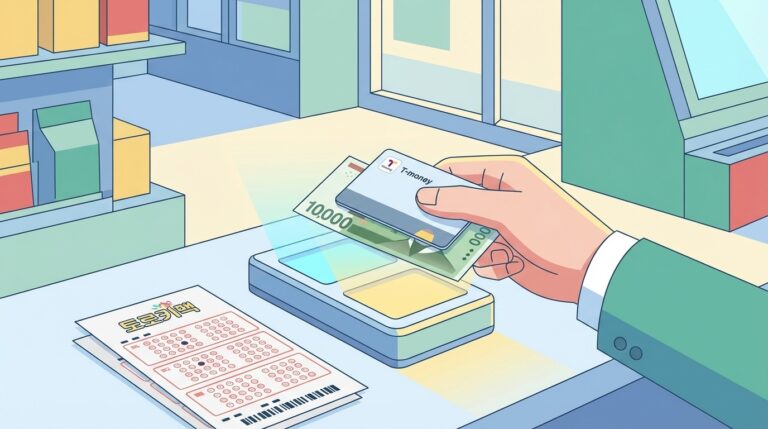
Hitting the Jackpot at the K-Store: Mastering T-money & Lotto like a Local
Phase 1: The Immersive Hook
“Bbeep. Jansae-kiga bujok-hamnida.” (Beep. Insufficient balance.)
We’ve all seen it in K-Dramas. The main character is running away from a breakup (or running towards their destiny), they hop onto a bus, slap their card on the reader, and… freeze. The dreaded “insufficient balance” sound blares out. The driver stares. The passengers sigh. It’s the ultimate K-Drama nightmare.
Or maybe you’ve dreamt of winning big? You saw a pig in your dream last night (a sign of wealth in Korea!), and you want to try your luck at the lottery. You walk into a GS25 or CU, but you freeze. How do you ask for a ticket? Do you just point?
Hi there! I’m your Senior Editor at Daily Hangul. Today, we are going to navigate the bustling counter of a Korean Convenience Store (Pyeoneui-jeom). But we aren’t buying banana milk today. We are tackling the two most technical transactions: Recharging your Transport Card (T-Money) and Buying a Lottery Ticket (Lotto).
Knowing these phrases isn’t just about utility; it’s about flowing with the fast-paced “Ppalli-Ppalli” (Hurry-Hurry) culture of Seoul without holding up the line. Let’s get you prepared.
Phase 2: Deep Dive into Key Expressions
1. 충전해 주세요 (Chungjeon-hae juseyo)
- Pronunciation: [Chung-jeon-hae ju-se-yo] Think of ‘Chung’ like a heavy metal ‘Chunk’ without the ‘k’.
- Meaning: Please recharge/top up.
- K-Culture Moment: You’ll hear the word 충전 (Recharge) everywhere. In dramas, when a couple hugs, one might say “Energy recharging…” (에너지 충전 중). It applies to batteries, cards, and human emotions!
- Editor’s Insight: This is the standard, polite request. You usually put your cash and card on the counter simultaneously.
- Situation Spectrum:
[🚫 Formal Boardroom] ———— [⚠️ Polite/Standard] ———— [✅ Casual]- This phrase is Standard (⚠️). It works for everyone, from the part-timer (Alba) to the owner.
- 🤔 Think About It: Why does Korean use the same word for “charging electricity” and “topping up money”? It reflects a society where digital currency is seen as “power” or “fuel” for movement.
2. 오천 원어치 주세요 (O-cheon won-eochi juseyo)
- Pronunciation: [O-cheon won-uh-chi ju-se-yo]
- Meaning: Please give me 5,000 won worth (of something).
- Context: Used when buying Lotto (Lottery). You don’t usually say “one ticket.” You buy by the amount. 1 game is 1,000 won.
- Editor’s Insight: The suffix -어치 (-eochi) is magic. It means “worth of.” It’s super useful in markets too (e.g., “10,000 won worth of tteokbokki”).
- Situation Spectrum:
[🚫 Formal] ———— [✅ Standard/Casual]
3. 현금영수증 해 주세요 (Hyeongeum-yeongsujeung hae juseyo)
- Pronunciation: [Hyeon-geum-young-su-jeung hae ju-se-yo]
- Meaning: Please issue a cash receipt.
- Editor’s Insight: Since T-money and Lotto purchases often require cash, you might want proof for tax deductions (if you work in Korea). It’s a very “local” thing to ask.
- 🤔 Think About It: Korea is almost a cashless society, yet T-money charging and Lotto are strictly Cash Only at convenience stores. Why? (See Phase 9!)
Phase 3: Textbook vs. Real Life
| Situation | 📖 Textbook Korean | 🗣️ Real Korean | 💡 Why the difference? |
|---|---|---|---|
| Recharging T-money | 교통카드를 충전하고 싶습니다. (I would like to recharge my transport card.) | 만 원 충전이요. (10,000 won charge, please.) | In a busy store, efficiency is key. Nouns + “Yo” is polite but fast. |
| Buying Lotto | 복권 한 장 주세요. (Please give me one lottery ticket.) | 로또 5천 원, 자동이요. (Lotto 5,000 won, automatic.) | You must specify the amount and the method (Auto/Manual). |
| Confirming Payment | 신용카드로 계산할 수 있나요? (Can I calculate with a credit card?) | 카드 돼요? (Does card work?) | “Doe-yo?” (Does it work/Is it okay?) is the ultimate survival verb. |
💡 Bottom Note: At a B2 level, drop the full sentences like “…hago sipseumnida.” Go for “Noun + Juseyo” or “Noun + Iyo/Yo.” It sounds much more natural.
Phase 4: Cultural Context — K-Culture Deep Dive
4-1. The “Two-Hand” Rule (Non-verbal)
Even in a rush, when you hand over your cash or card to the Alba-saeng (part-timer), use two hands or support your right elbow with your left hand. It’s a micro-gesture that says, “I respect your work,” even if the interaction takes 3 seconds.
4-2. The “Pig Dream” (K-Culture Connection)
Did you dream of a pig, fire, or poop last night? In K-Culture, these are Gil-mong (Lucky Dreams). If a Korean friend says, “I had a pig dream!” they will likely run to the nearest convenience store to buy a Lotto ticket.
Critical Insight: In dramas, you often see characters buying Lotto tickets when they hit rock bottom. It represents the “Life Reversal” (Insaeng yeokjeon) fantasy, deeply rooted in the high-pressure economic environment of modern Korea.
Phase 5: Immersive Roleplay
Setting: It’s Friday evening, 8 PM. A GS25 near Gangnam Station. The store is packed with people buying beer and hangover cures. You are standing at the counter.
Characters:
– YOU: A foreign student who just realized your card balance is zero.
– Alba (Part-timer): A university student, looking tired but working fast.
The Dialogue:
Alba: (Scanning items quickly) 봉투 필요하세요? (Bongtu piryo-haseyo? – Do you need a bag?)
YOU: 아뇨, 괜찮아요. 저, 교통카드 충전 좀 할게요.
(Anyo, gwaenchana-yo. Jeo, gyotong-kadeu chungjeon jom hal-ge-yo.)
(No, I’m okay. Uh, I’d like to recharge my transport card.)
Alba: (Points to the pad) 네, 올려주세요. 얼마 해 드릴까요?
(Ne, ollyeo-juseyo. Eolma hae deuril-kkayo?)
(Sure, place it here. How much should I do for you?)
YOU: 만 원이요. 여기 현금이요.
(Man-won-iyo. Yeogi hyeongeum-iyo.)
(10,000 won, please. Here is the cash.)
Alba: (After processing) 충전됐습니다.
(Chungjeon-dwaet-seumnida.)
(It’s recharged.)
🔀 Decision Point! You suddenly remember your “Pig Dream.” You have 5,000 won left. What do you say?
A) “그리고 로또 주세요.” (And give me Lotto.)
B) “아, 잠시만요! 로또 5천 원어치, 자동으로 주세요.” (Ah, wait! 5,000 won worth of Lotto, automatic please.)
C) “이 돈으로 복권 살 수 있어요?” (Can I buy a lottery ticket with this money?)
✅ Best Choice: B
– Why? It gives all the necessary info: Wait (signal to not close transaction) + Item + Amount + Method (Automatic). In Korea, “Automatic” (machine picks numbers) is the most common way to buy quickly.
Alba: 네, 자동 5천 원이요. (Hands ticket with two hands) 감사합니다.
Phase 6: 10-Second Shadowing Drill
Let’s practice the flow. Don’t sound like a robot; sound like a busy Seoulite.
Emotion: 😊 Polite but brisk (You don’t want to hold up the line!)
- 교통카드 / 만 원만 / 충전해 주세요.
(Gyotong-kadeu / man won-man / chungjeon-hae juseyo.)
Please recharge just 10,000 won on my transport card. -
로또 / 5천 원어치 / 자동으로 주세요.
(Lotto / o-cheon won-eochi / jadong-euro juseyo.)
Please give me 5,000 won worth of Lotto, automatic selection.
Phase 7: K-Culture Mini Glossary
| Korean | Romanization | Meaning | Context |
|---|---|---|---|
| 교통카드 | Gyotong-kadeu | Transport Card | Usually refers to T-money or Cashbee cards. Essential for survival. |
| 자동 / 수동 | Jadong / Sudong | Auto / Manual | Used for Lotto numbers. ‘Auto’ is for trusting luck; ‘Manual’ is for when you dreamt specific numbers. |
| 현금 | Hyeongeum | Cash | Crucial: You cannot charge cards or buy Lotto with a credit card! |
| 당첨 | Dangcheom | Winning (prize) | If you win, you are “Dangcheom-dwaet-da.” |
Phase 8: Traveler’s Survival Kit
Since this unit is about Moving & Money, here is what you absolutely must know.
🆘 Survival Card: The “Cash Only” Rule
– 🇰🇷 “카드 안 돼요?” (Kadeu an dwae-yo? – Can’t I use a card?)
– 🛑 Answer: No. Convenience stores cannot accept credit cards for T-money charging, Garbage bags, and Lottery tickets due to low margins and government regulations.
– 💡 Pro Tip: Always carry at least 10,000 KRW in cash (bills) just for your T-money card.
– 📍 ATMs: Most Korean convenience stores have ATMs inside if you forget cash!
Phase 9: Think Deeper — Why Cash in a Tech City?
The Paradox of Korean Fintech
Korea is one of the most cashless societies in the world. You can pay for a 500-won lollipop with a credit card. Yet, why are T-money and Lotto strictly cash-only at convenience stores?
It’s about Margins and Regulations. For T-money, the profit margin for the store owner is tiny (less than 1%), so credit card fees would eat up the entire profit. For Lotto, it’s about preventing gambling addiction—making you physically spend cash adds a psychological layer of “spending real money” that credit cards mask.
💬 Your Turn: In your country, can you buy lottery tickets with a credit card? Do small shops hate card payments? Share in the comments!
Phase 10: FAQ & Troubleshooting
Q: Can I use T-money to buy things inside the store?
A: YES! Ironically, you need cash to charge the card, but once charged, the T-money card acts like a debit card. You can buy water, snacks, and even pay for taxis with it.
Q: I won the lottery (small amount)! Where do I claim it?
A: If you win 4th (50,000 won) or 5th place (5,000 won), you can exchange it for cash or new tickets at any convenience store. Just hand them the winning ticket.
❌ Common Mistake #1: Trying to charge T-money with a credit card.
✅ Fix: Just hand over cash. If you don’t have it, ask: “근처에 ATM 있어요?” (Is there an ATM nearby?)
Phase 11: Wrap-up & Mission
Summary: Today we mastered the “Cash-Only” zone of the convenience store: Recharging T-money and buying Lotto using specific quantifiers like “-eochi.”
🚀 Action Missions:
– 🥉 Bronze: Stand in front of a mirror and practice saying “Man-won chungjeon-hae juseyo” while pretending to hand over a bill with two hands.
– 🥈 Silver: Next time you are in a K-Mart or Asian grocery in your country, see if they sell lottery tickets and try to ask in Korean (if the staff is Korean)!
– 🥇 Gold: In Korea? Go to a CU or GS25, recharge your card, and buy one line of Lotto (1,000 won) using the phrase “Cheon-won-eochi, jadong-iyo.” Post a photo of your ticket (blur the QR code!) on our community!
Phase 12: Interactive Quiz
- Situation: You want to buy 5,000 won worth of Lotto, and you want the machine to pick the numbers. What do you say?
- A) 로또 5천 장 주세요. (Give me 5,000 tickets of Lotto.)
- B) 로또 5천 원어치, 수동으로 주세요. (Lotto 5,000 won worth, manual please.)
- C) 로또 5천 원어치, 자동으로 주세요. (Lotto 5,000 won worth, automatic please.)
- True or False (Culture): You can recharge your T-money card using Apple Pay or a Credit Card at the convenience store counter.
- [ True / False ]
- Situation: The clerk hands you your recharged card. What is the most natural, casual-polite thing to say as you leave?
- A) 안녕히 계십시오. (Too formal)
- B) 수고하세요~ (Work hard / Thank you for your trouble)
- C) 감사합니다, 사랑해요. (Thank you, I love you – Too weird!)
Answers:
1. C (A is buying 5,000 tickets! B is manual selection.)
2. False (Cash only for recharging!)
3. B (‘Sugo-haseyo’ is the perfect friendly goodbye to staff.)
Frequently Asked Questions (FAQ)
Q: What does "충전해 주세요 (Chungjeon-hae juseyo)" mean in Korean and how do you pronounce it?
A: In Korean, "충전해 주세요 (Chungjeon-hae juseyo)" is pronounced [Chung-jeon-hae ju-se-yo] and means: Please recharge/top up.
Q: What does "오천 원어치 주세요 (O-cheon won-eochi juseyo)" mean in Korean and how do you pronounce it?
A: In Korean, "오천 원어치 주세요 (O-cheon won-eochi juseyo)" is pronounced [O-cheon won-uh-chi ju-se-yo] and means: Please give me 5,000 won worth (of something).
Q: What does "현금영수증 해 주세요 (Hyeongeum-yeongsujeung hae juseyo)" mean in Korean and how do you pronounce it?
A: In Korean, "현금영수증 해 주세요 (Hyeongeum-yeongsujeung hae juseyo)" is pronounced [Hyeon-geum-young-su-jeung hae ju-se-yo] and means: Please issue a cash receipt.







