

Don’t Wander Aimlessly! How to Find Hidden Gems in a Korean Convenience Store 🏪
Phase 1: Welcome to the “Pyeonuijeom” Maze!
안녕하세요! This is your Daily Hangul Senior Editor.
Picture this: You’ve just finished watching a K-Drama where the lead characters share a steaming cup of ramyeon and a triangular gimbap at a convenience store patio. Inspired, you walk into a GS25, CU, or 7-Eleven in Seoul. The door chimes—Ding-dong!—and you are greeted by a wall of 3,000 colorful items packed into a tiny space.
You’re looking for that specific Banana Milk or the hangover cure you saw in the show, but you’re lost. The part-timer (alba) is busy stocking shelves at lightning speed. Do you just wander in circles? No!
Today, we aren’t just learning how to ask “Where is it?” We are learning how to ask with the “Nunchi” (social sense) of a local, ensuring you get your snack without disrupting the pali-pali (hurry-hurry) flow of the store. Let’s get that insider badge. 🎖️
Phase 2: Deep Dive into Key Phrases
1. 혹시 [Item] 있어요? (Do you happen to have [Item]?)
- Pronunciation: [Hoksi … isseoyo?] (Sounds like: Hok-she … ee-sso-yo?)
- Meaning:
- Literal: By chance, does [Item] exist?
- Real Nuance: “I don’t want to bother you, but do you carry this?”
- K-Culture Moment: In romance K-Dramas, before a confession, a character often starts with “Hoksi…” (By any chance…). It signals hesitation and politeness. In a store, it softens your request so you don’t sound demanding.
- Editor’s Insight: Starting a sentence with “Hoksi” instantly raises your politeness level. It tells the listener, “I know you might not have it, and that’s okay.”
- Situation Spectrum:
[🚫 Formal Meeting] ———— [⚠️ Stranger/Staff] ———— [✅ Friends]- (Actually, this is versatile! Use it with staff ✅, strangers ✅, but drop ‘yo’ for friends.)
- 🤔 Think About It: Why do Koreans value “softening” a question with words like Hoksi? It relates to “Chemyon” (Face). If they say “no,” the “by any chance” makes the rejection less direct and embarrassing for both parties.
2. [Item] 어디 쪽에 있어요? (Which side is [Item] on?)
- Pronunciation: [ … Eodi jjoge isseoyo?] (Sounds like: Oh-dee jjo-ge …?)
- Meaning:
- Literal: Which side does it exist?
- Real Nuance: “Point me in the right direction (so I can find it myself).”
- Editor’s Insight: Just asking “Eodi-eyo?” (Where is it?) is grammatically correct but feels a bit like you want them to fetch it for you. Adding “Jjok” (side/direction) implies you are willing to walk there; you just need a hint. It shows independence!
- Situation Spectrum:
[🚫 Boss] ———— [⚠️ Staff/Stranger] ———— [✅ Friends]- Perfect for service interactions. ⚠️/✅
3. 이거 찾고 있는데… (I’m looking for this…)
- Pronunciation: [Igeo chatgo inneunde…] (Sounds like: Ee-geo chat-go in-neun-deh…)
- Meaning: “I am currently looking for this… (and I need help).”
- K-Culture Moment: This is the “trailing off” technique. Koreans rarely finish sentences with a direct command. Ending with “…nde” leaves room for the other person to step in and help voluntarily.
- Editor’s Insight: Use this when showing a picture on your phone (like a photo of a specific K-Pop collab snack).
Phase 3: Textbook vs. Real Life
| Situation | 📖 Textbook Korean | 🗣️ Real Korean (Street Smart) | 💡 Why different? |
|---|---|---|---|
| Getting Attention | 실례합니다. (Excuse me.) | 저기요~ (Over here / Excuse me) | “Sillyehamnida” is too formal for a $1 purchase. “Jeogiyo” is the standard attention-getter. |
| Asking Location | 칫솔은 어디에 있습니까? | 칫솔 어디 있어요? | Particle omission (removing ‘eun’) makes it faster and more conversational. |
| Not Finding it | 없습니다. (It is not here.) | 안 보이는데요… (I can’t seem to see it…) | Koreans prefer describing the situation (can’t see) rather than a blunt “No.” |
Bottom Note: For B1 learners, dropping the particle (like ‘eun/neun’) is the hallmark of sounding natural. Don’t be afraid to keep it short!
Phase 4: Cultural Deep Dive — The “Pali-Pali” Nunchi
4-1. Non-verbal Communication: The “Phone Thrust”
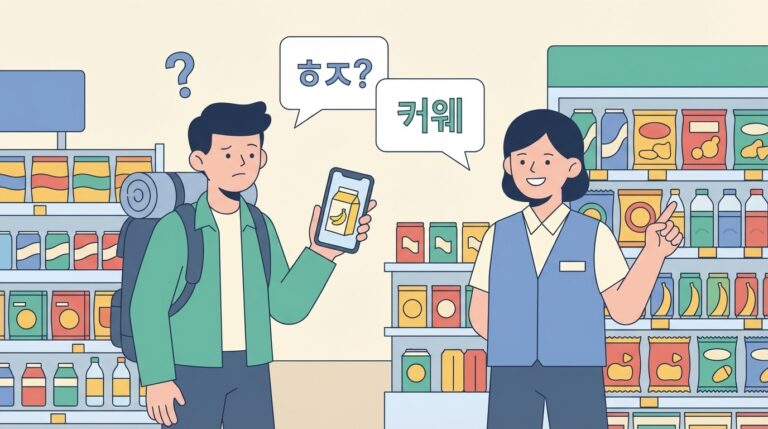
If you don’t know the name of the item (e.g., Samgak-gimbap or Hangover jelly), it is perfectly acceptable—and efficient—to show a photo on your phone to the staff while saying “Igeo itseoyo?” (Do you have this?).
- Nunchi Tip: Don’t ask when there is a long line behind you. Wait until the counter is clear. K-Store staff are often working alone and handle cooking, cleaning, and cashiering simultaneously.
4-2. K-Culture Connection: The “1+1” Hunt
In Korea, convenience stores are famous for “1+1” (One plus One) or “2+1” events.
* K-Drama Trope: Often, a character will buy a “1+1” drink and shyly give the free extra one to their crush.
* Critical View: If you ask where an item is, the staff might point you to the “Event Shelf.” Why? Because Koreans love efficiency and value (Ga-seong-bi). If you buy one without the free gift, the staff might even look at you with pity and say, “Bring one more!”
Phase 5: Immersive Roleplay Scenario
Setting: It’s 11 PM on a Friday in Hongdae. You are at a CU convenience store. You need a phone charger urgently because your battery is at 2%. The part-timer looks tired but is organizing shelves.
Characters:
* YOU: A traveler with a dying phone.
* Alba (Part-timer): Young student, wearing a vest, moving fast.
— Dialogue Start —
(You approach the counter, but the Alba is near the fridge)
YOU: (Quietly) 저기요…
(Jeogiyo…)
(Excuse me…)
Alba: (Turns around) 네, 필요하신 거 있으세요?
(Ne, piryohasin geo isseuseyo?)
(Yes, do you need anything?)
YOU: [ 🔀 DECISION POINT ]
How do you ask for a charger?
* A) “충전기 주세요.” (Give me a charger.)
* B) “혹시… 아이폰 충전기 있어요?” (By any chance… do you have an iPhone charger?)
* C) “충전기 어디입니까?” (Where is the charger? – Formal)
✅ Best Choice: B
* Why? Option A is too direct (demanding). Option C is too stiff (like a robot). Option B uses “Hoksi” and specific detail (iPhone), which saves time.
(Continuing with Choice B)
Alba: 아, 아이폰이요? 5번 라인 쪽에 있어요.
(Ah, iPhone-iyo? O-beon lain jjoge isseoyo.)
(Ah, iPhone? It’s on the side of aisle 5.)
YOU: 아, 감사합니다!
(Ah, gamsahamnida!)
(Ah, thank you!)
(🎭 Stage Direction: You walk to aisle 5, but there are too many cables. You can’t find it.)
YOU: (Holding up a cable) 이거 아이폰 맞아요?
(Igeo iPhone majayo?)
(Is this right for iPhone?)
Alba: 네, 맞아요. 2+1 행사 중이에요.
(Ne, majayo. To-peul-won haengsa jung-ieyo.)
(Yes, that’s right. It’s on a 2+1 promotion.)
Phase 6: 10-Second Shadowing Drill
Repeat this three times. Focus on the hesitation in the beginning!
Sentences:
1. 🥺 (Polite/Hesitant) Jeogiyo, / hoksi / multisyu / isseoyo?
(Excuse me, by any chance, do you have wet wipes?)
2. 🤔 (Curious) Igeo / eodi jjoge / isseoyo?
(Which side is this on?)
Phase 7: K-Culture Mini Glossary
| Korean | Romanization | English | Context |
|---|---|---|---|
| 행사 | Haeng-sa | Event/Promo | Usually refers to 1+1 or 2+1 deals. |
| 편의점 | Pyeonuijeom | Convenience Store | The lifeline of modern Korea. Open 24/7. |
| 알바 | Alba | Part-timer | Short for “Arbeit” (German). Used for part-time staff. |
| 신상 | Sinsang | New Item | Koreans love new trends. Asking “Sinsang eodiyeyo?” is very trendy. |
Phase 8: Traveler’s Survival Kit (Convenience Store Edition)
Don’t panic if you can’t speak fluent Korean. Just memorize these cards!
🆘 Survival Card #1: The Magic Picture
* Phrase: “이거 있어요?” (Igeo isseoyo?)
* Action: Show a photo of the item on your phone.
* Pro Tip: This works 100% of the time for medicines, specific chips, or drinks.🆘 Survival Card #2: The Microwave
* Phrase: “데워 주세요.” (Dewo juseyo – Please warm it up.)
* Reality: Usually, you do it yourself! Look for the microwave (전자레인지) zone. If you are unsure, ask: “Eotteoke haeyo?” (How do I do it?).📌 Editor’s Travel Note:
* Bags: Plastic bags cost money (20-100 won). Often they will ask “Bongtu piryohaseyo?” (Need a bag?). Just nod or say “Ne.”
* T-Money: You can recharge your transport card here. Say: “T-money chung-jeon haejuseyo.”
Phase 9: Think Deeper — “Why is it so quiet?”
Selected Viewpoint: Media vs. Reality
In K-Dramas, the handsome part-timer often has long, deep conversations with the female lead at the counter. In reality? Korean convenience store interactions are incredibly fast and often silent. Efficiency is the virtue.
🧠 Think Deeper: Does this silence mean Koreans are unfriendly? No. It is a form of “Negative Politeness”—respecting the other person’s time and space by not imposing unnecessary small talk. In your culture, is small talk with a cashier considered polite or annoying?
Phase 10: FAQ & Troubleshooting
- Q: Can I ask the staff to find the item for me?
- A: If the store is empty, yes. If it’s busy, try to look for it yourself first using the “Eodi jjoge…” phrase. Staff are often single-manning the store.
- Q: Is it rude to wear headphones while asking?
- A: Yes. Take them off. It’s a sign of respect.
❌ Common Mistake: Shouting “Yogi-yo!” (Over here!)
✅ Correction: “Yogi-yo” is mostly used in restaurants to call a waiter. In a quiet store, use “Jeogi-yo” (Excuse me / Over there) gently, or just approach the counter.
Phase 11: Wrap-up & Action Mission
One-Liner: Start with “Hoksi,” ask for the “Jjok” (direction), and don’t forget to check for 1+1 deals!
🎬 Action Mission:
* 🥉 Bronze: Look at a photo of a Korean convenience store online and point to items saying “Igeo eodi jjoge isseoyo?”
* 🥈 Silver: Go to a local Asian market (or any store) and practice asking “Do you happen to have [Item]?” using the polite “Hoksi” mindset.
* 🥇 Gold: Visit a Korean convenience store (or pretend!), pick up a “2+1” item, and ask the staff “Igeo 2+1 majayo?” (Is this 2+1 right?).
💬 Your Turn: What is the one Korean snack you represent? I’m definitely a spicy Ramyeon—hot tempered but comforting! Tell me in the comments!
Phase 12: Interactive Quiz
1. Which phrase is the most natural way to get a staff member’s attention?
A) Ya! (Hey!)
B) Jeogiyo… (Excuse me…)
C) Yeoboseyo? (Hello? – on phone)
2. True or False?
“In Korea, if you ask where an item is, the staff will always walk you to the shelf and hand it to you.”
(False! They will likely point to the direction ‘Jjok’ to respect efficiency.)
3. Fill in the Blank:
To sound polite when asking if they have an item, start your sentence with “______…”
(Answer: Hoksi)
See you in the next lesson! Annyeong! 👋
Frequently Asked Questions (FAQ)
Q: What does "혹시 [Item] 있어요? (Do you happen to have [Item]?)" mean in Korean and how do you pronounce it?
A: In Korean, "혹시 [Item] 있어요? (Do you happen to have [Item]?)" is pronounced [Hoksi ... isseoyo?] and means: Literal: By chance, does [Item] exist?
Q: What does "[Item] 어디 쪽에 있어요? (Which side is [Item] on?)" mean in Korean and how do you pronounce it?
A: In Korean, "[Item] 어디 쪽에 있어요? (Which side is [Item] on?)" is pronounced [... Eodi jjoge isseoyo?] and means: Literal: Which side does it exist?
Q: What does "이거 찾고 있는데... (I'm looking for this...)" mean in Korean and how do you pronounce it?
A: In Korean, "이거 찾고 있는데... (I'm looking for this...)" is pronounced [Igeo chatgo inneunde...] and means: "I am currently looking for this... (and I need help)."







