

Phase 1: Empathy — Immersive Hook
Hello! Daily Hangul Editor here.
Picture this: You are in Seoul. Tonight is the night. You scored tickets to your favorite K-Pop group’s fan meeting, or maybe you’re heading to a high-end K-BBQ restaurant in Gangnam with new friends. You put on your absolute favorite shirt, do a little spin in the mirror, and suddenly—pop! A button flies across the hotel room.
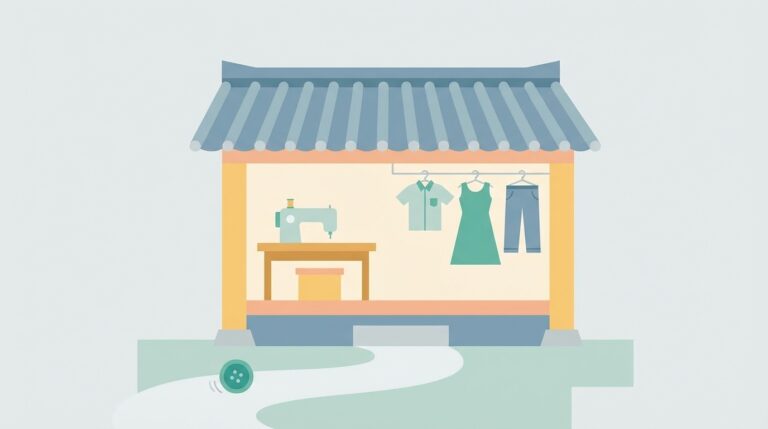
Panic sets in. You run down to the street and see a small, cozy shop with clothes hanging in the window. A sign reads 세탁소 (Setaekso – Dry Cleaners). An older, friendly-looking owner (Sajangnim) looks up from an ironing board.
Your textbook taught you how to say “Hello” and “Where is the bathroom?” but… how on earth do you say “My button fell off!” in Korean?
Don’t worry! As your personal Korean tutor and local navigator, I’ve seen countless students freeze in this exact moment. Today, we are going to learn how to handle a fashion emergency like a true local. By the end of this guide, you won’t just get your shirt fixed—you might even get a warm smile and a “You speak Korean well!” from the Sajangnim.
Let’s dive into the magic words!
Phase 2: Deep Dive into Core Expressions
Here are the top 3 survival phrases you need for this A1 (Super Beginner) mission.
1. 단추가 떨어졌어요
- Pronunciation: dan-chu-ga tteol-eo-jyeoss-eo-yo [Dan-chew-gah ddull-uh-juss-uh-yo]
- Meaning: (Literal) The button fell off. / (Real Nuance) My button fell off, help!
- K-Culture Moment: In K-Dramas, when the clumsy but lovable protagonist ruins their outfit before a big date, they run to the neighborhood dry cleaner in a panic shouting this exact phrase.
- Editor’s Insight: 단추 (Danchu) means button, and 떨어졌어요 (tteol-eo-jyeoss-eo-yo) means “fell off” or “dropped.” Notice how we don’t say “I broke the button.” We just state that the button playfully decided to jump off the shirt! It’s soft, polite, and states the problem clearly.
- Situation Spectrum:
[🚫 Do Not Use] ———— [⚠️ Caution] ———— [✅ Freely Use]
- Friends (Casual): ⚠️ (Drop the ‘yo’ and just say “떨어졌어” to friends!)
- Shop Owners/Strangers (Polite): ✅
- Boss/Elders (Formal): ✅
- 🤔 Think About It: Why do Koreans blame the button instead of themselves? In Korean culture, using passive or indirect language helps soften negative situations and keeps everyone’s feelings (Gibun) comfortable.
2. 이거 수선해 주세요
- Pronunciation: i-geo su-seon-hae ju-se-yo [Ee-guh soo-sun-heh joo-seh-yo]
- Meaning: (Literal) Please do repair for this. / (Real Nuance) Please fix this for me.
- K-Culture Moment: You’ll hear the word 수선 (Suseon – repair) everywhere in Korean shopping districts like Hongdae or Myeongdong. Buy pants that are too long? You ask for Suseon!
- Editor’s Insight: 이거 (I-geo) means “this.” 주세요 (Ju-se-yo) is your golden magic word meaning “Please give me” or “Please do for me.” Point at your shirt, smile, and say this. It works like a charm.
- Situation Spectrum:
[🚫 Do Not Use] ———— [⚠️ Caution] ———— [✅ Freely Use]
- Shop Owners/Service Staff (Polite): ✅
3. 언제 돼요?
- Pronunciation: eon-je dwae-yo? [Uhn-jeh dweh-yo?]
- Meaning: (Literal) When does it become? / (Real Nuance) When will it be ready?
- K-Culture Moment: Koreans love the Ppalli-Ppalli (Hurry, hurry!) culture. But at a traditional dry cleaner, things take time. Asking this polite question helps you know if you can wear that shirt to your dinner tonight!
- Editor’s Insight: Keep your voice light and tilt your head slightly. It sounds less demanding and more like a curious, polite inquiry.
- Situation Spectrum:
[🚫 Do Not Use] ———— [⚠️ Caution] ———— [✅ Freely Use]
- Shop Owners (Polite): ✅
Phase 3: Textbook vs Real Life
Let’s look at how textbook Korean differs from the real words you’ll hear on the streets of Seoul.
| Situation | 📖 Textbook Korean | 🗣️ Real Korean | 💡 Why is it different? |
|---|---|---|---|
| Explaining the problem | 제 셔츠의 단추가 떨어졌습니다. (My shirt’s button has fallen off.) | 사장님, 이거 단추가 떨어졌어요. (Boss, this button fell off.) | Real life drops pronouns like “my” and adds friendly titles like “Sajangnim” to build rapport! |
| Asking to fix it | 이것을 수선해 주시겠습니까? (Would you kindly repair this?) | 이거 수선해 주세요. (Please fix this.) | Textbooks teach overly formal grammar. “~주세요” is perfectly polite and much easier to say! |
| Asking the time | 언제 찾으러 오면 됩니까? (When should I come to retrieve it?) | 언제 돼요? (When will it be ready?) | Efficiency! Koreans love shorter phrases that get straight to the point while staying polite. |
Bottom Note: As an A1 learner, stick to the “Real Korean” column. It’s short, natural, and makes you sound like a local!
Phase 4: Cultural Deep Dive
4-1. Non-verbal Communication: The Two-Handed Handover
In Korea, hands speak as loudly as words. When you hand your ruined shirt to the dry cleaner owner, do not use one hand. Use two hands to pass the clothing over, or use your right hand while lightly supporting your right elbow with your left hand. This subtle gesture shows immense respect to the elder shop owner and will instantly win you brownie points!
4-2. K-Culture Connection: The Neighborhood Setaekso (세탁소)
If you’ve watched K-Dramas like Crash Course in Romance or Reply 1988, you know that the local neighborhood shops are the heart of the community. The traditional Setaekso isn’t just a place to clean clothes; it’s an artisan’s workshop.
While modern coin laundries (코인 세탁소) are popping up everywhere for washing, if you need a button fixed or pants hemmed, you must find a traditional Setaekso or a Suseonjip (수선집 – Alteration shop). The Sajangnim usually sits behind a giant sewing machine, ready to perform magic on your wardrobe.
Phase 5: Immersive Roleplay
Scenario A: The Pre-Concert Panic
– Setting: Friday, 3:00 PM. A small, steam-filled dry cleaner shop in an alleyway in Mapo-gu. The rhythmic sound of a sewing machine fills the air.
– Characters:
– YOU: A foreign traveler who just lost a button on your lucky concert outfit.
– Sajangnim (사장님): A sweet 60-year-old shop owner with reading glasses perched on her nose.
Sajangnim: 어서 오세요~ (Welcome~)
(Romanization) Eoseo oseyo~
(English) Welcome!
(🎭 Stage Direction: She stops sewing and looks up at you with a warm smile.)
YOU: 안녕하세요! 사장님, 이거…
(Romanization) Annyeonghaseyo! Sajangnim, igeo…
(English) Hello! Boss, this…
Sajangnim: 아이고, 옷이 찢어졌어요?
(Romanization) Aigo, osi jjijeojyeosseoyo?
(English) Oh my, did the clothes tear?
YOU: 아니요, 단추가 떨어졌어요.
(Romanization) Aniyo, dan-chu-ga tteol-eo-jyeoss-eo-yo.
(English) No, the button fell off.
(🎭 Stage Direction: You hand her the shirt with two hands, pointing at the missing button spot.)
Sajangnim: 아하, 단추! 금방 해 줄게요.
(Romanization) Aha, danchu! Geumbang hae julgeyo.
(English) Aha, the button! I’ll do it right away.
🔀 Your Turn! How should you ask when it will be ready?
– A) “언제 돼요?” (Eonje dwaeyo?)
– B) “빨리 빨리!” (Ppalli ppalli!)
– C) “수선해 주세요.” (Suseonhae juseyo.)✅ Best Choice: A — It is the polite and natural way to ask “When will it be ready?”
⚠️ Choice B Analysis: Never say “Ppalli ppalli” (Hurry!) to a shop owner as a beginner. It can sound very rude and demanding, even though it’s a famous Korean cultural trait!
Scenario B: Bonus K-Culture Scenario
Imagine you are at a spicy K-Food restaurant. You drop a piece of bright red Kimchi on your white shirt! You can rush to the Setaekso and say:
“사장님! 얼룩 지워 주세요!” (Sajangnim! Eolluk jiwo juseyo! – Boss! Please remove the stain!)
Phase 6: 10-Second Shadowing Drill
Let’s practice the flow of the sentence. Follow the slash (/) for pauses and match the emotion tag!
🥺 (Looking slightly sad about the shirt)
사장님! / 이거 / 단추가 / 떨어졌어요~
(sa-jang-nim! / i-geo / dan-chu-ga / tteol-eo-jyeoss-eo-yo~)
😊 (Brightly asking for help)
이거 / 수선해 / 주세요!
(i-geo / su-seon-hae / ju-se-yo!)
Phase 7: K-Culture Glossary
| Korean | Romanization | English | Contextual Meaning |
|---|---|---|---|
| 세탁소 | setaekso | Dry Cleaners | The place to go for dry cleaning and minor repairs. |
| 수선 | suseon | Repair/Alteration | Fixing holes, replacing buttons, or adjusting hems. |
| 사장님 | sajangnim | Boss/Owner | The ultimate respectful title for any shop owner in Korea! |
| 단추 | danchu | Clothing Button | Specifically for clothes. (Elevator buttons are just ‘버튼’ – beoteun). |
| 얼룩 | eolluk | Stain | What you get when you eat spicy Korean noodles too fast! |
Phase 8: Traveler’s Survival Kit
If you are traveling in Korea, fixing clothes is a great way to save a favorite item. Here are your absolute survival phrases for the dry cleaners!
🆘 Survival Phrases for the Setaekso
– 🇰🇷 “얼마예요?” (eolmayeyo?)
– 🗣️ Pronunciation: [Uhl-mah-yeh-yo?]
– 📍 Meaning: How much is it?
– 💡 Pro Tip: If you can’t understand the Korean numbers they say back to you, just politely hand them your phone with the calculator app open. They will happily type the price for you!📌 Editor’s Travel Note
– Finding a shop: Open KakaoMap or Naver Map and type “세탁소” or “수선집”. Look for places tucked away in residential alleys.
– Cash vs Card: While Korea is a “card-first” country, small neighborhood repair shops often prefer Cash or Bank Transfer for tiny jobs like fixing a single button (which usually costs around 2,000 to 5,000 KRW).
– Tipping: DO NOT TIP! There is no tipping culture in Korea. Just a warm “감사합니다” (Thank you) and a slight bow is the perfect reward.
Phase 9: Think Deeper — “Language & Power”
🧠 Think Deeper: The Magic of Passive Korean
Notice how we say “단추가 떨어졌어요” (The button fell off) instead of “I broke my button”? In Korean language and culture, maintaining harmony and protecting Gibun (feelings/mood) is crucial. By using passive or indirect phrasing, the language naturally shifts the blame away from the person and onto the situation. It’s a beautiful, conflict-free way to communicate! Instead of a confrontational “You made a mistake,” Koreans might say “A mistake happened.” This reflects a society that values collective peace over individual finger-pointing.💬 Your Turn: Does your native language use passive voice to soften bad news? How would you naturally say this in your country? Share in the comments!
Phase 10: FAQ & Troubleshooting
Here are some questions my students always ask:
Q: Can I use “단추 (Danchu)” for a computer keyboard or an elevator?
No! Danchu is strictly for clothing buttons. For electronics or elevators, use the English loanword: 버튼 (beoteun).
Q: Is it okay to haggle the price at a Korean dry cleaner?
Generally, no. The prices for basic repairs are already very low and standardized. Haggling for a $3 button repair might make the Sajangnim uncomfortable.
❌ Common Mistake #1: Saying “너 (Neo – You)” or “당신 (Dangsin – You)” to the shop owner.
✅ Do This Instead: NEVER use “you” in Korean when speaking to strangers or elders! Always call them by their title: 사장님 (Sajangnim – Boss/Owner).
Phase 11: Wrap-up & Action Items
✨ One-Liner Summary: When disaster strikes your wardrobe in Korea, smile and say “사장님, 단추가 떨어졌어요!” (Boss, the button fell off!).
🎯 Action Mission:
– 🥉 Bronze (Solo): Stand in front of a mirror, hold a shirt, and practice saying “이거 수선해 주세요” 3 times out loud.
– 🥈 Silver (Online): Drop a comment below with an emoji of your favorite clothing item and type the phrase you learned today!
– 🥇 Gold (Real Life): Next time you are in Korea, locate a local Setaekso on your map app just so you know where it is for emergencies!
📺 K-Culture Mission:
Watch one episode of any slice-of-life K-Drama (like Hometown Cha-Cha-Cha). Pay attention to the background shops. Can you spot a dry cleaner with hanging clothes?
Phase 12: Interactive Quiz
Test your new survival skills!
1. You want to ask the owner when your shirt will be ready. What do you say?
– A) 얼마예요? (Eolmayeyo?)
– B) 언제 돼요? (Eonje dwaeyo?)
– C) 빨리 빨리! (Ppalli ppalli!)
2. True or False – K-Culture Edition:
“If the repair only costs 3,000 KRW, you should give the owner 5,000 KRW and tell them to keep the tip.”
3. Fill in the blank:
To get the shop owner’s attention politely, you should call them __________.
(Check your answers below!)
(Answers: 1: B – ‘Eonje dwaeyo’ means ‘When will it be ready?’. 2: False – Korea has no tipping culture! Just pay the exact amount. 3: 사장님 / Sajangnim!)
Frequently Asked Questions (FAQ)
Q: What does "단추가 떨어졌어요" mean in Korean and how do you pronounce it?
A: In Korean, "단추가 떨어졌어요" is pronounced [dan-chu-ga tteol-eo-jyeoss-eo-yo [Dan-chew-gah ddull-uh-juss-uh-yo] and means: (Literal) The button fell off. / (Real Nuance) My button fell off, help!
Q: What does "이거 수선해 주세요" mean in Korean and how do you pronounce it?
A: In Korean, "이거 수선해 주세요" is pronounced [i-geo su-seon-hae ju-se-yo [Ee-guh soo-sun-heh joo-seh-yo] and means: (Literal) Please do repair for this. / (Real Nuance) Please fix this for me.
Q: What does "언제 돼요?" mean in Korean and how do you pronounce it?
A: In Korean, "언제 돼요?" is pronounced [eon-je dwae-yo? [Uhn-jeh dweh-yo?] and means: (Literal) When does it become? / (Real Nuance) When will it be ready?







