

Phase 1: Empathy — Immersive Hook
Hello! It’s the Daily Hangul Editor.
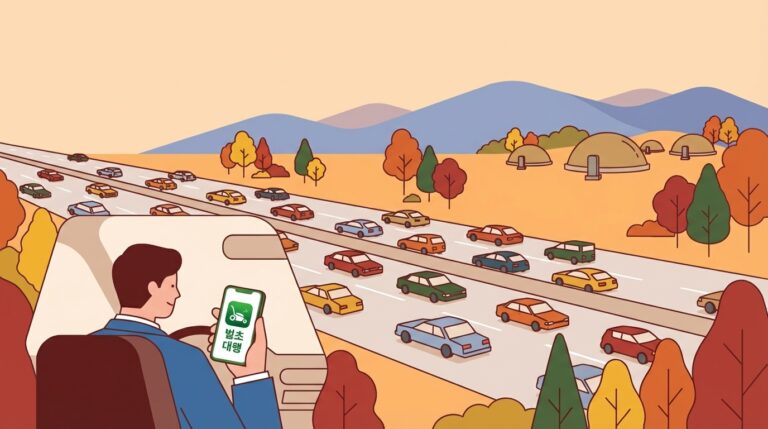
Imagine this: You’re watching a classic K-Drama set during Chuseok (Korean Thanksgiving). The trunk is loaded with premium Spam gift sets and pears the size of your head. The protagonist is gripping the steering wheel, sighing deeply as the radio announces, “The drive from Seoul to Busan will currently take 8 hours.” Cut to another scene: an uncle arguing about who has to go up the mountain to cut the grass around the ancestors’ graves.
If you’ve spent any time in Korea during major holidays like Seollal (Lunar New Year) or Chuseok, you know about the “Great National Migration” (민족 대이동). But as an advanced (C2) Korean learner, saying “길이 막혀요” (The road is blocked) just won’t cut it anymore. Furthermore, the traditional exhausting chore of cutting grass at ancestral graves (Beolcho) is experiencing a massive modern shift.
Today, we aren’t just learning vocabulary; we are diving deep into the intersection of modern convenience and traditional filial piety (효). Let’s unlock the expressions that will make Koreans think, “Wow, this person truly understands the heartbeat of modern Korean society.”
Phase 2: Deep Dive into Core Expressions
Here are the top-tier native expressions you need to survive and discuss Korean holiday travel.
1. 고속도로가 완전 주차장이에요.
- Pronunciation: [gosokdoroga wanjeon juchajang-ieyo] -> Sounds like: go-sok-do-ro-ga wan-jeon joo-cha-jang-ee-eh-yo
- Meaning: (Literal) The highway is completely a parking lot. / (Real nuance) The traffic is at an absolute standstill.
- K-Culture Moment: You’ll hear this on every radio broadcast during the holidays. When your favorite K-Pop idol does a live stream from their van heading to a provincial schedule, they’ll definitely sigh and drop this phrase.
- Editor’s Insight: The word ‘완전’ (completely) adds the perfect exasperated flavor. It implies a sense of shared misery that brings Koreans together during the holidays.
- Situation Spectrum:
[🚫 Absolute Ban] ———— [⚠️ Caution] ———— [✅ Freely]
- Close Friends (Casual): ✅ (고속도로 완전 주차장이네!)
- Colleagues (Semi-formal): ✅
- Superiors/Elders (Formal): ⚠️ (Use with -입니다: 고속도로가 주차장 같습니다.)
- 🤔 Think About It: Why do Koreans use a spatial metaphor (parking lot) to describe time lost? Does your native language have a similarly sarcastic metaphor for traffic?
2. 올해는 벌초 대행 불렀어요.
- Pronunciation: [olhaeneun beolcho daehaeng bulleosseoyo] -> Sounds like: ol-hae-neun bul-cho dae-haeng bool-luh-sso-yo
- Meaning: (Literal) This year, we called a grass-cutting proxy. / (Real nuance) We hired a service to tend to the ancestral graves this year instead of doing it ourselves.
- K-Culture Moment: In weekend family dramas, this is often the topic of a mild generational conflict. The elderly father insists on doing it manually, while the exhausted millennial son secretly books an app-based proxy service.
- Editor’s Insight: ‘대행’ (proxy/agency) is a massive part of modern Korean culture (think 대리운전 – proxy driving). Using this word shows you understand the socio-economic shift in Korea where time and convenience are bought to fulfill traditional duties.
- Situation Spectrum:
[🚫 Absolute Ban] ———— [⚠️ Caution] ———— [✅ Freely]
- Close Friends (Casual): ✅
- Colleagues (Semi-formal): ✅
- Superiors/Elders (Formal): ✅ (Very common small talk topic after holidays)
- 🤔 Think About It: Does paying someone to maintain an ancestral grave dilute the respect it’s meant to show, or does it ensure the tradition survives in a busy modern world?
3. 성묘 다녀오는 길이에요.
- Pronunciation: [seongmyo danyeo-oneun gil-ieyo] -> Sounds like: sung-myo da-nyuh-oh-neun geel-ee-eh-yo
- Meaning: (Literal) I am on the way back from visiting the grave. / (Real nuance) I’ve just paid my respects to my ancestors.
- K-Culture Moment: When friends ask why you look so tired on a Sunday afternoon just before Chuseok, this is the ultimate, unquestionable excuse. It carries weight.
- Editor’s Insight: Notice the verb ‘다녀오다’ (to go and come back). Koreans rarely just say ‘went’ (갔다); they emphasize the safe return, especially for important family duties.
- Situation Spectrum:
[🚫 Absolute Ban] ———— [⚠️ Caution] ———— [✅ Freely]
- Close Friends (Casual): ✅
- Colleagues (Semi-formal): ✅
- Superiors/Elders (Formal): ✅
Phase 3: Textbook vs. Real Life
| Situation | 📖 Textbook Korean | 🗣️ Real Native Korean | 💡 Why the difference? |
|---|---|---|---|
| Heavy Traffic | 차가 많이 막힙니다. | 차가 꼼짝도 안 해요. (The cars aren’t budging.) | Emphasizes the utter helplessness of the situation with a visual hyperbole. |
| Cutting Grass | 묘지의 풀을 벱니다. | 주말에 벌초하러 가요. / 벌초 대행 맡겼어요. | ‘벌초’ is a highly specific cultural vocabulary word replacing a generic description. |
| Rest Stop Break | 휴게소에서 밥을 먹습니다. | 휴게소 들러서 소떡소떡 먹고 가자. | Refers to specific, trending rest-stop food culture popularized by celebrities. |
Phase 4: Cultural Deep Dive
4-1. Non-verbal Communication: The Art of ‘Sighing’ and ‘Nunchi’
When traffic is at a standstill, complaining too aggressively ruins the mood for everyone in the car. The Korean way is a deep, collective sigh followed by passing around snacks (like peeled chestnuts or dried squid). If you are a passenger, the ultimate Nunchi (social tact) is offering to keep the driver awake with conversation or feeding them snacks while they drive.
4-2. K-Culture Connection: The Societal Shift in Dramas
Historically, Beolcho (clearing weeds around graves) was a sacred, non-negotiable family duty performed by the male descendants. In classic 90s K-Dramas, families would trek up mountains with scythes. Today? You’ll see modern dramas where characters simply open an app, pay a fee, and receive a photo confirmation that the ancestors’ grass has been neatly trimmed. It reflects the rapid transition from large, extended families to nuclear families.
Phase 5: Immersive Roleplay Scenario
Scenario A: The Gridlock on Gyeongbu Expressway
- Setting: Friday evening before Chuseok, 7 PM. You are in the passenger seat of your Korean colleague Minsu’s car, heading down to Busan for a business trip that tragically aligned with the holiday migration.
- Characters:
- YOU: An expat who speaks great Korean but is experiencing holiday traffic for the first time.
- Minsu (34): Your Korean colleague. He has been driving for 4 hours and you are still in the Seoul metropolitan area.
Minsu: 하아… 네비게이션 보니까 부산까지 아직 6시간 남았대요.
(Haa… nebigyeisyeon bonikka busankkaji ajik yeoseot sigan namatdaeyo.)
[Translation] Sigh… The navigation says we still have 6 hours left to Busan.
(🎭 Stage Direction: Minsu rubs his neck and taps the steering wheel in frustration.)
YOU: 진짜 고속도로가 완전 주차장이네요. 많이 피곤하시죠?
(Jinjja gosokdoroga wanjeon juchajang-ineyo. Mani pigonhasijyo?)
[Translation] The highway is truly a parking lot. You must be really tired, right?
Minsu: 명절 때마다 이러네요. 아까 휴게소라도 들를 걸 그랬어요.
(Myeongjeol ttaemada ireoneyo. Akka hyugesorado deulleul geol geuraesseoyo.)
[Translation] It’s like this every holiday. We should have stopped at the rest area earlier.
🔀 Your Turn! How do you respond?
– A) “운전 똑바로 하세요. (Drive properly.)”
– B) “제가 졸음 껌 하나 드릴까요? 아니면 제가 운전 좀 할까요? (Shall I give you some anti-drowsiness gum? Or should I drive for a bit?)”
– C) “대박! 한국 교통 최악이네요. (Daebak! Korean traffic is the worst.)”✅ Best Choice: B — Reason: Offering practical help or a snack is the ultimate display of Nunchi and consideration.
⚠️ Choice C Analysis: Complaining about the host country’s traffic while the host is doing the driving can come across as culturally insensitive and unhelpful.
Scenario B: The Post-Weekend Office Talk
(Monday morning at the office coffee machine. Your manager looks exhausted.)
YOU: 팀장님, 주말 잘 보내셨어요? 피곤해 보이세요.
Manager: 아휴, 주말에 시골 가서 벌초하고 왔더니 온몸이 쑤시네요.
YOU: 아, 벌초 다녀오셨구나. 요즘은 벌초 대행도 많이 한다던데, 직접 하셨나 봐요. 고생하셨습니다!
(Manager smiles, impressed by your deep cultural knowledge of ‘Beolcho Daehaeng’.)
Phase 6: 10-Second Shadowing Drill
Let’s practice the exasperated yet accepting tone of a Korean driver.
😤 아휴, / 고속도로가 / 완~~~전 / 주차장이네! (Ahyu, / gosokdoroga / wan~~~jeon / juchajang-ine!)
Tip: Drag out the ‘완~~~전’ (completely) to emphasize just how bad the traffic is. Shake your head slightly for extra native flair.
Phase 7: K-Culture Glossary
| Korean | Romanization | English Translation | Contextual Meaning |
|---|---|---|---|
| 귀성길 / 귀경길 | gwiseong-gil / gwigyeong-gil | Journey home / Journey back to Seoul | The massive directional traffic flow before and after major holidays. |
| 성묘 | seongmyo | Visiting ancestral graves | Paying respects, offering food, and bowing at the family grave. |
| 벌초 | beolcho | Trimming the grass at graves | The physical labor of maintaining the gravesite, usually done weeks before Chuseok. |
| 휴게소 먹방 | hyugeso meokbang | Rest area food eating | The culture of eating specific famous snacks at highway rest stops to survive the drive. |
Phase 8: Traveler’s Survival Kit
If you are traveling in Korea during a major holiday, you are stepping onto a battlefield. Here are your lifelines.
🆘 Survival Expression #1: At the Rest Stop
– 🇰🇷 “소떡소떡 하나랑 통감자 주세요.” (Sotteok-sotteok hanarang tonggamja juseyo.)
– 🗣️ Guide: [so-dduk-so-dduk ha-na-rang tong-gam-ja joo-seh-yo]
– 📍 Where to use: Highway rest areas (휴게소).
– 💡 Pro Tip: Sotteok-sotteok (sausage and rice cake skewers) became a national sensation after a famous comedian praised them on TV. It is the holy grail of traffic jam survival food.📌 Editor’s Travel Note: The KTX War
– Ticketing: Train tickets (KTX/SRT) for Chuseok and Seollal go on sale months in advance and sell out in literally 3 minutes.
– The Reverse Trip (역귀성): If you must travel, try going against the flow. Go to Seoul right before the holiday, and leave Seoul at the end. The highways will be magically empty!
Phase 9: Think Deeper — Language & Power / Social Change
The Commercialization of Filial Piety (효 – Hyo)
In traditional Korean Confucianism, physically tending to your ancestors’ graves (Beolcho) with your own sweat and blood was the ultimate demonstration of Hyo (filial piety). However, as Korea hyper-modernized, the concept of Beolcho Daehaeng (hiring proxy services via apps) emerged. Some older generations initially viewed this as highly disrespectful.
Yet, linguistically and culturally, the narrative has shifted. By creating a formalized term like ‘벌초 대행’, society legitimized the practice. It acknowledges a new reality: in a relentless capitalist society where getting a day off is hard, paying someone to ensure the ancestors’ graves are pristine is actually a modern evolution of respect, rather than the abandonment of it.
💬 Your Turn: In your culture, are there traditional family duties that have been outsourced to businesses? How do the older generations feel about it? Let us know in the comments!
Phase 10: FAQ & Troubleshooting
Q: Can I ask my boss why they don’t just use a ‘벌초 대행’ (proxy service)?
A: Be very careful here. While proxy services are common, traditional families might still take great pride in doing it themselves. Asking “Why don’t you just pay someone?” can sound dismissive of their family values. Instead, use it as an observation: “요즘은 대행도 많이 하던데, 직접 하시고 대단하시네요” (I hear proxy services are common these days, it’s impressive that you do it yourself).
Q: I get ‘성묘’ and ‘장례식’ confused. Are they the same?
A: No! This is a critical C2 mistake. ‘장례식’ (Jangnyesik) is a funeral, right after someone passes away. ‘성묘’ (Seongmyo) is the annual visiting of a grave to pay respects. Mixing these up is highly inappropriate.
❌ Common Mistake #1: Saying “묘지 청소하러 가요” (I am going to clean the cemetery).
✅ Do This Instead: Say “벌초하러 가요” (I am going to do Beolcho). The specific cultural vocabulary shows deep respect and linguistic mastery.
Phase 11: Wrap-up & Action Items
One-Liner Summary: Surviving Korean holidays requires mastering the art of enduring “parking lot highways” and understanding the modern shift toward “Beolcho” proxy services.
Action Mission:
– 🥉 Bronze (Solo): Stand in front of a mirror and sigh dramatically while saying “고속도로가 완전 주차장이네!”
– 🥈 Silver (Online): Leave a comment in Korean below about the worst traffic jam you’ve ever experienced using the word ‘주차장’.
– 🥇 Gold (Real Life): Next time a Korean friend or colleague returns from a long holiday weekend, ask them: “성묘 잘 다녀오셨어요? 고생하셨습니다!”
K-Culture Mission: Open Naver Maps or Kakao Map, find a major highway like the ‘경부고속도로’ (Gyeongbu Expressway), and trace the route to Busan. Imagine being stuck there for 8 hours. What snacks would you pack?
Phase 12: Interactive Challenge Quiz
1. Situational Judgment:
Your Korean manager comes into the office looking sunburned and exhausted on the Monday after Chuseok. What is the most culturally intelligent thing to say?
– A) 주말에 골프 치셨나 봐요! (Looks like you played golf this weekend!)
– B) 벌초 다녀오셔서 피곤하시겠어요. (You must be tired from doing Beolcho.)
– C) 고속도로 주차장 대박이죠? (The highway parking lot was crazy, right?)
Answer: B. It shows high-level cultural empathy. (A) might be offensive if he was actually doing hard labor for his ancestors, and (C) is too casual for a manager.
2. True or False – K-Culture Edition:
“It is considered highly illegal and disrespectful to hire someone to cut the grass at an ancestral grave in Korea today.”
Answer: False. ‘벌초 대행’ (Proxy grass-cutting) is now a massive, socially accepted seasonal industry, often managed through agricultural cooperatives or mobile apps.
How did you do? Welcome to the true C2 level of Korean culture. Until next time, safe travels and happy studying!
Frequently Asked Questions (FAQ)
Q: What does "고속도로가 완전 주차장이에요." mean in Korean and how do you pronounce it?
A: In Korean, "고속도로가 완전 주차장이에요." is pronounced [gosokdoroga wanjeon juchajang-ieyo] and means: (Literal) The highway is completely a parking lot. / (Real nuance) The traffic is at an absolute standstill.
Q: What does "올해는 벌초 대행 불렀어요." mean in Korean and how do you pronounce it?
A: In Korean, "올해는 벌초 대행 불렀어요." is pronounced [olhaeneun beolcho daehaeng bulleosseoyo] and means: (Literal) This year, we called a grass-cutting proxy. / (Real nuance) We hired a service to tend to the ancestral graves this year instead of doing it ourselves.
Q: What does "성묘 다녀오는 길이에요." mean in Korean and how do you pronounce it?
A: In Korean, "성묘 다녀오는 길이에요." is pronounced [seongmyo danyeo-oneun gil-ieyo] and means: (Literal) I am on the way back from visiting the grave. / (Real nuance) I've just paid my respects to my ancestors.







