

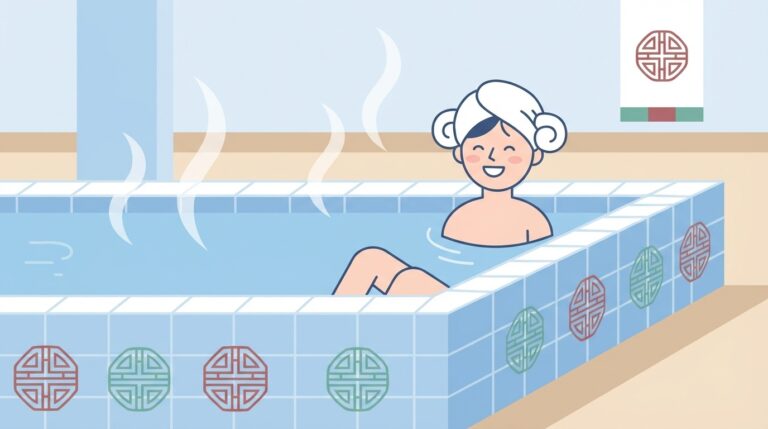
Why Koreans Scream “Cool!” in Freezing Water? 🛁 The Jjimjilbang Survival Guide
Phase 1: The Immersive Hook
Greeting: 안녕하세요! Hello, Daily Hangul family! It’s your editor, checking in from a steamy paradise.
The K-Culture Cold Open:
Picture this: You’re watching a K-Drama. The protagonist has just lost their job, or maybe they’re hiding from a chaebol heir. Where do they go? A Jjimjilbang (Korean Sauna). They wrap a towel around their head like a sheep (Yangmeori), crack a hard-boiled egg on their friend’s head, and then… they step into a pool of water.
Here’s the confusing part. An old man sits in a boiling hot tub and sighs, “Ah~ Siwonhada!” (It’s cool/refreshing). Then, the protagonist jumps into a freezing cold pool and shouts the exact same thing: “Ah! Siwonhada!”
The ‘Why’:
If you translate this literally, you might think Koreans have broken temperature sensors. But if you don’t understand the nuance of “Siwonhada,” you’re missing out on the very soul of Korean relaxation. Today, we are going into the Naengtang (Cold Bath) to understand why freezing water makes Koreans feel so… relieved.
Phase 2: Deep Dive into Core Expressions
Here are the top 3 expressions you need when you take the plunge.
1. 시원하다 (Siwonhada)
- Pronunciation: [si-won-ha-da] Sounds like “See-won” + “Ha-da”
- Meaning:
- Literal: To be cool (temperature).
- Real Nuance: To be refreshing, relieving, or unblocking. It’s the feeling of tension leaving your body.
- K-Culture Moment: In the movie Oldboy or any noir film, after a huge fight, the character might drink a cold beer or wash their face and say this. It means the stress is gone.
- Editor’s Insight: When you step into the Naengtang (Cold Bath) after sweating in the sauna, the shock wakes you up. That clarity? That is Siwonhada.
- Situation Spectrum:
[🚫 Formal Speech]————[⚠️ Polite (Yo)]————[✅ Casual]
- Note: In a bath, you are usually murmuring to yourself, so the form doesn’t matter as much!
- 🤔 Think About It: Why do Koreans use the same word for a cold breeze, hot soup, and a deep tissue massage? What do these three things have in common regarding “stress relief”?
2. 차가워요! (Chagawoyo!)
- Pronunciation: [cha-ga-wo-yo] Think “Cha” (Tea) + “Ga” (Go) + “Wo-yo”
- Meaning: It is cold (Objectively).
- K-Culture Moment: In variety shows like Running Man, when they get punished with water bombs in winter, they scream this.
- Editor’s Insight: Use this when you are complaining or stating a fact. If you step in the water and it hurts, you say “Chagawoyo!” If you settle in and feel good, you say “Siwonhada.”
3. 살 것 같다 (Sal geot gatda)
- Pronunciation: [sal-geot-gat-da] “Sal” sounds like “Saul”
- Meaning: “I feel like I can live now” (I feel revived).
- Editor’s Insight: This is the ultimate compliment to the bath. You were dying of heat in the sauna, but now? You are alive again.
- Situation Spectrum: Friendly/Self-talk ✅
Phase 3: Textbook vs. Real Life
| Situation | 📖 Textbook Korean | 🗣️ Real Korean (Jjimjilbang Mode) | 💡 Why different? |
|---|---|---|---|
| Entering cold water | 물이 차갑습니다. (The water is cold.) | 으~ 차거! (Eu~ Chageo!) | “Chageo” is a cute/lazy slang form of Chagawoyo. |
| Feeling refreshed | 기분이 상쾌합니다. (I feel refreshed.) | 어우, 시원하다~ (Eou, siwonhada~) | Textbooks describe the state; real life expresses the feeling. |
| After the bath | 기분이 아주 좋습니다. (I feel very good.) | 이제 좀 살겠네. (Ije jom salgenne.) | Koreans love dramatic exaggeration to show relief. |
Phase 4: Cultural Deep Dive
4-1. The “Nunchi” of the Bath
Before you enter the Naengtang (Cold Bath), you MUST shower first or scoop water to rinse your sweat off. If you jump straight in with sweat, you will get the “laser eyes” (stares) from everyone. That is bad Nunchi (sensing the vibe).
4-2. K-Drama Connection: The Yangmeori (Sheep Head)
You know that cute towel hat rolled up like two donuts? It’s called Yangmeori. It’s not just for fashion; in the hot sauna, it keeps your head cool. In the cold area, it keeps your head warm while your body freezes. It’s practical engineering!
Editor’s Tip: Don’t wear the towel into the water. That’s a hygiene no-no.
Phase 5: Immersive Roleplay
Setting: Saturday, 4 PM. Dragon Hill Spa (a famous Jjimjilbang). You have just survived 10 minutes in the 80°C Salt Room. You are sweating buckets. You approach the Naengtang (Cold Bath).
Characters:
– YOU: Exploring Korean culture, feeling brave but hot.
– MINSU: Your Korean friend, a sauna veteran.
(Dialogue)
Minsu: 와, 땀 진짜 많이 났다! 냉탕 콜? ❄️
(Wa, ttam jinjja mani natda! Naengtang col?)
(Wow, we sweat so much! Cold bath, you down?)
YOU: (Hesitating) [ 1 ]
Minsu: 야, 눈 딱 감고 들어와! 진짜 시원해.
(Ya, nun ttak gamgo deureowa! Jinjja siwonhae.)
(Hey, just close your eyes and come in! It’s really refreshing.)
YOU: (Dipping one toe in) 으! 너무 차가워요! 🥶
(Eu! Neomu chagawoyo!)
(Ugh! It’s too cold!)
Minsu: (Splashing water on his chest) 들어오면 달라. 빨리 와!
(Deureoomyeon dalla. Ppalli wa!)
(It’s different once you’re in. Come on!)
YOU: (Taking a deep breath and jumping in) 🌊 Splash
Minsu: 어때? 괜찮지?
(Eottae? Gwaenchanchi?)
(How is it? It’s okay, right?)
YOU: 와… [ 2 ]
🔀 Decision Point! How do you respond?
Option A: “진짜 시원하네요!” (Jinjja siwonhaneyo!) – You admit he was right.
Option B: “심장 멈추는 줄 알았어요!” (Simjang meomchuneun jul arasseoyo!) – Dramatic: “I thought my heart stopped!”
Option C: “살 것 같아요.” (Sal geot gatayo.) – Total relief.✅ Best Choice: Option A or C. Both show you are enjoying the culture. Option B is funny, but A/C fits the “Siwonhada” vibe better.
Phase 6: 10-Second Shadowing Drill
Repeat this after a long day of work (or a cold shower)!
😊 Feeling of pure relief:
아~~ / 이제야 / 좀 / 살 것 같다!
(Ah~~ / i-je-ya / jom / sal geot gat-da!)
“Ah~~ / Finally / now / I feel like I can live!”
Phase 7: K-Culture Mini Glossary
| Korean | Romanization | English | Context |
|---|---|---|---|
| 찜질방 | Jjimjilbang | Korean Sauna | 24-hour spa with hot rooms, sleeping areas, and snacks. |
| 냉탕 | Naengtang | Cold Bath | The pool usually kept at 18-20°C. |
| 온탕 | Ontang | Hot Bath | The standard hot pool (38-42°C). |
| 때 | Ttae | Dead Skin/Dirt | Koreans scrub this off. Don’t do this in the communal pool! |
| 식혜 | Sikhye | Sweet Rice Drink | The #1 drink to have after a bath. |
| 양머리 | Yangmeori | Sheep Head | The towel folding technique seen in K-Dramas. |
Phase 8: Traveler’s Survival Kit (Sauna Edition)
Heading to a Jjimjilbang? Here is your survival card.
🆘 Survival Expression #1
– 🇰🇷 “여기서 계산 돼요?” (Yeogiseo gyesan dwaeyo?)
– 🗣️ Translation: Can I pay here?
– 📍 Use case: Buying eggs or Sikhye.
– 💡 Pro Tip: In most Jjimjilbangs, your Locker Key is your credit card. You tap the key on the reader to buy snacks, and you pay everything at the exit. Don’t bring your wallet inside!📌 Editor’s Travel Note: The Nudity Rule
– Warning: The bath area (where the water is) is 100% naked. No swimsuits. No towels in the water.
– Mindset: Nobody is looking at you. Everyone is there to relax. It’s awkward for 30 seconds, then it’s freedom.
Phase 9: Think Deeper — Language & Sensation
Why does “Cool” mean “Relief”?
In English, “Cool” usually describes temperature or style. In Korean, 시원하다 (Siwonhada) describes the unblocking of energy.
- When you eat hot spicy soup? It unblocks your sinuses → Siwonhada.
- When you get a massage? It unblocks your muscles → Siwonhada.
- When you enter a cold bath? It unblocks your overheated pores → Siwonhada.
This reflects the Korean philosophy that health comes from circulation (Ki/Qi). If things are flowing, you are healthy.
💬 Your Turn: Does your language have a word that means “Hot” but feels “Cool”? Tell us in the comments!
Phase 10: FAQ & Troubleshooting
Q: I have tattoos. Can I enter a Korean Jjimjilbang?
A: Generally, Yes. Unlike Japan where onsens are strict, Korean saunas are more lenient. However, if you have full-body tattoos, you might get some stares from older generations, but you likely won’t be kicked out.
Q: Can I bring my phone into the sauna room?
A: Common Mistake! The hot rooms (Hanjeungmak) are too hot for phones. They might overheat or explode. Leave them in the locker or the cool resting area.
❌ Common Mistake #1: Wearing underwear into the bath area.
✅ Fix: Be brave! Strip down completely before walking from the locker room to the bath area.
Phase 11: Wrap-up & Mission
One-Liner: “Siwonhada” isn’t just about temperature; it’s the sound of your stress leaving your body.
🔥 Action Mission:
– 🥉 Bronze: Say “Ah, Siwonhada!” next time you drink a cold glass of water.
– 🥈 Silver: Search “Jjimjilbang Yangmeori tutorial” on YouTube and make a sheep hat with your towel.
– 🥇 Gold: Visit a Korean spa (or a sauna in your country), jump in the cold pool, and shout “Sal geot gatda!”
K-Culture Mission: Watch the drama “Legend of the Blue Sea” (Ep 3) or “My Love from the Star” to see classic Jjimjilbang scenes!
Phase 12: Interactive Quiz
- Situation: You are eating extremely hot and spicy Kimchi stew. You feel sweaty but relieved. What do you say?
- A) It is cold! (Chagawoyo)
- B) Ah, Siwonhada!
- C) It is salty! (Jjayo)
- Culture: What should you NOT do in the Naengtang (Cold Bath)?
- A) Wear a swimsuit.
- B) Close your eyes.
- C) Say “Chagawoyo.”
Answers:
1. (B) Even though it’s hot, the feeling of relief makes it “Siwonhada.”
2. (A) No swimsuits allowed! You must be naked.
Frequently Asked Questions (FAQ)
Q: What does "시원하다 (Siwonhada)" mean in Korean and how do you pronounce it?
A: In Korean, "시원하다 (Siwonhada)" is pronounced [si-won-ha-da] and means: Literal: To be cool (temperature).
Q: What does "차가워요! (Chagawoyo!)" mean in Korean and how do you pronounce it?
A: In Korean, "차가워요! (Chagawoyo!)" is pronounced [cha-ga-wo-yo] and means: It is cold (Objectively).
Q: What does "살 것 같다 (Sal geot gatda)" mean in Korean and how do you pronounce it?
A: In Korean, "살 것 같다 (Sal geot gatda)" is pronounced [sal-geot-gat-da] and means: "I feel like I can live now" (I feel revived).







