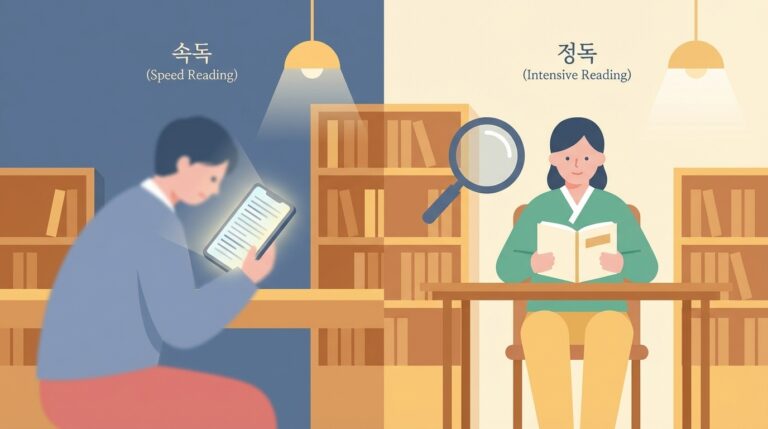
Speed vs. Depth: Mastering the Art of Korean Reading 📚
Phase 1: The “Book Cafe” Vibes ☕
Hello! This is your Senior Editor from Daily Hangul.
Picture this: You are in a trendy book cafe in Yeonnam-dong. It’s raining outside, jazz is playing softly, and you are holding a copy of a book recommended by your favorite K-Pop idol (let’s say, RM of BTS). You look around. The student to your left is furiously flipping pages of a TOEIC exam book. The person to your right is staring at a single page of a poetry collection for twenty minutes, occasionally sipping their lukewarm Americano.
They are both reading, but the energy is completely different. One is in survival mode; the other is in “healing” mode.
As a C1 learner, you’ve passed the stage of deciphering Hangul characters. Now, it’s about intention. Are you scanning information to survive the “Pali-pali” (hurry-hurry) culture, or are you savoring the nuance of the language? Today, we dissect the crucial difference between 속독 (Sok-dok) and 정독 (Jeong-dok)—terms that define not just how you read, but how you think in Korean.
Phase 2: Deep Dive into Core Expressions 🧐
Since you are at an advanced level, we will look at the Hanja (Sino-Korean) roots to truly grasp these concepts.
1. 속독 (Sok-dok)
- Pronunciation: [sok-ttok] (Note the tensed pronunciation of ‘d’ due to the previous ‘k’ sound)
- Meaning: Speed Reading / Skimming
- Hanja Breakdown: 速 (Fast) + 読 (Read)
- K-Culture Moment: Think of a webtoon reader on the subway during rush hour. Their thumb scrolls at lightning speed. Or a student cramming 10 minutes before an exam. That is Sok-dok.
- Editor’s Insight: While this implies efficiency, using it in the wrong context can sound dismissive. If you say you “Sok-dok-ed” a heartfelt letter, it sounds like you didn’t care.
- Situation Spectrum:
[🚫 Love Letter/Contract] ———— [⚠️ News Article] ———— [✅ Webtoon/Data]- 🤔 Think About It: Korea is famous for its fast internet and fast delivery. Do you think this speed obsession has made Sok-dok the default mode of consuming content in Korea?
2. 정독 (Jeong-dok)
- Pronunciation: [jeong-dok]
- Meaning: Intensive Reading / Precise Reading
- Hanja Breakdown: 精 (Refined/Essence) + 読 (Read)
- K-Culture Moment: In K-Dramas like Goblin (Guardian), when the protagonist reads a poem about first love, time stops. He isn’t just reading; he is inhaling the words. That is Jeong-dok.
- Editor’s Insight: This is a highly respected trait. Saying “I am doing Jeong-dok of your book” is a massive compliment to an author.
- Situation Spectrum:
[🚫 Scanning a Menu] ———— [⚠️ Email from Boss] ———— [✅ Literature/Study]- 🤔 Think About It: Why do Koreans value Jeong-dok in academic settings so much? It ties back to the Confucian tradition of studying texts until you memorize the “essence.”
3. 행간을 읽다 (Haeng-gan-eul ik-da)
- Pronunciation: [haeng-gan-eul ik-tta]
- Meaning: Reading between the lines
- Context: Literal meaning is “reading the spaces between the lines.”
- K-Culture Moment: In a tense boardroom scene in a corporate drama, a subordinate says, “Yes, I understand,” but the eyes say otherwise. The smart manager “reads between the lines.”
- Editor’s Insight: This is the ultimate C1 skill. Korean is a high-context language. What is not said is often more important than what is written.
Phase 3: Textbook vs. Real Life 🗣️
| Situation | 📖 Textbook Korean | 🗣️ Real Street Korean | 💡 Why the difference? |
|---|---|---|---|
| Asking someone to read carefully | “자세히 읽어 보세요.” (Please read in detail.) | “꼼꼼히 좀 봐.” (Look at it meticulously/meticulously check it.) | “꼼꼼히” emphasizes the attitude of being thorough, not just the act of reading. |
| Skimming through a document | “속독했습니다.” (I speed-read it.) | “대충 훑어봤어.” (I roughly swept through it.) | “속독” sounds like a technical skill; “훑어보다” is the natural verb for scanning. |
| Being deeply moved by a book | “정독했습니다.” (I read it intensively.) | “완전 파고들었잖아.” (I completely dug into it.) | “파다” (to dig) metaphorically means to immerse oneself deeply into a fandom or subject. |
💡 Editor’s Note: Using “파다” (to dig) creates an instant bond. “나 요즘 한국 소설 파고 있어” sounds much more passionate than “읽고 있어.”
Phase 4: Cultural Context — The “Nunchi” of Reading 🇰🇷
4-1. The Posture of Respect
In Western cultures, reading is often a solitary, relaxed act. In Korea, how you read in public can signal your diligence. In a library or “Study Cafe” (dok-seo-sil), doing Jeong-dok with perfect posture is almost a performative act of working hard. Slouching or flipping pages too loudly (Sok-dok noise) can earn you glares.
4-2. K-Culture Connection: “Pil-sa” (Transcribing)
A unique reading culture in Korea is 필사 (Pil-sa)—transcribing books by hand. You might see Instagram posts of beautifully handwritten lyrics or book passages. This is the extreme version of Jeong-dok. It’s popular among K-Pop fans who transcribe lyrics to feel closer to the artist’s message. It’s a meditative act against the fast-paced digital world.
Phase 5: Immersive Roleplay — The Book Club 🎭
Setting: A quiet evening at a Book Club meeting in Gangnam. You are the only foreigner, sitting with three Koreans who take literature very seriously.
Characters:
* YOU: An expat who loves Korean literature but was too busy to finish the book this week.
* Ji-eun (Club Leader): Sharp, intellectual, notices everything.
Dialogue:
Ji-eun: 자, 이번 주 선정 도서 ‘채식주의자’, 다들 어떠셨나요? 꽤 난해한 부분도 있었는데.
(Ja, ibeon ju seonjeong doseo ‘The Vegetarian’, dadeul eotteosyeonnayo? Kkwae nanhaehan bubundo isseonneunde.)
(So, this week’s book ‘The Vegetarian’, how was it for everyone? There were some quite difficult parts.)
Member A: 저는 문체가 너무 아름다워서 정독하느라 2주나 걸렸어요.
(I took 2 weeks because I was reading closely; the writing style was so beautiful.)
Ji-eun: (Turning to you) OO씨는요? 바쁘셔서 다 못 읽으신 건 아니죠?
(How about you, OO? You weren’t too busy to finish it, were you?)
🔀 Decision Point: How do you answer?
- A) “솔직히 시간이 없어서 속독으로 빨리 읽었어요.”
- B) “내용이 너무 깊어서, 행간을 읽으려고 노력했어요.”
- C) “대충 훑어봤는데 재미있더라고요.”
✅ Best Choice: B
* Why? Even if you didn’t finish, mentioning “reading between the lines” (행간) shows you engaged with the text deeply. It frames your struggle as an intellectual effort rather than a lack of time.
⚠️ Choice A Analysis: Admitting to Sok-dok in a serious literature club might make you seem superficial.
🚫 Choice C Analysis: “대충” (roughly) is disrespectful to the author and the club in this formal context.
Phase 6: 10-Second Shadowing Drill 🗣️
Let’s practice the nuance of savoring a text.
Emotion: 🤔 Thoughtful & Sentimental
“좋은 책은 / 한 번 속독하고 끝내는 게 아니라 / 두고두고 정독해야죠.”
(Jo-eun chae-geun / han beon sok-ppo-ka-go kkeun-nae-neun ge a-ni-ra / du-go-du-go jeong-do-kae-ya-jyo.)
Meaning: “A good book shouldn’t just be speed-read once and finished; you should read it intensively over and over again.”
Phase 7: K-Culture Mini Glossary 📖
| Korean | Romanization | Meaning | Context |
|---|---|---|---|
| 문해력 | Mun-hae-ryeok | Literacy / Reading comprehension | A hot topic in Korea recently; the ability to truly understand text, not just read letters. |
| 필사 | Pil-sa | Transcribing | Writing out text by hand to practice writing or calm the mind. |
| 스압 | Seu-ap | Scroll Pressure | Slang for “Scroll Apyeok” (Pressure). Used online when a post is too long (requires Sok-dok). |
| 세 줄 요약 | Se-jul yo-yak | 3-Line Summary | The internet culture demanding efficiency. “TL;DR” in Korean style. |
Phase 8: Traveler’s Survival Kit — The Bookstore & Library ✈️
Even if you are traveling, visiting a massive bookstore like Kyobo or a Starfield Library is a must. Here is how to navigate.
🆘 Survival Expression #1: Finding a Book
* 🇰🇷 “도서 검색대 어디에 있어요?” (Doseo geomsaekdae eodie isseoyo?)
* 🗣️ Meaning: Where is the book search kiosk?
* 💡 Pro Tip: Korean bookstores are huge. Don’t wander; use the geomsaekdae to print a location slip.🆘 Survival Expression #2: Sampling a Book
* 🇰🇷 “이거 견본품인가요?” (Igeo gyeonbonpumingayo?)
* 🗣️ Meaning: Is this a sample copy?
* 💡 Pro Tip: Many books are wrapped. Look for the sticker that says ‘견본’ (Sample) to read freely (Sok-dok) before buying.
Phase 9: Think Deeper — “Snack Culture” vs. Deep Reading 🧠
The Rise of “Snack Culture” (스낵 컬처)
Korea is leading the global trend of webtoons and web novels. These formats are designed for mobile screens and quick consumption—perfect for Sok-dok. Paragraphs are short, and visuals dominate.
Why does this matter?
Critics argue that this is lowering the younger generation’s 문해력 (Literacy/Comprehension). If you are used to scrolling, can you handle a dense contract or a philosophical essay? As a learner, you face the same challenge. Are you learning “Survival Korean” (Sok-dok) or “Deep Korean” (Jeong-dok)?
💬 Your Turn: Does your country have a debate about “declining literacy” due to smartphones? How do you balance speed and depth in your reading?
Phase 10: FAQ & Troubleshooting 🛠️
Q: Can I use ‘정독’ for watching a drama?
A: Yes! Surprisingly, Koreans say “드라마 정주행” (Binge-watching) or “복습” (Reviewing/Rewatching), but you can also say “대본을 정독하듯이 봤어” (I watched it as closely as reading a script). It implies you analyzed every scene.
Q: Is it rude to read a book on the subway?
A: Not at all. But reading a physical book (especially a difficult one) is becoming a “flex.” It signals you are intellectual. Just make sure not to spread your elbows too wide!
❌ Common Mistake:
Don’t confuse 다독 (Da-dok) with 속독 (Sok-dok).
* 속독: Reading fast (Speed).
* 다독: Reading many books (Quantity).
* Correction: “I want to read many books this year” -> “올해는 다독하고 싶어요” (Not 속독).
Phase 11: Wrap-up & Action Mission 🎁
One-Liner: Sok-dok is for information, Jeong-dok is for emotion; know which gear to shift into.
🚀 Action Mission:
* 🥉 Bronze: Go to Naver Webtoon, pick a series, and practice Sok-dok (scrolling speed).
* 🥈 Silver: Pick one paragraph of a Korean news article and do Jeong-dok (look up every unknown word).
* 🥇 Gold: Try Pil-sa (Transcribing). Write out the lyrics of your favorite ballad song by hand on paper. Feel the Jeong-dok effect.
Phase 12: Interactive Quiz 🧩
Situation: You receive a very important contract (lease agreement) for your new apartment in Seoul.
Q: Which reading method should you mention to your real estate agent to show you are serious?
- “제가 속독하고 바로 사인할게요.” (I’ll speed-read and sign right away.)
- “집에 가서 정독해 보고 연락드릴게요.” (I’ll go home, read it intensively, and contact you.)
- “다독해 보겠습니다.” (I will read many books.)
- “행간을 읽어 보겠습니다.” (I will read between the lines… implying you are looking for hidden tricks.)
🔽 Toggle Answer
Correct Answer: 2
* Explanation: Contracts require precision (Jeong-dok).
* Option 1 makes you look easy to scam.
* Option 3 is grammatically wrong context (quantity vs. quality).
* Option 4 is too suspicious; you read between the lines for feelings, not legal clauses. For contracts, stick to Jeong-dok (scrutinizing).
Frequently Asked Questions (FAQ)
Q: What does "속독 (Sok-dok)" mean in Korean and how do you pronounce it?
A: In Korean, "속독 (Sok-dok)" is pronounced [sok-ttok] and means: Speed Reading / Skimming
Q: What does "정독 (Jeong-dok)" mean in Korean and how do you pronounce it?
A: In Korean, "정독 (Jeong-dok)" is pronounced [jeong-dok] and means: Intensive Reading / Precise Reading
Q: What does "행간을 읽다 (Haeng-gan-eul ik-da)" mean in Korean and how do you pronounce it?
A: In Korean, "행간을 읽다 (Haeng-gan-eul ik-da)" is pronounced [haeng-gan-eul ik-tta] and means: Reading between the lines