

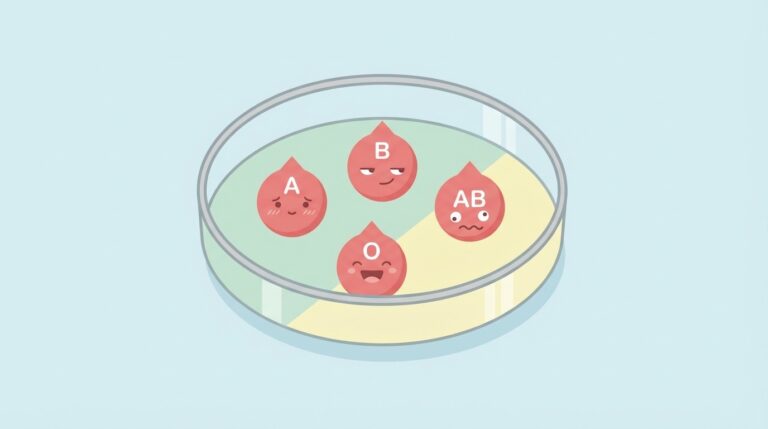
Phase 1: The Paradox of High-Tech Korea 🧬
안녕하세요! This is your Daily Hangul Senior Editor.
Imagine this: You are in Seoul, a city pulsating with 5G connectivity, autonomous robots delivering fried chicken, and world-class biotechnology. You are sitting at a trendy cafe in Seongsu-dong with a new Korean acquaintance. Suddenly, the conversation shifts from global economics to a question that feels… medically intrusive?
“혹시 혈액형이 뭐예요?” (By any chance, what is your blood type?)
Welcome to the great Korean paradox. Despite being a hyper-modern society, the belief in Blood Type Personality Theory (혈액형 성격설) remains a stubborn cultural zombie. It’s the “Zodiac of the East.” If you’ve ever watched a K-Drama where the “Type B” bad boy breaks a heart, or seen a K-Pop idol’s profile listing “Type A” right next to their height, you know this isn’t just biology—it’s a social lens.
As a C2 learner and a skeptic, you might feel the urge to scream, “That’s pseudoscience!” But hold on. In Korea, dismissing this too harshly is a social faux pas. Today, we will learn how to navigate this pseudoscientific minefield with the grace of a diplomat and the vocabulary of an intellectual.
Phase 2: Deep Dive into Skeptical Korean 🧐
Here are the sophisticated expressions you need to discuss this topic without killing the vibe.
1. 근거 없는 믿음 (Baseless belief / Myth)
- Pronunciation: [geun-geo eom-neun mi-deum] (Sounds like: geun as in ‘gun’, geo as in ‘go’, eom as in ‘um’, neun as in ‘nun’, mi-deum)
- Meaning: A belief lacking evidence (Pseudoscientific belief).
- K-Culture Moment: You might hear a news anchor or a cynical character in a thriller drama say, “그건 근거 없는 낭설입니다” (That is a baseless rumor/fallacy).
- Editor’s Insight: This is a powerful, academic phrase. Use it when you want to sound objective rather than confrontational. It shifts the blame to the belief, not the person holding it.
- Situation Spectrum:
[🚫 Casual Friends] ———— [⚠️ Colleagues] ———— [✅ Debate/Discussion] - 🤔 Think About It: Why does “belief” (믿음) sound softer than “superstition” (미신)? How does word choice affect the listener’s defensiveness?
2. 성급한 일반화의 오류 (The fallacy of hasty generalization)
- Pronunciation: [seong-geup-han il-ban-hwa-ui o-ryu]
- Meaning: Making a broad conclusion based on small samples.
- K-Culture Moment: Rarely used in K-Pop lyrics, but essential in Korean debate shows (like 100 Minute Debate). If you use this, Koreans will look at you with surprised respect: “Wow, you know logic terms?”
- Editor’s Insight: This is your weapon of choice. Instead of saying “You’re wrong,” you say “Isn’t that a bit of a hasty generalization?” It sounds intellectual and highly educated.
- Situation Spectrum:
[🚫 Drinking Party] ———— [⚠️ Casual Chat] ———— [✅ Intellectual Debate]
3. 그냥 재미로 보는 거죠 (Just doing it for fun)
- Pronunciation: [geu-nyang jae-mi-ro bo-neun geo-jyo]
- Meaning: Literal: “I just look at it for fun.” / Nuance: “I know it’s fake, but I enjoy the social ritual.”
- K-Culture Moment: This is the universal defense mechanism. When an idol is asked if they believe in fortune telling, 90% will answer with this phrase to appear rational yet culturally engaged.
- Editor’s Insight: This is your Exi Strategy. If you debunk someone’s belief too hard and the atmosphere gets cold, drop this line to smooth things over.
- Situation Spectrum:
[✅ ANYWHERE]
Phase 3: Textbook vs. Real Life 🥊
| Situation | 📖 Textbook Korean | 🗣️ Real Korean (Insider) | 💡 Why the difference? |
|---|---|---|---|
| Asking Blood Type | 혈액형이 무엇입니까? (What is your blood type?) | 너 혹시 A형이지? (You’re Type A, aren’t you?) | In reality, people guess based on your behavior (stereotyping) rather than asking neutrally. |
| Denying a trait | 저는 소심하지 않습니다. (I am not timid.) | 저 A형인데 트리플 A는 아니에요. (I’m Type A, but not Triple A.) | Triple A is slang for someone who embodies the extreme negative stereotypes (timid/petty) of Type A. |
| Expressing Skepticism | 저는 그것을 믿지 않습니다. (I do not believe that.) | 에이, 요새 누가 그걸 믿어요? MBTI면 모를까. (Ey~ who believes that these days? Maybe MBTI, sure.) | Believing in Blood Types is becoming “old school” (Latte generation); MBTI is the new trend. Usage shows generational awareness. |
Phase 4: Cultural Context — The “Nunchi” Algorithm 🧠
Why do Koreans love categorization?
It’s not about biology; it’s about efficiency. In a high-context society relying heavily on Nunchi (eye-measure/sensing the vibe), knowing someone’s “Type” provides a quick (albeit inaccurate) manual on how to treat them.
- K-Pop Connection: Even today, idol profiles list blood types. Why? Because it gives fans an instant character archetype to latch onto.
- Type A: The sensitive perfectionist (Leader material?)
- Type B: The creative bad boy/girl (Center material?)
- Type O: The social butterfly (Mood maker)
- Type AB: The genius or the psycho (4D character)
- Critical Perspective: While fun, this creates a “Barnum Effect” (validating vague statements). As a C2 speaker, notice how people cherry-pick traits to fit the blood type narrative.
Phase 5: Immersive Roleplay — The “Hoesik” Trap 🍻
Setting: A company dinner (Hoesik) at a grilled intestine (Gopchang) restaurant. The soju is flowing. Your team leader, Manager Kim (50s, traditional), is tipsy.
Characters:
* YOU: The rational foreign employee.
* Manager Kim: Believes firmly that blood type determines work ethic.
Dialogue:
Manager Kim: (Pouring soju)
자네는 일처리가 아주 꼼꼼해. 역시 A형이지? 틀림없어!
(Ja-ne-neun il-cheo-ri-ga a-ju kkom-kkom-hae. Yeok-si A-hyeong-i-ji? Teul-lim-eop-seo!)
[Translation] You are very meticulous with your work. You’re definitely Type A, right? No doubt about it!
🔀 Your Turn! How do you respond?
- Option A: “아닙니다. 저는 과학적 근거가 없는 이야기는 믿지 않습니다.” (No. I don’t believe stories without scientific basis.)
- Option B: “아, 제가 꼼꼼한가요? 사실 저는 O형입니다. 환경이 사람을 만드는 거죠.” (Ah, am I meticulous? Actually, I’m Type O. Environment makes the person.)
- Option C: “네! 부장님이 보시는 눈이 정확하시네요!” (Yes! You have a sharp eye, Manager!)
⚠️ Choice A Analysis: Too harsh. This kills the Heung (vibe). You sound like a textbook, not a colleague.
❌ Choice C Analysis: Lying. If your HR file says O, you look fake later. Also, it reinforces the bias.
✅ Best Choice: B. You politely correct the fact (Skepticism) but accept the compliment (“meticulous”) and offer an alternative explanation (“Environment”). This is High-Level Social Korean.
Phase 6: 10-Second Shadowing Drill 🎤
Context: Explaining your stance on pseudoscience without sounding arrogant.
😊 과학적 근거는 / 없지만 / 꽤 잘 맞는 것 / 같아요.
(gwa-hak-jeok geun-geo-neun / eop-ji-man / kkwae jal man-neun geot / ga-ta-yo.)
[Translation] There is no scientific basis, / but / it seems to fit / quite well.
- Intonation Tip: Raise the pitch on ‘없지만’ (concession) and lengthen ‘꽤~~~’ to emphasize your surprise.
Phase 7: K-Culture Mini Glossary 📚
| Korean | Romanization | Meaning | Context |
|---|---|---|---|
| 궁합 | Gung-hap | Marital Compatibility | Originally from Chinese astrology, now used for Blood Type/MBTI matching. “Our Gung-hap is good!” |
| 4차원 | Sa-cha-won | 4th Dimension (Eccentric) | Usually associated with Type AB. Means someone is quirky, weird, or uniquely creative. |
| 소름 | So-reum | Goosebumps | Used when a guess is correct. “Wow, So-reum! How did you know?” |
Phase 8: Traveler’s Survival Kit 🧳
Even if you are just traveling, you might meet locals at a guesthouse or a bar.
🆘 Survival Expression #1: The Deflection
* 🇰🇷 “저는 비밀이에요. 신비주의 컨셉이거든요.”
* (Jeo-neun bi-mil-i-e-yo. Sin-bi-ju-ui keon-sep-i-geo-deun-yo.)
* 🗣️ Meaning: “It’s a secret. My concept is ‘mysterious’.”
* 📍 Usage: When you don’t want to engage in the stereotyping game.
* 💡 Pro Tip: Koreans love the word “Concept” (컨셉). Using it makes you sound witty and culturally attuned.
Phase 9: Think Deeper — “The Barnum Effect in Seoul” 🧠
Global Era of Korean:
Why has MBTI largely replaced Blood Type theory among the younger generation (MZ Generation)?
It reflects Korea’s shift from “Unchangeable Fate” (Blood Type/Birth) to “Self-Reported Identity” (MBTI/Psychology). Blood type is something you are born with (implying a caste-like destiny), whereas MBTI feels more “scientific” and flexible, even if it’s still often misused. However, the desire to categorize remains unchanged. As a global citizen, ask yourself: Does my culture have a similar shortcut for judging personality? (e.g., Horoscopes, Hogwarts Houses?)
Phase 10: FAQ & Troubleshooting 🛠️
Q: Is it rude to tell a Korean that blood type personality theory is a lie?
A: Yes and No. If you say “That’s stupid” (그거 바보 같은 소리예요), it is extremely rude. However, if you say, “In my country, we think of it as pseudoscience, but it’s fascinating that it’s popular here,” you are being a Cultural Observer (C2 Level).
❌ Common Mistake: confusing Type B (B형) with Hepatitis B (B형 간염).
* Context matters! If you are at a hospital, B형 likely means the virus. If you are on a date, it means the “Bad Boy” personality.
Phase 11: Wrap-up & Action Mission 🎬
One-Liner: Knowing blood type stereotypes isn’t about believing them; it’s about understanding the Korean social code.
🚀 Action Mission:
* 🥉 Bronze: Look up your favorite Korean celebrity’s blood type. Does their public persona match the stereotype?
* 🥈 Silver: Post a comment on a Korean YouTube video (related to personality) saying: “혈액형은 과학이 아니지만, 재미는 있네요!” (Blood type isn’t science, but it is fun!)
* 🥇 Gold: Next time a Korean asks your blood type, use the “Survival Expression #1” (Mysterious Concept) and see if you can make them laugh.
Phase 12: Interactive Quiz 🧩
Scenario: You are Type A (Stereotype: Timid, Introverted). You just loudly sang a rock song at Karaoke. Your Korean friend looks shocked.
Which reaction shows the best “Korean Wit”?
- “See? Blood types are fake!” (Aggressive Skeptic)
- “I must be a mutant Type A.” (돌연변이 A형인가 봐요.)
- “Actually, I lied. I am Type O.” (Confusing)
Answer: [Toggle for Answer]
Correct: 2. Humor is the best way to bridge skepticism and culture. Calling yourself a “Mutant” (돌연변이) acknowledges the stereotype while breaking it playfully.
Frequently Asked Questions (FAQ)
Q: What does "근거 없는 믿음 (Baseless belief / Myth)" mean in Korean and how do you pronounce it?
A: In Korean, "근거 없는 믿음 (Baseless belief / Myth)" is pronounced [geun-geo eom-neun mi-deum] and means: A belief lacking evidence (Pseudoscientific belief).
Q: What does "성급한 일반화의 오류 (The fallacy of hasty generalization)" mean in Korean and how do you pronounce it?
A: In Korean, "성급한 일반화의 오류 (The fallacy of hasty generalization)" is pronounced [seong-geup-han il-ban-hwa-ui o-ryu] and means: Making a broad conclusion based on small samples.
Q: What does "그냥 재미로 보는 거죠 (Just doing it for fun)" mean in Korean and how do you pronounce it?
A: In Korean, "그냥 재미로 보는 거죠 (Just doing it for fun)" is pronounced [geu-nyang jae-mi-ro bo-neun geo-jyo] and means: Literal: "I just look at it for fun." / Nuance: "I know it's fake, but I enjoy the social ritual."







