

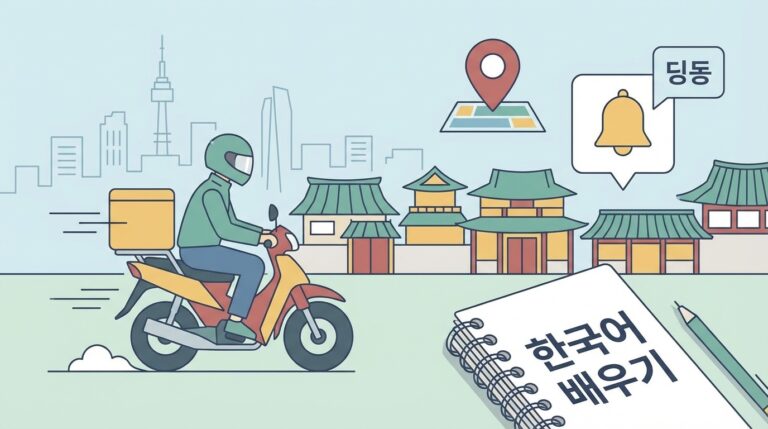
Phase 1: Immersive Hook
Hello! This is your Daily Hangul Editor. 👋
Picture this: You are watching a K-Drama. The main character gets dumped, walks into a restaurant, sits down, and shouts, “Imo! Soju, please!” Before the actor even finishes the sentence, a green bottle lands on the table with a satisfying thud.
Is this just TV magic? No. This is Korea.
Whether you’re ordering fried chicken at a park near the Han River or getting a package delivered at 6 AM the next day, Korea’s speed is legendary. We call this the “Pali-Pali” (Hurry-Hurry) culture.
But when the service is so fast that it feels like magic, simple textbook phrases like “Thank you” just don’t cut it. You need expressions that capture your shock, admiration, and pure joy.
Today, let’s learn how to react like a true local when Korea’s speed blows your mind.
Phase 2: Deep Dive into Key Expressions
Here are the top 3 phrases to use when your food arrives before you’ve even put down your spoon.
1. 벌써 나왔어요? (Beolsseo nawasseoyo?)
- Pronunciation: [Beol-sseo na-wa-sseo-yo?]
- Beol sounds like “Bird” without the ‘d’.
- Sseo sounds like “Saw”.
- Meaning:
- Literal: Did it come out already?
- Real Nuance: “Wait, did you teleport here? I just ordered!”
- K-Culture Moment: Think of a K-Variety show like Running Man. The cast arrives at a mission location, and the food is already set up. They gasp, “Wa, beolsseo?!” (Wow, already?!)
- Editor’s Insight: This is the ultimate compliment to a server. It implies they are efficient and attentive. Use a rising intonation at the end to emphasize your surprise.
- Situation Spectrum:
[🚫 Formal Boss] ———— [⚠️ Colleagues] ———— [✅ Server/Friends]
(Note: It is polite enough for servers because of the ‘yo’ ending, but avoid using it if your boss asks for a report!)- 🤔 Think About It: Why is speed considered a virtue in service? In some cultures, slow food is a luxury. In Korea, speed = respect for your time.
2. 속도가 장난 아니네요 (Sokdoga jangnan anineyo)
- Pronunciation: [Sok-do-ga jang-nan a-ni-ne-yo]
- Jang-nan sounds like “Jang” (as in Django) + “Nan” (as in Naan bread).
- Meaning:
- Literal: The speed is not a prank/joke.
- Real Nuance: “This speed is insane/unreal!”
- K-Culture Moment: You’ll hear “Jangnan anida” constantly in K-Pop fan content when idols see something amazing. “Wa, visuals are jangnan anida!” Here, we apply it to speed.
- Editor’s Insight: “Jangnan anida” is a magic phrase. You can use it for spicy food, good looks, or fast internet. Adding “-neyo” makes it soft and polite enough for a conversation with a coworker.
- Situation Spectrum:
[🚫 Strict Boss] ———— [⚠️ Friendly Senior] ———— [✅ Friends/Casual]- 🤔 Think About It: This expression uses a negative (“not a joke”) to emphasize a positive. Does your native language have a similar structure? (e.g., “Not bad!”)
3. 역시 한국이네요 (Yeoksi Hangugineyo)
- Pronunciation: [Yeok-shi Han-guk-i-ne-yo]
- Yeok sounds like “Yuck” but with a tight throat.
- Meaning:
- Literal: As expected, it is Korea.
- Real Nuance: “Only in Korea could this happen. I knew it!”
- K-Culture Moment: Often seen in YouTube comments on videos about Korean internet speed or subway efficiency.
- Editor’s Insight: This is a huge compliment to the country itself. If you say this to a Korean friend while receiving a delivery, they will feel a weird sense of national pride.
- Situation Spectrum:
[🚫 Funeral] ———— [⚠️ Business Meeting] ———— [✅ Casual/Social]- 🤔 Think About It: “Yeoksi” confirms an expectation. It shows you understand the reputation of the subject.
Phase 3: Textbook vs. Real Life
| Situation | 📖 Textbook Korean | 🗣️ Real Korean (Insa Style) | 💡 Why different? |
|---|---|---|---|
| Food arrives fast | 서비스가 빠릅니다. (The service is fast.) | 와, LTE급이네요! (Wow, it’s LTE level!) | Koreans love comparing speed to internet/data speeds (5G, LTE). |
| Delivery is here | 배달이 왔습니다. (Delivery has arrived.) | 배달 짱 빨라요. (Delivery is jjang/super fast.) | “Jjang” is a classic slang for “best/super.” |
| Refilling side dishes | 반찬 좀 더 주세요. (Give more side dishes please.) | 여기요! 사장님~ (Over here! Boss~) | Calling the owner “Boss” (Sajang-nim) ensures faster service than “Excuse me.” |
Phase 4: Cultural Deep Dive — The “Bell” and The “Rider”
4-1. The Magic Button: “Ding-Dong” 🛎️
In many Western countries, you wait for eye contact with the waiter. In Korea, we press the Call Bell (Huchul-bel).
* Don’t match eyes, match fingers: Look for the bell on the table (usually stuck to the side or napkin holder). Press it once.
* The Sound: You will hear a loud “Ding-Dong!” and a screen on the wall will display your table number.
* Nunchi Tip: If there is no bell, raise your hand and confidently say “Jeogiyo!” (Excuse me!). Don’t wait passively; in the Pali-Pali culture, passivity means you’ve finished eating.
4-2. K-Drama vs. Reality: The Delivery
- Drama: The lead actor orders Jajangmyeon, and it arrives in 30 seconds.
- Reality: It takes about 20-40 minutes. BUT, we have “Baedal Minjok” (Delivery Nation) apps. You can track the motorcycle (Rider) in real-time on a map.
- Critical View: Why is it so fast? The competition is fierce, and riders are often under immense time pressure. When you say “Sugo-hasyeosseumnida” (Thank you for your hard work) to a rider, you are acknowledging this intense labor.
Phase 5: Immersive Roleplay
Setting: It’s 11:00 PM on a Friday. You are at a “Chimaek” (Chicken + Beer) restaurant in Hongdae with your Korean friend, Minji (25, energetic, impatient).
Minji: 아, 배고파 죽겠다. 치킨 언제 나와? 😫
(Ah, baegopa jukgetda. Chicken eonje nawa?)
(Ah, I’m starving to death. When is the chicken coming?)
(🎭 Stage Direction: Suddenly, a server places a steaming plate of spicy chicken on the table.)
Server: 양념치킨 나왔습니다~ 🍗
(Yangnyeom chicken nawasseumnida~)
(Here is the seasoned chicken~)
🔀 YOUR TURN! How do you react?
- A) “감사합니다.” (Gamsahamnida.)
- B) “벌써요? 속도가 장난 아니네요!” (Beolsseoyo? Sokdoga jangnan anineyo!)
- C) “빨리빨리!” (Pali-Pali!)
✅ Best Choice: B
* Why: Option A is polite but boring. Option B matches Minji’s energy and compliments the restaurant. The server will likely grin.
* ⚠️ Why not C: Never shout “Pali-Pali” at a server unless you are joking with a very close friend. It can sound rude and demanding.
Minji: 대박! 여기 진짜 빠르다. 역시 한국이야. 그치? 😍
(Daebak! Yeogi jinjja ppareuda. Yeoksi Hangugiya. Geuchi?)
(Daebak! This place is super fast. As expected of Korea. Right?)
YOU:
(Make your own sentence using “Yeoksi”!)
Ex: 응, 역시 한국 서비스는 최고야! (Yeah, as expected, Korean service is the best!)
Phase 6: 10-Second Shadowing Drill
Practice these emotions. Don’t just read; act!
- 😲 Surprised & Impressed
- 와, / 벌써 / 나왔어요?
- (Wa, / beolsseo / nawasseoyo?)
- Note: Raise your pitch on ‘seo’ and ‘yo’.
- 🏎️ Admiring the Speed
- 속도가 / 장난 / 아니네요!
- (Sokdoga / jangnan / anineyo!)
- Note: Stress ‘Jang’ strongly.
Phase 7: Traveler’s Survival Kit (Delivery Edition)
Since you can’t talk about speed without mentioning delivery, here is your survival kit for ordering food to your hotel or Airbnb.
🆘 Survival Expression #1: asking for status
– 🇰🇷 “배달 출발했나요?” (Baedal chulbal-haennayo?)
– 🗣️ Meaning: Has the delivery left?
– 📍 Use when: You are hangry (hungry + angry) and the app hasn’t updated.🆘 Survival Expression #2: The “Contactless” request
– 🇰🇷 “문 앞에 놔두세요.” (Mun ape nwadu-seyo.)
– 🗣️ Meaning: Please leave it in front of the door.
– 💡 Pro Tip: Koreans rarely meet the delivery rider face-to-face nowadays. We prefer them to drop the food, ring the bell, and leave. It’s faster for everyone!📌 Editor’s Travel Note
– Address Format: Make sure you have the exact Korean address (Road Name Address).
– Utensils: Many apps now have a checkbox: “No disposable spoons/chopsticks” to save the environment. If you need them, make sure that box is unchecked!
Phase 8: Think Deeper — The Cost of Speed
Subject: Why do Koreans love “Pali-Pali”?
Historically, Korea went through rapid economic growth (The Miracle on the Han River) in a very short time. Speed was equated with survival and success. This DNA is now embedded in the service industry.
However, think about this: Is faster always better?
While we enjoy the 20-minute delivery, the riders often risk their safety in traffic to meet these deadlines. When you use the phrase “Cheoncheonhi oseyo” (Please come slowly / Take your time) to a rider, you are showing a deep cultural empathy that goes beyond language.
💬 Your Turn: In your culture, is slow service seen as “relaxed and luxurious” or “lazy and incompetent”?
Phase 9: Wrap-up & Mission
One-Liner: When service is fast, don’t just say thanks—show your shock with “Beolsseo?” and “Jangnan anineyo!”
🔥 Action Mission:
– 🥉 Bronze: Look at your microwave or toaster. When it finishes, shout “Beolsseo?!”
– 🥈 Silver: Watch a “Korean Street Food” video on YouTube. Comment “Speed is jangnan anida!” in Korean or English.
– 🥇 Gold: Go to a fast-food restaurant or cafe. When they call your number quickly, say “Wa, beolsseo nawasseoyo?” to the staff with a smile.
See you in the next lesson! Stay Pali-Pali! 🚀
Frequently Asked Questions (FAQ)
Q: What does "벌써 나왔어요? (Beolsseo nawasseoyo?)" mean in Korean and how do you pronounce it?
A: In Korean, "벌써 나왔어요? (Beolsseo nawasseoyo?)" is pronounced [Beol-sseo na-wa-sseo-yo?] and means: a key conversational Korean expression covered in this lesson.
Q: What does "속도가 장난 아니네요 (Sokdoga jangnan anineyo)" mean in Korean and how do you pronounce it?
A: In Korean, "속도가 장난 아니네요 (Sokdoga jangnan anineyo)" is pronounced [Sok-do-ga jang-nan a-ni-ne-yo] and means: a key conversational Korean expression covered in this lesson.
Q: What does "역시 한국이네요 (Yeoksi Hangugineyo)" mean in Korean and how do you pronounce it?
A: In Korean, "역시 한국이네요 (Yeoksi Hangugineyo)" is pronounced [Yeok-shi Han-guk-i-ne-yo] and means: a key conversational Korean expression covered in this lesson.







