

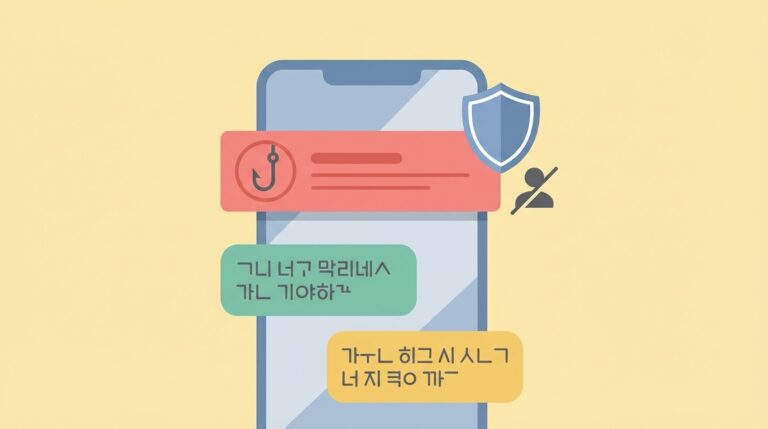
Phase 1: Immersive Hook — The “Buzz” That Isn’t Your Crush
안녕하세요! This is your Daily Hangul Editor.
Picture this: You are sitting in a hip cafe in Seongsu-dong (성수동), sipping an Iced Americano. Your phone buzzes. Zing! Your heart skips a beat. Is it that cute person you met at the language exchange? Is it a notification that your Coupang delivery arrived?
You check the screen. It reads:
[Web발신] (광고) 김미영 팀장입니다. 고객님께서는 최저 금리로…
(Sent from Web) (Ad) This is Team Leader Kim Mi-young. You are eligible for the lowest interest rate…
Welcome to the real Korea! 🇰🇷 If you live here long enough to get a phone number, you will meet the legendary “Kim Mi-young Team Leader” (the most famous fictitious spammer name in Korea). In K-Dramas, protagonists get mysterious texts from stalkers or debt collectors. In real life? We get texts about loans, gambling sites, and stock tips.
Today, we aren’t just learning vocabulary. We are learning Digital Self-Defense. Knowing how to say “Stop it” to a human is important, but knowing how to tell your smartphone to “Block and Report” is a survival skill in Korea’s hyper-connected society.
Let’s clean up your inbox, shall we?
Phase 2: Deep Dive — Core Expressions
1. 차단하다 (Cha-dan-ha-da)
- Pronunciation: [Cha-dan-ha-da] -> Sounds like “Cha” (tea) + “Dan” (done) + “Ha-da”. Think: “Tea is done, party is over, BLOCK.”
- Meaning: To block / To cut off
- K-Culture Moment: Think of an idol doing a V-Live. When rude comments appear, fans shout in the chat: “차단해 주세요!” (Please block them!). It’s the ultimate digital shield.
- Editor’s Insight: This isn’t just for spam. Did you break up with a toxic ex? You 차단하다 them on KakaoTalk. It implies a complete severance of connection.
- Situation Spectrum:
[🚫 Formal(Boss)] ———— [⚠️ Semi-formal] ———— [✅ Casual]
(You use the action freely, but telling someone “I blocked you” is obviously aggressive!)- 🤔 Think About It: In English, we “block” (like a wall). In Korean, 차단 (遮斷) literally means “to intercept and cut.” Why do you think the focus is on cutting the flow rather than just building a wall?
2. 신고하다 (Sin-go-ha-da)
- Pronunciation: [Sin-go-ha-da] -> Rhymes loosely with “Bingo”. If you see a scam, say Bingo and Sin-go!
- Meaning: To report (to authorities/admins)
- K-Culture Moment: In crime thrillers like Signal or Voice, you hear this constantly: “경찰에 신고해!” (Report it to the police!). But in your daily life, you’ll use it mostly for spam buttons.
- Editor’s Insight: This word is versatile. You report a fire (119), a crime (112), or a spammer (Spam button). It carries a sense of “official notification.”
- Situation Spectrum:
[🚫 Casual Banter] ———— [⚠️ Serious] ———— [✅ Administrative]- 🤔 Think About It: Reporting spam in Korea is very streamlined. Why do you think Korean apps make the “Report” button so accessible? (Hint: It relates to the Pali-pali culture of quick problem solving).
3. 낚이다 (Nak-ki-da)
- Pronunciation: [Nak-ki-da] -> Sounds like “Nike” + “da”.
- Meaning: To get hooked / To be fished / To get scammed (Slang)
- K-Culture Moment: A variety show member clicks a fake link and screams, “아! 낚였다!” (Ah! I got fished/tricked!).
- Editor’s Insight: This comes from fishing (낚시). If you click a spam link, you are the fish. It’s the perfect B2 level slang to describe falling for clickbait or a scam.
Phase 3: Textbook vs. Real Life
| Situation | 📖 Textbook Korean | 🗣️ Real Korean (In the streets) | 💡 Why the difference? |
|---|---|---|---|
| Receiving Spam | 스팸 문자가 너무 많이 와요. (I get too many spam texts.) |
아, 스팸 쩔어. 차단 박아. (Ah, spam is insane. Just slam that block button.) |
“박다” (to drive/slam) adds emphasis and annoyance. |
| Advising a friend | 그 번호를 차단하는 게 좋아요. (It is good to block that number.) |
걍 차단해. 싹 다. (Just block it. All of it.) |
“걍” is a common shortening of “그냥” (Just). Efficiency is key! |
| Getting scammed | 저는 사기를 당했습니다. (I was defrauded.) |
나 보이스피싱 낚일 뻔했어. (I almost got hooked by voice phishing.) |
Passive voice (scammed) vs. Active slang (hooked). |
💡 Editor’s Note: For B2 learners, using “낚이다” (got hooked) instead of “속았다” (was deceived) makes you sound much more like a native speaker who understands internet culture.
Phase 4: Cultural Deep Dive — The “Smishing” Epidemic
4-1. Non-verbal: The “Tsk” of Annoyance
When a Korean person sees a spam text, they don’t just delete it. There is a specific micro-expression:
1. A short tongue click (tsk). 😒
2. A quick frown.
3. The swift thumb swipe to the left (to block).
Try adding the “tsk” sound next time. It adds 100% fluency points.
4-2. K-Culture Connection: Voice Phishing (보이스피싱)
In many K-Movies (like Citizen of a Kind), you see the villain calling and saying, “This is the Prosecutor’s office.” This is Voice Phishing (보이스피싱).
However, the modern trend is Smishing (스미싱)—SMS Phishing. They act like your family: “Mom, I dropped my phone and screen broke. This is my friend’s number…”
Thinking Critically: Korea requires a “Real Name System” (실명제) for phone numbers, yet spam persists. Why? Because spammers often use overseas servers or hacked accounts. This constant battle shapes why Koreans are extremely suspicious of unknown numbers.
Phase 5: Immersive Roleplay — The Suspicious Link
Setting: A loud BBQ restaurant on a Friday night. You are with your Korean friend, Jisoo (28, savvy office worker, protects you from scams).
YOU: (Looking at your phone, confused)
Jisoo: 왜 그래? 뭐 안 좋은 일 있어? 🤨
(Wae geurae? Mwo an joeun il isseo?)
(Why? Is something wrong?)
YOU: 이상한 문자가 왔어. 택배 주소가 잘못됐대.
(Isanghan munjaga wasseo. Taekbae jusoga jalmot-dwaet-dae.)
(I got a weird text. It says my delivery address is wrong.)
Jisoo: (Stopping her chopsticks) 잠깐만. 링크 있어? 절대 누르지 마!
(Jamkkanman. Ringkeu isseo? Jeoldae nureuji ma!)
(Wait. Is there a link? Never press it!)
🔀 Decision Point! How do you respond?
- A) “응, 이미 눌렀는데…?” (Yes, I already pressed it…?)
- B) “당연하지. 바로 차단할 거야.” (Of course. I’m going to block it immediately.)
- C) “답장해서 물어볼까?” (Should I reply and ask?)
✅ Best Choice: B
* Jisoo: 오~ 똑똑한데? 한국 사람 다 됐네! 바로 차단하고 신고해.
(Oh~ Smart! You’ve become a total Korean! Block and report it right away.)
⚠️ Choice C Analysis:
* Jisoo: 헐! 야! 미쳤어? 답장하면 살아있는 번호라고 소문나! 절대 안 돼! 😱
(Hul! Hey! Are you crazy? If you reply, rumors will spread that your number is active! Absolutely not!)
* Tip: Never reply to spam in Korea. It confirms your number is active, and you will get 10x more spam.
Phase 6: 10-Second Shadowing Drill
Let’s practice the “Smart Smartphone User” vibe. Read along with the emotion tags!
- (😤 Firmly): 이상한 링크는 / 절대 / 누르지 마세요!
(Isanghan ringkeu-neun / jeoldae / nureuji maseyo!)
-> Never click on strange links! -
(😒 Annoyed): 아, 또 스팸이야. / 바로 / 차단해야지.
(Ah, tto seupaem-iya. / Baro / chadan-haeyaji.)
-> Ah, spam again. I should block it immediately. -
(🥺 Worried): 저 실수로 / 링크를 / 눌러버렸어요. 어떡하죠?
(Jeo silsuro / ringkeu-reul / nulleo-beoryeosseoyo. Eotteok-hajo?)
-> I accidentally clicked the link. What should I do?
Phase 7: K-Culture Mini Glossary
| Korean | Romanization | Meaning | Context |
|---|---|---|---|
| 보이스피싱 | Voice Phishing | Phone Scam | Scams done via voice calls (Police/Bank impersonation). |
| 스미싱 | Smishing | SMS Phishing | Scams via text messages containing malicious links. |
| 국제발신 | Gukje-balsin | Sent Int’l | A header on texts sent from overseas (highly suspicious if you aren’t expecting one). |
| 인증번호 | Injeung-beonho | Auth Number | The 6-digit code for 2FA. NEVER share this. |
| 읽씹 | Ik-ssip | Read & Ignore | Reading a message and not replying (rude in friendship, essential for spam). |
Phase 8: Traveler’s Survival Kit — Digital Safety
Even if you are just traveling, your SIM card might get spam. Or worse, you might lose your phone.
🆘 Survival Expression #1
– 🇰🇷 “스팸 번호 좀 차단해 줄 수 있어요?”
– (Seupaem beonho jom chadan-hae jul su isseoyo?)
– Meaning: Can you block this spam number for me?
– Where: Asking a Korean friend or hotel staff if you keep getting harassed by a number.📌 Editor’s Pro Tip: The 118 Call Center
If you think you got hacked or clicked a bad link in Korea, you can dial 118 (KISA – Korea Internet & Security Agency). They offer counseling on hacking and spam. (Interpretation service availability may vary, so have a Korean speaker help if possible).
Phase 9: Think Deeper — Privacy in the Age of “Pali-Pali”
Topic: The Paradox of Connectivity
Korea is one of the most connected countries in the world. You can get food delivered to a park bench just by phone location. But this convenience comes at a cost: your data is everywhere.
🧠 Think Deeper:
Korean websites often require your phone number for identity verification (본인인증). This makes online life secure but also means your phone number is your “digital ID card.” If that number leaks, the spam is endless.
💬 Your Turn: In your country, is your phone number treated as a private secret or a public ID? How aggressive is spam marketing where you live?
Phase 10: FAQ & Troubleshooting
Q: I got a text saying “[Web발신]” at the start. Is this always spam?
A: Not always! [Web발신] just means the text was sent from a computer interface, not a mobile phone. Delivery notifications, bank alerts, and hospital appointments also use this. Look at the content. If it promises money, it’s spam.
Q: Can I curse at the spammer?
A: Don’t do it. First, it’s usually a bot. Second, if it’s a real person, replying confirms your number is valid. Just perform the glorious reading and ignoring (읽씹) and blocking (차단).
❌ Common Mistake:
* Mistake: Clicking “Unsubscribe” (무료거부) links in a suspicious text.
* Reality: In legitimate texts, this works. In scam texts, clicking anything installs malware. If you aren’t sure, just use the phone’s system block feature.
Phase 11: Wrap-up & Action Mission
One-Liner Summary: When in doubt, don’t click, just Block (차단) and Report (신고)!
🚀 Action Mission:
– 🥉 Bronze: Look at your phone’s settings. Find where the “Block numbers” (수신 차단) menu is in Korean.
– 🥈 Silver: Watch a clip of the movie “Citizen of a Kind” (시민덕희) trailer on YouTube to hear “보이스피싱” vocab in action.
– 🥇 Gold: If you have a Korean friend, ask them: “너는 스팸 문자 오면 어떻게 해?” (What do you do when you get spam texts?).
K-Culture Mission: Go to your “Spam Messages” folder (if you have one). See if you can spot any headers like (광고) or [Web발신]. Now you know what they mean!
Leave a comment below: What’s the weirdest spam text you’ve ever received?
See you next time! 안녕! 👋
Frequently Asked Questions (FAQ)
Q: What does "차단하다 (Cha-dan-ha-da)" mean in Korean and how do you pronounce it?
A: In Korean, "차단하다 (Cha-dan-ha-da)" is pronounced [Cha-dan-ha-da] and means: To block / To cut off
Q: What does "신고하다 (Sin-go-ha-da)" mean in Korean and how do you pronounce it?
A: In Korean, "신고하다 (Sin-go-ha-da)" is pronounced [Sin-go-ha-da] and means: To report (to authorities/admins)
Q: What does "낚이다 (Nak-ki-da)" mean in Korean and how do you pronounce it?
A: In Korean, "낚이다 (Nak-ki-da)" is pronounced [Nak-ki-da] and means: To get hooked / To be fished / To get scammed (Slang)







