Phase 1: Immersive Hook
Hello! This is your Daily Hangul Editor.
Picture this: You are at a bustling Chimaek (Chicken & Beer) restaurant in Hongdae. The vibe is electric, K-Pop is blasting, and the spicy chicken is delicious. But suddenly, nature calls.
You look around. There is no sign of a restroom door inside the restaurant. You see people grabbing a weirdly large object—a stuffed Pikachu or a frying pan—off the wall before walking out the front door. Wait, are they leaving? No, they are going to the restroom!
In K-Dramas, they usually cut away before these awkward moments, but in real life, finding a restroom in Korea is a survival skill. It often involves passwords, keys attached to giant spoons, and sometimes, stepping out of the building entirely.
Don’t panic. Today, we will learn the magic words to save you from an embarrassing emergency.
Phase 2: Deep Dive (Key Phrases)
1. 화장실 어디예요? (Where is the restroom?)
- Pronunciation:
Hwajangsil eodiyeyo?- Hwa sounds like ‘Hwa’ in Hwaii.
- Jang sounds like ‘Jang’ in Django.
- Sil sounds like Seal.
- Eodi means “Where”.
- Meaning: Where is the restroom?
- K-Culture Moment: You will hear “Eodi?” (Where?) constantly in variety shows like Running Man when members are looking for hidden items. Here, we add politeness.
- Editor’s Insight: Use this when you genuinely cannot see the door. If you see a door but it’s locked, skip to expression #2.
- Situation Spectrum:
[🚫 Formal(Boss)] ———— [⚠️ Semi-formal] ———— [✅ Casual/Polite]- This is the standard polite form (-yo ending). It works for everyone from waiters to strangers.
- 🤔 Think About It: In many Western countries, restrooms are usually inside the establishment. In Korea, why are they often outside on the staircase landing? (Hint: It relates to how buildings are owned and shared!)
2. 비밀번호 있어요? (Is there a password?)
- Pronunciation:
Bimil-beono isseoyo?- Bimil means “Secret”.
- Beono sounds like Bono (U2 singer).
- Meaning: Is there a password/code?
- K-Culture Moment: Have you seen those digital door locks in every K-Drama apartment? Korean restrooms often use the same technology! The code is usually written on the receipt or a whiteboard near the cashier.
- Editor’s Insight: This is the most crucial phrase in Seoul. Many restrooms are locked to keep them clean for customers only.
- Situation Spectrum:
[🚫 Rude] ———— [✅ Standard Polite] ———— [✅ Very Polite]- Perfect for asking the staff.
3. 휴지 있어요? (Is there toilet paper?)
- Pronunciation:
Hyuji isseoyo?- Hyu sounds like Hyugh Jackman.
- Ji sounds like the letter G.
- Meaning: Do you have tissue/toilet paper?
- Editor’s Insight: Pro Tip: In many small Korean restaurants, the toilet paper is located outside the stall or near the restaurant entrance. If you don’t check before you go, you might be in trouble!
Phase 3: Textbook vs. Real Life
| Situation | 📖 Textbook Korean | 🗣️ Real Korean | 💡 Why is it different? |
|---|---|---|---|
| Asking location | 화장실이 어디에 있습니까? (Hwajangsil-i eodie isseumnikka?) | 화장실 어디예요? (Hwajangsil eodiyeyo?) | The textbook version is too military/formal. The real version is softer and faster. |
| Finding the key | 열쇠를 주시겠어요? (Yeolsoe-reul jusigesseoyo?) | 키 어디 있어요? (Ki eodi isseoyo?) | “Key” (Ki) is widely understood. Koreans prefer speed over long sentences in busy restaurants. |
| The Password | 비밀번호가 무엇입니까? (Bimilbeonoga mueosimnikka?) | 비번 뭐예요? (Bibeon mwoyeyo?) | “Bibeon” is the slang/shortened form of “Bimilbeono”. It’s faster to say! |
Bottom Note: As an A2 learner, stick to “Bimilbeono” to be safe, but if you hear “Bibeon,” know that they mean the password!
Phase 4: Cultural Deep Dive
4-1. Non-verbal Communication: The “Key” Ritual
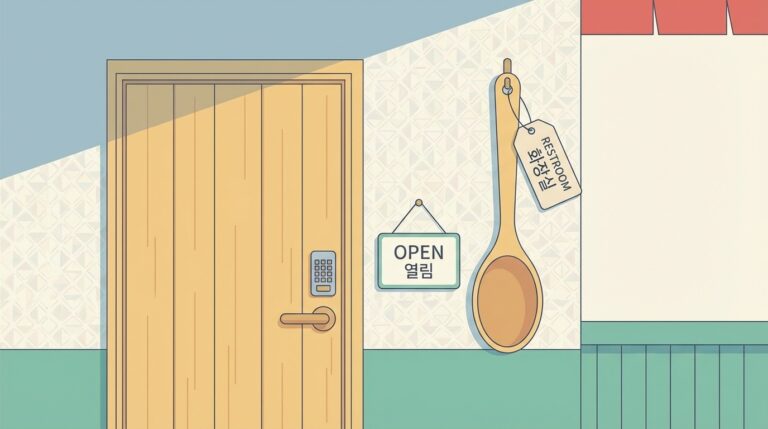
If you ask for the restroom, the owner might just silently point to a giant ladle, a stuffed doll, or a wooden block hanging on the wall.
* Why? Small keys get lost easily. By attaching them to huge objects, customers (hopefully) won’t accidentally put them in their pockets or forget to return them.
* Action: Take the object, go to the restroom, and bring it back. Do not leave it in the door!
4-2. K-Drama Connection: The “Shared” Restroom
In dramas like Fight for My Way, you might see characters running into a restroom on the stairs between floors.
* Context: Many buildings in Korea are “mixed-use.” The restaurant is just one tenant. The restroom on the stairs is shared by the whole building, hence the digital lock to keep non-customers out.
Phase 5: Immersive Roleplay
Setting: It’s Friday night at a busy BBQ place in Gangnam. You are with your Korean friend, Min-su. You really need to go.
Characters:
* YOU: A hungry traveler who drank too much water.
* Server: Busy part-time worker, wearing an apron.
(Dialogue Start)
YOU: (Looking around nervously) Min-su, I need to go to the bathroom.
Min-su: Ask the staff! I think it’s outside.
YOU: (You catch the server’s eye) 저기요! (Jeogiyo! – Excuse me!)
Server: 네, 손님! (Ne, sonnim! – Yes, customer!)
YOU: 화장실 어디예요? (Hwajangsil eodiyeyo?)
Server: 나가서 오른쪽 건물 반 층 위에 있어요. (Go out, turn right, it’s half a floor up.)
YOU: (You understand ‘Go out’ and ‘Right’, but wait…) 아… 비밀번호 있어요? (Ah… Bimilbeono isseoyo?)
Server: 네, 1234 별표(*)입니다. (Yes, 1234 asterisk.)
YOU: (Nodding) 1234 별… 감사합니다!
🔀 Decision Point: You are about to leave, but you see a roll of tissue by the door.
- Option A: Just run to the restroom. (Risky!)
- Option B: Grab some tissue and go.
- Option C: Ask “Is there tissue inside?”
✅ Best Choice: Option B. In older buildings, there is a 90% chance there is no paper inside. Just take some to be safe. It’s not stealing; it’s survival!
Phase 6: 10-Second Shadowing Drill
Repeat this sentence to sound natural. Focus on the emotion!
Context: You are desperate but polite.
🥺 Excuse me / Where is the restroom?
저기요 / 화장실 / 어디예요?
(Jeogiyo / Hwajangsil / Eodiyeyo?)
- Tip: Stretch the “Jeogiyooo” slightly to soften the attention-grabbing.
Phase 7: K-Culture Glossary
| Korean | Romanization | Meaning | Context |
|---|---|---|---|
| 화장실 | Hwajangsil | Restroom | Literally “Makeup Room.” Used for toilet/bathroom. |
| 비밀번호 | Bimilbeono | Password | Often shortened to “Bibeon” (비번). |
| 휴지 | Hyuji | Tissue | Toilet paper or napkins. |
| 남녀공용 | Namnyeo-gongyong | Unisex | Often found in smaller/older buildings. Check the lock! |
Phase 8: Traveler’s Survival Kit (Restroom Edition)
🆘 Survival Phrases TOP 3
- “비번 뭐예요?” (Bibeon mwoyeyo?)
- Use when: The door is locked and you forgot to check the receipt.
- “휴지 주세요.” (Hyuji juseyo.)
- Use when: The dispenser is empty.
- “여기 화장실 있어요?” (Yeogi hwajangsil isseoyo?)
- Use when: You are in a cafe/station and just need to know if one exists.
📌 Editor’s Travel Note:
* The Receipt is Key: The Wi-Fi password and Restroom password are often printed at the bottom of your receipt! Don’t throw it away!
* Subway Stations: Every subway station in Seoul has a free, clean restroom. They are the best safe havens for travelers.
* Trash Can: If you see a large trash can inside the stall next to the toilet, put used paper there (common in older plumbing systems). If there is no bin, flush it.
Phase 9: Think Deeper — “One Step Further”
Perspective: Urban Density & Shared Spaces
Why are restrooms so complicated in Korea? It reflects the high urban density. Many buildings in Seoul are tall and narrow (
Frequently Asked Questions (FAQ)
Q: What does "화장실 어디예요? (Where is the restroom?)" mean in Korean and how do you pronounce it?
A: In Korean, "화장실 어디예요? (Where is the restroom?)" is pronounced [Hwajangsil eodiyeyo?] and means: a key conversational Korean expression covered in this lesson.
Q: What does "비밀번호 있어요? (Is there a password?)" mean in Korean and how do you pronounce it?
A: In Korean, "비밀번호 있어요? (Is there a password?)" is pronounced [Bimil-beono isseoyo?] and means: a key conversational Korean expression covered in this lesson.
Q: What does "휴지 있어요? (Is there toilet paper?)" mean in Korean and how do you pronounce it?
A: In Korean, "휴지 있어요? (Is there toilet paper?)" is pronounced [Hyuji isseoyo?] and means: a key conversational Korean expression covered in this lesson.