

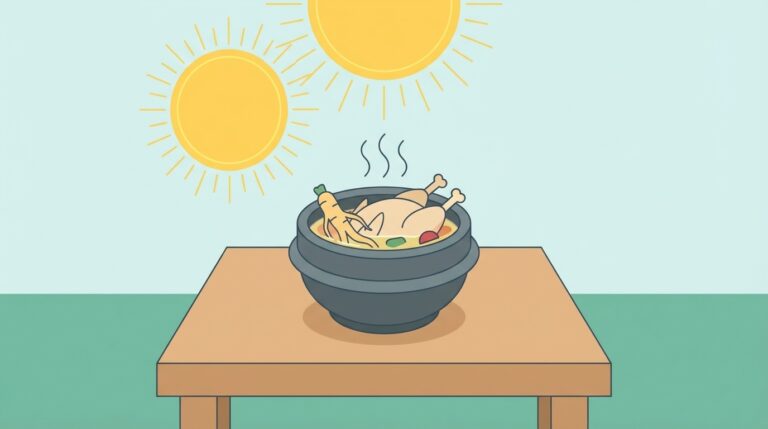
Why Are Koreans Eating Boiling Soup in 35°C Heat? 🥵
Phase 1: The Immersive Hook
안녕하세요! Hello! This is your Daily Hangul Editor.
Picture this: It’s mid-July in Seoul. The humidity is 90%, and just standing outside makes you feel like a melting ice cream. You walk past a restaurant, and there’s a massive line of people waiting. Inside, everyone is sweating while eating a boiling hot stone pot of chicken soup. 🍲
In a K-Drama, you might see a character wipe sweat from their forehead, take a sip of the scalding broth, and sigh, “Ah, siwonhada!” (It’s refreshing!).
You might be thinking: “Refreshing? Are they hallucinating from the heat?”
Today, we are diving into the world of Boyangsik (보양식)—energy food. If you don’t know this culture, you might think Koreans are crazy for fighting heat with heat. But once you learn these expressions, you’ll be the one leading your friends to the chicken soup restaurant saying, “Trust me, this is how we survive summer!” 😎
Phase 2: Deep Dive into Core Expressions
Here are the top 3 phrases you need to survive the Korean summer (or winter) energy slump.
1. 몸보신 좀 해야겠어요.
(Mom-bo-sin jom hae-ya-ges-seo-yo)
- Pronunciation: [Mom-bo-shin] sounds like “Mom” + “Bow” + “Shin” (like a shin guard).
- Meaning:
- Literal: I need to protect/nurture my body.
- Real Nuance: “I feel weak/drained. I need to eat something nutritious to recharge.”
- K-Culture Moment: In dramas, when a student is studying for a big exam or an employee is overworked, their mom or boss will drag them to a restaurant saying, “Let’s do mombosin!”
- Editor’s Insight: This isn’t just about being hungry. It’s about wellness. Use this when you feel burnt out.
- Situation Spectrum:
[🚫 Formal Boss] —— [✅ Colleagues] —— [✅ Friends]- 🤔 Think About It: In your culture, do you treat food as “medicine” or just “fuel”?
2. 이열치열이죠!
(I-yeol-chi-yeol-i-jyo!)
- Pronunciation: [Ee-yul-chee-yul] sounds rhythmic. Try saying it with a punchy accent.
- Meaning:
- Literal: Control heat with heat.
- Real Nuance: “Fight fire with fire!” (Eating hot food to beat the summer heat).
- K-Culture Moment: You are sweating at a spicy food restaurant. Someone asks, “Isn’t it too hot?” You wipe your sweat and say this phrase like a pro.
- Editor’s Insight: This is an ancient idiom (Sajeoseong-eo) that became everyday slang. It’s the #1 logic for eating hot soup in August.
- Situation Spectrum:
[✅ Everyone](Safe to use with anyone!)- 🤔 Think About It: Western culture often uses ice water to cool down. Why do you think Koreans believe heating the body helps cool it down?
3. 기운이 없어요.
(Gi-un-i eop-seo-yo.)
- Pronunciation: [Gi-oon] (Sounds like ‘Key’ + ‘Moon’ without the M).
- Meaning:
- Literal: I have no energy/Qi.
- Real Nuance: “I’m drained/exhausted.”
- K-Culture Moment: The perfect excuse to suggest eating expensive eel or beef. “I have no energy… so let’s eat BBQ.”
- Editor’s Insight: ‘Gi’ (Qi) is vital energy. In Korea, lacking ‘Gi’ is a serious condition that requires food therapy!
- Situation Spectrum:
[⚠️ Boss (Might sound like complaining)] —— [✅ Colleagues] —— [✅ Friends]
Phase 3: Textbook vs. Real Life
| Situation | 📖 Textbook Korean | 🗣️ Real Korean (Insa Style) | 💡 Why is it different? |
|---|---|---|---|
| Suggesting healthy food | 건강한 음식을 먹읍시다. (Let’s eat healthy food.) |
오늘 몸보신 콜? (Body recharge, call/deal?) |
‘Call’ comes from poker/betting, meaning “I’m in!” It’s super casual and efficient. |
| Feeling refreshed by hot soup | 국물이 시원합니다. (The soup is cool/refreshing.) |
으어~ 시원하다! (Uhh~ It’s refreshing!) |
The sound “Uhh~” (old man sound) is essential to show true relief. |
| Asking if someone is tired | 피곤해요? (Are you tired?) |
기 딸려? (Running low on energy/Gi?) |
‘Dallida’ (running low) is slang often used for batteries or energy. |
💡 Editor’s Note: “몸보신 콜?” is very casual. Use it with friends or close coworkers only!
Phase 4: Cultural Deep Dive — The Art of ‘Sambok’
4-1. Non-verbal: The “Sweat Wipe”
In Korea, sweating while eating Boyangsik is considered healthy—it means the toxins are leaving your body.
– Tip: Don’t complain about the heat inside the restaurant. Just grab a tissue, wipe your brow, and keep eating. It shows you are enjoying the meal properly.
4-2. K-Culture Connection: The “Sambok” Lines
If you visit Korea in July or August, you will hear about Chobok, Jungbok, and Malbok. These are the “Three Dog Days” (hottest days of the year).
– K-Food Reality: On these three specific days, Samgyetang (Ginseng Chicken Soup) restaurants have lines wrapping around the block.
– Critical View: Why wait 1 hour in the sun to eat hot soup? It’s a communal ritual. Eating the same food as everyone else on the same day creates a sense of belonging (Jeong).
Phase 5: Immersive Roleplay Scenario
Setting: It is ‘Chobok’ (the first hottest day). You are walking with your Korean coworker, Minji, looking for lunch. The sun is blazing.
Characters:
– YOU: A hungry expat melting in the heat.
– Minji: Your energetic Korean colleague who believes in food therapy.
START DIALOGUE
Minji: 와, 날씨 진짜 덥다. 오늘 초복인 거 알아요? ☀️
(Wa, nalssi jinjja deopda. Oneul Chobok-in geo arayo?)
(Wow, the weather is so hot. Do you know it’s Chobok today?)
YOU: 초복이요? 그게 뭐예요?
(Chobok-iyo? Geuge mwo-yeyo?)
(Chobok? What is that?)
Minji: 제일 더운 날이에요! 이런 날엔 삼계탕 먹고 몸보신 해야죠! 🍗
(Jeil deoun nar-ieyo! Ireon naren samgyetang meokgo mombosin haeyajyo!)
(It’s the hottest day! On days like this, we have to eat Samgyetang and recharge our bodies!)
🔀 Decision Point: How do you respond?
- A) “너무 더워요. 차가운 냉면 먹어요.” (Refuse: Too hot. Let’s eat cold noodles.)
- B) “이열치열이죠! 갑시다!” (Accept: Fight fire with fire! Let’s go!)
- C) “저는 닭고기 싫어요.” (Refuse: I don’t like chicken.)
✅ Best Choice: B
Even if you are hot, saying “I-yeol-chi-yeol” will impress Minji instantly. She will think you are a true Korean local!
Minji: (Clapping) 오! 한국 사람 다 됐네요! 가요, 제가 맛집 알아요.
(Oh! Hanguk saram da dwaenneyo! Gayo, jega matjib arayo.)
(Oh! You’ve become a total Korean! Let’s go, I know a delicious place.)
Phase 6: 10-Second Shadowing Drill
Let’s practice the magic phrase to accept a hot meal invitation!
Repeat after me (3 times):
😤 (Energetically) 이열치열! / 맛있는 거 먹고 / 힘냅시다!
(I-yeol-chi-yeol! / Masinneun geo meokgo / him-naepsida!)Meaning: Fight fire with fire! / Let’s eat something delicious / and cheer up!
Phase 7: K-Culture Mini Glossary
| Korean | Romanization | Meaning | Context |
|---|---|---|---|
| 삼계탕 | Samgyetang | Ginseng Chicken Soup | The #1 Boyangsik. A whole young chicken stuffed with rice, ginseng, and dates. |
| 장어 | Jangeo | Eel | The premium energy food for men (and women). Expensive but famous for stamina. |
| 전복 | Jeonbok | Abalone | The “Ginseng of the Sea.” Often added to porridge when you are sick. |
| 밥심 | Bapsim | The power of rice | The belief that Koreans get their strength from eating rice (a proper meal). |
Phase 8: Traveler’s Survival Kit (Restaurant Edition)
Ordering Boyangsik can be tricky because menus often have no pictures.
🆘 Survival Expression #1
– 🇰🇷 “이거 맵지 않게 해주세요.” (Igeo maepji anke haejuseyo.)
– Meaning: Please make this not spicy.
– Why? Some energy foods (like spicy octopus/Nakji) are FIRE. If you can’t handle spice, use this!🆘 Survival Expression #2
– 🇰🇷 “소금 조금만 주세요.” (Sogeum jogeumman juseyo.)
– Meaning: Please give me a little salt.
– Why? Samgyetang is often served unseasoned. You need to dip the meat in salt and pepper.📌 Editor’s Travel Note
– Kimchi is Key: These soups can be bland. They are designed to be eaten with Kkakdugi (radish kimchi). Don’t be shy to ask for a refill: “Kimchi jom deo juseyo!”
Phase 9: Think Deeper — Food & Identity
Why do Koreans share soup?
In many Western cultures, double-dipping is a taboo. But in Korea, eating from a boiling communal pot (Jeongol) is a sign of Jeong (deep affection/bond). While modern hygiene awareness is changing this (people use ladles more now), the spirit remains: “We are a family who shares rice.” (The Korean word for family, Sikgu, literally means “mouths that eat together”).
💬 Your Turn: Does your culture have a specific food you MUST eat on certain days (like Turkey on Thanksgiving)? Tell me in the comments!
Phase 10: FAQ & Troubleshooting
Q: I’m vegetarian. Can I do ‘Boyangsik’?
A: It’s harder, as most are meat-based. However, Kong-guksu (Cold Soy Milk Noodles) is a popular summer protein dish that is vegetarian-friendly! You can suggest this instead.
Q: Is it rude to leave the ginseng in the soup?
A: Nope! Some people eat it for health, some find it too bitter. It’s totally okay to leave the ginseng root and the jujube (date) in the bowl.
❌ Common Mistake: Drinking the soup straight from the big stone pot.
✅ Fix: Use the ladle to put soup into your smaller individual bowl. The stone pot stays VERY hot and can burn your lips!
Phase 11: Wrap-up & Mission
Summary: Today we learned that eating hot soup in summer (I-yeol-chi-yeol) is the Korean secret to recharging energy (Mombosin).
🚀 Action Missions:
– 🥉 Bronze: Stand in front of a mirror and practice saying “Ah~ Siwonhada!” with a refreshed face.
– 🥈 Silver: Go to a Korean restaurant (or Asian market) and find a menu item that looks like ‘Boyangsik’.
– 🥇 Gold: Visit a Korean restaurant, order a hot soup, and tell the waiter/owner: “Mombosin haeryeogo watseoyo!” (I came to energize my body!)
Phase 12: Interactive Quiz
Question: Your boss buys you expensive Eel (Jangeo) for dinner. What is the BEST reaction?
- “Eww, it looks like a snake.” 😱
- “Wow! Mombosin properly today! Thank you!” 😋
- “Is this spicy?” 🤔
Answer: [Toggle for Answer]
Correct: 2. Eel is expensive. Acknowledging it as “Mombosin” shows you understand the value and the boss’s intention to care for the team’s health!







