

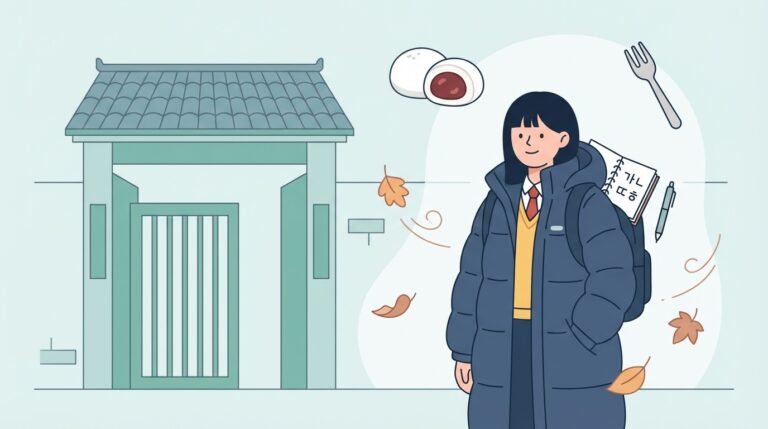
Phase 1: The November Mystery — Immersive Hook
Hello! This is your Daily Hangul Editor.
Picture this: It’s mid-November in Seoul. The autumn leaves are still beautiful, and the weather has been mild. But suddenly, overnight, the temperature drops below zero. The wind creates a biting chill that cuts through your coat.
On the news, you see scenes straight out of a K-Drama: thousands of police officers escorting students on motorcycles, airplanes are grounded so their noise doesn’t disturb listening tests, and mothers are praying outside school gates, clutching heating packs.
Welcome to the day of Suneung (수능), the Korean College Scholastic Ability Test. And that sudden drop in temperature? That is the legendary ‘Suneung Hanpa’ (Suneung Cold Snap).
Even if you aren’t taking the exam, understanding this day is crucial. If you try to order a loud construction job or plan a noisy party on this day, you might get some very angry looks. Today, let’s learn how to navigate this intense cultural moment and how to wish someone luck like a true local.
Phase 2: Deep Dive into Key Expressions
1. 수능 한파 (Suneung Hanpa)
- Pronunciation: [Suneung Hanpa] + Think of ‘Han’ as in ‘Han Solo’ and ‘Pa’ like ‘Pa’ in ‘Papa’.
- Meaning: Literal: Suneung Cold Wave / Real Nuance: The jinx where the weather suddenly turns freezing on exam day.
- K-Culture Moment: You will see this on every news channel. In K-Dramas like Reply 1988, the characters bundle up in layers upon layers on this specific day. It’s the day everyone breaks out their Long Padden (Long Puffer Jackets).
- Editor’s Insight: Even if the forecast says it’s warm, Koreans feel colder on this day due to the collective nervousness. It’s a psychological chill as much as a physical one!
- Situation Spectrum:
[🚫 Formal Only] ———— [✅ Universal]
(Used in news, casual conversation, weather forecasts — everywhere.)- 🤔 Think About It: Why do we blame the weather for our anxiety? Does your country have a ‘weather jinx’ associated with big events?
2. 찰싹 붙으세요! (Chalssak Buteuseyo!)
- Pronunciation: [Chal-ssak Bu-teu-se-yo] + ‘Chal-ssak’ sounds like a wet high-five or a slap. It means sticking tightly.
- Meaning: Literal: Please stick tightly! / Real Nuance: Pass the exam! (Don’t fall off the list of accepted students!)
- K-Culture Moment: This is why people give Yeot (Korean taffy) or Chapssaltteok (Sticky rice cakes) as gifts. You want the knowledge to stick to the student’s brain, and the student to stick to the university.
- Editor’s Insight: This is a very visual expression. Imagine a magnet snapping onto a fridge. That’s the energy of this phrase.
- Situation Spectrum:
[🚫 Friends Only] —— [✅ Standard] —— [🚫 Boss]
(Great for encouraging students, younger siblings, or friends.)- 🤔 Think About It: In many cultures, we say “Good luck” (abstract). In Korea, we say “Stick to it” (physical). Why is the metaphor so tangible here?
3. 잘 풀어요 (Jal Pureoyo)
- Pronunciation: [Jal Pu-reo-yo]
- Meaning: Literal: Untangle it well. / Real Nuance: Solve the questions well (and relax).
- K-Culture Moment: Before exams, friends might give each other toilet paper. Why? Because toilet paper unrolls (puli-da) easily! It’s a pun on “solving” problems easily.
- Editor’s Insight: Pulda means to solve (a math problem), to untie (a knot), and to relieve (stress). It’s a multi-purpose word for making things better.
- Situation Spectrum:
[🚫 Formal] ———— [✅ Casual/Polite]- 🤔 Think About It: Giving toilet paper as a good luck charm seems funny to foreigners, but it’s thoughtful in Korea. How does humor help with high-stress situations?
Phase 3: Textbook vs. Real Life
| Situation | 📖 Textbook Korean | 🗣️ Real Korean (Street Style) | 💡 Why is it different? |
|---|---|---|---|
| Wishing Luck | 시험 잘 보세요. (Please take the exam well.) | 수능 대박 나! (Hit the Suneung Jackpot!) | “Jackpot” (Daebak) captures the life-changing pressure of this exam better than just “doing well.” |
| Feeling Cold | 날씨가 춥습니다. (The weather is cold.) | 오늘 날씨 미쳤다… (The weather is crazy today…) | Emotional reaction is key. Just stating facts feels robotic in severe weather. |
| Cheering | 합격하세요. (Please pass.) | 딱 붙어! (Stick right on!) | Slang emphasizes the result (sticking) rather than the process. |
💡 Bottom Note: Use “수능 대박 나세요” (Suneung Daebak Naseyo) for polite encouragement. It’s the magic phrase during November.
Phase 4: Cultural Deep Dive — The Rules of Luck
4-1. Non-verbal Communication: The Art of Silence
On Suneung day, the entire country practices Nunchi (reading the room) on a massive scale. Construction sites pause work. Banks open an hour later to clear traffic for students. If you are in Korea on this day, keep your voice down near schools. Being loud near a test site is the ultimate “bad vibe.”
4-2. K-Food Connection: The “Slippery” Taboo
In K-Dramas, you might see a student refusing Miyeok-guk (Seaweed Soup) before an exam.
* Why? Seaweed is slippery.
* The Logic: Slippery = Sliding = Falling = Failing the exam.
* Instead: Eat sticky foods like glutinous rice cakes (Chapssaltteok) or taffy (Yeot) so you “stick” to the university!
Thinking Point: Is there a food in your country you avoid before big events? (e.g., Turkey makes you sleepy?)
Phase 5: Immersive Roleplay Scenario
Setting: It is mid-November. You are at a cafe with your Korean friend, Ji-min. Outside, the wind is howling, and people are wearing heavy puffer jackets. Ji-min looks worried because her younger brother is taking the Suneung exam today.
Characters:
* YOU: A supportive friend learning Korean.
* Ji-min (26): Your Korean friend, stressed on behalf of her brother.
Dialogue:
Ji-min: (Looking out the window) 와, 갑자기 너무 추워졌다. 진짜 수능 한파인가 봐.
(Wa, gapjagi neomu chuwo-jeot-da. Jinjja Suneung Hanpa-inga bwa.)
(Wow, it suddenly got so cold. I guess it really is the Suneung Cold Snap.)
YOU (Choose your response):
🔀 Your Turn! How do you respond?
– A) 네, 날씨가 안 좋아요. (Yes, the weather is bad.)
– B) 그러게! 동생분 추울 텐데 걱정되겠다. (I know! Your brother must be cold, you must be worried.)
– C) 수능 대박! (Suneung Jackpot!)✅ Best Choice: B — Why? Choice A is too robotic. Choice C is out of context (you aren’t talking to the student). Choice B shows empathy (Nunchi), acknowledging her worry and the cold.
(Continuing with Choice B…)
Ji-min: 응, 도시락은 따뜻하게 싸줬는데… 시험 잘 봐야 할 텐데.
(Eung, dosirak-eun ttatteut-hage ssa-jwonneunde… siheom jal bwaya hal tende.)
(Yeah, we packed him a warm lunch box… I hope he takes the test well.)
YOU: 걱정 마. 동생 똑똑하니까 ________!
(Geokjeong ma. Dongsaeng ttokttok-hanikka ________!)
(Don’t worry. Your brother is smart, so ________!)
Fill in the blank:
* Option 1: 딱 붙을 거야! (He will stick [pass]!)
* Option 2: 미역국 먹을 거야! (He will eat seaweed soup!)✅ Answer: Option 1. Never say Option 2 regarding an exam!
Phase 6: 10-Second Shadowing Drill
Let’s practice the magic phrase to wish someone success. Imagine you are cheering for a friend.
😊 Bright & Encouraging Tone:
긴장하지 말고 / 시험 / 잘 봐!
(Ginjang-haji malgo / siheom / jal bwa!)
“Don’t get nervous / and take the exam / well!”
Phase 7: K-Culture Mini Glossary
| Korean | Romanization | Meaning | Context |
|---|---|---|---|
| 수험생 | Suheomsaeng | Examinee | The student taking the test. They are treated like VIPs (or fragile glass) on this day. |
| 찹쌀떡 | Chapssaltteok | Sticky Rice Cake | A lucky food gift meaning “Stick to the university.” |
| 패딩 | Paeding | Puffer Jacket | The unofficial uniform of Korean winter. Essential for surviving Suneung Hanpa. |
| 미역국 | Miyeok-guk | Seaweed Soup | Delicious birthday soup, but forbidden on exam days (slippery = fail). |
Phase 8: Traveler’s Survival Kit (Winter Edition)
Since Suneung happens in November, if you are traveling then, you need to survive the Suneung Cold Snap too!
🆘 Survival Expression #1
– 🇰🇷 “핫팩 있어요?” (Hat-paek isseoyo?)
– 🗣️ Pronunciation: [Hat-Pack] sounds like ‘Hot Pack’. easy!
– 📍 Where: Convenience Stores (CU, GS25, 7-Eleven)
– 💡 Pro Tip: Korean “Hot Packs” are military-grade warm. Shake them to activate. Essential for November tourism.📌 Editor’s Travel Note
* Transport: On Suneung morning (7 AM – 9 AM), subways and buses are crowded but run more frequently to get students to testing sites. Avoid travel at this time if possible.
* Silence: If you hear sirens, it might be a police bike escorting a late student. It’s a national emergency service!
Phase 9: Think Deeper — “Han Ball Deo Gipi”
Collective Anxiety vs. The Weather
Why does the weather seem to drop specifically on exam day? Meteorologists say it’s just a coincidence of the season changing. However, culturally, “Suneung Hanpa” represents the psychological freezing of the nation. The entire country holds its breath for these students.
In Korea, one exam has historically determined one’s university, job, and social standing (though this is slowly changing). The “cold” is a physical manifestation of that immense pressure.
🧠 Think Deeper: In your country, is there a single event that stops the whole nation? Or is success seen as a series of smaller steps rather than one giant leap?
💬 Your Turn: How do you say “Break a leg!” in your language? Share in the comments!
Phase 10: FAQ & Troubleshooting
Q: Can I say “Suneung Daebak” to a stranger I see studying in a cafe?
A: Maybe (⚠️). While kind, Koreans usually keep to themselves. A random stranger cheering might add pressure. A silent nod or just being quiet is the best support. If you know the cafe owner and it’s their child, then YES, say it!
Q: Why are there forks on the chocolate packaging?
A: It’s a visual pun! “To fork” (jjik-da) also means “to guess” or “to pick” the right answer on a multiple-choice test. Giving a fork (or fork-shaped candy) means “Guess the answer correctly!”
❌ Common Mistake:
Don’t ask a student “How was the test?” immediately after they finish. If they messed up, they might be devastated. Just say “수고했어” (You worked hard) and offer them warm food.
Phase 11: Wrap-up & Action Mission
One-Liner: Suneung Hanpa is cold, but your warm words can melt the ice!
🚀 Action Mission:
* 🥉 Bronze: Look in the mirror and say “수능 대박!” with a fighting pose.
* 🥈 Silver: Go to a Korean convenience store or Asian market and find Chapssaltteok (Mochi) or Pepero (often sold around the same time).
* 🥇 Gold: If you have a Korean friend, ask them, “Did you experience Suneung Hanpa when you were a student?” (It’s a great conversation starter!)
Phase 12: Quiz — K-Culture Challenge
- Situational Judgment: Your friend is taking an exam tomorrow. What should you NOT buy them for lunch?
- A) Kimchi Stew
- B) Seaweed Soup (Miyeok-guk)
- C) Bulgogi
- D) Bibimbap
- True or False: On Suneung day, airplanes are prohibited from taking off or landing during the English listening test section.
- ( True / False )
Answers:
1. B (Slippery = Fail!)
2. True (It is strictly enforced to ensure silence!)
Frequently Asked Questions (FAQ)
Q: What does "수능 한파 (Suneung Hanpa)" mean in Korean and how do you pronounce it?
A: In Korean, "수능 한파 (Suneung Hanpa)" is pronounced [Suneung Hanpa] and means: Literal: Suneung Cold Wave / Real Nuance: The jinx where the weather suddenly turns freezing on exam day.
Q: What does "찰싹 붙으세요! (Chalssak Buteuseyo!)" mean in Korean and how do you pronounce it?
A: In Korean, "찰싹 붙으세요! (Chalssak Buteuseyo!)" is pronounced [Chal-ssak Bu-teu-se-yo] and means: Literal: Please stick tightly! / Real Nuance: Pass the exam! (Don't fall off the list of accepted students!)
Q: What does "잘 풀어요 (Jal Pureoyo)" mean in Korean and how do you pronounce it?
A: In Korean, "잘 풀어요 (Jal Pureoyo)" is pronounced [Jal Pu-reo-yo] and means: Literal: Untangle it well. / Real Nuance: Solve the questions well (and relax).







