

K-Drama Vibes: How to Survive “2-Cha” (Karaoke) Like a Local 🎤
Phase 1: The Immersive Hook
안녕하세요! Hello, Daily Hangul readers. It’s your editor, back from a Friday night out in Hongdae.
Picture this: You’ve just finished a delicious meal of Samgyeopsal and Soju. Everyone is flushed, happy, and loud. Suddenly, someone checks their watch, looks around with a mischievous grin, and shouts, “2차 가야지!” (We have to go to the 2nd round!).
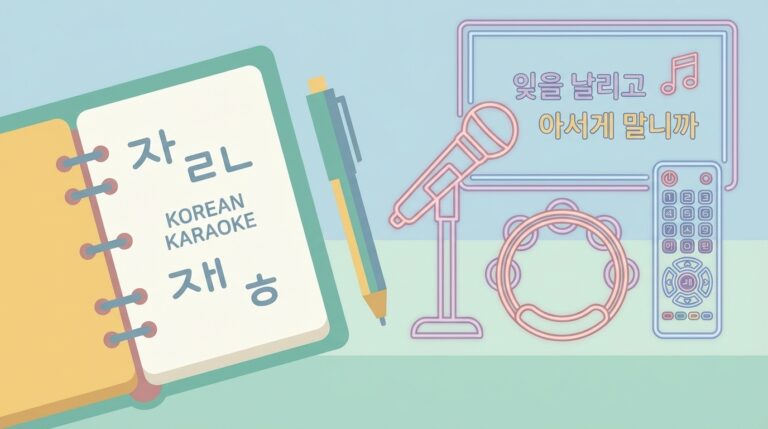
Cut to the next scene: You are in a small, neon-lit room. A disco ball is spinning. Your usually quiet boss is wearing a funny wig and shaking a tambourine like his life depends on it. Welcome to the Noraebang (Karaoke), the heart and soul of Korean nightlife.
In K-Dramas, this is where the protagonist vents their stress by screaming a rock ballad, or where the couple shares a shy duet. But in real life? It’s a battlefield of Nunchi (reading the room) and Service (free time). If you don’t know the rules, you might be the one sitting awkwardly in the corner while everyone else is bonding. Don’t worry—I’ve got your playlist covered.
Phase 2: Deep Dive into Core Expressions
Here are the top 3 phrases you need to survive the “2nd Round.”
1. 2차 가요! (I-cha gayo!)
- Pronunciation: [Ee-cha ga-yo!] (Sounds like the letter ‘E’ + ‘Cha’ as in ‘Cha-cha-cha’ + ‘Ga-yo’)
- Meaning: Literal: Let’s go to the 2nd stop. Real Nuance: The night isn’t over! Let’s move to the next location (usually a bar or karaoke).
- K-Culture Moment: In almost every office K-Drama, after the dinner scene, the youngest employee (Maknae) often looks nervously at the clock while the enthusiastic manager yells this.
- Editor’s Insight: ‘1차’ (Il-cha) is dinner/food. ‘2차’ (I-cha) is usually drinking or singing. ‘3차’ (Sam-cha)? That’s for the brave souls who stay out until 3 AM.
- Situation Spectrum:
[🚫 Formal Meeting] ———— [⚠️ With Boss] ———— [✅ Friends]
(Use with caution with a strict boss, but generally expected in drinking culture!)- 🤔 Think About It: Why do Koreans count the “rounds” of a night out? It signifies a change in atmosphere and bonding level. Round 1 is for eating; Round 2 is for loosening up.
2. 서비스 주세요~ (Service juseyo~)
- Pronunciation: [Seo-bi-su ju-se-yo] (‘Service’ typically means ‘free stuff’ in Konglish)
- Meaning: Literal: Please give me service. Real Nuance: Please give us extra free time on the karaoke machine!
- K-Culture Moment: You are at a Noraebang, and the timer shows “0 minutes left.” You pick up the interphone and say this with your cutest voice (Aegyo). Suddenly, “30 minutes” appears on the screen like magic.
- Editor’s Insight: In Korea, “Service” rarely means “waiter service.” It almost always means freebies. In a restaurant, it’s free soda/dumplings. In a Noraebang, it’s time.
- Situation Spectrum:
[🚫 Fancy Hotel] ———— [⚠️ Restaurant] ———— [✅ Noraebang/Market]- 🤔 Think About It: Why is “Service” (freebies) so important in Korean commerce? It builds Jeong (affection/connection) between the owner and the customer.
3. 분위기 띄워! (Bunwigi tti-wo!)
- Pronunciation: [Bun-wi-gi ddee-wo] (‘Ui’ sounds like ‘we’; ‘tti’ sounds like a sharp ‘D’)
- Meaning: Literal: Float the atmosphere. Real Nuance: Hype up the vibe! / Get the party started!
- K-Culture Moment: Used by K-Pop idols at concerts when they want the fans to jump, or by friends when someone picks a sad ballad too early in the night.
- Editor’s Insight: Selecting a sad song at the start of a Noraebang session is a “vibe killer.” You need to “float” (lift) the mood first with dance songs.
- Situation Spectrum:
[🚫 Funeral] ———— [⚠️ Serious Talk] ———— [✅ Party/Karaoke]
Phase 3: Textbook vs. Real Life
| Situation | 📖 Textbook Korean | 🗣️ Real Korean | 💡 Why the difference? |
|---|---|---|---|
| Suggesting Karaoke | 노래방에 갑시다. (Noraebang-e gapsida.) | 노래방 콜? (Noraebang Call?) | “Call?” is used like “Deal?” or “I’m in!” derived from poker terms. |
| Asking for a song | 무슨 노래를 부르고 싶어요? (Museun noraereul…) | 18번 뭐예요? (18-beon mwoyeyo?) | “18-beon” refers to a person’s signature/favorite song (originally from Kabuki theater terms). |
| Cheering | 잘한다! (Jalhanda! – Good job!) | 찢었다! (Jjijeotda!) | Literally “You tore it apart!” (Slang for “You crushed it/slayed”). |
💡 Editor’s Note: “18-beon” is B1/B2 level knowledge! If you ask a Korean “What is your 18-beon?” instead of “What is your favorite song?”, they will be shocked by your fluency.
Phase 4: Cultural Context — The Art of Reading the Room
4-1. Non-verbal Communication: The Tambourine Master
In a Noraebang, sitting still is a crime. Even if you aren’t singing, you have a job. You must clap or shake the tambourine. However, do not shake the tambourine during a sad ballad (unless you want death stares).
4-2. K-Culture Connection: The “Ending Fairy”
Just like K-Pop idols have an “Ending Fairy” (ending pose) on music shows, Noraebang has an ending rule. The last song (막곡 – makgok) should be a group anthem where everyone screams together. Think big bang’s “Fantastic Baby” or PSY’s “Champion.”
Phase 5: Immersive Roleplay Scenario
Setting: It’s 9:00 PM in Sinchon. You are with Min-su (your energetic Korean friend) and Ji-eun (a slightly shy colleague).
Min-su: 아, 배부르다! 근데 이대로 집에 가기엔 좀 아쉽지 않아? 🎤
(Ah, baebureuda! Geunde idaero jibe gagien jom aswipji ana?)
(Ah, I’m full! But isn’t it a shame to go home like this?)
Ji-eun: 맞아요. 딱 한 잔만 더 할까요?
(Majayo. Ddak han janman deo halkkayo?)
(Right. Should we have just one more drink?)
Min-su: 술 말고, 소화도 시킬 겸 노래방 어때? 2차 가자!
(Sul malgo, sohwa-do sikil gyeom noraebang eottae? I-cha gaja!)
(Instead of alcohol, how about Karaoke to digest? Let’s go for round 2!)
🔀 YOUR TURN! How do you respond?
- Option A: “저는 노래를 잘 못해요…” (I can’t sing well…) [The Humble Route]
- Option B: “좋아요! 서비스 많이 주는 곳으로 가요!” (Good! Let’s go to a place that gives lots of service!) [The Pro Route]
- Option C: “싫어요. 피곤해요.” (No. I’m tired.) [The Party Pooper Route]
✅ Best Choice: Option B.
By mentioning “Service,” you show you understand the culture. Min-su will love this response.
(If you chose B)
Min-su: 오~ OOO 씨, 한국 사람 다 됐네! 가자, 내가 단골집 알아!
(Oh~ [Your Name], you’ve become a total Korean! Let’s go, I know a regular spot!)
Phase 6: 10-Second Shadowing Drill
Let’s practice the magic spell to get free time.
Emotion: 🥺 Cute & Desperate (Aegyo)
사장님~ / 저희 / 서비스 / 쪼~금만 / 더 주세요!
(Sajangnim~ / jeo-hui / seo-bi-su / jjo~geum-man / deo ju-se-yo!)
Boss~ / we / service / just a liiiitle bit / more please give!
💡 Note: Elongate the “Jjo” (little) to emphasize how small your request is (even if you want 30 minutes).
Phase 7: K-Culture Glossary
| Korean | Romanization | English Meaning | Context |
|---|---|---|---|
| 18번 | Sippal-beon | Go-to Song | Your signature song that you sing best. |
| 취소 | Chwi-so | Cancel | The button on the remote to skip a song. Don’t press this when others are singing! |
| 탬버린 | Taem-beo-rin | Tambourine | The holy instrument of the Noraebang. |
| 코인 노래방 | Koin Noraebang | Coin Karaoke | Small booths where you pay per song (cheap/casual). Great for solo practice. |
Phase 8: Traveler’s Survival Kit
Are you traveling to Korea? You will likely see “노래연습장” (Singing Practice Room) signs everywhere.
🆘 Survival Phrases for Noraebang
1. “신곡 업데이트 됐어요?” (Singok update dwaesseoyo?) – “Are the new songs updated?” (Important if you want to sing the latest K-Pop).
2. “물 좀 주세요.” (Mul jom juseyo.) – “Please give me some water.” (Singing makes you thirsty!).
3. “리모컨이 안 돼요.” (Rimokeoni an dwaeyo.) – “The remote control isn’t working.”📌 Editor’s Travel Note:
– Cost: Regular Noraebang charges by the hour (20,000~30,000 KRW). “Coin Noraebang” charges by song (500~1,000 KRW for 2 songs).
– Payment: Most accept cards, but Coin Noraebangs often need cash (bills/coins) inside the booth.
Phase 9: Think Deeper — “Why Do We Sing Together?”
Collectivism in a Microphone:
In many Western cultures, karaoke is a performance—you stand on a stage in a bar, and strangers watch you. In Korea, Noraebang is a private room. It’s not about showing off to strangers; it’s about strengthening the bond within your specific group (In-group vs. Out-group dynamics).
Singing together, even if you are terrible, is an act of vulnerability. By looking silly together, hierarchies dissolve slightly. The intern can dance with the CEO. This reflects the Korean desire for “Uri” (Us/We)—creating a shared emotional experience to solidify the relationship.
💬 Your Turn: Does your country have a culture of singing together? Or is it mostly for professional singers? Tell us in the comments!
Phase 10: FAQ & Troubleshooting
Q: Can I sing a pop song (English song)?
A: YES! Every machine has a huge selection of Pop. Bruno Mars and Adele are very popular. However, try not to sing 3 slow English ballads in a row. It might kill the “High Tension” vibe.
Q: Can I sit down while singing?
A: If it’s a ballad, yes. If it’s a dance song and everyone else is standing/dancing, you should probably stand up too!
❌ Common Mistake #1: Skipping someone else’s song because you don’t like it.
✅ Fix: NEVER touch the ‘Cancel’ (취소) button unless it is your own song. It is considered extremely rude.
Phase 11: Wrap-up & Mission
One-Liner Summary: To survive a Korean 2nd round (2-cha), remember to ask for “Service” time and never kill the vibe with a sad song first!
Action Mission:
– 🥉 Bronze: Listen to a K-Pop song and imagine it’s your “18-beon” (Signature song).
– 🥈 Silver: Search “Coin Noraebang Seoul” on YouTube to see what the machines look like.
– 🥇 Gold: Go to a Korean restaurant, and if they give you free side dishes, say “Waa, Service! Thank you!”
K-Culture Mission: Watch a clip of the drama “Hospital Playlist” (슬기로운 의사생활). The main characters go to Karaoke often. Observe who sings, who plays the tambourine, and how they interact!
Phase 12: Quiz — Interactive Challenge
1. Situation Judgment:
Your boss is singing a very old, trot song you don’t know. What should you do?
– A) Check your phone.
– B) Press ‘Cancel’ to sing your song.
– C) Clap along and try to follow the rhythm.
2. Fill in the Blank:
“We want more time! Let’s ask the owner for _______!”
– A) Discount
– B) Service
– C) Kimchi
3. True or False:
“18-beon” means your 18th favorite song.
– (True / False)
Answers:
1. C (Even if you don’t know it, showing support is good Nunchi!)
2. B (Service = Free time)
3. False (It means your #1 favorite/signature song!)
See you in the next Daily Hangul lesson! Keep that tambourine shaking! 🎵
Frequently Asked Questions (FAQ)
Q: What does "2차 가요! (I-cha gayo!)" mean in Korean and how do you pronounce it?
A: In Korean, "2차 가요! (I-cha gayo!)" is pronounced [Ee-cha ga-yo!] and means: Literal: Let's go to the 2nd stop. Real Nuance: The night isn't over! Let's move to the next location (usually a bar or karaoke).
Q: What does "서비스 주세요~ (Service juseyo~)" mean in Korean and how do you pronounce it?
A: In Korean, "서비스 주세요~ (Service juseyo~)" is pronounced [Seo-bi-su ju-se-yo] and means: Literal: Please give me service. Real Nuance: Please give us extra free time on the karaoke machine!
Q: What does "분위기 띄워! (Bunwigi tti-wo!)" mean in Korean and how do you pronounce it?
A: In Korean, "분위기 띄워! (Bunwigi tti-wo!)" is pronounced [Bun-wi-gi ddee-wo] and means: Literal: Float the atmosphere. Real Nuance: Hype up the vibe! / Get the party started!







