

Unit: “Menu, please” (메뉴판 주세요)
Phase 1: The “Hungry & Confused” Moment (Immersive Hook)
Greeting: Hello! I’m your Daily Hangul Editor, your local guide to surviving and thriving in Korea.
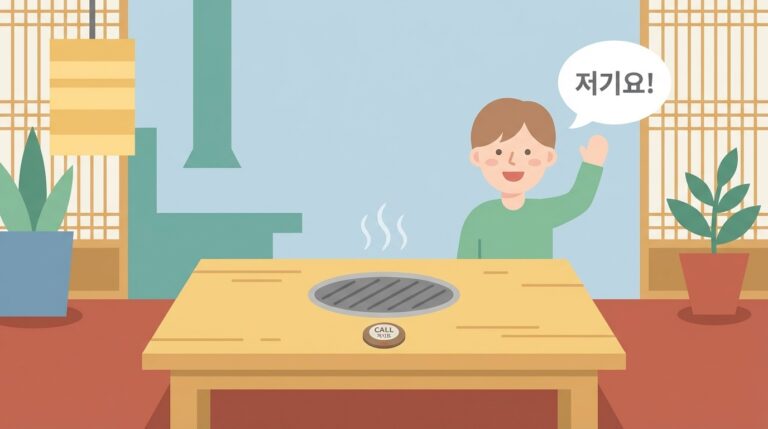
The Scene: You’ve just walked into a bustling Samgyeopsal (pork belly) restaurant in Seoul. The smell of grilled meat is heavenly. You find a table, sit down, and wait. And wait. And wait.
In a Western restaurant, a server would have greeted you with a menu within 30 seconds. But here? The staff is rushing past you, grilling meat at other tables, seemingly ignoring you. You start to panic. “Do they hate me? Is there invisible ink?”
The Reality: Nope! They don’t hate you. In Korea, the service culture is “Call-based,” not “Hover-based.” If you don’t speak up, you might be waiting until closing time. Today, we’re going to learn the magic spell to summon food.
This guide is built on real frustrations my students faced when they first arrived in Korea—starving in a crowded room because they were too polite to shout!
Phase 2: Deep Dive — The Magic Spells
Here are the only three things you need to say to get the ball rolling.
1. 저기요 (Jeogiyo)
- Pronunciation: [Jeo-gi-yo]
- Sound Analogy: Sounds like “Jug” + “E” + “Yo” (Imagine lifting a jug).
- Meaning:
- Literal: “Over there.”
- Real Nuance: “Excuse me!” or “Hey, I need attention!”
- K-Culture Moment: You’ve seen this in every K-Drama. The protagonist raises their hand slightly (palm down) and says “Jeogiyo!” to stop someone or call a server.
- Editor’s Insight: This is your “activator.” You must say this loud enough to be heard over the K-Pop background music. Don’t whisper!
- Situation Spectrum:
[🚫 Boss/Elders] ———— [✅ Restaurant Staff] ———— [✅ Strangers]- 🤔 Think About It: In English, “Excuse me” can mean “I’m sorry” or “Get out of my way.” In Korean, Jeogiyo is purely for getting attention. Why do you think Korean separates “Sorry” (Mianhaeyo) and “Excuse me” (Jeogiyo)?
2. 메뉴판 좀 주세요 (Menyupan jom juseyo)
- Pronunciation: [Menyupan jom juseyo]
- Sound Analogy: Menu-pan (pan like a frying pan) + Jom + Ju-say-yo.
- Meaning:
- Literal: Menu board a little give please.
- Real Nuance: “Could I please have the menu?”
- Editor’s Insight:
- Menu-pan: The suffix pan means “board” or “plate.”
- Jom: This is the magic sauce. Literally “a little,” but here it softens your request. It makes you sound polite and native.
- Situation Spectrum:
[✅ Everywhere]3. 여기요 (Yeogiyo)
- Pronunciation: [Yeo-gi-yo]
- Sound Analogy: Yogi (like the bear) + Yo.
- Meaning: “Over here!”
- Editor’s Insight: An alternative to Jeogiyo. Use this when the server looks around confused, wondering who called them. You are saying, “I’m right here!”
Phase 3: Textbook vs. Real Life
| Situation | 📖 Textbook Korean | 🗣️ Real Street Korean | 💡 Why the difference? |
|---|---|---|---|
| Calling a server | 종업원님! (Employee-nim!) | 저기요! / 사장님! (Excuse me / Boss!) | “Employee” sounds robotic. We treat staff like owners (Sajangnim) to show respect. |
| Asking for menu | 메뉴판을 주시겠습니까? | 메뉴판 주세요. | Korean loves efficiency. Drop the robotic endings in busy restaurants. |
| No one is coming | (Waiting patiently) | (Pressing the Bell) 띵동! | Technology solves social awkwardness. The “Ding-Dong” button is king. |
Bottom Note: Sajangnim (Boss) is the cheat code. Even if they are a part-timer student, calling them “Boss” makes them feel good and might get you faster service!
Phase 4: Cultural Deep Dive
4-1. The Art of “Nunchi” (Eye Measure)
When you shout “Jeogiyo,” don’t stare intensely into the waiter’s eyes. In Korea, you raise your hand, say the phrase, and once they acknowledge you with a nod or a “Ne!” (Yes!), you can lower your hand. Staring too hard can be awkward.
4-2. K-Food Connection: The “Wall Menu”
In many authentic Korean restaurants (especially BBQ places or soup shops), there are no physical menu books.
– Why? The menu is huge and stuck on the wall (look for 차림표 – Charimpyo).
– K-Drama Scene: Notice how characters just sit and shout “Two servings of Samgyeopsal!” without opening a book? They read the wall.
– Tip: If you ask for a menu and the auntie points to the wall, don’t be offended!
Phase 5: Immersive Roleplay
Setting: It’s 7:00 PM on a Friday in Gangnam. A noisy Chicken & Beer (Chimaek) place. K-Pop is blasting. You are with two friends.
Characters:
– YOU: Hungry traveler.
– Minji: A part-time server running around with 5 beer mugs.
Dialogue:
YOU: (The music is loud. You need to be brave.)
저기요! (Jeogiyo!)
Minji: (Stops and looks around) 네~ 잠시만요! (Ne~ Jamsimanyo! / Yes, just a moment!)
(Stage Direction: Minji drops off beer at another table and comes to you.)
Minji: 주문하시겠어요? (Jumun hasigesseoyo? / Would you like to order?)
🔀 Decision Point: You don’t know what to eat yet. What do you say?
A) “Uh… um… sorry…”
B) “메뉴판 좀 주세요.” (Menyupan jom juseyo)
C) “Give me menu!”
✅ Best Choice: B. Clear and polite.
⚠️ Choice A Analysis: Being silent or just saying “sorry” in English confuses the server. They might think you are ready to order.
YOU: 아, 메뉴판 좀 주세요. (Ah, menyupan jom juseyo.)
Minji: 네, 여기 있습니다. (Ne, yeogi isseumnida. / Yes, here it is.)
Phase 6: 10-Second Shadowing Drill
Let’s practice the rhythm. Don’t be shy!
1. Calling the server (Voice: Confident & Projecting 📢)
저기요! 👋
Jeo-gi-yo!2. Asking for the menu (Voice: Soft & Polite 😊)
메뉴판 / 좀 / 주세요.
Menyupan / jom / juseyo.
Phase 7: K-Culture Mini Dictionary
| Korean | Romanization | Meaning | Context |
|---|---|---|---|
| 벨 | Bel | Call Button | The button on the table that makes a “Ding-dong” sound. Press it instead of shouting! |
| 사장님 | Sajangnim | Boss/Owner | The magic word to call any staff member politely. |
| 셀프 | Sel-peu | Self-Service | If you see this sign, get your own water and side dishes! |
| 이모 | Imo | Auntie | Used in casual, old-school restaurants for older female servers. (Use with caution!) |
Phase 8: Traveler’s Survival Kit
For the “Menu, Please” Situation:
🆘 Survival Phrase #1
– 🇰🇷 “이거 주세요.” (Igeo juseyo)
– 🗣️ Meaning: “Please give me this.”
– 📍 Usage: When you can’t read the Hangul menu. Just point at a picture or what the next table is eating and say this!📌 Editor’s Travel Note: The Call Button
Look at the table carefully. Is there a small circular button? That is the Service Bell.
– Pro Tip: Don’t shout “Jeogiyo” if there is a bell. Just press it once (don’t spam it!). The staff number board will light up with your table number.
Phase 9: Think Deeper — “One Step Further”
Culture: The “Palli-Palli” (Hurry-Hurry) Culture
Why do Koreans have bells on tables and shout for servers? It’s connected to the “Palli-Palli” culture—the desire for speed and efficiency. In many Western cultures, dining is a slow, private experience, and shouting is rude. In Korea, dining is often a communal, high-energy activity. Calling the server is seen as helping them do their job faster, not annoying them.
💬 Your Turn: Does your culture prefer “silent waiting” or “active calling” in restaurants? Let us know in the comments!
Phase 10: FAQ & Troubleshooting
Q: Can I really shout across the restaurant?
A: Yes! If the place is loud and local (like a BBQ joint), it’s necessary. If it’s a quiet, high-end fine dining place, just make eye contact or raise your hand slightly.
Q: Is it rude not to tip?
A: Please do NOT tip. In Korea, tipping is not expected and can sometimes be seen as pity or rude. The price you see is the final price. Keep your cash!
❌ Common Mistake:
– Waiting for the server to bring the bill to your table.
– ✅ Fix: In 99% of Korean restaurants, you take the bill (often on your table) to the counter near the exit to pay.
Phase 11: Wrap-up & Action Mission
One-Liner Summary: Don’t wait to be served—raise your hand, press the bell, or shout “Jeogiyo!” to get that delicious food.
🚀 Action Mission:
– 🥉 Bronze: Say “Jeogiyo” 3 times in front of a mirror with a hand gesture.
– 🥈 Silver: Watch a “Mukbang” (Eating show) on YouTube and listen for when they order food.
– 🥇 Gold: Go to a Korean restaurant in your city and try saying “Menyupan jom juseyo” to the staff!
📺 K-Culture Mission: Watch a scene from the drama “Reply 1988”. Look for scenes where they eat Tteokbokki. Observe how casual their ordering style is!
Phase 12: Quiz — Interactive Challenge
1. You sat down, but there is no menu book. You see a list of food on the wall. What is this called?
– A) Wall-paper
– B) Menu-pan (or Charimpyo)
– C) Graffiti
2. Which object on the table saves you from shouting “Jeogiyo”?
– A) The spoon box
– B) The water bottle
– C) The Call Bell (Ding-dong)
3. True or False?
– “You should wait silently for 20 minutes for the server to notice you because it’s polite.”
– (False! Speak up or you’ll starve!)
(Scroll down for answers)
.
.
.
Answers: 1-B, 2-C, 3-False
Frequently Asked Questions (FAQ)
Q: What does "저기요 (Jeogiyo)" mean in Korean and how do you pronounce it?
A: In Korean, "저기요 (Jeogiyo)" is pronounced [Jeo-gi-yo] and means: a key conversational Korean expression covered in this lesson.
Q: What does "메뉴판 좀 주세요 (Menyupan jom juseyo)" mean in Korean and how do you pronounce it?
A: In Korean, "메뉴판 좀 주세요 (Menyupan jom juseyo)" is pronounced [Menyupan jom juseyo] and means: a key conversational Korean expression covered in this lesson.
Q: What does "여기요 (Yeogiyo)" mean in Korean and how do you pronounce it?
A: In Korean, "여기요 (Yeogiyo)" is pronounced [Yeo-gi-yo] and means: a key conversational Korean expression covered in this lesson.







