

Phase 1: The Immersive Hook
Greeting: 안녕하세요! Welcome back to Daily Hangul. I’m your editor, and today we’re leaving the streets of Seoul for a moment to look up at the sky.
K-Culture Cold Open: Have you watched the Korean blockbuster film Space Sweepers (승리호)? Imagine being on a rusty spaceship, chasing after valuable debris while dodging deadly projectiles. Captain Jang shouts commands, and the crew argues about money. In that movie, space isn’t a silent void; it’s a messy, dangerous, and highly commercialized junkyard.
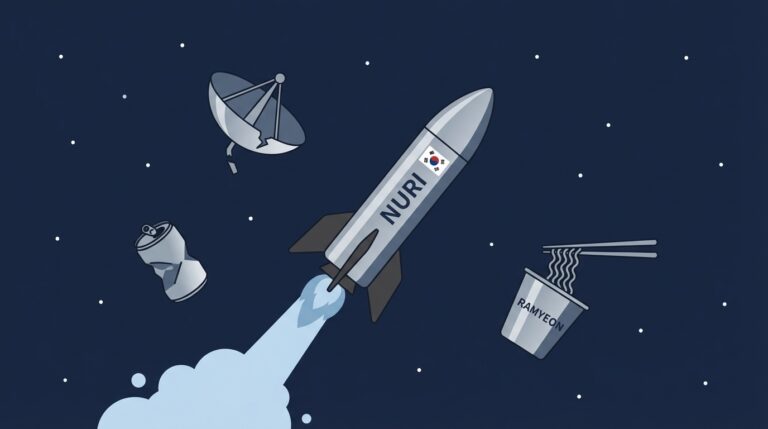
The ‘Why’: Now, bring that back to reality. With Korea’s recent success in launching the Nuri rocket (누리호) and the Danuri orbiter, the conversation in Seoul isn’t just about K-Pop anymore; it’s about K-Space. If you’re discussing tech news or debating the future with Korean intellectuals, you can’t just use basic words like “bad.” You need the C2-level vocabulary to discuss ethics, liability, and sustainability.
Transparency: This guide is built for advanced learners who want to move beyond “survival Korean” into “intellectual Korean.” Let’s dive into the debris field.
Phase 2: Deep Dive into Key Expressions
1. 천문학적인 비용 (Cheonmunhak-jeogin biyong)
- Pronunciation: [cheon-mun-hak-jjeok-in bi-yong] (Think of ‘Cheon’ like ‘Churn’, ‘mun’ like ‘moon’.)
- Meaning: Astronomical costs (Literal: Astronomical costs)
- K-Culture Moment: You hear this on the news when discussing the budget for a new K-Pop idol group’s debut or, more seriously, the cost of cleaning up space junk.
- Editor’s Insight: At the C2 level, we don’t say “very expensive” (너무 비싸요). We use idioms. Use this to emphasize scale. It implies a number so high it’s almost impossible to count.
- Situation Spectrum:
[🚫 Kids] ———— [⚠️ Friends] ———— [✅ Formal/News] - 🤔 Think About It: Why does Korean use “astronomy” to describe money? It highlights how far removed these sums are from daily life—just like the stars.
2. 책임 소재 (Chaegim sojae)
- Pronunciation: [chae-gim so-jae]
- Meaning: Locus of responsibility / Where the accountability lies
- K-Drama Context: In legal dramas like Extraordinary Attorney Woo, lawyers fight over this. “Who is responsible?” In space ethics: If a satellite crashes, whose fault is it?
- Editor’s Insight: ‘책임’ means responsibility, and ‘소재’ means location or whereabouts. It’s a sophisticated way to ask, “Who are we going to blame?”
- Situation Spectrum:
[🚫 Casual Chat] ———— [⚠️ Meeting] ———— [✅ Debate/Legal]
3. 무분별한 개발 (Mubunbyeol-han gaebal)
- Pronunciation: [mu-bun-byeol-han gae-bal]
- Meaning: Indiscriminate/Thoughtless development
- K-Culture Moment: Often used by environmentalists in documentaries criticizing the destruction of nature for golf courses, or in this case, filling orbit with thousands of satellites.
- Editor’s Insight: ‘분별’ means discernment or discretion. ‘무(無)’ is without. It carries a strong negative nuance of being reckless and lacking foresight.
- 🤔 Think About It: Korea developed rapidly (The Miracle on the Han River). This word is often used now to reflect on the side effects of that speed. Is space the next ‘Han River’ needing protection?
Phase 3: Textbook vs. Real Life (Debate Edition)
| Situation | 📖 Textbook Korean | 🗣️ Real Debate Korean | 💡 Why the difference? |
|---|---|---|---|
| Discussing Risk | 우주 쓰레기가 위험합니다. (Space trash is dangerous.) | 우주 공간의 슬럼화가 우려됩니다. (I am worried about the ‘slum-ification’ of space.) | Advanced speakers use sociological metaphors to describe physical phenomena. |
| Blaming Corporations | 회사가 책임을 져야 합니다. (Companies should take responsibility.) | 민간 기업의 도덕적 해이를 경계해야죠. (We must guard against the moral hazard of private firms.) | ‘Moral hazard’ is a key concept in Korean ethical debates. |
| Suggesting Solutions | 규칙을 만들어야 해요. (We need to make rules.) | 구속력 있는 국제 조약이 시급합니다. (A binding international treaty is urgent.) | C2 level requires precise legal terminology. |
Phase 4: Cultural Context — The “Nunchi” of Space
4-1. Non-verbal: The “Serious Nod”
In a high-level discussion about ethics, your body language must match your vocabulary. When listening to someone explain the dangers of the Kessler Syndrome (chain reaction of collisions), maintain eye contact and give a slow, heavy nod. It signals, “I understand the gravity of this situation.”
4-2. K-Culture Connection: The “Hell Joseon” to “Hell Space” Parallel
In recent Korean cinema (like Space Sweepers or The Silent Sea), space is often depicted not as a utopia, but as an extension of social inequality—a theme often discussed in Korea as “Hell Joseon” (hellish socio-economic reality).
The Trope: The rich live in pristine habitats (or on Mars), while the poor clean up the mess.
Critical Insight: When you discuss space ethics in Korean, you are often implicitly discussing class warfare. Using terms like ‘양극화’ (polarization) in the context of space travel will make you sound like a true cultural insider who understands the subtext of Korean sci-fi.
Phase 5: Immersive Roleplay Scenario
Setting: A tech conference at the DDP (Dongdaemun Design Plaza) in Seoul. You are debating with Dr. Kim, a cynical aerospace engineer.
Characters:
– YOU: An ethics consultant for a global tech firm.
– Dr. Kim: A brilliant but pragmatic engineer who believes development comes first.
Dialogue:
Dr. Kim: 위성 인터넷망 구축은 거스를 수 없는 대세입니다. 기술 발전이 우선이죠.
(Wiseong inteonet-mang guchuk-eun geoseureul su eomneun daese-imnida.)
“Building a satellite internet network is an irresistible trend. Tech progress comes first.”
YOU: 물론 효용성은 인정합니다. 하지만 [ 1 ]를 고려하지 않으면, 궤도 전체가 마비될 수 있습니다.
(Mullon hyoyongseong-eun injeonghamnida. Hajiman [ 1 ]-reul goryeohaji aneumyeon, gwedo jeonche-ga mabidoel su itseumnida.)
“Of course, I admit the utility. But if we don’t consider [ 1 ], the entire orbit could be paralyzed.”
Dr. Kim: 구더기 무서워서 장 못 담그나요? 비용 문제로 규제만 늘릴 순 없어요.
(Gudeogi museowoseo jang mot damgeunayo?)
“Are you afraid to make soy sauce because of maggots? (Idiom: Don’t let fear of side effects stop necessary action). We can’t just increase regulations due to costs.”
🔀 Decision Point: How do you counter this idiom?
Option A: “Safety is more important than money!” (A bit simple)
Option B: “This isn’t just about maggots; it’s about the jar breaking entirely. We need sustainable development.”
YOU (Option B): 이건 구더기 문제가 아닙니다. 지속 가능한 개발이 전제되지 않으면, 우주 산업 자체가 공멸할 겁니다.
(Igeon gudeogi munje-ga animnida. Jisok ganeung-han gaebal-i jeonje-doeji aneumyeon, uju saneop jache-ga gongmyeolhal geomnida.)
“This isn’t about maggots. If sustainable development isn’t the premise, the space industry itself will face mutual destruction.”
Dr. Kim: (Nods slowly) 공멸이라… 표현이 꽤 세시군요. 하지만 틀린 말은 아닙니다.
“Mutual destruction… your wording is strong. But you aren’t wrong.”
Phase 6: 10-Second Shadowing Drill
Let’s practice a sentence that makes you sound like a CEO giving a keynote speech.
Emotion: 😤 Firm & Persuasive (Serious tone)
The Sentence:
우주는 / 특정 기업의 소유물이 아닌, / 우리 후손에게 물려줘야 할 / 공공의 자산입니다.
Pronunciation:
Uju-neun / teukjeong gieop-ui soyumul-i anin, / uri huson-ege mullyeojwoya hal / gonggong-ui jasan-imnida.
Meaning:
Space is not / the property of specific corporations, / but a public asset / that must be handed down to our descendants.
Phase 7: K-Culture Mini Glossary (Sci-Fi Edition)
| Korean | Romanization | English | Context |
|---|---|---|---|
| 케슬러 증후군 | Keseulleo jeunghugun | Kessler Syndrome | The scenario where space junk collisions cause a domino effect. |
| 민간 우주 기업 | Mingan uju gieop | Private Space Enterprise | Companies like SpaceX or Korea’s fictional equivalents. |
| 우주 식민지 | Uju singminji | Space Colony | A common setting in K-Webtoons/Dramas. |
| 궤도 안착 | Gwedo anchak | Settling into orbit | Used literally for satellites, or metaphorically for a project stabilizing. |
Phase 8: Traveler’s Survival Kit (Stargazing Edition)
Even if you aren’t going to space, you might visit a science museum or a stargazing spot in Korea (like Anbandegi in Gangwon-do).
🆘 Survival Expression #1
– 🇰🇷 “오늘 기상 조건이 관측하기에 좋은가요?”
– (Oneul gisang jogeon-i gwancheukhagie joeungayo?)
– 🗣️ Meaning: “Are the weather conditions good for observation today?”
– 📍 Use at: Gwacheon National Science Museum, Observatories.📌 Editor’s Travel Note
– Anbandegi (안반데기): This is the “mecca” for galaxy photography in Korea. It’s a cabbage patch high in the mountains.
– Tip: It’s freezing even in summer. If you go to discuss the “universe,” bring a padded jacket (padding)!
Phase 9: Think Deeper — “Global Commons”
Topic: Who Owns the Sky? (Language & Power)
In Korean, we have the word ‘홍익인간’ (Hongik Ingan), which means “to broadly benefit the human world.” It’s the founding philosophy of Korea.
🧠 Think Deeper:
When we translate Western concepts of “Space Law” (often based on ‘first come, first served’ colonization history) into Korean, does it clash with the communal spirit of Hongik Ingan? Or does modern Korean capitalism embrace the “winner takes all” mentality? How does the language used in Korean news regarding the Nuri rocket reflect national pride vs. global responsibility?
Phase 10: FAQ & Troubleshooting
Q: Can I use these words (indiscriminate, mutual destruction) in daily conversation?
A: No. If you use ‘gongmyeol’ (mutual destruction) when your friend drops a piece of chicken, you will be the weird foreigner. Keep these for intellectual debates, presentations, or writing essays.
Q: How do I talk about Sci-Fi movies without sounding childish?
A: Instead of saying “It was fun” (재미있었어요), focus on the themes. “The movie’s depiction of the ethical dilemma (윤리적 딜레마) regarding space debris was impressive.”
❌ Common Mistake: Confusing ‘쓰레기’ (Garbage – general) with ‘폐기물’ (Waste – industrial/hazardous).
✅ Fix: When talking about space junk scientifically, ‘우주 폐기물’ sounds more professional than ‘우주 쓰레기’, though both are used. ‘폐기물’ implies it needs specialized disposal.
Phase 11: Wrap-up & Action Items
Summary: Today we learned how to discuss the commercialization of space, using high-level vocabulary like astronomical costs and sustainable development, while avoiding the moral hazard of sounding like a textbook robot.
Your Mission:
– 🥉 Bronze: Read a Korean news headline about the ‘Nuri’ rocket or SpaceX. Identify one word from today.
– 🥈 Silver: Watch a clip of Space Sweepers on YouTube. Can you catch the word ‘money’ (don) or ‘debt’ (bit) being used angrily?
– 🥇 Gold: Leave a comment on a Korean tech YouTube channel (like EO or Syuka World) discussing space: “우주 산업도 중요하지만, 책임 소재를 명확히 해야 합니다.” (Space industry is important, but we must clarify where the responsibility lies.)
Phase 12: Interactive Quiz
- Situational Judgment: You are at a dinner with the Minister of Science. He asks for your opinion on private space travel. Which response is most appropriate for C2 level?
- A) 우주 여행은 정말 쿨해요! (Space travel is so cool!)
- B) 돈이 많이 들지만 재미있을 것 같아요. (It costs a lot, but sounds fun.)
- C) 민간 기업의 참여는 환영하지만, 무분별한 개발은 규제해야 합니다. (I welcome private participation, but indiscriminate development must be regulated.)
- Fill in the Blank: “Satellites crashing causes a chain reaction known as the [ ______ ] Syndrome.”
- Answer: 케슬러 (Kessler)
- True or False (Culture): In Korean debate culture, using strong idioms like “Are you afraid of maggots so you don’t make soy sauce?” is considered rude and should never be used.
- False. While strong, proverbs are highly respected in debates if used correctly to illustrate a point about risk vs. reward. It shows high cultural literacy.
(Scroll up to check your answers!)
Frequently Asked Questions (FAQ)
Q: What does "천문학적인 비용 (Cheonmunhak-jeogin biyong)" mean in Korean and how do you pronounce it?
A: In Korean, "천문학적인 비용 (Cheonmunhak-jeogin biyong)" is pronounced [cheon-mun-hak-jjeok-in bi-yong] and means: Astronomical costs (Literal: Astronomical costs)
Q: What does "책임 소재 (Chaegim sojae)" mean in Korean and how do you pronounce it?
A: In Korean, "책임 소재 (Chaegim sojae)" is pronounced [chae-gim so-jae] and means: Locus of responsibility / Where the accountability lies
Q: What does "무분별한 개발 (Mubunbyeol-han gaebal)" mean in Korean and how do you pronounce it?
A: In Korean, "무분별한 개발 (Mubunbyeol-han gaebal)" is pronounced [mu-bun-byeol-han gae-bal] and means: Indiscriminate/Thoughtless development







