

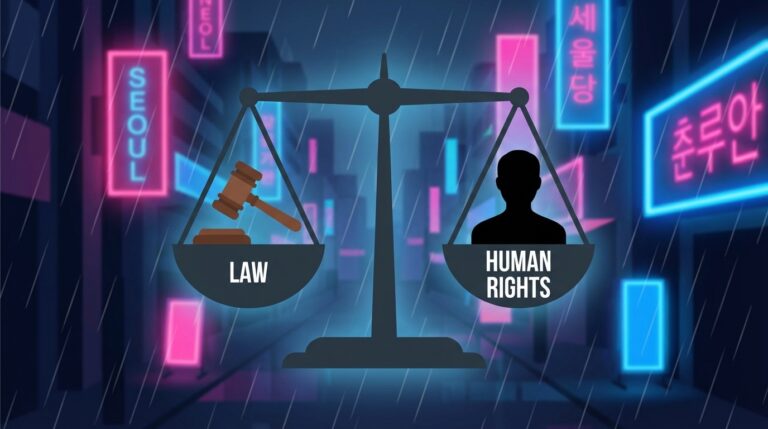
Phase 1: The Noir Side of Seoul — Immersive Hook
안녕하세요! This is your Daily Hangul Editor.
Imagine this scene: You’re watching a gritty K-Movie like The Outlaws (범죄도시) or a dark social drama like Extracurricular (인간수업). The neon lights reflect off the rain-slicked streets of a back alley in Gangnam. A detective sighs, lighting a cigarette, looking at a raid on a hidden establishment. The news anchor in the background discusses the ‘Special Act on Sex Trade (성매매 특별법).’
This isn’t the romantic Seoul of K-Dramas. This is the raw, complex reality of South Korean society. As a C1 learner, you’re ready to move beyond ordering Bulgogi. To truly understand the Korean news or engage in a deep, philosophical discussion over Soju with your close Korean friends, you need to navigate these “taboo” topics.
Today, we tackle a heavy one: The debate on the legalization of prostitution. Is it a ‘necessary evil’ or a ‘violation of human rights’? Let’s dive into the vocabulary of the Korean underground.
Phase 2: Core Expressions (Deep Dive)
These words will turn you from a foreigner into a sophisticated debater.
1. 필요악 (Pil-yo-ak)
- Pronunciation: [pir-yo-ak] (Sounds like ‘Peer-yo-ack’)
- Meaning: Necessary evil
- K-Culture Moment: Used often in political dramas or crime thrillers when a corrupt prosecutor justifies their actions. “Societal stability requires a necessary evil.”
- Editor’s Insight: This is a high-level Hanja word (Required + Evil). Use this when you want to argue that something is bad but unavoidable to prevent worse chaos.
- Situation Spectrum:
[🚫 Casual Chat] ———— [✅ Debate/Serious Talk] ———— [✅ News/Academic]- 🤔 Think About It: Koreans use this term often regarding the sex industry or strict education systems. Why do you think ‘compromise’ is framed as ‘evil’ here?
2. 음지화되다 (Eum-ji-hwa-doe-da)
- Pronunciation: [eum-ji-hwa-doe-da]
- Meaning: To be driven underground / To become shadowed
- Context: Literally “becoming shade-ized.” It refers to illegal activities hiding deeper to avoid crackdowns.
- Editor’s Insight: This is the key argument for legalization supporters. They argue that bans only make things go deeper underground (
음지화), making it harder to control.- Situation Spectrum:
[🚫 Dating] ———— [⚠️ Work] ———— [✅ Social Debate]3. 풍선 효과 (Pung-seon hyo-gwa)
- Pronunciation: [pung-seon hyo-gwa]
- Meaning: Balloon Effect
- Definition: When you squeeze one part of a balloon, another part bulges out. Used to describe how cracking down on one illegal area just pushes the crime to another area.
- K-Culture Moment: You’ll hear this on the 9 PM News whenever the government announces new real estate regulations or vice crackdowns.
Phase 3: Textbook vs. Real Life
How the news speaks vs. how your friend speaks at a pojangmacha (tent bar).
| Context | 📖 Textbook / News | 🗣️ Real Korean (Debate Mode) | 💡 Why the difference? |
|---|---|---|---|
| On Regulation | 정부는 성매매를 엄격히 규제해야 합니다. (The government must strictly regulate prostitution.) |
막는다고 되냐? 다 음지로 숨어들지. (Do you think blocking it works? They all just hide underground.) |
‘음지로 숨다’ is the colloquial idiomatic phrase for ‘Eum-ji-hwa.’ |
| On Morality | 성 상품화는 심각한 사회 문제입니다. (Sexual commodification is a serious social issue.) |
솔직히 그거 다 눈 가리고 아웅하는 거 아니야? (Honestly, isn’t that just covering your eyes and saying ‘aung’?) |
Proverb: Pretending not to know what everyone knows (hypocrisy). |
Phase 4: Cultural Context — The “Room Salon” Reality
4-1. The Elephant in the Room: “Business Culture”
In Korea, the discussion of prostitution is inextricably linked to “Hoesik” (Company Dinners) and corporate hospitality. You might have seen scenes in movies like Inside Men (내부자들) where deals are made in lavish private rooms called Room Salons (룸살롱).
While the Special Act on Sex Trade (2004) made buying and selling sex strictly illegal, the debate rages on because of the “Double Standard.” Many Koreans criticize the hypocrisy of a society that demands Confucian purity on the surface but maintains a massive underground industry.
4-2. Non-verbal Cue: The “Sigh and Nod”
When discussing this topic, you will often see Koreans sigh (휴...) and nod slowly. This isn’t just fatigue; it’s an acknowledgment of the complexity and the lack of a clear solution. Avoid being too aggressive or judgmental; show that you understand the nuance.
Phase 5: Immersive Roleplay — The Late Night Debate
Setting: It’s 2 AM at a Pojangmacha (street food tent) in Jongno. Rain drums on the tarp. You are with Min-su (34, corporate manager, cynical but smart). You just finished talking about a news report on a crackdown.
Min-su:
(Sighs heavily and pours soju)
“야, 뉴스 봤냐? 또 단속한다고 난리네. 솔직히 저게 의미가 있나 싶다.”
(Ya, nyuseu bwannya? Tto dansok-handago nalline. Soljiki jeoge uimiga inna sipda.)
“Hey, did you see the news? Making a fuss about crackdowns again. Honestly, I wonder if that even has any meaning.”
YOU (Select your response):
🔀 Your Turn! How do you respond?
- A) “맞아. 어차피 수요가 있으면 공급은 계속될 텐데…”
(Right. As long as there is demand, supply will continue…)- B) “그래도 법으로 막는 게 도덕적으로 맞지 않아?”
(Still, isn’t it morally right to block it by law?)- C) “한국은 왜 이렇게 유흥 문화가 발달했을까?”
(Why is nightlife culture so developed in Korea?)
If you chose A (The Realist Approach):
Min-su:
“내 말이 그 말이야! 그냥 합법화해서 세금 걷고 관리하는 게 낫지 않냐? 괜히 음지화되니까 더 위험해지는 거라고.”
(Nae mari geu mariya! Geunyang hap-beop-hwa-haeseo segeum geotgo gwanli-haneun ge natji annya? Gwaenhi eum-ji-hwa-doe-nikka deo wiheom-haejineun georago.)
“That’s exactly what I’m saying! Isn’t it better to just legalize it, collect taxes, and manage it? It just gets more dangerous because it’s driven underground for no reason.”
✅ Editor’s Note: Min-su is using the classic logic of ‘Public Management’ (공창제) versus the ‘Balloon Effect’. This is a very common stance among Korean men in private discussions.
Phase 6: 10-Second Shadowing Drill
Let’s practice a sentence that makes you sound intellectually sharp.
😤 Logical / Critical Tone
“무조건 막는다고 / 해결될 문제가 아니에요. / 오히려 음지화될 뿐이죠.”
(Mujogeon mangneundago / haegyeol-doel munjega anieyo. / Ohiryeo eum-ji-hwa-doel ppunijyo.)
“Blindly blocking it / isn’t going to solve the problem. / It will only become driven underground.”
Phase 7: K-Culture Mini Glossary
| Korean | Romanization | English | Context |
|---|---|---|---|
| 공창제 | Gong-chang-je | State-regulated prostitution | A system where the state manages the sex trade legally. |
| 성 상품화 | Seong sang-pum-hwa | Sexual commodification | Treating sex/bodies as products. A key argument against legalization. |
| 단속 | Dansok | Crackdown / Enforcement | Police raids on illegal activities. |
| 2차 | I-cha | Round 2 | Usually means “going to a second bar,” but in business entertainment contexts, it can be a euphemism for sex services. Be careful with context! |
Phase 8: Survival Kit — Discussing Controversy
⚠️ Danger Zone: This topic is NOT for casual acquaintances. Only discuss this with close friends or in an academic setting.
🛡️ Diplomatic Debate Phrases (Essential for C1)
- “동전의 양면성이 있는 것 같아요.” (It seems like two sides of the same coin.)
- Use this to stay neutral.
- “현실적으로는 어렵겠지만…” (It might be difficult realistically, but…)
- Use this before proposing an ideal solution.
- “그 말씀도 일리가 있네요.” (That point also has validity / makes sense.)
- The best way to respect someone’s opinion before disagreeing.
Phase 9: Think Deeper — “Moralism vs. Realism”
The Korean Paradox:
Korea is deeply rooted in Confucianism, which emphasizes moral purity, hierarchy, and family values. Yet, it has one of the most intense nightlife and entertainment cultures in the world.
🧠 Editor’s Question: Why does this gap exist? Some argue that the extreme pressure of Korean corporate/social life creates a need for an “outlet” that society simultaneously shuns. The debate on legalization isn’t just about law; it’s a battle between the “Face” (Che-myeon) Korea wants to show the world and the “Reality” of its stress-relief mechanisms.
Phase 10: FAQ & Troubleshooting
- Q: Can I ask a Korean friend about their opinion on this?
- Editor: Only if you are very close. If you ask this on a first date or to a coworker you just met, you will be labeled as “weird” or “creepy.” Read the room (Nunchi).
- Q: Is ‘Room Salon’ a common word?
- Editor: Yes, everyone knows it, but saying “I went to a Room Salon” is an admission of engaging in sketchy entertainment. It is often used in news to criticize politicians or CEOs.
- ❌ Common Mistake: Using slang like “몸을 팔다” (selling body) in a serious debate.
- ✅ Better: Use “성매매” (Prostitution) or “성 노동” (Sex work – if emphasizing labor rights). Words have power.
Phase 11: Wrap-up & Mission
One-Liner: To discuss Korean society deeply, you must understand the vocabulary of its shadows, like 필요악 (necessary evil) and 음지화 (going underground).
🎯 Action Mission:
* 🥉 Bronze: Practice the Shadowing Drill sentence until you can say it without stuttering.
* 🥈 Silver: Search for the movie The Outlaws (범죄도시) or VETERAN (베테랑) clips on YouTube. Listen for the word “단속” (crackdown).
* 🥇 Gold: (Mental Exercise) If a Korean friend asks, “Do you think prostitution should be legal?”, draft a 3-sentence answer in Korean using the word ‘풍선 효과’.
Phase 12: Quiz — The Logic Check
Q1. Which expression is MOST appropriate when arguing that banning something only hides it better?
* A) 눈 가리고 아웅 (Cover eyes and say ‘aung’)
* B) 음지화되다 (To go underground)
* C) 금상첨화 (Icing on the cake)
* D) 작심삼일 (Giving up after 3 days)
Q2. True or False?
* “In a formal business meeting, it is appropriate to suggest going to a ‘Room Salon’ to build rapport.”
Answers:
1. B. This is the core vocabulary of today’s lesson.
2. False. Absolutely not. While it happens in dark corners of industry, suggesting it openly in a formal meeting is a huge risk to your reputation and potentially illegal.
Frequently Asked Questions (FAQ)
Q: What does "필요악 (Pil-yo-ak)" mean in Korean and how do you pronounce it?
A: In Korean, "필요악 (Pil-yo-ak)" is pronounced [pir-yo-ak] and means: Necessary evil
Q: What does "음지화되다 (Eum-ji-hwa-doe-da)" mean in Korean and how do you pronounce it?
A: In Korean, "음지화되다 (Eum-ji-hwa-doe-da)" is pronounced [eum-ji-hwa-doe-da] and means: To be driven underground / To become shadowed
Q: What does "풍선 효과 (Pung-seon hyo-gwa)" mean in Korean and how do you pronounce it?
A: In Korean, "풍선 효과 (Pung-seon hyo-gwa)" is pronounced [pung-seon hyo-gwa] and means: Balloon Effect







