

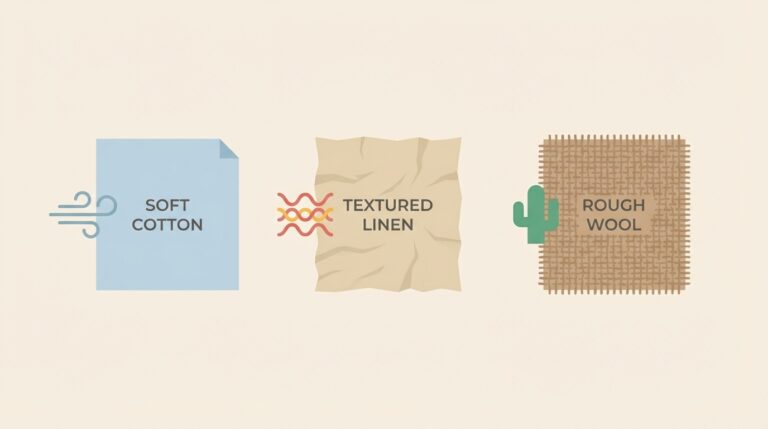
Phase 1: The Fabric of K-Style — Immersive Hook
Greeting: 안녕하세요! Welcome back to Daily Hangul. I’m your editor, ready to guide you through the threads of Korean culture.
K-Culture Cold Open: Picture this typical K-Drama scene: The CEO protagonist steps out of a luxury sedan. It’s the middle of July in Seoul—a humid 30°C (86°F). Yet, they look impeccable in a three-piece suit. How? While we’re sweating just watching them, the secret isn’t just movie magic; it’s the fabric choice. Or think about your favorite K-Pop idol’s airport fashion. That oversized shirt that drapes perfectly? It’s not just big; it’s about the specific weight and texture of the material.
The ‘Why’: As a C1 learner, you’re beyond asking “Is this pretty?” (이거 예뻐요?). You need to articulate why it feels luxurious, or complain specifically about why a sweater irritates your skin. In the fast-paced world of Dongdaemun fashion markets or high-end Cheongdam boutiques, knowing your 원단 (fabric) vocabulary distinguishes a tourist from a connoisseur.
Transparency: Today’s lesson draws from real conversations between designers at Dongdaemun Market and demanding customers in tailored suit shops. We are going deep into textures and functionality.
Phase 2: Deep Dive into Texture & Function
1. [까끌거리다] (To be prickly/scratchy)
- Pronunciation: [Kka-kkeul-geo-ri-da]
(Think of the sharp ‘K’ sound like a scratch, and ‘kkeul’ like ‘gull’ but with a tighter throat) - Meaning:
- Literal: To feel rough or prickly.
- Real Nuance: This is the specific onomatopoeic verb used when wool or synthetic fibers irritate the skin. It implies a sensory discomfort that ruins the luxury of the garment.
- K-Culture Moment: In reality TV shows like I Live Alone, you often see celebrities trying on clothes and immediately pulling at their neck, saying, “아, 이거 너무 까끌거려요” (Ah, this is too scratchy). It’s a deal-breaker for sensitive Korean consumers.
- Editor’s Insight: Koreans have high standards for tactile comfort. Even if a sweater is 100% Cashmere, if the weave is bad, it’s labeled ‘까끌거린다’. You can also use ‘따갑다’ (stinging), but ‘까끌거리다’ specifically describes the texture of the fabric against skin.
- Situation Spectrum:
[🚫 Formal Report] ———— [✅ Shop/Casual]- This is a descriptive verb mostly used in conversation or reviews.
- 🤔 Think About It: Korean has a vast array of ‘mimetic’ words (sound/shape symbolism) for textures (bo-deul-bo-deul for soft, kka-kkeul-kka-kkeul for rough). Why do you think Korean emphasizes sensory feelings so heavily in everyday language compared to English?
2. [통기성이 좋다/뛰어나다] (Good/Excellent breathability)
- Pronunciation: [Tong-gi-seong-i jo-ta] + [Tong-gi sounds like ‘tongue-ghee’]
- Meaning:
- Literal: Air permeability is good.
- Real Nuance: “It breathes well.” Essential for surviving Korean summers.
- K-Culture Moment: Watch any commercial for ‘Cool-Tech’ innerwear or hiking gear (deung-san-bok) which middle-aged Koreans love. The narrator will emphasize “뛰어난 통기성” (outstanding breathability) alongside sweat absorption.
- Editor’s Insight: This is a more technical, C1-level term. While a child might say “It’s cool” (시원해요), an adult analyzing fabric quality uses “tong-gi-seong.” It makes you sound knowledgeable about material science.
- Situation Spectrum:
[✅ All Situations]- Suitable for shopping, technical discussions, and formal reviews.
3. [구김이 잘 가다] (Wrinkles easily)
- Pronunciation: [Gu-gim-i jal ga-da] + [Gu-gim sounds like ‘goo’ + ‘gim’ (seaweed)]
- Meaning:
- Literal: Wrinkles go well (onto the fabric).
- Real Nuance: High maintenance. It implies the fabric (like linen) is natural but requires constant ironing.
- K-Culture Moment: The “Airport Fashion” critique. If an idol wears linen, fans might comment on the natural vibe, but anti-fans might attack the ‘구김’ (wrinkles) as looking messy (지저분하다). Korean society places a high value on a ‘neat/clean’ (단정한) appearance.
- Editor’s Insight: Use this when hesitating to buy something. “이거 린넨이라 구김이 너무 잘 가지 않을까요?” (Since this is linen, won’t it wrinkle too easily?)
- Situation Spectrum:
[✅ All Situations]
Phase 3: Textbook vs. Real Life
| Situation | 📖 Textbook Korean | 🗣️ Real Korean (Pro Level) | 💡 Why the difference? |
|---|---|---|---|
| Checking material | 이 옷은 무슨 소재예요? (What material is this clothes?) | 이거 혼용률이 어떻게 돼요? (What’s the mix ratio?) | Asking for ‘mix ratio’ shows you care about the percentage (e.g., Wool 80%, Poly 20%). |
| Touching fabric | 부드러워요. (It is soft.) | 와, 이거 촉감 대박인데요? (Wow, this tactile feeling is a hit.) | ‘Chok-gam’ (touch/feeling) is the specific noun for the sensation of touching fabric. |
| Washing instruction | 물로 씻으면 안 돼요. (You shouldn’t wash with water.) | 이거 드라이 맡겨야 하죠? (I have to entrust this to dry cleaning, right?) | Koreans almost exclusively use the verb ‘맡기다’ (to entrust) for dry cleaning. |
Phase 4: Cultural Deep Dive — The ‘TPO’ Obsession
4-1. Non-verbal: The “Fabric Rub”
When you visit a clothes market like Dongdaemun or a department store, you will see Koreans rubbing fabric between their thumb and index finger. This isn’t just fidgeting; it’s a silent assessment of thickness, weave density, and softness. To look like an insider, don’t just look at the clothes—feel the hem of the shirt seriously before checking the price tag.
4-2. K-Culture Connection: K-Drama & The ‘Suit’ Logic
In K-Dramas like Vincenzo or Business Proposal, the suit is a symbol of power. Notice how villains often wear shiny, synthetic-looking fabrics (implying cheapness or flashiness), while the sophisticated protagonist wears matte, high-quality wool or cashmere. The fabric speaks before the character does. Also, the concept of TPO (Time, Place, Occasion) is strictly followed in Korea. Wearing highly wrinkled linen to a formal wedding might be judged as lacking ‘Sung-ui’ (sincerity/care).
Phase 5: Immersive Roleplay — At the Custom Tailor Shop
Setting: A bespoke tailor shop in Gangnam. Quiet jazz playing. Walls lined with fabric swatches. You are looking for a summer suit.
Characters:
– YOU: A client looking for style but worried about the heat.
– Manager Kim: A professional tailor (40s), very polite but opinionated about style.
Dialogue:
Manager Kim: 고객님, 여름용 슈트 보신다고요? 이 이탈리아산 린넨은 어떠세요? 색감이 아주 좋습니다.
(Gogaengnim, yeoreum-yong suit bosindagoyo? I Italia-san linen-eun eotteoseyo? Saekgam-i aju jotseumnida.)
(Customer, you’re looking for a summer suit? How about this Italian linen? The color shade is excellent.)
YOU: 음, 색깔은 예쁜데… [ 1 ].
(Hmm, the color is pretty but… [ 1 ].)
Manager Kim: 아, 그러시면 ‘시어서커(Seersucker)’ 소재는 어떠세요? 몸에 달라붙지 않아서 훨씬 시원합니다.
(Ah, then how about Seersucker material? It doesn’t stick to the body so it’s much cooler.)
YOU: 오, 만져보니까 좋네요. 그런데 [ 2 ]?
(Oh, touching it, it’s nice. But [ 2 ]?)
🔀 Your Decision Point! Fill in the blanks.
Option A (Focus on Maintenance):
[1] 린넨은 구김이 너무 잘 가서 관리하기 힘들 것 같아요. (Linen wrinkles too easily, so it seems hard to manage.)
[2] 이거 물세탁 가능한가요? (Is water washing possible for this?)Option B (Focus on Comfort):
[1] 제가 피부가 예민해서 좀 까끌거릴까 봐 걱정돼요. (My skin is sensitive so I’m worried it might be prickly.)
[2] 통기성은 린넨보다 좋은가요? (Is the breathability better than linen?)✅ Editor’s Advice:
If you chose Option A, you are a practical realist! Asking about maintenance (managing wrinkles) is a very Korean concern.
If you chose Option B, you prioritize sensory experience. Using “tong-gi-seong” makes you sound like an expert.
Phase 6: 10-Second Shadowing Drill
Read these aloud to practice the flow of technical adjectives.
- (🤔 Thoughtful/Analytical)
이 원단은 / 통기성은 좋은데 / 너무 까끌거려서 / 못 입겠어요.
(I won-dan-eun / tong-gi-seong-eun jo-eun-de / neo-mu kka-kkeul-geo-ryeo-seo / mot ip-ge-sseo-yo.)
Translation: This fabric has good breathability, but it’s too scratchy so I can’t wear it. -
(🙅♂️ Regretful/Annoyed)
아, 잠깐 앉았다 일어났는데 / 벌써 구김이 간 것 좀 봐.
(Ah, jam-kkan an-jat-da i-reo-nat-neun-de / beol-sseo gu-gim-i gan geot jom bwa.)
Translation: Ah, I sat down for a second and got up, look at how it already wrinkled.
Phase 7: K-Culture Mini Glossary
| Korean | Romanization | English | Context |
|---|---|---|---|
| 혼용률 | honyong-nyul | Blend Ratio | The % of materials (e.g., Poly 60%, Rayon 40%). Crucial check for quality. |
| 신축성 (스판) | sinchuk-seong | Elasticity | Often called “Span” (Spandex) in Korea. “스판기 있어요?” (Does it have stretch?) |
| 보풀 | bopul | Pilling/Fuzz | The little balls of fiber that form on sweaters. “보풀이 일어나다” (Pilling occurs). |
| 하늘하늘하다 | haneul-haneul-hada | Flowy/Airy | Used for light fabrics like chiffon intended for a feminine, innocent look. |
Phase 8: Traveler’s Survival Kit — Shopping & Laundry
Even if you aren’t buying fabric, you will likely do laundry or shop for clothes in Korea.
🆘 Survival Expressions
– Looking for specific material: “이거 면(Cotton) 100%인가요?” (Is this 100% cotton?)
– Checking transparency: “이거 비침 있어요?” (Is this see-through/transparent?) Vital for summer whites!
– At the Laundromat (Coin Wash): “울 코스 (Wool Course)” implies the gentle cycle for delicate fabrics.📌 Editor’s Travel Note: Free Size & Fit
Korea is famous for “Free Size” (One size fits all). However, depending on the fabric’s 신축성 (elasticity), ‘Free’ might mean ‘XS’ or ‘L’. Always check the elasticity before assuming it fits!
Phase 9: Think Deeper — “Appearance vs. Comfort”
The Psychology of ‘Fit’:
Korean fashion often prioritizes the silhouette and visual texture over pure physical comfort, though this is changing with the “Athleisure” trend. Historically, being “neatly dressed” (단정하다) was a sign of education and status. This is why you might see people enduring heat in layers or wearing stiff wool coats in freezing winter instead of bulky padded jackets (though ‘Long Padding’ has become its own survival trend).
🧠 Think Deeper:
Does your culture have a fabric that is considered “high status” but uncomfortable? How does the climate of your country dictate the vocabulary you use for clothes? (e.g., words for ‘warmth’ vs. ‘cooling’).
Phase 10: FAQ & Troubleshooting
- Q: Can I use ‘까끌거리다’ for a person’s personality?
- A: Actually, yes! A specialized slang usage. If someone is difficult, sensitive, or prickly, you can say “성격이 까칠하다” (similar root). But ‘까끌거리다’ is mostly for physical texture.
- Q: Is ‘Man-made fiber’ a bad word in Korea?
- A: Not necessarily. While natural fibers (Cheon-yeon) are prized, technical synthetic fibers (Gi-neung-seong) are highly valued for hiking and summer heat. It depends on the context.
- ❌ Common Mistake: Saying “Skin is bad” instead of “Fabric is rough.”
- Don’t say: “피부가 아파요” (My skin hurts) – this sounds like a medical condition.
- Say: “옷이 따가워요/까끌거려요” (The clothes are stinging/scratchy).
Phase 11: Wrap-up & Action Mission
One-Liner: Knowing fabric terms like 까끌거리다 and 통기성 shifts you from a passive shopper to an active critic of Korean fashion.
Action Mission:
– 🥉 Bronze: Check the label of the shirt you are wearing now. Describe it in Korean (e.g., “This is cotton, so it wrinkles.”).
– 🥈 Silver: Go to an online Korean fashion mall (like Musinsa or Zigzag), read a review, and find the word ‘재질’ (material quality) or ‘핏’ (fit).
– 🥇 Gold: Next time you touch a rough sweater, exclaim out loud: “으, 너무 까끌거려!” (Ugh, too scratchy!)
K-Culture Mission: Watch a scene from a historical drama (Sageuk). Look at the Hanbok (Silk/Ramie). Imagine describing that texture. Is it ‘Bodeul-bodeul’ (soft) or ‘Ppat-ppat’ (stiff)?
💬 Your Turn: What is the most uncomfortable fabric you have ever worn for the sake of fashion? Tell us in the comments!
Frequently Asked Questions (FAQ)
Q: What does "[까끌거리다] (To be prickly/scratchy)" mean in Korean and how do you pronounce it?
A: In Korean, "[까끌거리다] (To be prickly/scratchy)" is pronounced [Kka-kkeul-geo-ri-da] and means: Literal: To feel rough or prickly.
Q: What does "[통기성이 좋다/뛰어나다] (Good/Excellent breathability)" mean in Korean and how do you pronounce it?
A: In Korean, "[통기성이 좋다/뛰어나다] (Good/Excellent breathability)" is pronounced [Tong-gi-seong-i jo-ta] and means: Literal: Air permeability is good.
Q: What does "[구김이 잘 가다] (Wrinkles easily)" mean in Korean and how do you pronounce it?
A: In Korean, "[구김이 잘 가다] (Wrinkles easily)" is pronounced [Gu-gim-i jal ga-da] and means: Literal: Wrinkles go well (onto the fabric).







