

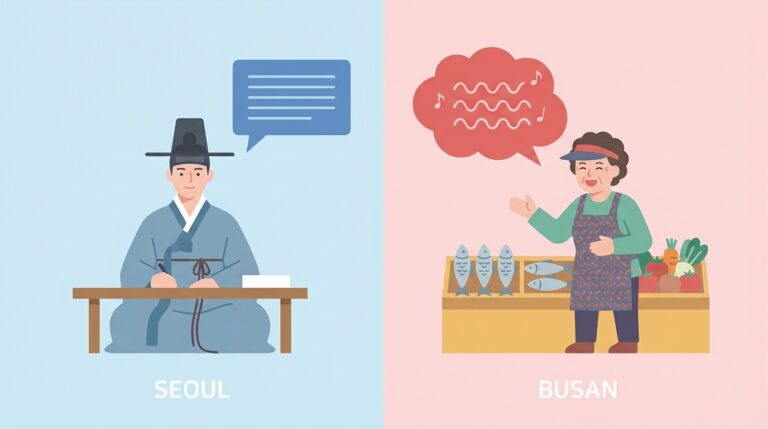
Phase 1: The Hook — Why Do Gangsters in Movies Sound Different?
Hello! It’s your Daily Hangul editor. 👋
Imagine this: You are watching a gritty Korean noir movie like New World (Sinsegye) or Nameless Gangster. The scene is intense. A guy from Seoul in a sleek suit gets angry and curses. It sounds sharp, cold, and precise. Then, a character from Busan or Jeolla-do gets angry. Suddenly, the cursing sounds like a roller coaster—it has rhythm, pitch, and somehow feels… deeper? 🎢
Many intermediate learners ask me, “I know ‘Sibal’ (Shibal), but what was that long, singing sentence the main character just yelled?”
Welcome to the fascinating world of Standard vs. Dialect Swearing. In Korea, swearing isn’t just about bad words; it’s about regional identity, emotion, and sometimes, twisted affection.
⚠️ Disclaimer: This lesson is for educational purposes and media comprehension (Passive Vocabulary). I strongly advise against using these words, especially if you are not fluent. You might sound rude rather than cool! Use this to understand K-Movies, not to fight in Hongdae.
Phase 2: Deep Dive into Expressions
Let’s analyze the vibe difference between the standard “Seoul style” and the “Regional style.”
1. Saekki (새끼) [Standard/Seoul]
- Pronunciation: Saek-ki (Sounds like ‘Sack’ + ‘Key’ said sharply)
- Meaning: Literally “baby animal” or “offspring.” Figuratively, “Jerk,” “Bastard,” or “Punk.”
- The Seoul Vibe: In Seoul standard Korean, this word is often spit out sharply and quickly. It feels cold and cutting. It is the most common mild swear word.
- K-Culture Moment: In almost any K-Drama set in an office, when the bad boss yells at the incompetent employee: “Ya, i saekki-ya!” (Hey, you jerk!)
- Situation Spectrum:
[🚫 Boss/Elders] ———— [⚠️ Close Friends] ———— [✅ Angry Soliloquy] - 🤔 Think About It: Why does a word meaning “baby” become a curse? It demeans the person to the level of an animal. Does your language use animal terms as insults?
2. Mundi / Mundi-Gasinai (문디 / 문디 가시나) [Gyeongsang-do Dialect]
- Pronunciation: Mun-di (Low-High pitch) / Ga-si-na (Girl)
- Meaning: Historically, Mundi referred to a leper (Hansen’s disease patient). However, in Gyeongsang-do (Busan/Daegu), grandmothers often use it toward grandchildren or close friends.
- The Dialect Vibe: It implies, “You frustrate me, but you are mine.” It’s rough but can be surprisingly affectionate (Aejeong) depending on the tone.
- K-Culture Moment: In the drama Reply 1997 or Reply 1994, parents often yell this at their bickering children. It sounds aggressive to outsiders, but it’s actually a sign of closeness.
- Editor’s Insight: If a stranger says this, it’s an insult. If a Busan grandmother says this while giving you extra food, it means she loves you.
3. Yeombyeong (염병) [Jeolla-do Dialect]
- Pronunciation: Yeom-byeong (Sounds like ‘Yum’ + ‘Byung’)
- Meaning: Literally “Typhoid Fever” (an infectious disease). It curses someone to catch a plague.
- The Dialect Vibe: Jeolla-do swearing is famous for being “sticky” (chaljida / 찰지다). It flows like a rap. It often combines with other words like Yeombyeong-hal.
- K-Culture Moment: Watch the movie Sunny. The character from Jeolla-do has a “cursing battle” (Yok-battle). Her curses are creative, rhythmic, and incredibly fast.
Phase 3: Textbook vs. Real Life (The Vibe Check)
| Situation | 📖 Standard (Seoul/Textbook) | 🗣️ Dialect (Real Life Context) | 💡 Why the difference? |
|---|---|---|---|
| Scolding a friend | “Ya, neo jeongmal nappa.” (Hey, you are really bad.) | “Aigo, i mundi jongsja-ya!” (Gyeongsang-do) | Dialects often use historical slang to express frustration + affection simultaneously. |
| Expressing shock | “Eomeo, eotteokhae!” (Oh my, what to do!) | “O-mae! Ssib-jang!” (Jeolla-do – Very strong/vulgar) | Regional interjections are much more visceral and explosive than standard Seoul speech. |
| Calling a guy | “Ya, neo!” (Hey, you!) | “Ya, imma!” or “Jeomma!” (Busan) | Shortened forms of “i nom-a” (this guy). More casual and rough. |
💡 Bottom Note: Seoul people tend to use swearing to cut ties or show anger. In the countryside provinces, swearing is sometimes used to build bonds (paradoxically!).
Phase 4: Cultural Deep Dive — The “Swearing Granny”
4-1. The Phenomenon of “Yokjaengi Halmeoni” (욕쟁이 할머니)
Have you ever been to a restaurant where the owner screams at you?
* “Why are you so late? Sit down and shut up! Eat this!”
In Western culture, you might call the police or leave a 1-star review. In Korea, this is a genre of restaurant called “Yokjaengi Halmeoni Jip” (Swearing Grandma’s House).
- Why? It’s not hate. It’s “Jeong” (Deep Affection). It mimics the feeling of going to your grandmother’s house in the countryside. She scolds you because she cares that you are skinny or tired. The “curse” effectively means, “I treat you like my own grandson, so I don’t need to be formally polite.”
4-2. K-Drama Connection: The “Reply” Series
If you watch Reply 1994 (set in Seoul but with students from all over Korea), you will see the characters fighting. The Seoul boy is terrified of the Jeolla-do and Gyeongsang-do roommates because their “friendly conversation” sounds like a prelude to a fistfight.
- Non-verbal Tip: When dialect speakers swear affectionately, they often hit you on the back or shoulder. It’s a physical sign of “no hard feelings.”
Phase 5: Immersive Roleplay — The Busan Restaurant
Setting: A busy, noisy Gukbap (Rice soup) restaurant in Busan. You are with your Korean friend, Min-jun.
Characters:
* YOU: A foreign exchange student who speaks intermediate Korean.
* Ajumma (NPC): The owner, loud, energetic, speaks strong Busan dialect.
The Scene:
Ajumma: (Slamming a side dish on the table) Mwo hano! Peoteok an-go!
(Standard: Mwo hae! Ppal-li anja! / Translation: What are you doing? Sit down quickly!)
Min-jun: Ah, Auntie, give us lots of meat, okay?
Ajumma: Sikkeureopda, mundi-ya! Just eat what I give you! (She smiles while saying this).
🔀 Decision Point: How do you react to her roughness?
- A) Look offended and ask Min-jun why she is angry.
- B) Smile brightly and say, “Jal meokgetseumnida!” (I will eat well!)
- C) Try to swear back at her jokingly.
✅ Best Choice: B. In a Yokjaengi place, the best reaction is to accept the “rough love” and enjoy the food. Showing you aren’t scared earns you respect.
⚠️ Why not C? As a foreigner, swearing at an elder (even jokingly) is incredibly risky. You might cross the line between “culture” and “rudeness.”
Phase 6: 10-Second Shadowing Drill
Let’s practice the intonation difference. Don’t worry about the meaning, focus on the melody.
1. Seoul Style (Standard) – Flat & Sharp 😐
* “Ya / neo / jigeum / mwo-ha-nya?” (Hey, what are you doing now?)
* Pitch: ⎯⎯⎯⎯ ↘️
2. Busan Style (Dialect) – Rhythmic & Wavy 🌊
* “Ma! / Ni / mwo-hano!”
* Pitch: ↗️ ↘️ ↗️ ↘️ (Like a wave)
Tip: Seoul speech feels like hitting a drum once. Busan speech feels like singing a short, punchy song.
Phase 7: K-Culture Glossary (Dialect Edition)
| Korean | Romanization | Meaning | Context |
|---|---|---|---|
| 사투리 | Saturi | Dialect | Regional speech patterns (e.g., Busan Saturi). |
| 억양 | Eogyang | Intonation/Accent | The musical quality that distinguishes dialects. |
| 찰지다 | Chaljida | Chewy / Sticky | Used to describe swearing that sounds “perfect” or “satisfying” to hear. |
| 촌스럽다 | Chonseureopda | Countryside-like / Tacky | Often used by Seoul people to describe dialect, though now dialect is considered charming. |
Phase 8: Traveler’s Survival Kit (Regional Trip)
If you travel to Busan, Daegu, or Jeonju, keep this in mind:
🆘 Survival Insight #1: Volume ≠ Anger
* Scenario: You ask for directions in a Busan market. The merchant shouts at you.
* Reality: They aren’t angry. The “standard volume” in the southern provinces is often louder than in Seoul. They are likely just enthusiastic.🆘 Survival Insight #2: Don’t Mimic Gangster Movies
* Rule: Never use “Niga gara, Hawaii” (You go to Hawaii – quote from the movie Friend) to a stranger. It’s a joke only among very close friends.
* Safe Bet: Stick to standard Korean (Seoul-mal). Locals will understand you perfectly. You don’t need to fake an accent.
Phase 9: Think Deeper — Media vs. Reality
Why are movie gangsters always from the countryside?
In Korean media, the “Standard Language” (Seoul) is associated with elites, education, and cold logic. Dialects (Saturi) are often used to portray characters who are “raw,” “masculine,” “uneducated,” or “warm-hearted but rough.”
This stereotype reinforces the idea that Seoul = Power/Brain and Provinces = Physicality/Emotion. By using dialect swearing in movies, directors quickly establish a character’s “toughness” without needing dialogue.
💬 Your Turn: Does your country have specific accents associated with “tough guys” or “gangsters” in movies? How does that compare to reality?
Phase 10: FAQ & Troubleshooting
- Q: Can I use “Mundi” or “Gasina” to my Korean boyfriend/girlfriend?
- A: Maybe. “Gasina” (Girl) is common in Busan couples, but some women find it derogatory because it creates a hierarchy. Always ask first: “Oppa, is it okay if I joke in Saturi?”
- Q: If someone swears at me in a dialect, should I be offended?
- A: Look at their eyes. Are they smiling? Is there food involved? If yes, it’s affection. If their face is red and they are pointing a finger, run.
- ❌ Common Mistake: Using Jiral (fitting/going crazy) casually.
- Correction: Even though you hear it in movies, it refers to epilepsy seizures. It is offensive to many. Avoid using it.
Phase 11: Wrap-up & Action Mission
One-Liner: Dialect swearing is more about emotion and rhythm than just bad words; understand the melody, but keep your own language polite!
🚀 Action Missions:
* 🥉 Bronze: Watch a clip of the movie Friend (Chingu) or the drama Reply 1997. Close your eyes and listen to the pitch change.
* 🥈 Silver: Find a “Saturi” teaching video on YouTube. Try to mimic the intonation of a simple greeting like “Bap meogeonna?” (Did you eat?).
* 🥇 Gold: Next time you visit a Korean restaurant (even in your country), ask the staff: “Is this recipe Seoul style or Jeolla-do style?” See if they open up about their hometown!
Phase 12: Quiz — The “Vibe” Check
1. Which situation is likely “Affectionate Swearing” (Jeong)?
* A) A taxi driver yelling at another driver in traffic.
* B) A grandmother in a market calling you “Puppy” (Gangaji) or “Rascal” while giving you a free apple.
* C) A boss shouting at a subordinate for being late.
2. True or False?
* “Standard Seoul Korean is always polite, and Dialect is always rude.”
3. Scenario:
* Your friend from Busan says, “Ma! Sikkeureopda!” (Hey! You’re loud!) while laughing and hitting your arm.
* Meaning: Is he actually angry?
Answers:
1. B. (This is the classic Yokjaengi Halmeoni vibe.)
2. False. You can be extremely rude in Seoul dialect, and extremely polite in Busan dialect. It’s about the words, not the region.
3. No. Physical touch + Laughter + Dialect usually means “We are close enough to be rough.”
Frequently Asked Questions (FAQ)
Q: What does "Saekki (새끼) [Standard/Seoul]" mean in Korean and how do you pronounce it?
A: In Korean, "Saekki (새끼) [Standard/Seoul]" is pronounced [Saek-ki (Sounds like 'Sack' + 'Key' said sharply] and means: Literally "baby animal" or "offspring." Figuratively, "Jerk," "Bastard," or "Punk."
Q: What does "Mundi / Mundi-Gasinai (문디 / 문디 가시나) [Gyeongsang-do Dialect]" mean in Korean and how do you pronounce it?
A: In Korean, "Mundi / Mundi-Gasinai (문디 / 문디 가시나) [Gyeongsang-do Dialect]" is pronounced [Mun-di (Low-High pitch] and means: Historically, Mundi referred to a leper (Hansen's disease patient). However, in Gyeongsang-do (Busan/Daegu), grandmothers often use it toward grandchildren or close friends.
Q: What does "Yeombyeong (염병) [Jeolla-do Dialect]" mean in Korean and how do you pronounce it?
A: In Korean, "Yeombyeong (염병) [Jeolla-do Dialect]" is pronounced [Yeom-byeong (Sounds like 'Yum' + 'Byung'] and means: Literally "Typhoid Fever" (an infectious disease). It curses someone to catch a plague.







