

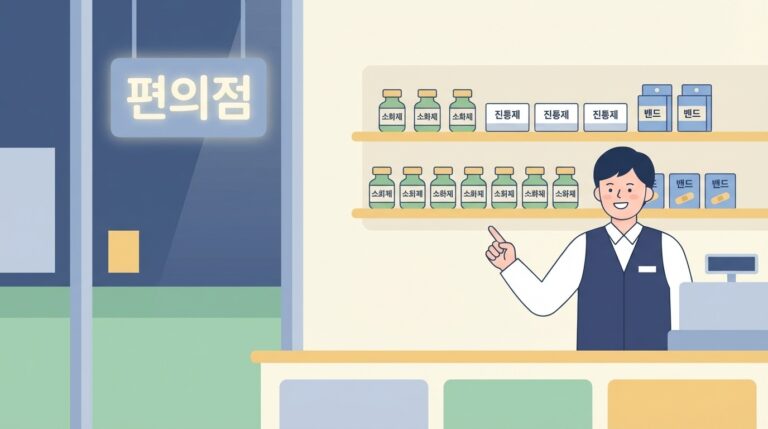
Phase 1: Immersive Hook
🚑 Late Night Emergency after “Fire Noodles”?
Hello! This is your Daily Hangul Editor. 👋
Picture this: You just finished a delicious, fiery bowl of Tteokbokki or that famous “Fire Noodle” (Buldak-bokkeum-myeon) at your hotel. It was amazing, but now it’s 2:00 AM, and your stomach is waging a war. 😱
In many countries, you might panic because pharmacies are closed. But in Korea? You are in the land of 24-hour convenience stores (pyeonijeom).
There is a scene often seen in K-Dramas: The lead character runs into a convenience store late at night, breathless, buying medicine for their sick crush. Today, you will learn how to be the hero of your own story (or just save your own stomach).
Don’t worry about complex medical terms. We are going to learn the survival phrases to get you the relief you need instantly.
Phase 2: Deep Dive into Core Expressions
Here are the 3 essential items you can buy at a Korean convenience store (CVS) without a prescription.
1. 소화제 있어요? (Do you have digestive medicine?)
- Pronunciation:
so-hwa-je i-sseo-yo?- Sound-alike: So (like soap) + Hwa (like what) + Je (like Jelly)
- Meaning: “Is there digestive medicine?”
- K-Culture Moment: Koreans love spicy and heavy food, so Sohwaje is almost a national essential. In variety shows, you often see celebs drinking a small bottle of liquid medicine after a big meal. That is liquid Sohwaje (like Whal-myeong-su).
- Editor’s Insight: If you feel bloated or have a stomach ache from food, this is your magic word. You can buy the pill form or the drink form.
- Situation Spectrum:
[🚫 Formal] ———— [✅ Casual/Polite](Safe to use with store clerks) - 🤔 Think About It: Why is digestive medicine sold in convenience stores, but stronger stomach medicine isn’t? It reflects the Korean balance between convenience (fast relief) and safety (doctor’s control).
2. 진통제 주세요. (Please give me painkillers.)
- Pronunciation:
jin-tong-je ju-se-yo- Sound-alike: Jin (like Jeans) + Tong (like tongue) + Je
- Meaning: “Please give me painkillers.”
- K-Culture Moment: In K-Dramas, when a character has a “stress headache” from their mother-in-law or a difficult boss, they often reach for this.
- Editor’s Insight: Common brands like Tylenol are available. If you can’t remember Jintongje, saying “Tylenol” usually works, but knowing the Korean word makes you look like a pro!
- Situation Spectrum:
[✅ Standard Polite]
3. 밴드 있어요? (Do you have Band-Aids?)
- Pronunciation:
baen-deu i-sseo-yo?- Sound-alike: Ban (like band) + Deu (like Duh)
- Meaning: “Do you have a band-aid?”
- K-Culture Moment: Walking around Seoul or hiking Seoraksan requires comfortable shoes. If you get a blister, you need this. It’s a classic K-Drama trope: the male lead putting a band-aid on the female lead’s heel.
- Editor’s Insight: Koreans simply say “Band” (Band-eu) for Band-Aids/Plasters.
Phase 3: Textbook vs. Real Life
| Situation | 📖 Textbook Korean | 🗣️ Real Korean (Street Smart) | 💡 Why is it different? |
|---|---|---|---|
| Asking for medicine | 약국이 어디예요? (Where is the pharmacy?) |
여기 약 팔아요? (Do you sell medicine here?) |
At 2 AM, looking for a pharmacy is useless. You need to know if the CVS has it. |
| Specific Brand | 해열 진통제 주세요. (Give me fever reducer/painkiller.) |
타이레놀 있어요? (Do you have Tylenol?) |
Brand names are often faster and clearer than medical terms. |
Bottom Note: Most Korean convenience stores have a specific shelf for “Safe Household Medicine” (안전상비의약품). Look for the medical cross symbol ➕.
Phase 4: Cultural Deep Dive
4-1. The “Hangover” Culture (Sook-chwi)
Is your head hurting not because of stress, but because of Soju from last night?
In Korea, “Hangover Cure Drinks” (숙취해소제 – suk-chwi-hae-so-je) are a massive market.
- K-Drama Context: You’ve definitely seen a scene where a team manager buys these small brown bottles for the whole team before or after a Hoesik (company dinner).
- Tip: These are usually in the refrigerator, not the medicine shelf. Look for bottles with pictures of raisins or liver.
4-2. Non-verbal Communication (Body Language)
If you forget the words Sohwaje or Jintongje, use the universal language of pain!
* Stomach: Rub your tummy in a circle and make a pained face. 😣
* Head: Touch your temples.
* Korean Context: Korean clerks are generally very quick-witted (Nunchi). They will likely point you to the medicine cabinet immediately.
Phase 5: Immersive Roleplay
Setting: It is 11:00 PM. You are at a CU or GS25 (major CVS brands) near your hotel. You ate too much spicy fried chicken.
Characters:
* YOU: A hungry traveler with a stomach ache.
* Clerk: A part-time university student working the night shift.
Dialogue:
YOU: (Walking to the counter holding your stomach)
저기요… 소화제 있어요?
(Jeogiyo… sohwaje isseoyo?)
Excuse me… do you have digestive medicine?
Clerk: 아, 네. 저쪽에 있어요. (Pointing to a shelf)
(Ah, ne. Jeojjog-e isseoyo.)
Ah, yes. It’s over there.
YOU: (Looking at the shelf, confused between pills and drinks)
🔀 Decision Point! Which one do you choose?
- A) Point at the drink bottle and ask: “이거 마시는 거예요?” (Is this for drinking?)
- B) Just grab anything and hope for the best.
✅ Best Choice: A. Korean liquid digestive medicine (like Whal-myeong-su) is very famous and fast-acting. Asking clarifies usage.
Clerk: 네, 마시는 소화제예요. 효과 빨라요.
(Ne, masineun sohwaje-yeyo. Hyogwa ppallayo.)
Yes, it’s drinking digestive medicine. It works fast.
YOU: 감사합니다! 이거 주세요.
(Gamsahamnida! Igeo juseyo.)
Thank you! Please give me this.
Phase 6: 10-Second Shadowing Drill
Let’s practice! Speak with emotion.
- 😣 In pain: 배가 / 너무 / 아파요.
(Bae-ga / neo-mu / a-pa-yo.)
My stomach / hurts / so much. -
🥺 Desperate: 소화제 / 있어요?
(So-hwa-je / i-sseo-yo?)
Digestive medicine / do you have? -
💊 Relieved: 이거 / 주세요.
(I-geo / ju-se-yo.)
This one / please give me.
Phase 7: K-Culture Mini Glossary
| Korean | Romanization | Meaning | Context |
|---|---|---|---|
| 편의점 | Pyeonijeom | Convenience Store | The hub of Korean life. Open 24/7. |
| 약 | Yak | Medicine | Used for both pills and medical creams. |
| 숙취 | Sukchwi | Hangover | The result of “Chicken & Beer” (Chimaek) night. |
| 반창고 | Banchanggo | Band-Aid | Formal name, but “Band” is used more often. |
Phase 8: Traveler’s Survival Kit (Buying Medicine)
🆘 Survival Card #1: The Magic Question
* 🇰🇷 “상비약 어디 있어요?” (Sang-bi-yak eo-di i-sseo-yo?)
* 🗣️ Meaning: “Where is the household medicine?”
* 📍 Where: Any 24-hour Convenience Store.
* 💡 Pro Tip: Not all medicines are sold at CVS. Only basic ones (painkillers, digestives, ointments, patches). For antibiotics, you must go to a hospital or pharmacy during the day.
📌 Editor’s Travel Note:
If the store is small, the medicine might be behind the counter. In that case, you have to ask the clerk directly. Showing a picture of the medicine on your phone is the ultimate cheat code!
Phase 9: Think Deeper — “Convenience or Safety?”
Topic: The Speed of Korea (Pali-Pali Culture)
In Korea, being able to buy medicine at a convenience store is a relatively new change (since 2012). Before that, you had to wait for a pharmacy to open. This change reflects Korea’s “Pali-Pali” (Hurry-Hurry) culture—we value efficiency and speed.
🧠 Think About It:
In your country, can you buy medicine at a supermarket or convenience store? Or only at a pharmacy? How does this reflect your culture’s view on safety versus convenience?
Phase 10: FAQ & Troubleshooting
Q: Can I buy antibiotics (항생제) at the convenience store?
A: No. 🚫 Korea has strict laws on antibiotics. You must see a doctor to get a prescription. CVS only sells “safe, mild” medicines.
Q: Is the medicine expensive at CVS?
A: It is slightly more expensive than a pharmacy, but still very cheap by international standards (usually $2~$5 USD).
❌ Common Mistake: asking for “Drug store” (like Olive Young) for medicine.
✅ Correction: Olive Young in Korea is mostly for beauty/cosmetics. They sell vitamins, but usually NOT painkillers or digestives. Go to CU, GS25, 7-Eleven, or Emart24 for medicine.
Phase 11: Wrap-up & Mission
One-Liner: When you are sick at night in Korea, the Convenience Store (Pyeonijeom) is your 24-hour hospital lobby!
🚀 Action Mission:
* 🥉 Bronze: Say “Sohwaje isseoyo?” out loud 3 times right now.
* 🥈 Silver: Search “Korean digestion drink” on Google Images so you recognize the bottle.
* 🥇 Gold: Go to a Korean mart or CVS, find the medicine section, and take a selfie with a box of “Band” (Band-aids)!
K-Culture Mission: Watch a K-Drama scene where characters are drinking alcohol. Look for the “Hangover Drink” bottle—it’s usually small and brown!
💬 Your Turn: Have you ever gotten sick while traveling? What did you do? Tell us in the comments! 👇
Frequently Asked Questions (FAQ)
Q: What does "소화제 있어요? (Do you have digestive medicine?)" mean in Korean and how do you pronounce it?
A: In Korean, "소화제 있어요? (Do you have digestive medicine?)" is pronounced [so-hwa-je i-sseo-yo?] and means: a key conversational Korean expression covered in this lesson.
Q: What does "진통제 주세요. (Please give me painkillers.)" mean in Korean and how do you pronounce it?
A: In Korean, "진통제 주세요. (Please give me painkillers.)" is pronounced [jin-tong-je ju-se-yo] and means: a key conversational Korean expression covered in this lesson.
Q: What does "밴드 있어요? (Do you have Band-Aids?)" mean in Korean and how do you pronounce it?
A: In Korean, "밴드 있어요? (Do you have Band-Aids?)" is pronounced [baen-deu i-sseo-yo?] and means: a key conversational Korean expression covered in this lesson.







