

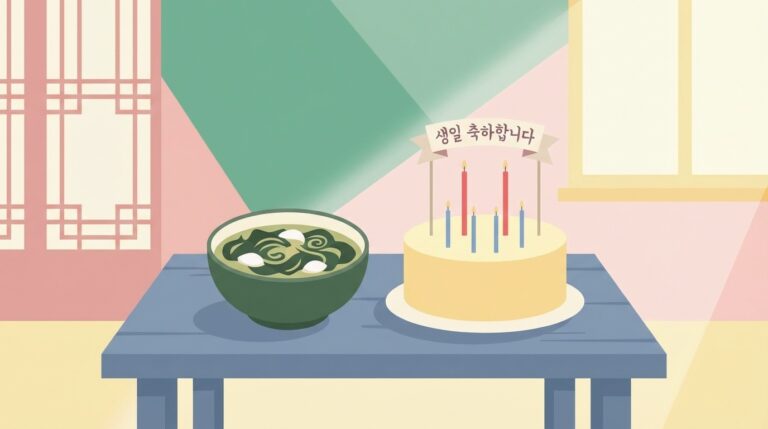
Phase 1: Immersive Hook
Greeting: Hello! This is your Daily Hangul Senior Editor. 👋
The Scene: Picture this. You are at a bustling K-BBQ restaurant or a dimly lit Noraebang (Karaoke) in Hongdae. Suddenly, the music cuts, someone brings out a cake, and your Korean friends start clapping in a specific, slightly slow rhythm. They look at you, expecting you to join in. You know the tune—it’s the universal “Happy Birthday” melody—but the lyrics? You start mumbling “Happy Birthday to you…” in English while everyone else is belting out Korean words.
The ‘Why’: Sure, singing in English is fine. But if you can belt out the Korean lyrics, especially the emotional “I love you” part, you instantly graduate from “Foreign Guest” to “True Friend.” Plus, do you know why we ask if you’ve had seaweed soup on your birthday? It’s not just about food; it’s about deep cultural respect.
Transparency: This guide combines the standard lyrics everyone knows with the real-world slang and cultural rituals I’ve seen at hundreds of birthday parties in Seoul.
Phase 2: Deep Dive into Key Phrases
Here are the top 3 expressions you need to survive a Korean birthday party.
1. 생일 축하합니다 (Saeng-il chuk-ha-ham-ni-da)
- Pronunciation: [Saeng-il chuk-ha-ham-ni-da]
(Tip: ‘Chuk-ha’ sounds like the ‘chu’ in a sneeze + ‘ka’. Don’t pronounce the ‘H’ too strongly.)- Meaning: Happy Birthday (Formal/Standard)
- K-Culture Moment: This is the chorus you hear in every K-Drama when the protagonist walks into a surprise party. It is the standard lyric used in the song, regardless of who you are singing to.
- Editor’s Insight: Even though it ends in ‘hamnida’ (very formal), we use this specific phrase in the song for everyone—friends, family, or bosses. It fits the rhythm best!
- Situation Spectrum:
[🚫 ] ———— [⚠️ ] ———— [✅ Use Everywhere]
(Safe for everyone because it is a song lyric.)- 🤔 Think About It: Why do you think Koreans use the formal honorific form in a song even for close friends? It reflects the idea that a birthday is a solemn, respectful occasion to celebrate someone’s existence.
2. 사랑하는 [Name]의 생일 축하합니다 (Sarang-ha-neun [Name]-ui…)
- Pronunciation: [Sarang-ha-neun…]
- Meaning: Happy birthday to my beloved [Name].
- K-Culture Moment: This is the climax of the song. In K-Pop idol birthday lives, the members pause here to shout the member’s name loudly.
- Editor’s Insight: You might feel shy saying “Sarang-ha-neun” (beloved/loving) to a casual friend. But in this song, it’s mandatory! Don’t be the cool guy who skips it; it kills the vibe.
- Situation Spectrum:
[🚫 ] ———— [⚠️ ] ———— [✅ Required]
(You must sing this part!)- 🤔 Think About It: In many Western cultures, saying “I love you” to a friend might be heavy. In Korea, this song makes it socially acceptable to express affection publicly.
3. 태어나 줘서 고마워 (Tae-eo-na jwo-seo go-ma-wo)
- Pronunciation: [Tae-eo-na jwo-seo go-ma-wo]
- Meaning: Thank you for being born.
- K-Culture Moment: You’ll see this phrase written on cakes or in heartfelt letters in romantic K-Dramas (think Crash Landing on You vibes). It’s the ultimate compliment.
- Editor’s Insight: This is B1 level gold. Instead of just “Happy Birthday,” saying this implies, “My life is better because you exist in it.” Use this for close friends or romantic partners.
- Situation Spectrum:
[🚫 Bosses] ———— [⚠️ Acquaintances] ———— [✅ Close Friends/Lovers]
Phase 3: Textbook vs. Real Life
| Situation | 📖 Textbook Korean | 🗣️ Real Korean | 💡 Why the difference? |
|---|---|---|---|
| Writing a card | 생일 축하해요 (Saeng-il chuk-ha-hae-yo) | 생일 축하해! HBD! or 생축! (Saeng-chuk) | “Saeng-chuk” is a slang abbreviation for speed and closeness among Gen Z/Alpha. |
| Asking about food | 미역국 드셨어요? (Did you eat seaweed soup?) | 미역국은 먹었냐? (Did you eat seaweed soup?) | The latter is affectionate scolding among friends, checking if they are taking care of themselves. |
| Receiving a gift | 감사합니다 (Thank you) | 대박! 뭘 이런 걸 다… (Daebak! Why did you get this…) | Koreans often show politeness by pretending the gift is “too much” before accepting it. |
Bottom Note: Only use “Saeng-chuk” with friends your age or younger. If you say this to your boss, you might need to find a new job! 😅
Phase 4: Cultural Context — K-Culture Deep Dive
4-1. Non-verbal: The “Birthday Beat”
When singing the Korean birthday song, the clapping isn’t a fast, jazzy 4/4 beat. It’s often a bit slower, more deliberate, and rhythmic. Watch the people around you and match their clapping speed to avoid being the “rushing foreigner.”
4-2. K-Food Connection: The Mystery of Seaweed Soup (Miyeok-guk)
If you watch K-Dramas, you know the birthday person must eat Miyeok-guk (Seaweed Soup).
- The Context: Traditionally, Korean mothers eat nutrient-rich seaweed soup for weeks after giving birth to recover.
- The Meaning: By eating this soup on your birthday, you aren’t just celebrating yourself; you are honoring your mother’s suffering and love on the day she gave birth to you.
- Critical View: Is it a birthday party or a “Thank You Mom” party? In Korea, individual identity is deeply tied to family. Your birth is a family achievement, not just a personal one.
Phase 5: Immersive Roleplay
Setting: Friday night at a lively Pocha (Korean pub). The table is full of snacks. A cake with lit candles is in the center.
Characters:
* YOU: An expat invited to a close Korean friend’s party.
* Minji: The birthday girl (your close friend).
* Jun-ho: Another friend, holding the cake.
(The group finishes singing the song…)
Jun-ho: (Loudly) 자, 소원 빌고 촛불 끄자! 🎂
(Ja, so-won bil-go chot-bul kkeu-ja!)
(Okay, make a wish and blow out the candles!)
Minji: (Closing eyes) 음… (She makes a wish and blows the candles. 🌬️)
Everyone: 와아아!! 👏👏👏 (Cheering)
YOU: 민지야, 생일 진심으로 축하해. 🎉
(Minji-ya, saeng-il jin-sim-eu-ro chuk-ha-hae.)
(Minji, I genuinely congratulate your birthday.)
Minji: 고마워! 와주서 정말 기뻐.
(Go-ma-wo! Wa-jwo-seo jeong-mal gi-ppeo.)
(Thanks! I’m really happy you came.)
🔀 Decision Point: How do you deliver the gift?
- A) Just hand it over silently.
- B) “오다가 주웠어.” (I picked it up on the way.)
- C) “이거 별거 아니야.” (This is nothing special.)
✅ Best Choice: C — “Igeo byeol-geo a-ni-ya.” This is standard humility. It lowers expectations and shows modesty.
😎 Cool Choice: B — “O-da-ga ju-wos-seo.” This is a classic Tsundere (cold outside, warm inside) phrase made famous in older K-Dramas. It implies “I didn’t try too hard,” but everyone knows you did. Funny for close friends!
Phase 6: 10-Second Shadowing Drill
Practice this sentiment to sound natural!
😊 Emotion: Warm & Sincere
Sentence: 태어나 / 줘서 / 정말 / 고마워!
Romanization: Tae-eo-na / jwo-seo / jeong~mal / go-ma-wo!
Meaning: Thank you / so much / for / being born!
Phase 7: K-Culture Mini Glossary
| Korean | Romanization | Meaning | Context |
|---|---|---|---|
| 기프티콘 | Gifticon | Mobile Gift Voucher | The most common birthday gift in Korea (Starbucks, Cake, Chicken) sent via KakaoTalk. |
| 쏘다 | Sso-da | To treat/pay | On your birthday in Korea, you usually pay for the meal (sso-da) for your friends! |
| 만나이 | Man-nai | International Age | Korea recently adopted the international age system legally, but in social settings, the “Korean Age” confusion still exists. |
Phase 8: Traveler’s Survival Kit (Bakery Edition)
Buying a cake in Korea can be tricky if you don’t know the hidden tools!
🆘 Survival Expression #1: Asking for candles
* 🇰🇷 “초는 몇 개 드릴까요?” (Cho-neun myeot gae deu-ril-kka-yo?) – Clerk asking you.
* 🗣️ Your Answer: “큰 거 2개, 작은 거 5개 주세요.” (Big ones 2, small ones 5 please.)
* Big candle = 10 years, Small candle = 1 year. (e.g., 25 years old)📌 Editor’s Pro Tip: Where are the matches?
You bought a cake but can’t find matches? Check the plastic knife! The handle of the cake knife usually has a hidden cap. Pop it open, and you’ll find matches and a striker inside. Don’t buy a lighter at the convenience store like I did my first year! 🤯
Phase 9: Think Deeper — “Food & Identity”
Why do we eat Seaweed Soup (Miyeok-guk)?
In many Western cultures, birthdays are about the individual—my party, my cake, my day. But in Korea, the central dish, Miyeok-guk, shifts the focus to the mother. It is the food the mother ate to recover after labor. By eating it, the child acknowledges, “I am here because of my mother’s pain and effort.”
This reflects the Collectivism deeply rooted in Korean society. Even on the day that is most about you, you are reminded that you are part of a lineage.
💬 Your Turn: Does your country have a birthday food that honors parents? Or is it purely about the birthday person? Let me know in the comments!
Phase 10: FAQ & Troubleshooting
- Q: Can I just say “Happy Birthday” in English?
- A: Yes! Everyone understands “Happy Birthday.” But adding “축하해” (Chuk-ha-hae) makes it 10x warmer.
- Q: What is a “Lunar Birthday” (음력 생일)?
- A: Older generations (parents/grandparents) often celebrate their birthday according to the Lunar Calendar, so the date changes every year. Always check with your Korean friend: “Do you follow Solar (양력) or Lunar (음력)?”
- ❌ Common Mistake: blowing out candles immediately.
- Fix: Wait for the song to finish completely. And please, don’t spit on the cake while blowing! (Koreans are very hygiene-conscious post-pandemic).
Phase 11: Wrap-up & Action Items
One-Liner: Singing the Korean lyrics and understanding the “Seaweed Soup” meaning is the key to Korean hearts.
🚀 Action Missions:
* 🥉 Bronze: Look in the mirror and practice “Tae-eo-na jwo-seo go-ma-wo” until you don’t stutter.
* 🥈 Silver: Next time you see a “HBD” story on Instagram, reply with “생일 축하해요!” instead of English.
* 🥇 Gold: Go to a Korean bakery (like Paris Baguette) and find the matches hidden in the knife handle!
📺 K-Culture Mission: Watch a “Birthday V-Live” (or Weverse Live) replay of your favorite K-Pop idol. Wait for the moment they blow out the candles and listen to what they say. Do they mention Miyeok-guk?
Phase 12: Interactive Quiz
- Situation: Your Korean friend Minji turns 24. How many candles do you ask for?
- a) 24 small candles.
- b) 2 Big, 4 Small.
- c) Just one big one.
- Culture: Why does your friend hit you playfully when you say “O-da-ga ju-wos-seo” (Picked it up on the way) while giving a gift?
- a) They are offended.
- b) They know you are joking and trying to be cool (Tsundere).
- c) They think you actually found it in the trash.
Answers:
1. (b) – Big = 10 years, Small = 1 year.
2. (b) – It’s a classic joking phrase that shows intimacy.
Frequently Asked Questions (FAQ)
Q: What does "생일 축하합니다 (Saeng-il chuk-ha-ham-ni-da)" mean in Korean and how do you pronounce it?
A: In Korean, "생일 축하합니다 (Saeng-il chuk-ha-ham-ni-da)" is pronounced [Saeng-il chuk-ha-ham-ni-da] and means: Happy Birthday (Formal/Standard)
Q: What does "사랑하는 [Name]의 생일 축하합니다 (Sarang-ha-neun [Name]-ui...)" mean in Korean and how do you pronounce it?
A: In Korean, "사랑하는 [Name]의 생일 축하합니다 (Sarang-ha-neun [Name]-ui...)" is pronounced [Sarang-ha-neun...] and means: Happy birthday to my beloved [Name].
Q: What does "태어나 줘서 고마워 (Tae-eo-na jwo-seo go-ma-wo)" mean in Korean and how do you pronounce it?
A: In Korean, "태어나 줘서 고마워 (Tae-eo-na jwo-seo go-ma-wo)" is pronounced [Tae-eo-na jwo-seo go-ma-wo] and means: Thank you for being born.







