

Phase 1: Immersive Hook
Hello! It’s your Daily Hangul Editor. 👋
Imagine this scene: You’ve just binged a K-Drama where the protagonist, exhausted by the cutthroat corporate life in Seoul, escapes to a quiet temple in the mountains to find themselves. The scene shifts from the neon lights of Gangnam to the sound of wind chimes and rustling leaves. 🍃
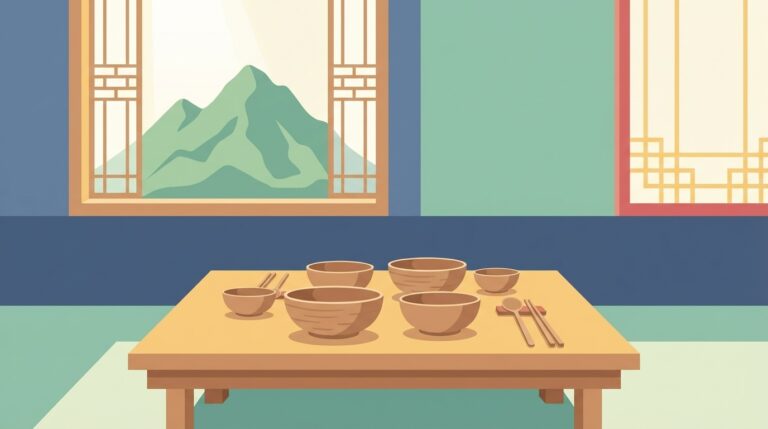
Or perhaps you saw that famous Chef’s Table episode on Netflix featuring Jeong Kwan snim, and you were mesmerized by how she treats food not just as fuel, but as a spiritual practice. Now, you are actually there. You’ve booked a Templestay. You’re sitting on the floor, legs crossed, in front of a wooden table.
The air is silent. A monk looks at you kindly but expectantly. Everyone picks up their bowls. You’re hungry, but you realize this isn’t a BBQ restaurant where you shout “Over here!” (여기요!).
If you treat a temple meal like a visit to a K-BBQ joint, things will get awkward very fast. Temple food, or 사찰 음식 (Sachal Eumsik), is the original Korean slow food/vegan dining. Today, let’s learn the language of mindfulness that will make you look like a pro during your spiritual detox. 🧘♀️
Phase 2: Deep Dive into Key Expressions
1. 공양 (Gongyang)
- Pronunciation: [Gong-yang] Sounds like ‘Gong’ (like a bell) + ‘yang’ (like yin-yang)
- Meaning: Meal / Offering (Buddhist term)
- K-Culture Moment: In historical dramas or serious melodramas, you might hear a monk ask, “공양하셨습니까?” (Have you had your meal?). It’s not just “Did you eat?”—it implies receiving food with gratitude.
- Editor’s Insight: In the secular world, we say 식사 (Siksa) or 밥 (Bap). But inside a temple, eating is a religious practice. Using the word 공양 instantly shows you respect their culture. It elevates the act of eating to something sacred.
- Situation Spectrum:
[🚫 Casual Friends] ———— [⚠️ Standard Formal] ———— [✅ Temple/Religious] - 🤔 Think About It: Why does Korean have a specific religious vocabulary for “eating”? How does changing the word change your attitude toward the food on your plate?
2. 남기지 않겠습니다 (Namgiji an-get-seumnida)
- Pronunciation: [Nam-gi-ji an-get-seum-ni-da]
- Meaning: I will not leave anything behind (I will finish everything).
- K-Culture Moment: You know those K-Variety shows like 2 Days & 1 Night where they play games to win food? In temples, the “game” is strict: Zero Waste. Every grain of rice must be eaten.
- Editor’s Insight: This isn’t just about being polite. In Buddhist philosophy, leaving food is disrespectful to the labor and nature that created it. This phrase is your commitment to that philosophy.
- Situation Spectrum:
[🚫 Casual Friends] ———— [⚠️ Restaurant] ———— [✅ Temple/Formal Event] - 🤔 Think About It: In many Western cultures, leaving a little food can signal that you are full. In Korea, especially in temples, a clean bowl is the highest compliment. Why the difference?
3. 오신채는 빼 주세요 (Osinchae-neun ppae juseyo)
- Pronunciation: [O-sin-chae-neun ppae ju-se-yo]
- Meaning: Please exclude the five pungent vegetables.
- K-Culture Moment: If you are a strict vegetarian K-Pop fan, you know this struggle! Osinchae refers to garlic, green onions, chives, onions, and leeks. These are banned in temple food because they are believed to disturb meditation.
- Editor’s Insight: Even if you aren’t at a temple, if you are a strict vegetarian visiting a regular restaurant, asking for food without 오신채 (if they understand the term) or specifically garlic/green onions is crucial.
- Situation Spectrum:
[🚫 Casual Chat] ———— [⚠️ Regular Restaurant] ———— [✅ Temple/Strict Vegan] - 🤔 Think About It: Can you imagine Korean food without garlic? It seems impossible, right? Yet, temple food is considered the root of Korean cuisine. What does this tell us about the versatility of Korean flavors?
Phase 3: Textbook vs. Real Life
| Situation | 📖 Textbook Korean | 🗣️ Real Temple Korean | 💡 Why the difference? |
|---|---|---|---|
| Saying “Thank you for the meal” | 잘 먹겠습니다 (Jal meok-get-seumnida) | 감사히 먹겠습니다 (Gamsahi meok-get-seumnida) | “Jal” implies enjoyment/taste. “Gamsahi” focuses on gratitude for the offering. |
| Calling a monk | 저기요 / 스님 (Jeogiyo / Seunim) | 스님 (Seunim) with a bow | Never use “Jeogiyo” (Hey over there) to a monk! It’s too casual/rude. |
| Saying “I’m full” | 배불러요 (Bae-bul-leoyo) | 양은 충분합니다 (Yang-eun chungbun-hamnida) | “I’m full” focuses on your belly. “The amount is sufficient” focuses on modesty. |
Bottom Note: Inside a temple, silence is golden. Often, a bow replaces words entirely. Use verbal expressions sparingly.
Phase 4: Cultural Deep Dive — The Art of Silence 🤫
4-1. Non-verbal Communication: The “Baru” Hold
In a formal monastic meal (Barugongyang), you don’t just eat; you meditate.
* Nunchi (Eye-measure): You must eat at the same speed as others. Do not finish first; do not finish last. Watch the senior monk.
* Posture: Hold your bowl (Baru) with two hands close to your mouth. Do not bend your neck down to the table like a dog. This is considered dignified.
4-2. K-Culture Connection: The “Healing” Trope
In dramas like My Liberation Notes or Hospital Playlist, characters often seek nature or temples when they are burnt out. The Templestay is the ultimate “Main Character Energy” moment for healing.
* The Vibe: It’s not about the food tasting “delicious” (spicy/salty/sweet). It’s about the food tasting “clean” (담백하다 – dambaekhada). If you want to sound like a local foodie critic, use this word: “This food is very dambaekhada.”
Phase 5: Immersive Roleplay 🎭
Setting: Lunchtime at a serene temple in Jirisan Mountain. You are participating in a Templestay program. You are sitting across from Hye-min, a temple volunteer (NPC).
Characters:
* YOU: A foreign visitor trying to respect the culture.
* Hye-min: A helpful Korean volunteer, softly spoken.
Dialogue:
Hye-min: (Whispering) 보살님, 여기 음식은 뷔페식이에요. 드실 만큼만 덜으세요.
(Bosallim, yeogi eumsig-eun bwinpesig-ieyo. Deusil mankeumman deoreuseyo.)
(Traveler, the food here is buffet style. Please take only as much as you can eat.)
🎭 Stage Direction: She hands you a wooden bowl and spoon.
YOU: 아, 네. [ 1. Make a choice ]
🔀 Your Turn! How do you respond?
* A) “남기면 벌금 있나요?” (Is there a fine if I leave leftovers?)
* B) “욕심내지 않고 조금만 담겠습니다.” (I won’t be greedy and will take just a little.)
* C) “고기는 없나요?” (Is there no meat?)✅ Best Choice: B — This perfectly captures the Buddhist spirit of non-greed (Musoyu).
⚠️ Choice A Analysis: While practical, it sounds a bit too transactional for a temple.
(Continuing with Choice B…)
Hye-min: 네, 좋아요. 그리고 식사 중에는 묵언입니다.
(Ne, joayo. Geurigo siksa jung-eneun mugeon-imnida.)
(Yes, good. And during the meal, we practice silence.)
YOU: (Nods) 알겠습니다. 감사히 먹겠습니다.
(Alget-seumnida. Gamsahi meok-get-seumnida.)
(Understood. I will eat with gratitude.)
Hye-min: (After the meal, pointing to a kettle) 마지막에 물로 그릇을 씻어서 드셔야 해요.
(Majimag-e mullo geureuseul ssiseoseo deusyeoya haeyo.)
(At the end, you must wash the bowl with water and drink it.)
YOU: (Slightly surprised but calm) 네… 남기지 않겠습니다.
(Ne… namgiji an-get-seumnida.)
(Yes… I will not leave anything behind.)
Phase 6: 10-Second Shadowing Drill 🗣️
Let’s practice the ultimate phrase for polite dining in a spiritual setting. Focus on a calm, low tone.
“Please help me realize the value of this food.”
🙏 Polite & Spiritual:
이 음식이 / 어디서 왔는지 / 생각하겠습니다.
(I eumsigi / eodiseo wanneunji / saeng-gaka-get-seumnida.)Meaning: I will think about / where this food / came from.
Phase 7: K-Culture Mini Glossary 📘
| Korean | Romanization | Meaning | Context |
|---|---|---|---|
| 발우공양 | Baru-gongyang | Monastic Meal | A formal, ritualized meal using wooden bowls. |
| 묵언 | Mug-eon | Vow of Silence | Often written on signs. It means “No chatting.” |
| 보살님 | Bosal-nim | Bodhisattva | In temples, laywomen are often addressed respectfully as “Bosallim” (meaning you have a Buddha nature). |
| 채식 | Chaesik | Vegetarian | The general term for vegetarian diet. |
| 비건 | Bigeon | Vegan | A loanword widely used in Korea now for strict vegetarians. |
Phase 8: Traveler’s Survival Kit 🎒
Even if you aren’t in a temple, being a vegetarian in Korea can be tricky because Kimchi often has salted shrimp, and soups have anchovy broth. Here is your survival card.
🆘 Survival Card: The Vegetarian Filter
* 🇰🇷 “저는 고기랑 해산물을 못 먹어요.” (Jeoneun gogirang haesanmureul mon-meogeoyo.)
* I can’t eat meat and seafood.
* 🇰🇷 “육수(broth)에 고기나 멸치 들어갔나요?” (Yuksue gogina myeolchi deureogannayo?)
* Is there meat or anchovy in the broth? (Critical for soups!)
* 🇰🇷 “비건 옵션 있나요?” (Bigeon opsyeon innayo?)
* Do you have a vegan option? (Works in trendy areas like Hongdae/Itaewon)📌 Editor’s Travel Note
* HappyCow App: This app is a lifesaver for finding vegan spots in Seoul.
* Bibimbap Hack: If you are stuck in a random restaurant, order Bibimbap and say “Gogi ppae juseyo” (No meat, please). It’s the safest bet!
Phase 9: Think Deeper — “Food and Identity” 🧠
Why is eating alone (Honbap) historically weird in Korea?
In Korea, “Have you eaten?” (밥 먹었어?) is a greeting asking “How are you?”. Food is the glue of the community (Jeong, 정). Sharing side dishes (Banchan) from the same table symbolizes that we are “family” or “team.”
However, the Temple Food experience is the opposite. You face your own bowl. You eat in silence. It forces you to confront your own greed and hunger without the distraction of social chatter.
💬 Your Turn: In your culture, is a meal a time for loud celebration or quiet nourishment? How would you feel eating in total silence with strangers?
Phase 10: FAQ & Troubleshooting 🛠️
Q: Can I drink alcohol during a Templestay?
A: Absolutely NO. 🚫 Drinking alcohol in the temple grounds is strictly forbidden and can get you expelled. Save the Soju for when you return to the city.
Q: Do I have to shave my head to do a Templestay?
A: No! 😂 You are a guest, not a monk. You just need to wear the comfortable uniform they provide.
Q: Is temple food always bland?
A: Not at all. It uses aged soy sauce (Ganjang) and soybean paste (Doenjang) that might be older than you! The flavors are deep and complex, just not spicy or garlicky.
❌ Common Mistake: Leaving your chopsticks stuck vertically in the rice bowl.
✅ Fix it: This looks like incense for a funeral. Always place your chopsticks on the table or the bowl rest.
Phase 11: Wrap-up & Mission 🚀
One-Liner: Temple food isn’t just a meal; it’s a meditation where you “eat with gratitude” (감사히 먹겠습니다) and leave nothing behind.
🎯 Action Missions:
* 🥉 Bronze: Look at your next meal and say aloud, “Gamsahi meok-get-seumnida” before eating.
* 🥈 Silver: Post a photo of a healthy meal on social media with the hashtag #TempleFoodVibes and write “Namgiji an-get-seumnida” in the caption.
* 🥇 Gold: Go to a Korean restaurant, order a veggie dish, and successfully ask “Does this broth have meat in it?” (Yuksue gogi deureogannayo?).
🎬 K-Culture Mission: Watch the “Jeong Kwan” episode of Chef’s Table (Netflix) or a clip of I Live Alone (Templestay episode) to see the visual difference in dining etiquette!
Phase 12: Quiz — Interactive Challenge 🧩
1. Situation Judgment:
A monk pours you tea. What is the most polite thing to do?
* A) Hold the cup with one hand and drink immediately.
* B) Hold the cup with two hands, bow slightly, and wait for the monk to drink first.
* C) Say “Cheers!” and clink glasses with the monk.
2. True or False:
* “In a temple, it is polite to leave a little bit of rice to show you are full.”
* (True / False)
Answers:
1. B (Two hands = Respect. Clinking glasses is for the pub!)
2. False (In a temple, you must finish everything, even the water used to clean the bowl, to show non-wastefulness.)
Frequently Asked Questions (FAQ)
Q: What does "공양 (Gongyang)" mean in Korean and how do you pronounce it?
A: In Korean, "공양 (Gongyang)" is pronounced [Gong-yang] and means: Meal / Offering (Buddhist term)
Q: What does "남기지 않겠습니다 (Namgiji an-get-seumnida)" mean in Korean and how do you pronounce it?
A: In Korean, "남기지 않겠습니다 (Namgiji an-get-seumnida)" is pronounced [Nam-gi-ji an-get-seum-ni-da] and means: I will not leave anything behind (I will finish everything).
Q: What does "오신채는 빼 주세요 (Osinchae-neun ppae juseyo)" mean in Korean and how do you pronounce it?
A: In Korean, "오신채는 빼 주세요 (Osinchae-neun ppae juseyo)" is pronounced [O-sin-chae-neun ppae ju-se-yo] and means: Please exclude the five pungent vegetables.







