

“My Watch Says I’m Stressed!”: Master Korean Health Tech Vocabulary (IoT Edition)
Phase 1: The Immersive Hook
안녕하세요! Daily Hangul’s Senior Editor here.
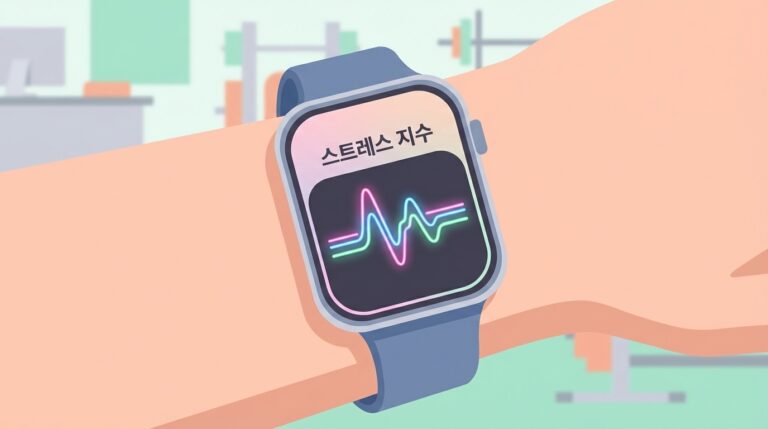
Imagine this scene from a recent K-Drama: The protagonist, a high-flying CEO, suddenly clutches their chest in a sleek Gangnam office. But before they collapse, their wrist buzzes. A close-up shot of their smartwatch flashes red: “스트레스 지수 높음” (High Stress Level).
In real life, you might not be a drama CEO, but if you’re living in Korea—one of the most connected societies in the world—you’ll see people constantly checking their wrists. They aren’t just checking the time; they are obsessing over their 만보 (10,000 steps) or complaining about their 수면 점수 (sleep score).
At the C1 level, saying “I exercised” (운동했어요) isn’t enough. You need to talk data, synchronization, and analysis. Today, we dive into the Korean language of Quantified Self—how to discuss the healthcare data on your wearable device like a true tech-savvy Seoulite.
Phase 2: Deep Dive — Key Expressions
1. 연동되다 (To be synced/interlocked)
- Pronunciation: [yeondong-doeda] (Sounds like: yawn-dong + doe-da)
- Meaning: While 연결하다 means simply “to connect” (like Bluetooth), 연동되다 implies a deeper integration where data flows between systems (e.g., watch to phone, or phone to hospital app).
- K-Culture Moment: You buy a new smart scale. Your Korean friend asks, “Is it synced with your health app?” If it’s not, it’s just a dumb scale.
- Editor’s Insight: This is a crucial passive verb in the IoT world. It sounds much more professional and technical than just saying “working together.”
- Situation Spectrum:
[🚫 Formal Ban] ———— [⚠️ Caution] ———— [✅ Free to Use]- Friends: ✅
- Colleagues: ✅
- Tech Support/Doctors: ✅ (Standard terminology)
- 🤔 Think About It: Why does Korean distinguish between connection (connection) and interlocking motion (synchronization)? It reflects a desire for precision in engineering and relationships.
2. 수치를 측정하다 (To measure numerical values/stats)
- Pronunciation: [suchireul cheukjeong-hada]
- Meaning: “To measure the figures/data.”
- K-Culture Moment: In a gym (Health Club), trainers don’t just guess your weight. They put you on an InBody machine to measure your muscle mass and fat percentage down to the decimal.
- Editor’s Insight: Don’t use 재다 (to measure length/weight casually) here. In an IoT/Medical context, 측정하다 adds authority and scientific validity.
- Situation Spectrum:
- Casual Chat: ⚠️ (Can sound too formal, try “나왔어” – came out)
- Medical/Tech Context: ✅
3. 목표를 달성하다 (To achieve a goal)
- Pronunciation: [mokpyoreul dalseong-hada]
- Meaning: To achieve/attain a target.
- K-Culture Moment: Every evening in Korea, you might hear a chime from someone’s wrist. It’s the “Goal Achieved” notification. Koreans are goal-oriented; hitting that man-bo (10,000 steps) is a daily mission for many office workers.
- Editor’s Insight: This phrase is widely used in business, but equally common in fitness apps. It carries a nuance of effort and final success.
Phase 3: Textbook vs. Real Life
| Situation | 📖 Textbook Korean | 🗣️ Real Korean (Insiders) | 💡 Why the difference? |
|---|---|---|---|
| Checking sleep data | “어제 잠을 잘 잤는지 확인했어요.” (I checked if I slept well yesterday.) | “오늘 수면 점수 완전 망했어.” (My sleep score is totally ruined today.) | Young Koreans treat health metrics like game scores (Gamification). |
| Heart rate alert | “심장 박동 수가 높습니다.” (Heart beat count is high.) | “심박수 튀었다.” (Heart rate bounced/spiked.) | 튀다 provides a vivid image of a sudden, abnormal jump on a graph. |
| Data Syncing | “정보가 전화기로 보내집니다.” (Information is sent to the phone.) | “앱이랑 동기화 됐어?” (Is it synchronized with the app?) | 동기화 (Synchronization) is the precise IT term used in UI/UX. |
Bottom Note: At the C1 level, using nouns like 점수 (score) or 수치 (figures) makes you sound more analytical than using descriptive verbs alone.
Phase 4: Cultural Deep Dive — The “Body Profile” Obsession
4-1. The Quantification of Health
In Korea, health is often visualized as data. The trend of “Body Profile” (바디 프로필)—where ordinary people diet strictly for months to take professional model-like photos—drives the usage of wearable health tech. It’s not just about “feeling healthy”; it’s about proving it with numbers (body fat %, muscle mass kg).
4-2. K-Drama Trope: The “Stress Warning”
Have you noticed in office dramas, the smartwatch is a storytelling device? It objectively validates the character’s suffering.
– Critical View: While efficient, does this reliance on data disconnect us from our actual body sensations? Koreans often ignore pain until the machine tells them something is wrong.
Phase 5: Immersive Roleplay
Setting: A Monday morning in the office pantry. You (a foreign manager) and Min-ji (a health-conscious Korean colleague) are getting coffee.
Characters:
– YOU: Wearing the latest Galaxy Watch. Trying to improve sleep habits.
– Min-ji: 29, always carries protein shakes, obsessed with health stats.
Dialogue:
Min-ji: 과장님, 주말 잘 보내셨어요? 안색이 좀 피곤해 보이시는데요. ☕
(Gwanjang-nim, jumal jal bonaesyeosseoyo? Ansaegi jom pigonhae boisineundeyo.)
[Manager, did you have a good weekend? You look a bit tired.]
(Stage Direction: Min-ji glances at your wrist.)
YOU: 네, 사실 어제 잠을 좀 설쳤어요. 워치 보니까 수면 질이 엉망이더라고요.
(Ne, sasil eoje jameul jom seolchyeosseoyo. Watch bonikka sumyeon jil-i eongmang-ideoragoyo.)
[Yes, actually I tossed and turned yesterday. I looked at my watch and the sleep quality was a mess.]
Min-ji: 아, 진짜요? 깊은 수면 시간이 짧게 나오던가요?
(Ah, jinjja-yo? Gipeun sumyeon sigani jjalge naodongayo?)
[Ah, really? Did it say your deep sleep time was short?]
🔀 Decision Point! How do you describe the data?
A) “네, 그래프가 계속 빨간색이었어요. 스트레스 지수도 높게 측정됐고요.”
(Yes, the graph kept showing red. The stress index was measured high too.)
B) “그냥 기계가 나쁘다고 했어요.”
(Just the machine said it was bad.)
C) “수면 점수가 50점대라니, 충격적이죠?”
(My sleep score is in the 50s, shocking right?)✅ Best Choice: A or C.
Why? Option A uses specific terminology (그래프, 스트레스 지수, 측정) suitable for C1 level. Option C uses the “score” concept which is very natural in Korean casual/semi-formal chat.
⚠️ Choice B Analysis: Too simple for your level and lacks the “tech” nuance we are aiming for.
YOU (Choosing A): 네, 맞아요. 스트레스 지수도 높게 측정됐어요. 운동 부족인가 봐요.
(Ne, majayo. Stress jisu-do nopge cheukjeong-dwaesseoyo. Undong bujokinga bwayo.)
[Yes, correct. The stress index was measured high, too. I guess it’s lack of exercise.]
Min-ji: 그럼 오늘 점심에 저랑 회사 헬스장 가실래요? 기구들이랑 워치 연동하면 기록하기 편해요!
(Geureom oneul jeomsime jeorang hoesa health-jang gasillaeyo? Gigudeul-irang watch yeondong-hamyeon girok-hagi pyeonhaeyo!)
[Then want to go to the company gym with me at lunch? If you sync the machines with your watch, it’s easy to record!]
Phase 6: 10-Second Shadowing Drill
Let’s practice complaining about your health stats like a native.
😤 (Frustrated/Worried)
아니, / 아무것도 안 했는데 / 심박수가 왜 이렇게 / 튀는 거야?
(Ani, / amugeotdo an haenneunde / simbaksu-ga wae ireoke / twineun geoya?)
“No way, / I didn’t do anything / so why is my heart rate / spiking like this?”
- Focus: Stress the word 튀는 (spiking) to show your disbelief.
- Break: Pause after ‘아니’ to set the mood.
Phase 7: K-Culture Glossary (Health Tech Edition)
| Korean | Romanization | Meaning | Context |
|---|---|---|---|
| 인바디 | InBody | Body Composition Analysis | Originally a brand name, now a generic noun for body analysis (muscle/fat). “인바디 재러 가자.” (Let’s go measure InBody.) |
| 만보 | Man-bo | 10,000 Steps | The golden standard for daily activity in Korea. |
| 홈트 | Hom-teu | Home Training | Working out at home using YouTube or Apps (very popular since pandemic). |
| 스마트 밴드 | Smart Band | Fitness Tracker | Distinguished from a full ‘Smart Watch’. Focuses on tracking. |
| 활력 징후 | Hwallyeok Jinghu | Vital Signs | Used in medical settings or advanced health apps. |
Phase 8: Traveler’s Survival Kit (Medical/Pharmacies)
Even if you aren’t living in Korea, you might need to show your health data to a pharmacist or doctor if you feel sick.
🆘 Survival Tech-Talk #1
– 🇰🇷 “제 워치 기록 좀 봐주시겠어요?” (Je watch girok jom bwajusigesseoyo?)
– 🗣️ Meaning: “Could you please look at my watch records?”
– 📍 Use when: Showing your heart rate history or sleep patterns to a doctor.🆘 Survival Tech-Talk #2
– 🇰🇷 “이 앱이랑 호환되나요?” (I app-irang hohwan-doenayo?)
– 🗣️ Meaning: “Is it compatible with this app?”
– 📍 Use when: Buying smart devices or gym equipment in Korea.📌 Editor’s Note: Korean doctors are very tech-literate. Don’t be shy about showing them your Apple Health or Samsung Health data. It’s often welcomed as good reference material.
Phase 9: Critical Thinking — “Gamification of Health”
Think Deeper:
Korean culture often emphasizes quantification—ranking in schools, specs for jobs, and now, scores for health. Wearable devices give us a “Sleep Score” or “Body Battery” score out of 100.
Does this “Gamification” (게임화) help Koreans stay healthy, or does it add another layer of stress to achieve a “perfect score” even in sleep? In your culture, is health discussed in numbers and scores, or more in terms of feeling and intuition?
💬 Your Turn: How would you translate “I feel under the weather” vs. “My stats are low”? Which feels more natural to you?
Phase 10: FAQ & Troubleshooting
Q: Can I use the word ‘기계’ (Machine) for my Apple Watch?
A: You can, but it sounds like you are talking about heavy machinery. Use ‘기기’ (device) or just ‘워치’ (watch). ‘웨어러블 기기’ is the formal term.
Q: Is it rude to check my watch during a meeting/dinner?
A: YES. Even if you are checking a health alert, older Koreans might think you are bored or checking the time. If you must, explain: “죄송합니다, 중요 알림이 와서요.” (Sorry, I got an important notification.)
❌ Common Mistake:
Don’t say “내 건강을 계산하고 있어” (I am calculating my health).
✅ Say “내 건강 상태를 체크/기록하고 있어” (I am checking/recording my health condition).
Phase 11: Wrap-up & Action Mission
One-Liner: To sound like a C1 speaker, stop saying “good/bad” and start talking about “measuring, analyzing, and syncing.”
🎯 Action Missions:
– 🥉 Bronze: Change your phone/watch language to Korean for 1 hour. Find the word ‘건강’ (Health) and ‘설정’ (Settings).
– 🥈 Silver: Go to a Korean tech store (or website like Coupang) and read the specs of a smartwatch. Look for the word ‘측정’ (Measure).
– 🥇 Gold: Post a screenshot of your daily step count on social media with the caption: “오늘 만보 달성! 뿌듯하다.” (Achieved 10k steps today! So proud.)
K-Culture Mission: Watch a “Body Profile” preparation vlog on YouTube (Search: 바디프로필 준비). Notice how many times they mention ‘인바디’ and ‘수치’.
Phase 12: Interactive Quiz
1. Fill in the blank:
“새로 산 체중계가 핸드폰 앱이랑 ______이 안 돼.”
(My new scale won’t ______ with my phone app.)
- A) 결혼 (Marriage)
- B) 연동 (Syncing/Interlocking)
- C) 약속 (Promise)
2. True or False (Culture):
In Korea, it is considered very strange and medical to refer to your muscle mass or body fat percentage in casual conversation.
– (True / False)
Answers:
1. B) 연동. This is the core IoT vocabulary word!
2. False. Thanks to the fitness boom, discussing InBody results (muscle mass, body fat) is very common among friends and colleagues over lunch.
Frequently Asked Questions (FAQ)
Q: What does "연동되다 (To be synced/interlocked)" mean in Korean and how do you pronounce it?
A: In Korean, "연동되다 (To be synced/interlocked)" is pronounced [yeondong-doeda] and means: While 연결하다 means simply "to connect" (like Bluetooth), 연동되다 implies a deeper integration where data flows between systems (e.g., watch to phone, or phone to hospital app).
Q: What does "수치를 측정하다 (To measure numerical values/stats)" mean in Korean and how do you pronounce it?
A: In Korean, "수치를 측정하다 (To measure numerical values/stats)" is pronounced [suchireul cheukjeong-hada] and means: "To measure the figures/data."
Q: What does "목표를 달성하다 (To achieve a goal)" mean in Korean and how do you pronounce it?
A: In Korean, "목표를 달성하다 (To achieve a goal)" is pronounced [mokpyoreul dalseong-hada] and means: To achieve/attain a target.







