

Phase 1: The Immersive Hook
Greeting:
Hello, language enthusiasts! This is your Senior Editor at Daily Hangul, back with another deep dive into the soul of Korea.
The K-Culture Cold Open:
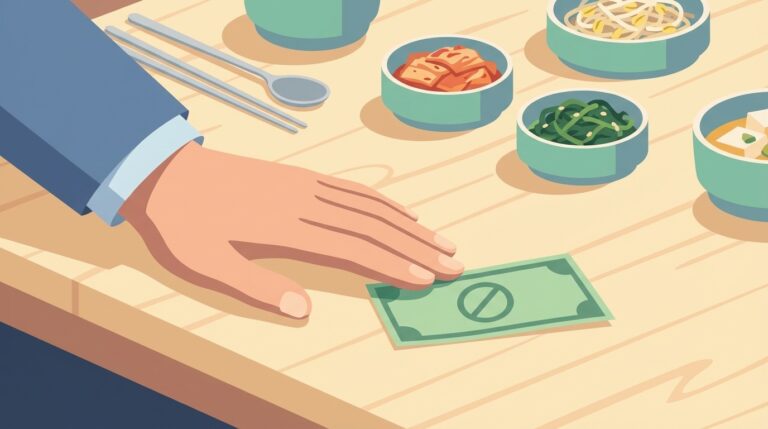
Picture this: You are watching a tense scene in a K-Drama. The protagonist, a hardworking part-timer at a BBQ restaurant, chases a customer out onto the street. Is the customer a “dine-and-dash” criminal? No. The customer left a 10,000 won bill on the table as a thank you. The protagonist hands it back, breathless, saying, “You left this behind.”‘ The customer looks confused; the server looks almost insulted.
Why? Because in the script of Korean culture, money isn’t just currency—it’s pride.
The ‘Why’:
In many Western cultures, tipping is a mandatory language of gratitude. In Korea, it can be a mistranslation of respect. At a C2 (Advanced) level, we aren’t just learning how to pay; we are learning the subtle art of “Jeong” (affection) and the complex social dance of “who pays for whom.” Misunderstanding this won’t just cost you money; it might cost you ‘face.’
Transparency:
This guide synthesizes years of observing bewildered expats in Hongdae and the unspoken rules of Gangnam business dinners.
Phase 2: Deep Dive into Core Expressions
1. 마음만 받겠습니다 (Maeum-man bat-get-seumnida)
- Pronunciation: [ma-eum-man bat-get-seum-ni-da] Sounds like: “Ma-uhm-man” (My mind/heart only) + “bat-get” (bat get) + “seumnida”
- Meaning:
- Literal: I will accept only your heart/mind.
- Nuance: “I appreciate your gesture/kindness, but I cannot accept the money/gift.”
- K-Culture Moment:
Think of a historical drama where a righteous scholar refuses a bribe, or a modern rom-com where the female lead refuses money from the male lead’s rich mother. It is the ultimate shield of dignity. - Editor’s Insight:
This is the most elegant way a Korean server or host might decline your tip. It frames your offer as “kindness” (so you aren’t embarrassed) but firmly rejects the cash (maintaining their professionalism). - Situation Spectrum:
[🚫 Casual Friends] ———— [⚠️ Colleagues] ———— [✅ Formal/Service] - 🤔 Think About It:
Why does Korean culture separate “heart” (intention) from “material” (money) so distinctly in polite refusals? In a high-context society, the intention is often valued higher than the action.
2. 잘 먹었습니다 (Jal meogeot-seumnida)
- Pronunciation: [Jal meo-geot-seum-ni-da]
- Meaning:
- Literal: I ate well.
- Nuance: “Thank you for the meal (and your service).” This is your verbal tip.
- K-Culture Moment:
Every variety show ever (like I Live Alone or Running Man). When the cast leaves a restaurant, they shout this in unison to the owner (Emo-nim/Sajang-nim). It is the punctuation mark of a meal. - Editor’s Insight:
Since you cannot leave money, you must leave your voice. Leaving a restaurant silently is considered colder than not tipping in the US. Shout it out as you walk through the door! - Situation Spectrum:
[✅ Casual] ———— [✅ Formal] ———— [✅ Everywhere]
3. 오늘은 제가 쏠게요 / 제가 사겠습니다 (Oneul-eun jega ssol-geyo)
- Pronunciation: [O-neul-eun je-ga ssol-ge-yo] ‘Sso-da’ literally means ‘to shoot’ (like a gun).
- Meaning:
- Nuance: “It’s on me today.” / “I’ll treat you.”
- Editor’s Insight:
In Korea, splitting the bill (Dutch Pay) is becoming common among the younger generation (Gen Z), but in business or established friendships, the “Treat Culture” dominates. Taking turns paying (1st round me, 2nd round you) is the glue of social bonding.
Phase 3: Textbook vs. Real Life
| Situation | 📖 Textbook Korean | 🗣️ Real Korean | 💡 Why the difference? |
|---|---|---|---|
| Refusing a Tip | 팁은 필요 없습니다. (Tips are not needed.) |
서비스예요. / 됐어요. (It’s service / It’s done.) |
“Need not” sounds robotic. “Service” implies it’s a gift from the house contextually. |
| Splitting the Bill | 각자 계산합시다. (Let’s calculate separately.) |
N빵 하자! (En-bbang haja!) Or 따로 결제해주세요. |
“N-bbang” is slang from ‘1/N’. Efficiency and casual vibes dictate the slang. |
| Thanking the host | 감사합니다. (Thank you.) |
잘 먹었습니다! 사장님 최고! (Ate well! Boss is the best!) |
Simple thanks feels transactional. Koreans value emotional connection (Jeong). |
Bottom Note: “N빵” is strictly for friends. Never suggest “N빵” to your boss unless you want to be the topic of the next coffee break.
Phase 4: Cultural Deep Dive
4-1. Non-verbal Communication: The Card Ritual
In the West, you might slide a card across the table. In Korea, handing over your credit card is a ceremony.
– The Two-Hand Rule: Always pass your card with two hands (or support your right elbow with your left hand). This isn’t just about respect; it signifies that the transaction is important to you.
– Eye Contact: Don’t stare too intensely (challenging), but don’t look away (dismissive). A soft gaze at the person, then the card.
4-2. K-Culture Connection: The “Service” (서비스) Phenomenon
In K-Food culture, “Service” is not an act; it’s a noun.
– Scene: You order Soju and pork belly. Suddenly, a steamed egg pot (Gyeran-jjim) arrives. You didn’t order it. The auntie (Imo) says, “Service-ya” (It’s service).
– Logic: This is the Korean reverse-tip. Instead of you giving extra money, the owner gives extra food to build loyalty (Dan-gol culture). Attempting to tip here insults the owner’s generosity. They are the host; you are the guest.
Phase 5: Immersive Roleplay — The “Battle for the Bill”
Setting: A vibrant Gopchang (beef tripe) restaurant in Mapo-gu. Friday night. The air smells of grilling meat and camaraderie. You are with Min-ji (34, your senior colleague, ‘Sunbae’).
YOU: (Wiping mouth) Wah, that was delicious.
Min-ji: (Grabbing the bill) 가자. 내가 낼게. (Let’s go. I’ll pay.)
(Stage Direction: Min-ji moves toward the register with speed.)
🔀 Decision Point: What do you do?
– A) Stand there and say “Thank you.”
– B) Physically block her path and try to pay yourself.
– C) Suggest splitting the bill 50/50.
If you chose A: You are polite, but you missed a chance to show ‘Sense’ (Sens-e).
If you chose C: (Wrong Move) Unless you are peers, suggesting a split to a Sunbae can be seen as drawing a line or rejecting their care.
✅ If you chose B: This is the correct Korean “Performance.”
Dialogue Continues (Scenario B):
YOU: (Blocking her hand) 에이, 선배님! 제가 낼게요! 지난번에 사주셨잖아요.
(Ei, Sunbae-nim! Jega nael-geyo! Jinan-beone sa-ju-syeot-ja-na-yo.)
(Ay, Sunbae! I’ll pay! You bought it last time.)
Min-ji: (Pushing your hand away laughing) 됐어, 인마. 너 승진하면 그때 사.
(Dwaesseo, inma. Neo seung-jin-hamyeon geu-ttae sa.)
(Forget it, kid. You buy when you get promoted.)
YOU: 그럼… 2차는 제가 모시겠습니다!
(Geureom… 2-chaneun jega mosi-get-seumnida!)
(Then… I will escort you/treat you for the 2nd round!)
Min-ji: 오케이, 콜! (Okay, Call!/Deal!)
Phase 6: 10-Second Shadowing Drill
Let’s practice the “Verbal Tip.” Say this as you walk out the door.
Emotion: 😊 Energetic & Grateful (Bright voice!)
사장님! / 오늘도 / 잘 / 먹고 / 갑니다! / 번창하세요!
(Sajang-nim! / oneul-do / jal / meok-go / gamnida! / beon-chang-ha-se-yo!)Translation: Boss! / Today again / I ate well / and am leaving! / Please prosper (make lots of money)!
Phase 7: K-Culture Glossary
| Korean | Romanization | Meaning | Context |
|---|---|---|---|
| N빵 | N-bbang | Dutch Pay / Splitting | Slang. Derived from math variable ‘N’ + ‘Bbang’ (sharing/bread). Usage: Casual friends. |
| 총무 | Chongmu | General Affairs / Treasurer | In a group of friends traveling, one person is designated ‘Chongmu’ to handle the pooled money and pay for everything. |
| 선결제 | Seon-gyeol-je | Pre-payment | Common in cafes, food courts, and PC bangs. Don’t sit down and wait for a waiter! |
| 승인 | Seung-in | Approval | What you see on the card terminal screen. “승인 완료” (Approved). |
Phase 8: Traveler’s Survival Kit (Payment Edition)
🆘 Payment Survival Phrases
1. “영수증 주세요.” (Yeong-su-jeung ju-se-yo) – “Please give me the receipt.” (Essential for expense reports).
2. “카드 돼요?” (Kadeu dwaeyo?) – “Do you take cards?” (Almost everywhere does, even taxis, but polite to ask in tiny stalls).
3. “따로 계산할게요.” (Tta-ro gye-san-hal-ge-yo) – “We will pay separately.” (Use at cafes).📌 Editor’s Pro Tip: The Taxi Situation
While restaurants don’t tip, Taxis are a grey area. If the fare is 9,500 KRW and you give 10,000 KRW cash, you can say: “잔돈은 됐어요” (Jan-don-eun dwaesseoyo – Keep the change). This is cool, chic, and acceptable. It’s not a “tip,” it’s “avoiding the hassle of coins.”
Phase 9: Think Deeper — “Why No Tipping?”
Language & Society:
Why does offering a tip feel insulting to some Koreans? It links back to the concept of Pride (Jajonsim). In the Confucian hierarchy, receiving unearned money can feel like being treated as a beggar or a subordinate. A professional chef or server takes pride in their salary and their craft.
Also, consider the Egalitarian Ideal: The price on the menu is the final price. This transparency is valued. When you tip, you introduce a variable that suggests, “I have more money than you, so here is some charity.” In Korea, Service (generosity) flows from the top down (owner to guest), not bottom up (guest to worker).
💬 Your Turn: In your culture, is tipping an act of gratitude or an obligation? How would you feel if someone refused your money? Let me know in the comments!
Phase 10: FAQ & Troubleshooting
Q: I saw a “Tip Box” in a cafe in Itaewon. Should I put money in?
A: Itaewon is a special district with heavy Western influence. It’s not “Real Korea” in that sense. You can put spare change there, but it is absolutely not expected. In a regular neighborhood? Never.
Q: What if the service was terrible? Can I refuse to pay the service charge?
A: There is no separate “service charge” in Korea (VAT is included in the menu price). You pay the menu price. If you are unhappy, you simply never come back. That is the ultimate punishment.
❌ Common Mistake: Leaving cash on the table and walking out.
✅ Correction: The server will run after you thinking you forgot it. Always pay at the counter (POS) by the door, not at the table.
Phase 11: Wrap-up & Action Mission
One-Liner Summary: In Korea, keep your extra cash in your pocket, pay with two hands, and use your voice to “tip” the staff with gratitude.
🚀 Action Missions:
– 🥉 Bronze (Solo): Practice saying “Jal meogeot-seumnida” with a slight bow in front of a mirror.
– 🥈 Silver (Online): Comment below with the price of a Big Mac in your country (Let’s compare global costs!).
– 🥇 Gold (Real Life): Go to a Korean restaurant in your city. When leaving, catch the owner’s eye and shout, “Jal meogeot-seumnida!” Watch their face light up.
K-Culture Mission: Watch a K-Drama scene involving a team dinner (Hoesik). Look for who pays. Is it the boss? The youngest? Watch the fight for the bill!
Phase 12: Quiz — The Sense Challenge
1. Situation: You are at a cafe with a Korean friend. You ordered coffee. The friend pulls out their card.
– A) Let them pay and say nothing.
– B) Say “No! N-bbang!” and throw cash at them.
– C) Let them pay, but say “I’ll buy dessert/cake!”
2. True or False:
– “It is polite to leave 10% on the table at a high-end BBQ place.”
3. Meaning:
– What does it mean if the owner gives you a free Pepsi? _________________
Answers:
1. C (Reciprocity is key!)
2. False (It creates confusion. They might think you lost money.)
3. Service (It’s a gift, not a mistake.)
Frequently Asked Questions (FAQ)
Q: What does "마음만 받겠습니다 (Maeum-man bat-get-seumnida)" mean in Korean and how do you pronounce it?
A: In Korean, "마음만 받겠습니다 (Maeum-man bat-get-seumnida)" is pronounced [ma-eum-man bat-get-seum-ni-da] and means: Literal: I will accept only your heart/mind.
Q: What does "잘 먹었습니다 (Jal meogeot-seumnida)" mean in Korean and how do you pronounce it?
A: In Korean, "잘 먹었습니다 (Jal meogeot-seumnida)" is pronounced [Jal meo-geot-seum-ni-da] and means: Literal: I ate well.
Q: What does "오늘은 제가 쏠게요 / 제가 사겠습니다 (Oneul-eun jega ssol-geyo)" mean in Korean and how do you pronounce it?
A: In Korean, "오늘은 제가 쏠게요 / 제가 사겠습니다 (Oneul-eun jega ssol-geyo)" is pronounced [O-neul-eun je-ga ssol-ge-yo] and means: Nuance: "It's on me today." / "I'll treat you."







