

The UFO on Your Table: Surviving the “Jindongbel” Moment in Korean Cafes 🛸☕
Phase 1: Welcome to the “Self-Service” Kingdom
안녕하세요! (Annyeonghaseyo!) This is your Daily Hangul Senior Editor.
Imagine this: You are in a trendy cafe in Hongdae. You’ve successfully ordered an Iced Americano (fighting!). You pay, and you expect the barista to start making your coffee immediately. But instead, they hand you a strange, round plastic disk with lights on it. 🛸
In a K-Drama, this is the moment the main characters sit down, put this device on the table, and start a deep, emotional conversation about their past… until BZZZZZ! The device vibrates aggressively, interrupting the romantic tension.
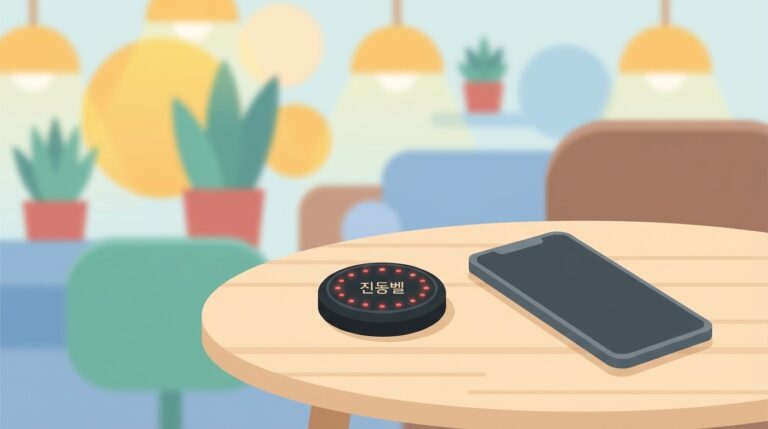
That device is the Jin-dong-bel (Vibration Bell). If you stand at the counter waiting for your coffee, you’ll block the line. If you sit too far away without it, you’ll never get your drink. Today, let’s master the art of receiving this “digital waiter.”
Phase 2: Deep Dive — The Magic Words
Here are the 3 key expressions you will hear and say during this interaction.
1. 진동벨 (Jindongbel)
- Pronunciation: [Jin-dong-bel]
- Sounds like: Jin (like the name) + Dong (like a bell sound) + Bell.
- Meaning: Vibration Bell (Buzzer)
- K-Culture Moment: You will see this everywhere—from Starbucks to tiny independent cafes. It is the symbol of Korea’s “Balli-Balli” (Hurry-Hurry) culture mixed with high-tech efficiency.
- Editor’s Insight: It’s not just a tool; it’s your queue ticket. Don’t lose it!
- Situation Spectrum:
[🚫 Formal] ———— [✅ Standard] ———— [✅ Casual](Everyone uses this word!)- 🤔 Think About It: In many Western cafes, they shout your name (“Coffee for Sarah!”). Why do you think Koreans prefer a silent vibrating machine over shouting names?
2. 진동벨로 알려 드릴게요 (Jindongbello allyeo deurilgeyo)
- Pronunciation: [Jin-dong-bel-lo / al-lyeo / deu-ril-ge-yo]
- Tip: Focus on “Allyeo” (sounds like ‘all-yuh’).
- Meaning: “I will let you know via the vibration bell.”
- Editor’s Insight: This is the barista telling you, “Please go sit down and wait.” You don’t need to understand every grammar point here. Just hear “Jindongbel” and know it’s time to take the disk.
- Situation Spectrum: Mostly used by staff to customers.
3. 감사합니다 (Gamsahamnida)
- Pronunciation: [Gam-sa-ham-ni-da]
- Meaning: Thank you.
- Editor’s Insight: When they hand you the bell, you must take it and say this. It signals the transaction is done.
Phase 3: Textbook vs. Real Life
How does a Korean textbook teach this versus what actually happens in a busy Gangnam cafe?
| Situation | 📖 Textbook Korean | 🗣️ Real Korean (Street) | 💡 Why the difference? |
|---|---|---|---|
| Handing over the bell | 진동벨을 가지고 기다려 주십시오. (Please take the bell and wait.) | 진동벨 드릴게요. (Giving you the bell.) | Speed. Koreans value efficiency. Short is sweet! |
| When it rings | 진동벨이 울리면 픽업대로 오십시오. (Come to the pickup counter when it rings.) | 울리면 오세요. (Come when it rings.) | We skip words that are obvious from context. |
💡 Editor’s Note: As an A1 learner, you don’t need to speak the “Real Korean” sentences yet, but you need to understand them so you don’t stand there confused!
Phase 4: Cultural Deep Dive — The “Nunchi” of the Buzzer
4-1. Non-verbal Communication (Body Language)
- Two Hands: When the barista hands you the bell (and your card/receipt), take it with two hands (or support your right arm with your left hand). It shows respect.
- The Look: Do not stare at the coffee machine. Take the bell, make slight eye contact, nod, and turn away to find a seat. Standing at the counter is bad Nunchi (social sense).
4-2. K-Culture Connection: K-Drama Trope 📺
In romance dramas, have you noticed?
1. The couple orders coffee.
2. They receive the Jindongbel.
3. They sit down.
4. Just as the guy is about to confess his love… VRRRRRR! The bell vibrates violently on the wooden table, ruining the mood.
* Reality Check: The vibration is actually quite strong! If you put it on a wobbly table, it makes a loud noise. Most Koreans put it on top of a napkin to dampen the sound.
Phase 5: Interactive Roleplay 🎭
Setting: A hip cafe in Seongsu-dong (the Brooklyn of Seoul). Saturday afternoon. It’s crowded.
Characters:
* YOU: A thirsty traveler.
* Barista: A stylish part-timer wearing a black apron.
(You just ordered an Iced Americano)
Barista: 결제 되었습니다. (Payment complete.)
(The barista hands you a round, buzzing disk and a receipt)
Barista: 진동벨로 알려 드릴게요. 📟
(Jindongbello allyeo deurilgeyo)
[I will let you know via the vibration bell.]
🔀 DECISION POINT: What do you do?
- A) Stand there and watch him make coffee.
- B) Take the bell with two hands, say “Gamsahamnida,” and find a seat.
- C) Try to give the bell back to him immediately.
✅ Best Choice: B
* Why: This is the standard procedure. The bell means “Go sit down.”
* Analysis of A: This makes the barista uncomfortable. It’s “Pressure!”
* Analysis of C: He hasn’t made your drink yet! You give it back after you get the coffee.
Phase 6: 10-Second Shadowing Drill 🗣️
Let’s practice the sentence you will hear most often so it doesn’t sound like alien language.
- Context: The barista hands you the device.
- Emotion: Professional & Quick (😊)
진동벨 / 울리면 / 오세요.
(Jin-dong-bel / ul-li-myeon / o-se-yo)
“Come when the buzzer rings.”
Phase 7: K-Culture Mini Glossary 📘
| Korean | Romanization | English | Context |
|---|---|---|---|
| 진동 | Jindong | Vibration | Used for phones and buzzers. |
| 픽업대 | Pigeop-dae | Pickup Counter | Where you return the bell and get coffee. |
| 셀프 | Sel-peu | Self-service | Water, napkins, and returning trays are all “Self.” |
Phase 8: Traveler’s Survival Kit 🎒
In Korean cafes, knowing how to handle the buzzer is as important as ordering.
🆘 Survival Expression #1
* 🇰🇷 “진동벨 고장 난 것 같아요.” (Jindongbel go-jang nan geo ga-ta-yo.)
* Meaning: “I think the buzzer is broken.”
* Use when: You’ve waited 20 minutes and everyone else got their coffee.📌 Editor’s Travel Note
* Range: The buzzers have a range. If you go to the restroom on the 2nd floor, it might not ring. Stay on the main floor until you get your drink!
* Return Policy: You must give the bell back when you pick up the coffee. Don’t take it home as a souvenir! (It happens more than you think…)
Phase 9: Think Deeper — Technology & Silence 🧠
Why does Korea love the Jindongbel?
Think about the noise level. In a busy Starbucks in New York, baristas shout names. “Grande Latte for Mike!!” It’s loud and chaotic. In Seoul, the cafe is often a place for studying or quiet dates. The Jindongbel allows the cafe to remain (relatively) quiet and maintains privacy. You are not a name; you are a signal.
💬 Your Turn: Does your country use buzzers, names, or table service? Which do you prefer?
Phase 10: FAQ & Troubleshooting 🛠️
- Q: Can I keep the buzzer on my table?
- A: Yes! That’s where it belongs. Just watch for the lights flashing and the vibration.
- Q: The barista didn’t give me a buzzer! Did they forget?
- A: If it’s a very small cafe, or if you are the only customer, they might just call you directly. Or, they might bring it to you (rare, but happens in luxury places).
- ❌ Common Mistake: Trying to tap the buzzer like a credit card on the counter.
- Fix: Just hand it to the staff when you pick up the coffee.
Phase 11: Wrap-up & Mission 🚀
Summary: The Jindongbel is your silent friend. Take it, sit down, wait for the buzz, and swap it for coffee.
🎯 Action Missions:
* 🥉 Bronze: Say “Jin-dong-bel” out loud 3 times. Feel the rhythm.
* 🥈 Silver: Watch a YouTube vlog of a Korean cafe visit. Spot the moment they get the buzzer.
* 🥇 Gold: Go to a Korean bakery or cafe in your city. If they give you a buzzer, say “Gamsahamnida” with a slight bow!
Phase 12: Interactive Quiz 📝
1. What should you do when the barista says “Jin-dong-bel deurilgeyo”?
* A) Start dancing.
* B) Take the bell and go find a seat.
* C) Say “No, thank you.”
2. True or False?
* You can take the Jindongbel home as a souvenir because it is cute. ( )
🔑 Answers:
1. B (Please find a seat!)
2. False (Absolutely not! It is expensive property of the cafe!)
Frequently Asked Questions (FAQ)
Q: What does "진동벨 (Jindongbel)" mean in Korean and how do you pronounce it?
A: In Korean, "진동벨 (Jindongbel)" is pronounced [Jin-dong-bel] and means: a key conversational Korean expression covered in this lesson.
Q: What does "진동벨로 알려 드릴게요 (Jindongbello allyeo deurilgeyo)" mean in Korean and how do you pronounce it?
A: In Korean, "진동벨로 알려 드릴게요 (Jindongbello allyeo deurilgeyo)" is pronounced [Jin-dong-bel-lo / al-lyeo / deu-ril-ge-yo] and means: a key conversational Korean expression covered in this lesson.
Q: What does "감사합니다 (Gamsahamnida)" mean in Korean and how do you pronounce it?
A: In Korean, "감사합니다 (Gamsahamnida)" is pronounced [Gam-sa-ham-ni-da] and means: Thank you.







