

Wedding Crashers? Nope, Just Tourists! 🎎 How to Enjoy a Traditional Korean Wedding
Phase 1: Immersive Hook
Hello, Daily Hangul family! It’s your editor here.
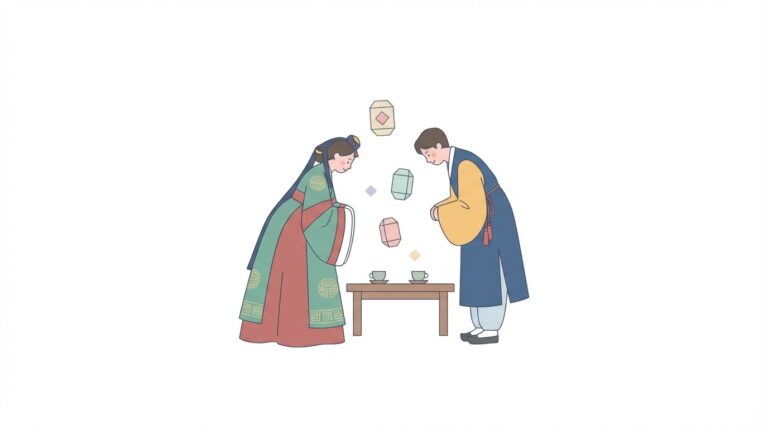
Picture this: You are walking through the Korean Folk Village (or maybe Namsangol Hanok Village in Seoul). Suddenly, you hear loud drums and gongs—Kwaeng-gwa-ri! 🥁 People are gathering in a circle. In the center, there’s a table with a boiled chicken (yes, a real chicken) and two people in stunning, colorful robes bowing to each other.
It feels like you just walked onto the set of a historical K-Drama like The Red Sleeve or Mr. Queen. You want to say something nice to the couple (or the actors), but “Congratulations” in English feels… a bit quiet.
In Korea, weddings are loud, festive, and communal. If you just stand there silently, you might miss the chance to be part of the joy. Today, we’re going to learn the perfect phrases to say when watching a traditional wedding ceremony (Jeontong Honrye), whether it’s a reenactment or the real deal!
Phase 2: Deep Dive into Core Expressions
Here are the top 3 expressions you need to know to blend in.
1. 축하드려요 (Congratulations)
- Pronunciation: [Chuk-ha-deu-ryeo-yo]
- Sound Analogy: “Chuk” sounds like the ‘chook’ in “Look,” and “ha” is a sharp breath out.
- Meaning:
- Literal: I give you congratulations.
- Real Nuance: “I am so happy for you!” (Formal & Polite)
- K-Culture Moment: In every K-Drama wedding scene, guests line up to say this while handing over a white envelope (money gift). It’s the universal password for celebrations.
- Editor’s Insight: You might hear “Chuk-ha-hae” (Casual), but since you are watching strangers or performers, sticking to the polite “-yo” ending is safer and more respectful.
- Situation Spectrum:
[🚫 Friends Only] ———— [✅ Safe for Everyone] ———— [⚠️ Very Formal]
- Use 축하드려요 anywhere! ✅
🤔 Think About It: Why does Korean have a specific verb “to give congratulations” (드리다) instead of just an adjective like “Happy”? It implies offering your heart to them.
2. 잘 어울려요 (You look good together)
- Pronunciation: [Jal eo-ul-lyeo-yo]
- Sound Analogy: “Eo-ul” sounds a bit like “Owl” without the strong ‘w’.
- Meaning:
- Literal: You match well.
- Real Nuance: “You are a perfect couple!” or “You have great chemistry.”
- K-Culture Moment: Think of K-Pop fans commenting on a duet performance. “Their voices match well!” That’s eo-ul-lyeo-yo.
- Editor’s Insight: This is the best compliment for a couple. It’s not just about looks; it’s about their vibe fitting together like puzzle pieces.
- Situation Spectrum:
[🚫 Boss] ———— [✅ Casual/Polite] ———— [✅ Friends]
- Perfect for commenting to the person standing next to you while watching. ✅
🤔 Think About It: In the West, we might say “You look beautiful.” Why do Koreans prefer “You match well”? (Hint: Harmony vs. Individualism)
3. 행복하세요 (Please be happy)
- Pronunciation: [Haeng-bok-ha-se-yo]
- Sound Analogy: “Haeng” rhymes with “Bang”, “Bok” rhymes with “Poke”.
- Meaning:
- Literal: Do happiness.
- Real Nuance: “I wish you a happy life together.”
- K-Culture Moment: The classic tear-jerker line in dramas when the second lead says goodbye to the main character: “…Haengbok-haseyo.” (But here, we use it joyfully!)
- Editor’s Insight: It sounds like a command (“Be happy!”), but in Korean, it’s a warm blessing.
Phase 3: Textbook vs. Real Life
| Situation | 📖 Textbook Korean | 🗣️ Real Korean (Street/Insa) | 💡 Why is it different? |
|---|---|---|---|
| Seeing the bride | 신부가 아름답습니다. (The bride is beautiful.) | 와, 진짜 예쁘다! (Wah, jin-jja ye-ppeu-da!) | “Beautiful” is too poetic. “Yeppeuda” is the instant emotional reaction. |
| Cheering | 박수를 치세요. (Please clap.) | (Clapping) 우와아아! (U-wa-a-a!) | Koreans express joy with sound effects, not just words! |
| Asking about the event | 이것은 결혼식입니까? (Is this a wedding?) | 이거 진짜 결혼식이에요? (Is this a real wedding?) | Adding “real” (jin-jja) shows your surprise and curiosity. |
💡 Bottom Note: At a traditional wedding performance, it is okay to be a little loud and expressive! It adds to the Heung (excitement).
Phase 4: Cultural Deep Dive
4-1. Non-verbal: The Big Bow (Jeol)
In Western weddings, the kiss is the climax. In Traditional Korean weddings, the Bowing (Jeol) is the main event. The bride and groom bow to each other multiple times deeply to show respect.
* Tip: When they bow, the audience usually goes quiet to focus, then claps when they stand up.
4-2. K-Drama Connection: The “Dates and Chestnuts”
Have you seen the scene where parents throw things at the couple holding a fabric sheet? That’s Paebaek (폐백).
* Dates (Jujubes): Symbolize sons.
* Chestnuts: Symbolize daughters.
* Meaning: It’s a wish for fertility and many children. If you see this, cheer loudly when they catch a lot!
Phase 5: Immersive Roleplay
Setting: A sunny Saturday at the Korean Folk Village. You are watching a wedding reenactment with your Korean friend, Minji.
Characters:
* YOU: An enthusiastic tourist learning Korean.
* Minji: Your Korean friend who loves explaining culture.
(The groom enters on a horse 🐴)
Minji: 와, 신랑 들어온다! 옷 진짜 멋있다.
(Wah, sillang deureo-onda! Ot jinjja meositda.)
[Wow, the groom is coming in! His clothes are so cool.]
YOU: (Pointing at the blue robe)
저 옷 색깔이 정말 예뻐요.
(Jeo ot saek-kkari jeongmal yeppeoyo.)
[That clothes’ color is really pretty.]
Minji: 그치? 파란색은 신랑, 빨간색은 신부야.
(Geuchi? Paransaek-eun sillang, ppalgansaek-eun sinbu-ya.)
[Right? Blue is for the groom, Red is for the bride.]
(The couple stands facing each other)
🔀 Decision Point: What do you say now?
A) “사랑해요!” (Saranghaeyo! – I love you!)
B) “두 분 잘 어울려요!” (Du bun jal eoul-lyeoyo! – You two match well!)
C) “안녕하세요.” (Annyeonghaseyo. – Hello.)✅ Best Choice: B. It compliments the couple perfectly in this context.
⚠️ Why not A? “Saranghaeyo” is too personal and weird to shout at strangers!
⚠️ Why not C? It’s a greeting, not a reaction to a ceremony.
YOU (Choosing B): 와, 두 분 진짜 잘 어울려요!
(Wah, du bun jinjja jal eoul-lyeoyo!)
[Wow, you two really match well!]
Minji: (Laughing) 맞아, 진짜 한 쌍의 원앙 같다.
(Maja, jinjja han ssang-ui won-ang gata.)
[Right, they look like a pair of mandarin ducks (symbols of love).]
Phase 6: 10-Second Shadowing Drill
Let’s practice the ultimate compliment. Repeat after the guide!
“The bride and groom / really match well!”
😊 Brightly & Cheerful:
신랑 신부가 / 진짜 / 잘 어울려요!
(Sillang sinbu-ga / jinjja / jal eo-ul-lyeo-yo!)
Phase 7: K-Culture Mini Glossary
| Korean | Romanization | English | Context |
|---|---|---|---|
| 한복 | Hanbok | Traditional Clothes | The vibrant robes worn at the wedding. |
| 연지곤지 | Yeonji-Gonji | Red dots on cheeks | The red circles on the bride’s cheeks to ward off evil spirits. |
| 국수 | Guksu | Noodles | Traditionally eaten at weddings to symbolize a “long” life. |
| 대추 | Daechu | Jujube (Date) | Thrown during the ceremony to symbolize children. |
Phase 8: Traveler’s Survival Kit
You are at a tourist spot watching this. You want to capture the moment.
🆘 Survival Expression #1
– 🇰🇷 “사진 찍어도 돼요?” (Sajin jjigeodo doeyo?)
– 🗣️ Pronunciation: [Sa-jin jji-geo-do dwe-yo]
– Meaning: Can I take a photo?
– 📍 Where to use: Folk villages, reenactments, or even with the performers after the show.
– 💡 Pro Tip: If they cross their arms (X shape), it means no. If they nod or smile, go ahead!📌 Editor’s Travel Note
– Best Places to See This: Korean Folk Village (Yongin), Namsangol Hanok Village (Seoul), Seoul Namsan Gugakdang.
– Timing: These performances usually happen on weekends in spring and autumn. Check the schedule online beforehand!
Phase 9: Think Deeper — “Food & Identity”
Why Noodles? (Guksu)
In Korea, asking “When are you going to feed me noodles?” is a secret code for “When are you getting married?”.
Why noodles? In the past, rice was precious, and flour was rare. Long noodles symbolize a long, happy life for the couple. Even today, at modern buffet weddings, there is always a noodle station. It shows how Koreans connect food shapes and textures to destiny and blessings.
💬 Your Turn: Does your culture have a specific food you must eat at weddings? Share in the comments!
Phase 10: FAQ & Troubleshooting
- Q: Can I wear white to a Korean wedding?
- A: ⚠️ Caution! In modern Korean weddings, guests absolutely avoid white because it competes with the bride. However, if you are just a tourist watching a traditional outdoor performance at a folk village, your clothes don’t matter. Wear whatever is comfortable!
- Q: Can I shout/cheer during the ceremony?
- A: Yes! Traditional weddings are meant to be community festivals. Unlike quiet church weddings, laughter and cheering (called Chu-im-sae) are welcome.
- ❌ Common Mistake: Bowing back to the couple when they bow.
- ✅ Fix: They are bowing to each other or their parents. You (the audience) just watch and clap.
Phase 11: Wrap-up & Action Mission
One-Liner Summary: When watching a traditional wedding, smile and say “Jal eoul-lyeoyo” (You match well) to show your support!
🚀 Action Mission:
* 🥉 Bronze: Say “축하드려요” (Congratulations) out loud 3 times in front of a mirror.
* 🥈 Silver: Watch a YouTube video of “Korean Traditional Wedding” and identify the “Red and Blue” robes.
* 🥇 Gold: Visit a Hanok Village in Korea (or a cultural festival in your country) and take a photo of a traditional ceremony!
Phase 12: Interactive Quiz
- Situation: The couple is catching dates and chestnuts in a fabric sheet. What does this symbolize?
- a) Who will do the dishes.
- b) Having many children (fertility).
- c) Making a lot of money.
- True or False (K-Culture): It is rude to make noise at a traditional Korean wedding.
- (True / False)
- Fill in the blank: The bride and groom look perfect together! “Du bun, jin-jja _____!”
- a) Jal eoul-lyeoyo (잘 어울려요)
- b) Jal meok-eosseoyo (잘 먹었어요)
Answers:
1. (b) – Dates = sons, Chestnuts = daughters.
2. False – It’s a festival! Noise adds to the joy.
3. (a) – (b) means “I ate well.”
Frequently Asked Questions (FAQ)
Q: What does "축하드려요 (Congratulations)" mean in Korean and how do you pronounce it?
A: In Korean, "축하드려요 (Congratulations)" is pronounced [Chuk-ha-deu-ryeo-yo] and means: a key conversational Korean expression covered in this lesson.
Q: What does "잘 어울려요 (You look good together)" mean in Korean and how do you pronounce it?
A: In Korean, "잘 어울려요 (You look good together)" is pronounced [Jal eo-ul-lyeo-yo] and means: a key conversational Korean expression covered in this lesson.
Q: What does "행복하세요 (Please be happy)" mean in Korean and how do you pronounce it?
A: In Korean, "행복하세요 (Please be happy)" is pronounced [Haeng-bok-ha-se-yo] and means: a key conversational Korean expression covered in this lesson.







