

Phase 1: The ‘Banchan’ Dilemma – An Immersive Hook
Greeting: 안녕하세요! It’s your Daily Hangul editor, fresh from a K-BBQ dinner in Mapo-gu.
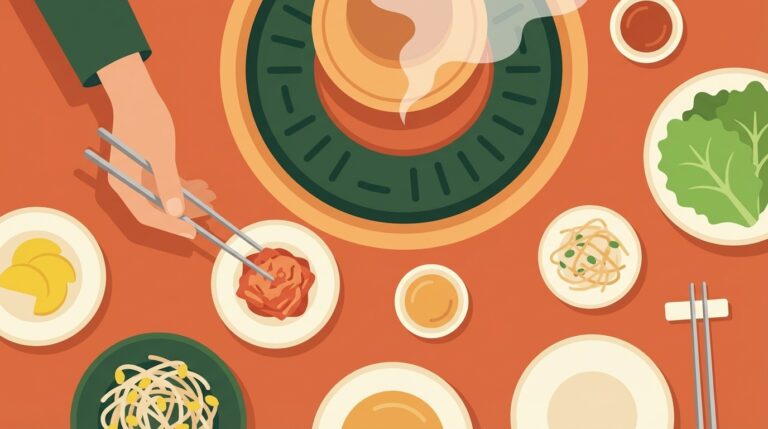
The Scene: Picture this. You are in a bustling Korean restaurant, just like the one in Weightlifting Fairy Kim Bok-joo. The air smells of grilled pork belly (Samgyeopsal) and happiness. Your table is covered with small plates—Kimchi, pickled radish, bean sprouts. You’ve devoured the Kimchi because it’s delicious. Now the plate is empty.
In your home country, asking for more might mean paying extra or bothering the waiter. But here? You see a local at the next table shout, ‘Sajangnim!’ and magically, a mountain of lettuce appears for free.
The ‘Why’: You want that Kimchi. But you don’t want to be rude, and you definitely don’t want to be the ‘confused foreigner’ pointing silently at a plate. Knowing how to ask for refills (Ri-pil) is the ultimate test of your Korean survival skills.
Transparency: This guide answers the #1 question my B1 students ask: “Is it really free? And how do I ask without sounding demanding?”
Phase 2: Core Expressions Deep Dive
Here are the three tools you need in your linguistic arsenal.
1. 사장님 / 여기요 [Calling the Server]
- Pronunciation: [Sa-jang-nim] / [Yeo-gi-yo]
- Sound Analogy: Sa-jang-nim sounds like saying ‘Massage’ without the ‘Ma’ + ‘Nim’ (rhymes with Jim). Yeo-gi-yo sounds like ‘Yogi’ Bear + ‘Yo’.
- Meaning: Boss / Over here (excuse me).
- K-Culture Moment: In K-Dramas, watch how the protagonist confidently raises their hand and projects their voice. It’s not a whisper; it’s a summons.
- Editor’s Insight: Westerners often wait for eye contact. In Korea, verbalizing is polite. Waiting silently makes you invisible. Use ‘Sajangnim’ (Boss) even if they aren’t the owner—it’s a sign of respect!
- Situation Spectrum:
[🚫 Formal Banquets] ———— [⚠️ Fine Dining] ———— [✅ Casual / BBQ]- 🤔 Think About It: Why do Koreans call everyone ‘Boss’? It elevates the worker’s status, showing respect in a service interaction.
2. 반찬 좀 더 주세요 [The Standard Request]
- Pronunciation: [Ban-chan jom deo ju-se-yo]
- Sound Analogy: Ban-chan (Bun-chan) + Jom (like ‘Joe’ with an m) + Deo (like ‘The’ in ‘The End’) + Ju-se-yo (Juice-say-yo).
- Meaning: Please give me some more side dishes.
- K-Food Moment: You’ll hear this constantly in places like Baek Jong-won’s alley restaurants. It’s the rhythm of a Korean meal.
- Editor’s Insight: The magic word here is 좀 (jom). Literally means ‘a little,’ but it softens the request. Without it, you sound robotic.
- Situation Spectrum:
[🚫 To the King] ———— [⚠️ Elders] ———— [✅ Everyone else]3. 혹시 셀프인가요? [The ‘Nunchi’ Check]
- Pronunciation: [Hok-si sel-peu-in-ga-yo?]
- Meaning: Is it self-service by any chance?
- Editor’s Insight: Many modern Korean restaurants have a ‘Self Bar’ to save labor costs. Asking this shows you have high Nunchi (social awareness).
- 🤔 Think About It: ‘Self’ is Konglish for ‘Self-Service.’ Why do you think English words are adopted for efficiency in Korea?
Phase 3: Textbook vs. Real Life
| Context | 📖 Textbook Korean | 🗣️ Real Korean (Street Smart) | 💡 Why the difference? |
|---|---|---|---|
| Calling Staff | 저기요 (Jeogiyo) | 사장님! / 여기요! (loudly) | ‘Jeogiyo’ can sometimes sound too timid or accusatory. ‘Sajangnim’ is flattering. |
| Asking for Refills | 반찬을 더 주십시오. | 이거 더 주세요. (Points to plate) | In a loud BBQ place, short & clear is better than grammatically perfect. |
| Saying Thanks | 감사합니다. | 잘 먹겠습니다! (When receiving) | Koreans acknowledge the effort of the service, not just the food. |
Bottom Note: “이거 더 주세요” (Give me more of this) is the MVP phrase because you don’t need to know the name of every vegetable!
Phase 4: Cultural Deep Dive — The Art of ‘Nunchi’ Refills
4-1. Non-verbal Communication: The Empty Plate Signal
In the West, you might wait for a server to notice. In Korea, Nunchi works both ways. If you want more, move the empty plate to the edge of the table near the aisle. This signals the staff without you saying a word. But if they are busy, don’t just wait—call them!
4-2. K-Culture Connection: K-Food Logic
- The ‘Jeong’ Factor: Why are side dishes free? It comes from Jeong (정)—the Korean concept of affection and sharing. Charging for kimchi feels ‘cold’ in Korean culture. However, don’t abuse it. Refilling expensive sides (like marinated crab) 5 times is bad Nunchi.
- The ‘Bell’ System: Many tables have a buzzer. Press it once. Pressing it repeatedly is like spam-calling someone. It’s considered rude.
Phase 5: Immersive Roleplay — Friday Night BBQ
Setting: It’s 8:00 PM on a Friday in Gangnam. The restaurant is packed. K-Pop is blasting. You are eating Samgyeopsal with a Korean colleague, Min-ji.
Characters:
* YOU: Hungry traveler who loves Kimchi.
* Min-ji (NPC): Your Korean friend, helpful but hungry.
Dialogue:
Min-ji: 와, 이 집 김치 진짜 맛있다! (Wow, the kimchi here is really tasty!)
(Min-ji eats the last piece of Kimchi.)
YOU: (Staring at the empty plate) …
Min-ji: 어? 다 먹었네. 더 시킬까? (Oh? We finished it. Shall we order more?)
🔀 YOUR TURN! How do you respond to the situation?
- A) (Wait silently for the waiter to come by)
- B) (Raise hand) “사장님! 여기 김치 좀 더 주세요!”
- C) (Stand up) “Excuse me, where is the kimchi?”
✅ Best Choice: B
Analysis: Choice A will leave you hungry; Korean servers are fast but focused on active calls. Choice B is perfect. Use a confident voice!
⚠️ Choice C Analysis: This works if there is a Self-bar, but usually, you stay seated unless you see the ‘SELF’ sign.
Server: (Rushing over) 네! 김치 더 드릴까요? (Yes! Shall I give you more kimchi?)
YOU: 네, 많이 주세요! (Yes, please give me a lot!)
Server: (Smiling) 네~ (Brings a huge pile).
Phase 6: 10-Second Shadowing Drill
Practice this until it flows naturally. Don’t be shy!
- Sentence: 사장님, / 여기 / 반찬 좀 / 더 주세요!
- Romanization: Sajangnim, / yeogi / banchan jom / deo juseyo!
- Emotion: 😊 Bright & Energetic (You are happy to eat more!)
- Key Point: Stretch the ‘yo’ slightly to sound softer. Juseyo~
Phase 7: K-Culture Mini Glossary
| Korean | Romanization | Meaning | Context |
|---|---|---|---|
| 눈치 | Nunchi | Social Awareness | Reading the room. e.g., Not asking for refills when the server is carrying hot stew. |
| 무한리필 | Muhan-refill | Unlimited Refill | Often found in K-BBQ signs. Means ‘All You Can Eat’. |
| 셀프 | Sel-peu | Self-Service | Water and side dishes are often ‘Self’. Look for the sign! |
| 서비스 | Seo-bi-seu | Service (Freebie) | If the boss gives you a free Coke, that’s ‘Service’! |
Phase 8: Traveler’s Survival Kit
Going to a restaurant in Korea? Keep these handy.
🆘 Survival Phrases
1. “물은 셀프인가요?” (Is water self-service?)
* Mu-reun sel-peu-in-ga-yo?
2. “앞치마 주세요.” (Please give me an apron.)
* Ap-chi-ma ju-se-yo. → Essential for BBQ to save your clothes!
3. “휴지 어디 있어요?” (Where are the tissues?)
* Hyu-ji eo-di i-sseo-yo? → Pro Tip: They are often in a drawer under the table.📌 Editor’s Travel Note
* The Magic Drawer: Can’t find chopsticks/spoons? Check the side of the table. There is usually a drawer!
* Water: In 90% of casual places, you get your own water from the purifier near the entrance.
Phase 9: Think Deeper — Food & Identity
Why is ‘Sharing’ so built into the language?
In Western dining, you have your plate. In Korea, the table is a shared space. Banchan (side dishes) are placed in the middle for everyone. This reflects the collectivist culture where ‘We’ (우리) is more important than ‘I’ (나). Asking for refills isn’t just about greed; it’s about maintaining the communal joy of eating. When you ask, “More Kimchi, please,” you are facilitating the group’s meal, not just yours.
🧠 Think Deeper: How does your culture handle side dishes? Is it pay-per-item or free-flow? Does that change how you eat?
Phase 10: FAQ & Troubleshooting
Q: Can I ask for a refill on the main dish (meat/stew)?
* Answer: No! Unless it’s an ‘Unlimited Refill’ (무한리필) restaurant, main dishes cost money. Only the small side dishes (Banchan) are free.
Q: Is it rude to shout ‘Yogi-yo’?
* Answer: Not at all! It’s actually ruder to make the server guess what you want. Just smile when you say it. 🙂
❌ Common Mistake: Waiting for the bill at the table.
✅ Fix: In most casual Korean restaurants, you take the bill (orders paper) to the counter by the door to pay when you leave.
Phase 11: Wrap-up & Mission
Summary: Don’t be shy! Use ‘Sajangnim’ to call, ‘Juseyo’ to ask, and enjoy the infinite world of Banchan.
🔥 Action Mission:
* 🥉 Bronze: Say “사장님, 김치 좀 더 주세요” 3 times in front of a mirror.
* 🥈 Silver: Go to a Korean restaurant in your city and identify which dishes are ‘Banchan’ (Refillable) and which are ‘Main’.
* 🥇 Gold: Visit a K-BBQ place and confidently ask for a refill in Korean!
💬 Your Turn: Have you ever been confused by the ‘Magic Drawer’ under the table? Tell me your story in the comments!
Phase 12: Interactive Quiz
1. Situation Check: You see a sign that says [물은 셀프입니다]. What should you do?
* A) Scream “Water please!”
* B) Wait for the waiter.
* C) Go get the water yourself from the purifier.
2. True or False: It is rude to ask for side dish refills more than once.
* A) True
* B) False
🔑 Answer Key:
1. C) ‘Self’ means do it yourself! (Koreans love efficiency).
2. B) False. As long as you eat it all, refills are welcomed. Just use your Nunchi if the place is crazy busy!
Frequently Asked Questions (FAQ)
Q: What does "사장님 / 여기요 [Calling the Server]" mean in Korean and how do you pronounce it?
A: In Korean, "사장님 / 여기요 [Calling the Server]" is pronounced [Sa-jang-nim] and means: Boss / Over here (excuse me).
Q: What does "반찬 좀 더 주세요 [The Standard Request]" mean in Korean and how do you pronounce it?
A: In Korean, "반찬 좀 더 주세요 [The Standard Request]" is pronounced [Ban-chan jom deo ju-se-yo] and means: Please give me some more side dishes.
Q: What does "혹시 셀프인가요? [The ‘Nunchi’ Check]" mean in Korean and how do you pronounce it?
A: In Korean, "혹시 셀프인가요? [The ‘Nunchi’ Check]" is pronounced [Hok-si sel-peu-in-ga-yo?] and means: Is it self-service by any chance?







