

Phase 1: The ‘Karrot’ Sound That changed Everything 🥕
Greeting: 안녕하세요! This is your Daily Hangul Editor, back with the secrets of living like a local in Seoul.
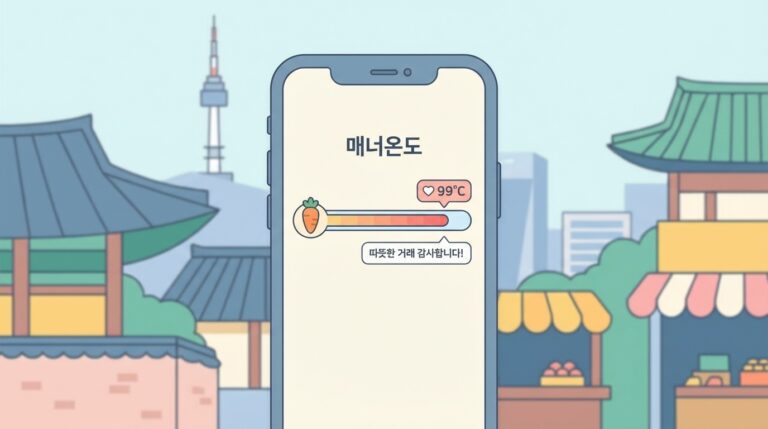
K-Culture Cold Open: You’ve seen it in K-Dramas. The protagonist is broke, so they decide to sell their ex-boyfriend’s gift. They meet a stranger at a subway station exit, exchange a paper bag, and bow awkwardly. Cut to the next scene: they are staring at their phone, smiling. Why? Because their “Manner Temperature” (매너 온도) just went up.
In Korea, second-hand trading (mostly done via the app Karrot Market or Danggeun) isn’t just about money. It’s a social game of RPG-like stats. If your “temperature” drops below 36.5°C, people will avoid you like a haunted house. Today, we’re learning how to end a trade perfectly so you get that coveted 5-star review and the title of “Manner King.”
The ‘Why’: If you don’t know these closing phrases, you might just say “Thank you” and walk away. To a Korean, that can feel cold. Knowing the right post-trade etiquette turns a simple transaction into a heartwarming connection—and guarantees they’ll want to trade with you again.
Phase 2: Deep Dive — The Art of the “Cool Deal”
Here are the top 3 expressions you need to secure that high manner rating.
1. 쿨거래 감사합니다 (Kul-georae gamsahamnida)
- Pronunciation: [Kul-geo-rae gam-sa-ham-ni-da] Sounds like ‘Cool’ + ‘Guh-rae’ (transaction)
- Meaning: “Thank you for the cool deal.”
- K-Culture Moment: In Korea, a “Cool Deal” (쿨거래) is the gold standard. It means no haggling, no being late, and no unnecessary questions. If someone buys your item instantly, send this message right after.
- Editor’s Insight: This is the ultimate compliment in the Korean trading world. It acknowledges that the buyer respected your time. It’s short, punchy, and modern.
- Situation Spectrum:
[🚫 Formal Biz] ———— [✅ Semi-formal] ———— [✅ Casual]- 🤔 Think About It: Why does Korean culture value “speed” and “coolness” (lack of friction) so much in transactions? It reflects the Pali-pali (hurry-hurry) culture where efficiency is a form of politeness.
2. 예쁘게 쓰세요 / 잘 쓰세요 (Yeppeuge sseuseyo / Jal sseuseyo)
- Pronunciation: [Yep-peu-ge sseu-se-yo] / [Jal sseu-se-yo]
- Meaning: “Please use it beautifully” (Literal) → “I hope you enjoy it.”
- K-Culture Moment: You hand over a dress or a bag. As you part ways, you say this. It adds a layer of Jeong (affection/attachment) to the object you are passing on.
- Editor’s Insight: Jal sseuseyo is standard. Yeppeuge sseuseyo is softer and often used for fashion items, decor, or goods exchanged between women. It implies, “This item was loved by me, and now I hope it serves you well.”
- Situation Spectrum:
[⚠️ Elders] ———— [✅ Strangers] ———— [✅ Friends]3. 매너 온도 남겨 드릴게요! (Maeneo ondo namgyeo deurilgeyo!)
- Pronunciation: [Mae-neo on-do nam-gyeo deu-ril-ge-yo]
- Meaning: “I will leave a review for your manner temperature!”
- K-Culture Moment: The moment the transaction marks “Sold” on the app. Sending this message signals that you are an active, considerate user.
- Editor’s Insight: It’s a subtle way of saying, “I’ll scratch your back if you scratch mine.” You are promising a good rating, prompting them to do the same for you.
- Situation Spectrum:
[🚫 Face-to-Face] ———— [✅ App Chat] ———— [✅ Text]
Phase 3: Textbook vs. Real Life
| Situation | 📖 Textbook Korean | 🗣️ Real Street Korean | 💡 Why the difference? |
|---|---|---|---|
| Confirming End | 거래가 완료되었습니다. (The trade is complete.) | 판매완료 눌렀어요! (I pressed ‘Sold’!) | Focuses on the action needed in the app immediately. |
| Asking for Review | 좋은 평가 부탁드립니다. (Please give a good evaluation.) | 매너 꾹! 부탁드려요 ^^ (Please press ‘Manner’! ^^) | ‘꾹’ (Kkuk) is the sound of pressing a button firmly. Cute & effective. |
| Saying Goodbye | 안녕히 가세요. (Goodbye.) | 조심히 들어가세요~ (Go back safely~) | Koreans care more about your safe return home than just the parting. |
Bottom Note: B2 learners, using “매너 꾹!” makes you sound like a native user of the app, whereas “좋은 평가…” sounds like a customer service bot.
Phase 4: Cultural Deep Dive — The Silence of the Exchange
4-1. Non-verbal: The “Inspection Silence”
When you meet for a trade (Direct Transaction or Jik-georae), there is often an awkward 10-30 seconds where the buyer checks the item.
– Do: Stand politely, maybe look at your phone to give them space, or hold a flashlight if it’s dark.
– Don’t: Stare at them intensely or rush them. This silence is part of the trust-building ritual.
4-2. K-Culture Connection: The “Jeong” (Parting Gift)
In K-Dramas or reality shows, you might see sellers giving a small free drink or a candy with the item. This is called “Deom” (덤).
– If you are selling something, adding a small chocolate or a wet wipe can skyrocket your Manner Temperature.
– Critical View: Why do Koreans give freebies to strangers? It softens the transactional nature of capitalism and reintroduces human connection (Jeong) into a cold financial exchange.
Phase 5: Immersive Roleplay — The Subway Station Meet-up
Setting: Gangnam Station Exit 10. It’s crowded. You (the buyer) found a seller for a limited edition K-Pop album.
Characters:
– YOU: A collector who wants this album desperately.
– Minji: A university student selling her collection. Fast-paced.
Dialogue:
Minji: (Looking at her phone) 혹시… 당근이세요? 🥕
(Hoksi… Danggeun-iseyo?)
(English) Excuse me… are you ‘Carrot’?
(Stage Direction: She spots you holding your phone nervously.)
YOU: 아, 네! 맞아요. 안녕하세요.
(Ah, ne! Majayo. Annyeonghaseyo.)
(English) Ah, yes! That’s right. Hello.
Minji: 여기 물건이요. 상태 확인해 보세요.
(Yeogi mulgeon-iyo. Sangtae hwaghinhae boseyo.)
(English) Here is the item. Please check the condition.
(Stage Direction: She hands over the album. You check it quickly. It’s perfect.)
🔀 Decision Point: How do you close this deal?
A) “Okay, bye.” (Walk away immediately)
B) “쿨거래 감사합니다! 상태 너무 좋네요. 매너 평가 남길게요!”
C) “좀 비싼데 깎아주시면 안 돼요?” (Ask for a discount after meeting)
✅ Best Choice: B — You acknowledge the quality and promise a good rating. This ensures she rates you well too.
⚠️ Choice C Analysis: Asking for a discount (Nego) at the meeting spot is considered the worst manner (Jin-sang). You will likely get a bad rating and be blocked.
Phase 6: 10-Second Shadowing Drill
Listen to the rhythm. Keep it light and cheerful!
- 😊 (Brightly) Thank you for the quick/easy deal!
- 쿨거래 / 감사합니다! / 저도 / 후기 남길게요!
- (Kul-georae / gamsahamnida! / jeodo / hugi namgilgeyo!)
- 🥺 (Softly) Please accept this small treat (giving a freebie).
- 이거 / 덤이에요. / 맛있게 / 드세요.
- (Igeo / deomieyo. / masitge / deuseyo.)
Phase 7: K-Culture Mini Glossary
| Korean | Romanization | Meaning | Context |
|---|---|---|---|
| 당근 (당신의 근처) | Danggeun | Carrot (Market) | Short for “Your Neighborhood.” The #1 trading app. |
| 네고 | Nego | Negotiation | Short for Negotiation. “네고 불가” means “Fixed Price.” |
| 직거래 | Jik-georae | Direct Trade | Meeting face-to-face to trade. |
| 거파 (거래 파기) | Geopa | Deal Breaker | Canceling the deal at the last minute. (Very bad!) |
| 잠수 | Jamsu | Ghosting | Lit. “Diving” underwater. Disappearing without a word. |
Phase 8: Traveler’s Survival Kit 🧳
Even if you aren’t using the app, you might visit Flea Markets (like Dongmyo) or buy from street vendors.
🆘 Survival Phrase #1: Closing the Deal
– 🇰🇷 “많이 파세요!” (Mani paseyo!)
– 🗣️ Pronunciation: [Ma-ni pa-se-yo]
– 📍 Where: Street stalls, flea markets, taxi.
– 💡 Meaning: “Sell a lot!” (Wish you prosperity). It’s the perfect goodbye to any vendor.📌 Editor’s Travel Note
– Cash is King: At flea markets or second-hand trades, Cash or Bank Transfer is expected. Cards are rare.
– Bags: Bring your own eco-bag. Sellers often hand over items “naked” or in flimsy plastic.
Phase 9: Think Deeper — “Trust in a High-Speed Society”
Korean Society & The Speed of Trust
Why is the term “Cool Deal” (no questions asked) considered good manners? In many Western cultures, asking questions shows diligence. In Korea, asking too many questions can be seen as “doubting” the seller or wasting time. The “Manner Temperature” system substitutes the need for long trust-building conversations. It’s a digital credit score that allows the Ppalli-ppalli (fast-fast) culture to function even between strangers.
💬 Your Turn: In your country, is it polite to chat a lot during a second-hand trade, or is it better to be quick? Tell us below!
Phase 10: FAQ & Troubleshooting
- Q: Can I text them late at night (after 10 PM)?
- Editor: Generally, No. Unless the item was just posted 5 minutes ago. Otherwise, wait until morning (8 AM).
- Q: The seller is younger than me. Can I use Banmal (casual language)?
- Editor: Absolutely NOT. Even if they are a student and you are older, Danggeun culture is strictly polite (Joendaemal). Using Banmal is a quick way to lower your temperature.
- ❌ Common Mistake: Trying to return an item because you changed your mind.
- ✅ Fix: Second-hand trades in Korea are usually final. Unless it’s a fake or broken (and not described), don’t ask for a refund. Resell it yourself instead.
Phase 11: Wrap-up & Mission
One-Liner: A good ending with “Mani paseyo” or “Kul-georae” guarantees you remain a trusted member of the community.
Action Mission:
– 🥉 Bronze: Practice saying “쿨거래 감사합니다” 3 times fast.
– 🥈 Silver: Go to a convenience store, buy something, and say “Mani paseyo!” (Sell a lot) to the clerk when leaving.
– 🥇 Gold: If you are in Korea, try buying a small item on Karrot Market and send a “Manner Heart” review!
Engagement: Have you ever bought something second-hand abroad? What was the hardest part? Let me know!
Phase 12: Quiz — Are You a Manner King?
- Situation: You met the seller, but the item has a scratch not mentioned in the photo.
- A) Scream “Scammer!” and leave.
- B) Politely point it out: “사진에 없던 기스가 있네요…” (There is a scratch not in the photo…)
- C) Just buy it and leave a bad review later.
- True or False: It is polite to ask for a discount after you meet the person face-to-face.
- (True / False)
(Answers: 1-B [Polite negotiation is allowed if description was wrong], 2-False [This is the ultimate bad manner])
Frequently Asked Questions (FAQ)
Q: What does "쿨거래 감사합니다 (Kul-georae gamsahamnida)" mean in Korean and how do you pronounce it?
A: In Korean, "쿨거래 감사합니다 (Kul-georae gamsahamnida)" is pronounced [Kul-geo-rae gam-sa-ham-ni-da] and means: "Thank you for the cool deal."
Q: What does "예쁘게 쓰세요 / 잘 쓰세요 (Yeppeuge sseuseyo / Jal sseuseyo)" mean in Korean and how do you pronounce it?
A: In Korean, "예쁘게 쓰세요 / 잘 쓰세요 (Yeppeuge sseuseyo / Jal sseuseyo)" is pronounced [Yep-peu-ge sseu-se-yo] and means: "Please use it beautifully" (Literal) → "I hope you enjoy it."
Q: What does "매너 온도 남겨 드릴게요! (Maeneo ondo namgyeo deurilgeyo!)" mean in Korean and how do you pronounce it?
A: In Korean, "매너 온도 남겨 드릴게요! (Maeneo ondo namgyeo deurilgeyo!)" is pronounced [Mae-neo on-do nam-gyeo deu-ril-ge-yo] and means: "I will leave a review for your manner temperature!"







