

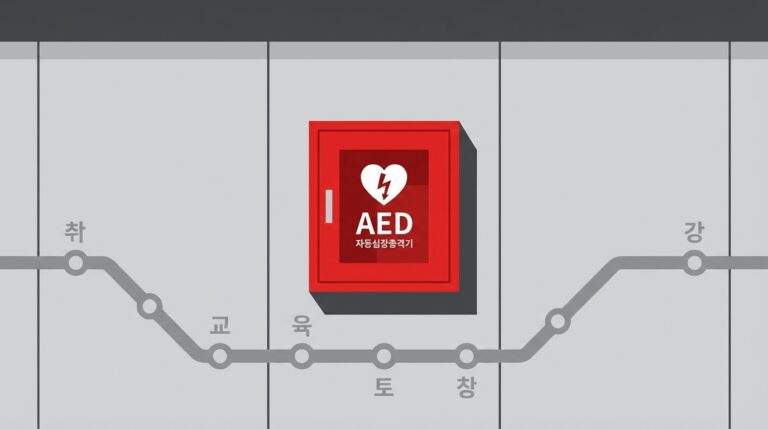
Phase 1: Immersive Hook
Hello! This is your Senior Editor at Daily Hangul.
Imagine this: You are at a bustling subway station in Seoul, perhaps changing lines at Sindorim during rush hour. Suddenly, a thud echoes through the crowd. Someone has collapsed. The crowd gasps—”어머!”—and freezes. It’s exactly like that tense scene in a medical K-Drama like Dr. Romantic (낭만닥터 김사부) or Hospital Playlist (슬기로운 의사생활). But there is no Master Kim to swoop in. The “Golden Time” is ticking.
At C1 level, you aren’t just a tourist asking for directions anymore. You are a capable individual who might need to take charge. In a high-stakes emergency, polite hesitations like “Excuse me, could you possibly…” don’t work. You need the sharp, commanding language of survival.
Today, we are learning how to be the protagonist who breaks the freeze. We are talking about AEDs (Automated External Defibrillators) and the authoritative Korean needed to save a life.
Phase 2: Deep Dive — Key Expressions
1. 자동 심장 충격기 (AED) [Jadong Simjang Chunggyeokgi]
- Pronunciation: [Ja-dong Sim-jang Chung-gyeok-gi] + (Imagine the rhythm of a heartbeat: Thump-Thump-Crash-Machine)
- Meaning: Automated External Defibrillator (Literal: Automatic Heart Shock Machine)
- K-Culture Moment: You will see these boxes in every subway station and apartment complex. In news reports about “Golden Time,” this word is the hero.
- Editor’s Insight: While many Koreans understand “AED,” the official term is 자동 심장 충격기. In older medical contexts or dramas, you might hear 제세동기 (Jesedonggi), but in a public emergency, stick to the descriptive term or clearly shout “AED!”
- Situation Spectrum:
[🚫 Formal/Polite] ———— [⚠️ Standard] ———— [✅ Urgent/Command]- This is a technical noun, so it’s neutral. But how you ask for it changes everything.
- 🤔 Think About It: Why is the Korean term so descriptive (Heart Shock Machine) compared to the acronym AED? Does this explicit naming help laypeople understand its function better during a panic?
2. 환자 발생! 비키세요! [Hwanja balsaeng! Bikiseyo!]
- Pronunciation: [Hwan-ja Bal-saeng! Bi-ki-se-yo!]
- Meaning: Patient emerging! (Emergency!) Step aside!
- K-Culture Moment: Think of the scene where paramedics rush a gurney through a hospital hallway. They don’t say “Excuse me.” They shout this.
- Editor’s Insight: 비키세요 comes from ‘비키다’ (to step aside/move out of the way). It is direct. In normal life, it’s rude. In an emergency, it is necessary. Do not add ‘요’ if you are truly shouting for space, but ‘비키세요’ maintains a sliver of social order.
- Situation Spectrum:
- Casual Street: 🚫 (You will start a fight)
- Emergency: ✅ (Essential)
3. 거기 파란 옷 입은 분! [Geogi paran ot ibeun bun!]
- Pronunciation: [Geogi paran ot ibeun bun]
- Meaning: You, the person wearing blue clothes over there!
- K-Culture Moment: Safety training videos in Korea always emphasize this. Due to the ‘Bystander Effect’ and cultural hesitation to intervene, you must pinpoint a specific person.
- Editor’s Insight: This is the “Designation” (지목) technique. Korean culture relies heavily on Nunchi (reading the room). In an emergency, everyone is reading everyone else, resulting in inaction. You must break the Nunchi cycle by assigning a specific role.
Phase 3: Textbook vs. Real Life
| Situation | 📖 Textbook Korean | 🗣️ Real Life (Survival) | 💡 Why the difference? |
|---|---|---|---|
| Asking for AED | “자동 심장 충격기가 어디에 있습니까?” (Where is the AED located?) | “AED! AED 있는 분?!” or “119 불러주세요!” | In panic, grammar disappears. Keywords and volume matter more than particles. |
| Clearing crowds | “실례합니다, 좀 지나가겠습니다.” (Excuse me, I will pass through.) | “비키세요! 물러나세요!” (Move! Back off!) | Politeness costs seconds. Saving face is less important than saving a life. |
| Checking consciousness | “괜찮으십니까?” (Are you alright?) | (Tapping shoulders hard) “여보세요! 여보세요!” | “여보세요” isn’t just for phones; it’s used to call out to someone whose attention is absent (or unconscious). |
Note: At C1 level, you know honorifics perfectly. The skill here is knowing when to drop them for efficiency without sounding uneducated.
Phase 4: Cultural Deep Dive
4-1. The Bystander Effect & “Pointing”
In many Western cultures, pointing is rude. In Korea, pointing with a finger is also generally impolite. However, in CPR training (심폐소생술 교육), Koreans are taught to point directly at a specific person to assign tasks: “You in the black padded jacket, call 119!” “You in the glasses, bring the AED!” This cuts through the collective hesitation. If you just shout “Help!”, people might look around, thinking someone else (someone older, someone more expert) will do it.
4-2. K-Drama Connection: The “Golden Time”
Medical dramas like Golden Time (골든타임) have popularized this term in Korea. It refers to the crucial minutes after a trauma or cardiac arrest. Because of this media exposure, if you shout “골든타임이에요! 도와주세요!” (It’s the Golden Time! Help!), Koreans instantly understand the gravity and are more likely to snap into action. It triggers a cultural script they’ve seen on TV.
Phase 5: Immersive Roleplay
Setting: A crowded subway platform. Line 2, Gangnam Station. Friday night. A middle-aged man suddenly clutches his chest and falls. You are the closest person.
Characters:
– YOU: A foreign resident who knows First Aid.
– Citizen (Minji): A young university student, frozen in shock.
Dialogue:
YOU: (Approaching quickly and tapping shoulders) 여보세요! 환자분! 제 말 들리세요?
(Yeoboseyo! Hwanjabun! Je mal deulliseyo?)
(Hello! Patient! Can you hear me?)
YOU: (No response. Checking breathing. Turning to the crowd) 의식이 없습니다! 심정지 환자예요!
(Uisigi eopseumnida! Simjeongji hwanjayeyo!)
(No consciousness! It’s a cardiac arrest patient!)
YOU: (Pointing directly at Minji) 거기 학생! 빨리 119 신고해 주세요!
(Geogi haksaeng! Ppalli 119 singohaejuseyo!)
(You, student! Call 119 quickly!)
Minji: (Startled) 네? 네! 신고할게요!
(Ne? Ne! Singohalgeyo!)
(Huh? Yes! I’ll report it!)
🔀 Decision Point: You need an AED. What do you say next?
A) “AED가 필요할 것 같은데요…” (I think we might need an AED…)
B) “누가 AED 좀 찾아주시겠어요?” (Could someone look for an AED?)
C) (Pointing at a man in a suit) “거기 양복 입은 분! 당장 AED 가져오세요!”
✅ Best Choice: C
Analysis: A is too passive. B is better but risks the bystander effect. C utilizes Specific Designation (지목) and imperative force. In a life-or-death scenario, clarity is kindness.
Man in Suit: 알겠습니다! 가져올게요!
(Algetseumnida! Gajyeoolgeyo!)
(Understood! I’ll bring it!)
Phase 6: 10-Second Shadowing Drill
Imagine you are controlling a chaotic scene. Use your “Command Voice.”
- 😤 환자가 / 의식이 / 없습니다! (Hwanjaga / uisigi / eopseumnida!) – The patient is unconscious!
- 😤 모두 / 뒤로 / 물러나세요! (Modu / dwiro / mulleonaseyo!) – Everyone, stand back!
- ⚡ 충전 중입니다! / 손 대지 마세요! (Chungjeon jungimnida! / Son daeji maseyo!) – It’s charging! Do not touch (the patient)!
Phase 7: K-Culture Mini Glossary
| Korean | Rom. | English | Context |
|---|---|---|---|
| 심폐소생술 | Simpye sosaengsul | CPR | Literal: Heart-Lung Resuscitation technique. |
| 골든타임 | Goldeun-taim | Golden Time | The critical window for survival. |
| 119 (일일구) | Il-il-gu | 119 | Korea’s emergency number (Fire/Ambulance). Police is 112. |
| 의인 | Uiin | Righteous Person | A title given by media/gov to citizens who save lives (Good Samaritan). |
| 하임리히법 | Haimrihibeop | Heimlich Maneuver | Often taught alongside CPR. |
Phase 8: Traveler’s Survival Kit
Where to find AEDs in Korea?
Even if you don’t carry one, you are never far from one in Seoul.
🆘 Survival Info
– Locations: Subway stations (usually near the ticket gate or station office), Apartment security offices (경비실), Community centers (주민센터).
– Look for: A box marked AED or 자동 심장 충격기.
– App: Download ‘E-Gen’ (응급의료정보제공) app. It maps all nearby AEDs and ERs.💡 Pro Tip: If you are in a subway station and can’t find it, shout to the station staff: “역무원님! AED 어디 있어요?” (Station master! Where is the AED?)
Phase 9: Think Deeper — “The Good Samaritan”
Topic: The Fear of Liability vs. The Law
For a long time, Koreans were hesitant to perform CPR on strangers due to fear of being sued if the patient died or suffered an injury (like broken ribs). There was also a specific cultural fear regarding gender—men hesitating to touch women to avoid sexual harassment accusations.
However, the Good Samaritan Law (선한 사마리아인 법) is now in effect in Korea. It protects rescuers from civil and criminal liability if they acted in good faith. Despite this, the cultural hesitation lingers. Knowing this context helps you understand why people might freeze and why you, as a decisive leader (armed with your C1 Korean), can be the catalyst that saves a life. You aren’t just using language; you are navigating a complex web of social anxiety.
Phase 10: FAQ & Troubleshooting
Q: Can I use English commands like “Back off!”?
A: In an emergency, tone conveys 80% of the meaning. People will understand the urgency. However, shouting “비키세요!” triggers a faster reflex in local Koreans.
Q: Is it rude to scream at an older person in this situation?
A: No. Safety trumps hierarchy. If an elder is blocking the medics, you can—and must—firmly say “나오세요!” (Come out/move out). Afterward, the culture of Jeong (bond) allows for a quick bow or “Sorry for shouting” once the crisis is over.
❌ Common Mistake: confusing 119 (Medical/Fire) with 112 (Police).
✅ Fix: Memorize: 119 for Pain/Fire, 112 for Crime.
Phase 11: Wrap-up
One-Liner: In an emergency, drop the elaborate honorifics and use clear, designated commands like “비키세요” and “119 신고해 주세요.”
Action Missions:
– 🥉 Bronze: Look at the AED map in your building or nearest subway station. Say “여기 자동 심장 충격기가 있네” aloud.
– 🥈 Silver: Watch a scene from Dr. Romantic (Youtube clips) and identify the urgency words (환자, 의식, 바이탈).
– 🥇 Gold: Download the E-Gen app and locate the nearest AED to your current location.
Phase 12: Quiz — Survival Check
1. You found a collapsed person. What is the most effective way to ask for help?
a) “도와주실 분 계신가요?” (Is there anyone who can help?)
b) “살려주세요!” (Save me!)
c) “거기 검은 패딩 입은 분, 119 신고해 주세요!” (You in the black padding, call 119!)
2. True or False?
In a medical emergency, you must use the highest honorifics (Hapsho-che) to bystanders.
3. What is the Korean phone number for Ambulance/Fire?
[ ]
Answers:
1. (c) Specific designation breaks the bystander effect.
2. False. Clarity and speed are more important. Polite imperative (-u-seyo) is enough.
3. 119
Frequently Asked Questions (FAQ)
Q: What does "자동 심장 충격기 (AED) [Jadong Simjang Chunggyeokgi]" mean in Korean and how do you pronounce it?
A: In Korean, "자동 심장 충격기 (AED) [Jadong Simjang Chunggyeokgi]" is pronounced [Ja-dong Sim-jang Chung-gyeok-gi] and means: Automated External Defibrillator (Literal: Automatic Heart Shock Machine)
Q: What does "환자 발생! 비키세요! [Hwanja balsaeng! Bikiseyo!]" mean in Korean and how do you pronounce it?
A: In Korean, "환자 발생! 비키세요! [Hwanja balsaeng! Bikiseyo!]" is pronounced [Hwan-ja Bal-saeng! Bi-ki-se-yo!] and means: Patient emerging! (Emergency!) Step aside!
Q: What does "거기 파란 옷 입은 분! [Geogi paran ot ibeun bun!]" mean in Korean and how do you pronounce it?
A: In Korean, "거기 파란 옷 입은 분! [Geogi paran ot ibeun bun!]" is pronounced [Geogi paran ot ibeun bun] and means: You, the person wearing blue clothes over there!







