

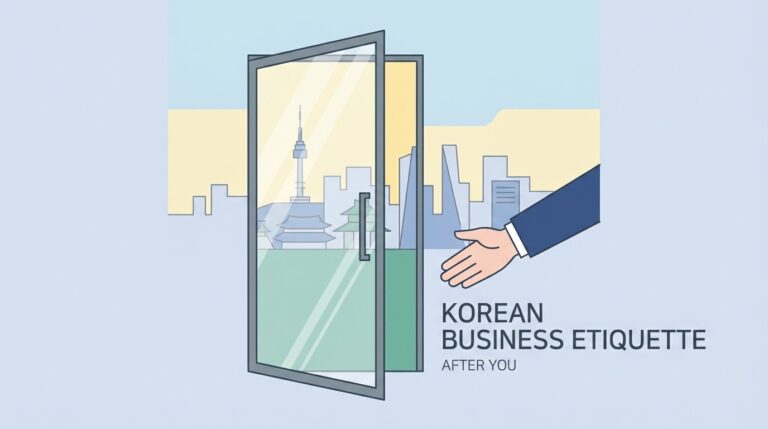
Phase 1: The Immersive Hook
Hello! This is your Senior Editor at Daily Hangul.
Picture this: You’re watching a rom-com K-Drama. The dashing male lead (Chaebol heir, obviously) walks towards a revolving door. Does he pause to let the female lead go first? Or does he stride through confidently while his secretary holds the door?
In Western etiquette, “Ladies First” is the golden rule. But in Seoul, you might have experienced a moment of confusion. You stood by the door, expecting the man behind you to grab it, but he just… squeezed past you.
Is chivalry dead in Korea? Not at all. It’s just that the rules of the game are different. In Korea, the invisible power dynamics of Age (나이) and Rank (직급) often override Gender. Today, we are decoding the complex algorithm of Korean door etiquette—where Confucian hierarchy meets modern manners.
This isn’t just about being polite; it’s about reading the room (Nunchi) at a C2 level.
Phase 2: Deep Dive into Core Expressions
At an advanced level, we move beyond simple phrases to words that describe the mindset.
1. 먼저 가세요 (Meonjeo gaseyo)
- Pronunciation: [Meon-jeo ga-se-yo] (Sounds like: ‘Mon-joe’ + ‘Ga-say-yo’)
- Meaning: Please go first (Literal: Go first)
- K-Culture Moment: In a crowded elevator scene in a drama, when the doors open, the junior employee holds the ‘Open’ button and says this to the CEO. It’s an act of submission and respect.
- Editor’s Insight: While grammatically simple, the tone dictates the nuance. A sharp tone implies annoyance (“Just go!”), while a soft, bowing tone implies deference.
- Situation Spectrum:
[🚫 Friends only] ———— [⚠️ Semi-formal] ———— [✅ Universal]
- Actually, this is ✅ Universal. You can use it with anyone.
- 🤔 Think About It: Why does Korean focus on the order of movement (First/Second) rather than the act of holding the door itself?
2. 의전 (Uijeon)
- Pronunciation: [Ui-jeon] (Sounds like: ‘We’ + ‘John’)
- Meaning: Protocol / Formality
- K-Drama Context: You hear this in corporate dramas like Misaeng. “의전에 신경 써 (Pay attention to protocol).” It implies knowing who sits where and who enters a room first.
- Editor’s Insight: This is a C2 keyword. If you hold the door for a client, you aren’t just being nice; you are performing ‘의전’.
- Situation Spectrum:
[🚫 Casual] ———— [⚠️ Business/Formal] ———— [✅ High Stakes]
- Use this word when discussing manners, not during the act.
- 🤔 Think About It: In your culture, is etiquette considered a professional skill or just a personal trait?
3. 배려 (Baeryeo)
- Pronunciation: [Bae-ryeo] (Sounds like: ‘Bear’ + ‘Yuh’ with a soft R)
- Meaning: Consideration / Thoughtfulness
- K-Pop Context: Fans often praise idols for their “Manner Hands” (hover hands) as a sign of 배려.
- Editor’s Insight: This is the ultimate compliment in Korea. “그 사람은 배려심이 깊어요” (That person is deeply considerate). Opening a door is a physical act of Baeryeo.
- Situation Spectrum:
[✅ All Situations]
Phase 3: Textbook vs. Real Life
| Situation | 📖 Textbook Korean | 🗣️ Real Korean (Street/Biz) | 💡 Why the difference? |
|---|---|---|---|
| Holding a door | “제가 문을 잡아 드리겠습니다.” (I will hold the door for you.) | (Silent nod) OR “잠시만요!” (Just a moment!) | Koreans value efficiency. Verbalizing the obvious slows things down. |
| Offering precedence | “숙녀분 먼저.” (Ladies first.) | “먼저 들어가시죠.” (Please enter first.) | “Ladies First” is a translated western concept. Real protocol is rank-based. |
| Behind someone | “지나가겠습니다.” (I will pass.) | “잠시만요~” (Excuse me/Wait a sec~) | “Jamsimanyo” is the magic key for any physical movement in shared space. |
Bottom Note: In a busy subway station, nobody says full sentences. Body language and a slight bow of the head do 90% of the talking.
Phase 4: Cultural Deep Dive — The Hierarchy Algorithm
4-1. Non-verbal: The “Eye-Contact” Rule
Unlike in the West, where you might smile and make eye contact while holding a door, in Korea, prolonged eye contact can be uncomfortable.
– The Move: Hold the door, look slightly down or at the person’s shoulder level, and give a light nod (Mokrye – 목례).
– The Trap: If you hold the door too long for a stranger who is far away, they will feel burdened (부담) to run. In Korea’s Ppalli-ppalli (Hurry-hurry) culture, making someone run is not considerate.
4-2. K-Culture Connection: K-Drama Trope
The “Wrist Grab” vs. The “Door Block”
In K-Dramas, the male lead often slams his hand against the door/wall to block the female lead (the Kabedon trope). This is aggressive romance in fiction, but in real life? It’s rude.
However, notice who opens the car door.
– Western Logic: The man opens for the woman.
– Korean Logic: The Maknae (Youngest) or Subordinate opens for the Senior/Boss.
Critique: If a young female employee is with an older male boss, she might be expected to hold the door for him. This is where Western learners get confused. The “Social Hierarchy” card trumps the “Gender” card.
Phase 5: Immersive Roleplay
Setting: A fancy office building in Gangnam. You are attending a high-stakes meeting.
Characters:
– YOU: A foreign executive (Director level).
– Min-su: Your Korean business partner (Team Leader level, younger than you).
(The elevator arrives. The doors open.)
Min-su: (Quickly pressing the ‘Open’ button and blocking the sensor with his hand)
이사님, 먼저 타시죠.
(Isanim, meonjeo tasijo.)
[Translation: Director, please get in first.]
(🎭 Stage Direction: He bows slightly, ushering you in.)
🔀 Decision Point: How do you react?
A) “No, no, after you! Ladies/Gentlemen first!” (Refuse and gesture him in)
B) “Oh, thank you.” (Walk in confidently)
C) “같이 가요!” (Grab the door from him and make him go first)
✅ Best Choice: B
– Why: In a business context, you are the superior (Director). Min-su is performing Uijeon (Protocol). Refusing his gesture repeatedly (Option A) creates a traffic jam and makes him awkward. Accepting his service with a nod is the most “professional” response in Korea.
– Analysis of C: Too casual. It breaks the hierarchy and might confuse him.
Phase 6: 10-Second Shadowing Drill
Practice the art of “Polite Refusal” or “Granting Permission.”
Context: When someone holds the door for you, acknowledge it quickly as you pass.
😊 Bright & Quick:
아, / 감사합니다! (Ah, / gam-sa-ham-ni-da!)🤵 Formal (Granting precedence):
먼저 / 들어가세요. (Meon-jeo / deu-reo-ga-se-yo.)
Phase 7: K-Culture Glossary
| Korean | Romanization | Meaning | Context |
|---|---|---|---|
| 상석 | Sangseok | Seat of Honor | The safest spot in a room/car, usually furthest from the door. |
| 서열 | Seoyeol | Rank/Hierarchy | The invisible ladder that decides who enters first. |
| 매너손 | Manner-son | Manner Hands | Not touching someone unnecessarily; respecting personal space. |
Phase 8: Traveler’s Survival Kit (The Elevator Edition)
Since “Holding the Door” happens most often in elevators in high-rise Seoul:
🆘 Survival Scenario: The ‘Close’ Button War
– Context: Koreans are famous for pressing the ‘Close’ (닫힘) button instantly. If you see someone running towards the elevator:
– Say this: “잠시만요!” (Jam-si-man-yo!)
– Action: Stick your hand (or foot) carefully to trigger the sensor, or press the ‘Open’ (열림) button.
– 💡 Pro Tip: If you are standing near the buttons, you are the unofficial “Elevator Operator.” It is polite to hold the ‘Open’ button until everyone gets off/on. Don’t just stand there looking at your phone!
Phase 9: Think Deeper — “Hierarchy vs. Chivalry”
Why does the ‘Lady First’ rule often fail in Korea?
Korea is deeply rooted in Neo-Confucianism, where social order is maintained through Seoyeol (Hierarchy). The order of precedence is usually: Elder/Boss > Younger/Subordinate.
In the West, chivalry (gender-based politeness) is a dominant social script. In Korea, while modern younger generations are adopting “Lady First,” in a mixed setting involving work or elders, Hierarchy is the stronger card.
🧠 Think Deeper: If a young woman holds the door for an older man in Korea, it is not “reverse chivalry”; it is “respect for elders.” As an advanced learner, can you distinguish when a Korean is being “rude” versus when they are simply following a “different hierarchy”?
Phase 10: FAQ & Troubleshooting
Q: A man didn’t hold the door for me. Was he being rude?
A: Not necessarily. If he was in a hurry, or if you were far away, he might have just prioritized speed (ppalli-ppalli). Also, if he perceives you as an equal or senior, he might not want to perform an “unnecessary” act of intimacy/service. Don’t take it personally.
Q: Should I hold the door for an older Korean man?
A: Yes. This is a power move. It shows you understand Hyo (Filial Piety) and respect. He will be impressed.
❌ Common Mistake: holding the door open for too long for a large group of strangers.
✅ Fix: Hold it for the person immediately behind you, then let go. You are not the doorman for the entire building!
Phase 11: Wrap-up & Action Mission
One-Liner: In Korea, open doors based on Rank and Age, not just Gender.
🚀 Action Missions:
– 🥉 Bronze: Practice saying “먼저 가세요” with a slight bow in front of a mirror.
– 🥈 Silver: Next time you are in an elevator (even in your home country), act as the “Operator” and press the Open button for everyone. Feel the Baeryeo.
– 🥇 Gold: Watch a K-Drama scene involving a CEO and employees. Observe the physical order of who enters the room/car first. Report back in the comments!
💬 Your Turn: Have you ever experienced a “Culture Clash” regarding door etiquette in Asia? Tell me your story below!
Phase 12: Interactive Quiz
Scenario: You (Female, 25) are entering a restaurant with your Boss (Male, 50).
Q: Who should open the door?
1. The Boss, because ‘Ladies First’.
2. You, because ‘Boss First’.
3. Wait for the waiter to open it.
🔻 Answers (Toggle to see):
Correct Answer: 2
Explanation: In a business/formal setting, rank overrides gender. You should open the door and usher him in saying “먼저 들어가세요.” If he insists on opening it for you, then you can accept, but the initial gesture should come from the subordinate.
Frequently Asked Questions (FAQ)
Q: What does "먼저 가세요 (Meonjeo gaseyo)" mean in Korean and how do you pronounce it?
A: In Korean, "먼저 가세요 (Meonjeo gaseyo)" is pronounced [Meon-jeo ga-se-yo] and means: Please go first (Literal: Go first)
Q: What does "의전 (Uijeon)" mean in Korean and how do you pronounce it?
A: In Korean, "의전 (Uijeon)" is pronounced [Ui-jeon] and means: Protocol / Formality
Q: What does "배려 (Baeryeo)" mean in Korean and how do you pronounce it?
A: In Korean, "배려 (Baeryeo)" is pronounced [Bae-ryeo] and means: Consideration / Thoughtfulness






