

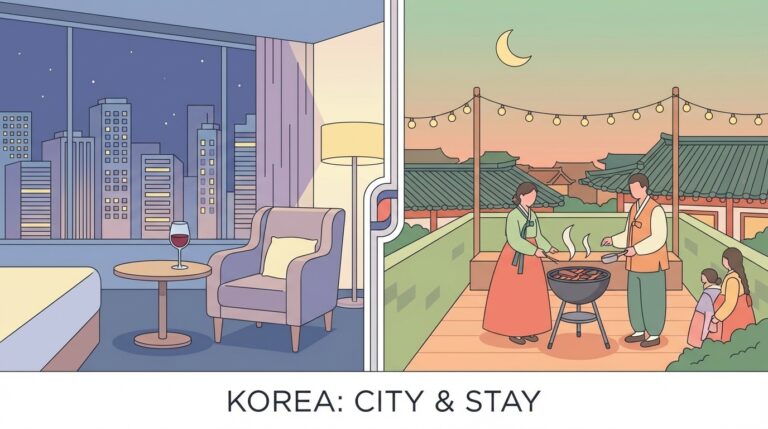
Phase 1: Immersive Hook
Hello, Daily Hangul readers! This is your editor. 👋
Picture this: You are the main character in a K-Drama set in Jeju Island.
In Scenario A, you are the sophisticated heir to a conglomerate (chaebol), sipping wine in a bathrobe while looking out at the ocean from a 5-star Hotel.
In Scenario B, you are a free-spirited traveler, laughing and grilling pork belly (Samgyeopsal) on a rooftop with new friends you just met at a Guesthouse.
Which vibe do you want for your next Korea trip?
Choosing accommodation in Korea isn’t just about a bed to sleep in; it’s about choosing the genre of your trip. If you don’t know the nuances, you might end up in a silent room when you wanted a party, or in a noisy bunk bed when you needed a ‘Hocance’ (Hotel Vacance). Let’s learn how to discuss these options like a local!
Phase 2: Deep Dive into Core Expressions
Here are the top 3 expressions you need when negotiating where to stay.
1. 가성비 (Gaseongbi)
- Pronunciation: [Ga-seong-bi] Sounds like ‘Gas-sung-bee’
- Meaning: Cost-effectiveness / Value for money
- K-Culture Moment: You’ll hear this constantly on Korean travel variety shows. If a place is cheap but amazing, the cast shouts, “Wa, gaseongbi daebak!” (Wow, the value is insane!).
- Editor’s Insight: Koreans love efficiency. If you choose a hotel that is too expensive but not that nice, your friend might judge your choices. Use this word to justify a cheaper guesthouse that is clean and cozy.
- Situation Spectrum:
[🚫 Formal Report] ———— [✅ Friends/Travel] ———— [✅ Shopping]- 🤔 Think About It: Why is “efficiency” so important in Korean consumer culture? Does your language have a single word that combines price and performance perfectly?
2. 분위기 깡패 (Bunwigi Kkangpae)
- Pronunciation: [Bun-wi-gi Kkang-pae]
- Meaning: Killer atmosphere / Vibe gangster (Literal)
- K-Culture Moment: Used on Instagram captions when posting photos of aesthetic cafes or boutique hotels.
- Editor’s Insight: Kkangpae means gangster/thug. It sounds aggressive, but it’s a huge compliment! It means the atmosphere is so good, it beats everything else. Use this when you want to convince your friend to book a slightly more expensive hotel because it’s “Instagrammable.”
- Situation Spectrum:
[🚫 To Elders] ———— [⚠️ Semi-formal] ———— [✅ Friends/Online]- 🤔 Think About It: Using “gangster” as a compliment is unique slang. It reflects a “powerful impact.” What slang in your language describes something overwhelmingly good?
3. ~ 쪽으로 알아보자 (~ Jjog-euro araboja)
- Pronunciation: [~ Jjog-eu-ro a-ra-bo-ja]
- Meaning: Let’s look into [Option] / Let’s research [Option]
- Editor’s Insight: This is the magic phrase for compromise. Instead of saying “I hate hotels,” you say, “Let’s look into guesthouses.” It softens your preference.
- Situation Spectrum:
[⚠️ Boss] ———— [✅ Colleagues] ———— [✅ Friends]
Phase 3: Textbook vs. Real Life
| Situation | 📖 Textbook Korean | 🗣️ Real Korean | 💡 Why is it different? |
|---|---|---|---|
| Suggesting a hotel | 호텔을 예약합시다. (Let’s reserve a hotel.) | 호캉스 갈까? (Shall we go for Hocance?) | Hocance (Hotel + Vacance) is a specific culture of enjoying hotel amenities, not just sleeping. |
| Asking about price | 가격이 합리적인가요? (Is the price reasonable?) | 여기 가성비 어때? (How is the cost-performance here?) | “Reasonable” sounds like a business contract. Gaseongbi is the everyday metric. |
| Checking reviews | 후기가 좋은 곳입니다. (It is a place with good reviews.) | 여기 평점 쩐다. (The rating here is dope.) | Younger generations use stronger slang like jjonda (dope/awesome) for emphasis. |
Bottom Note: If you are speaking to a travel agent, stick to the Textbook column. If you are talking to a Korean friend, switch to the Real Korean column to sound like an insider!
Phase 4: Cultural Deep Dive
4-1. The “Party” Culture in Guesthouses
Unlike many Western hostels which are just for sleeping, many Korean guesthouses (especially in places like Jeju or Gangneung) organize a “Guesthouse Party” (게하 파티) at night.
* The Vibe: Everyone pays a small fee (~20,000 KRW) for unlimited BBQ and Soju.
* Nunchi (Eye-measure): If you book a place famous for parties but refuse to join, it’s fine, but you might find the noise level annoying. If you want quiet, look for phrases like “조용한 휴식” (Quiet rest) in the description.
4-2. K-Drama Connection: The “Rooftop” Romance
In dramas like Itaewon Class or Fight for My Way, the rooftop (옥상 – Oksang) is where dreams are shared. Many guesthouses boast a “Rooftop View.” If you say, “Let’s drink beer on the rooftop” (옥상에서 맥주 한잔?), you are essentially reenacting a K-Drama scene. This is a huge selling point for guesthouses over stuffy hotels.
Phase 5: Immersive Roleplay
Setting: A cafe in Seoul. You are planning a weekend trip to Busan with your Korean friend, Min-ji.
Characters:
* YOU: Want to save money and meet people.
* Min-ji (28): Tired from work, wants luxury and sleep.
Min-ji: 이번 부산 여행 때 숙소 어디로 잡지? 나 진짜 푹 쉬고 싶어… 😩
(Ibeon Busan yeohaeng ttae sukso eodiro japji? Na jinjja puk swigo sipeo…)
[Translation: Where should we book for this Busan trip? I really want to rest properly…]
🔀 YOUR TURN! How do you respond?
A) “호텔은 너무 비싸요. 게스트하우스 갑시다.”
(Hotels are too expensive. Let’s go to a guesthouse.)
– Verdict: A bit too blunt. Min-ji might feel you don’t care about her exhaustion.B) “우리 가성비 좋은 게스트하우스는 어때? 파티도 재밌을 것 같아!”
(Uri gaseongbi joeun geseuteuhauseu-neun eottae? Patido jaemisseul geot gata!)
(How about a guesthouse with good value? The party seems fun too!)
– Verdict: Risky. Min-ji just said she wants to rest. “Party” might trigger her.C) “호텔은 좀 비싸니까, 분위기 좋은 에어비앤비나 조용한 게스트하우스 쪽으로 알아보는 건 어때?”
(Hoteureun jom bissanikka, bunwigi joeun Airbnb-na joyonghan geseuteuhauseu jjog-euro araboneun geon eottae?)
(Since hotels are a bit pricey, how about looking into a nice-vibe Airbnb or a quiet guesthouse?)
– Verdict: ✅ Best Choice! You acknowledged the budget (fact) and offered a compromise (quiet/nice vibe) using “~jjog-euro araboja.”
Min-ji: 음… 시끄러운 건 싫은데. 조용한 곳이면 괜찮아! 👌
(Eum… sikkeureoun geon sireunde. Joyonghan gosimyeon gwaenchana!)
[Translation: Hmm… I hate noise. If it’s a quiet place, I’m okay with it!]
Phase 6: 10-Second Shadowing Drill
Let’s practice the “Compromise” skill. Say this with a persuasive but gentle tone.
😊 Since we are going to the ocean, how about a place with a view?
바다 가는 김에 / 오션뷰 있는 곳으로 / 잡는 건 어때?
(Bada ganeun gime / ocean-view inneun goseuro / jamneun geon eottae?)
Key Points:
* ~Gime (김에): While we are at it / Since we are doing X anyway.
* Ocean-view (오션뷰): Yes, Koreans use the English word!
Phase 7: K-Culture Glossary
| Korean | Romanization | Meaning | Context |
|---|---|---|---|
| 호캉스 | Hocance | Hotel Vacation | A popular trend of spending a holiday purely inside a hotel to relax. |
| 게하 | Ge-ha | Guesthouse | Slang/Abbreviation for Guest House. Used frequently in text. |
| 조식 | Josik | Breakfast | Crucial decision factor. “Is josik included?” is a must-ask question. |
| 풀빌라 | Pul-billa | Pool Villa | A luxury accommodation with a private pool. Very trendy for couples/groups. |
| 입실 / 퇴실 | Ibsil / Toesil | Check-in / Check-out | Formal terms used on booking apps and hotel signs. |
Phase 8: Traveler’s Survival Kit
Situation: Looking at a Korean Booking App (Yanolja / Yeogi-eottae)
🆘 Survival Vocabulary #1
– 🇰🇷 “여기 짐 보관 되나요?” (Yeogi jim bogwan doenayo?)
– 🗣️ Meaning: Can I store my luggage here?
– 📍 Where: Front desk (before check-in or after check-out).
– 💡 Pro Tip: Many guesthouses have no elevator. If you ask this, also check if they can help you carry it up (짐 옮겨 주실 수 있나요?).📌 Editor’s Travel Note
– Toothbrushes: By law, many luxury hotels in Korea no longer provide free toothbrushes (environmental regulations). Always pack one or buy it at a convenience store (Pyeonuijeom) nearby.
– Shoes: In guesthouses, you MUST take off your shoes at the entrance. Walking inside with shoes on is a cultural disaster.
Phase 9: Think Deeper — “The Rise of Hocance”
Topic: Why pay for a hotel in your own city?
In many Western cultures, hotels are strictly for travel away from home. But in Korea, “Hocance” (checking into a hotel in Seoul while living in Seoul) is massive. Why?
- Escape: Many young Koreans live with parents until marriage. A hotel offers rare privacy.
- Convenience: Korean life is fast-paced (Pali-pali). People want to rest without the labor of cooking or cleaning.
- Status: It’s an affordable luxury that looks great on social media.
💬 Your Turn: Does the concept of a “Staycation” in a hotel exist in your country? Or is it considered a waste of money? Let me know!
Phase 10: FAQ & Troubleshooting
Q: Is it okay to stay in a ‘Motel’ in Korea?
* Answer: Maybe. In Korea, “Motels” are often rebranded as “Boutique Hotels,” but they can still be associated with “Love Motels” (rented by the hour for couples). If you are traveling with family, verify carefully. If you are with friends and just need a cheap, clean place with a big TV and computer, high-end motels are actually great gaseongbi options!
❌ Common Mistake #1: Thinking “Pension” refers to retirement money.
* Correction: In Korea, a Pension (펜션) is a holiday rental house, usually in the countryside or near the beach, similar to a chalet or cabin. It’s great for group BBQs!
Phase 11: Wrap-up & Action Mission
Summary: Today we learned how to balance budget (Gaseongbi) and vibe (Bunwigi) when suggesting accommodation (Sukso) using the soft suggestion form ~neun eottae?.
🚀 Action Mission:
* 🥉 Bronze: Look at a photo of a hotel and say “Bunwigi Kkangpae!” out loud.
* 🥈 Silver: Go to a Korean booking site (like Agoda or Booking.com set to Korea) and find a place. Describe it using “Gaseongbi” or “Ocean-view.”
* 🥇 Gold: Message a friend (or post on social media) about your dream trip: “Next time, let’s go for Hocance!”
K-Culture Mission: Watch an episode of “Hyori’s Bed & Breakfast” (Hyo-ri-ne Min-bak) on Netflix. Notice how the guests interact in the shared dining area. That is the true essence of Korean guesthouse culture!
Phase 12: Interactive Quiz
- Situation: You found a hotel that is cheap but very clean and nice. What do you say?
- A) Gaseongbi daebak! (Value is jackpot!)
- B) Bunwigi kkangpae! (Vibe gangster!)
- True or False: You should keep your shoes on when entering a guesthouse bedroom to be polite.
- (True / False)
- Scenario: Your friend says “I want to swim privately.” Which accommodation type is best?
- A) Guesthouse
- B) Pool Villa
- C) Motel
Answers:
1. A (B is for atmosphere/visuals)
2. False (Taking off shoes is mandatory!)
3. B (Pool Villas are famous for private pools)
Frequently Asked Questions (FAQ)
Q: What does "가성비 (Gaseongbi)" mean in Korean and how do you pronounce it?
A: In Korean, "가성비 (Gaseongbi)" is pronounced [Ga-seong-bi] and means: Cost-effectiveness / Value for money
Q: What does "분위기 깡패 (Bunwigi Kkangpae)" mean in Korean and how do you pronounce it?
A: In Korean, "분위기 깡패 (Bunwigi Kkangpae)" is pronounced [Bun-wi-gi Kkang-pae] and means: Killer atmosphere / Vibe gangster (Literal)
Q: What does "~ 쪽으로 알아보자 (~ Jjog-euro araboja)" mean in Korean and how do you pronounce it?
A: In Korean, "~ 쪽으로 알아보자 (~ Jjog-euro araboja)" is pronounced [~ Jjog-eu-ro a-ra-bo-ja] and means: Let's look into [Option] / Let's research [Option]







