

Phase 1: Immersive Hook
Greeting: Hello! It’s your Daily Hangul Editor here.
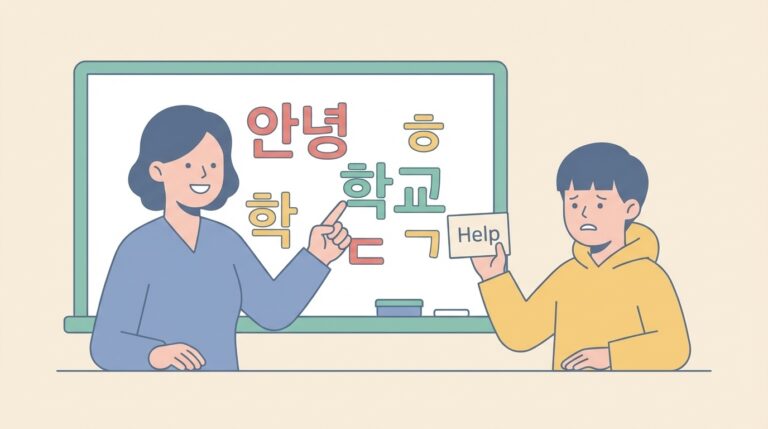
The Situation: Picture this. You are in a Korean language classroom (or maybe a Zoom session). The room is quiet. The teacher adjusts their glasses, looks around, and their eyes land on… YOU.
Your heart starts racing. 💓 The teacher points to a sentence on the whiteboard and says the magic words:
“자, 이거 읽어 보세요.” (Ja, igeo ilgeo boseyo.)
Panic mode on! 😱 In K-Dramas, this is the moment the protagonist stumbles, and the cute lead character helps them out. But in reality? It’s just you and the silence. Do you freeze? Do you mumble? Or do you confidently read it out loud like a K-Pop idol doing a fanchant?
The ‘Why’: Being asked to “read this” is the most common classroom command. Understanding this phrase—and knowing how to respond or ask for help—is the difference between a stressful class and a confident one. Today, we conquer the fear of reading aloud!
Phase 2: Core Expressions (Deep Dive)
1. 읽어 보세요 (Ilgeo boseyo)
- Pronunciation:
[il-geo bo-se-yo]- Sound-alike: “Ill” (as in sick) + “Go” + “Bo” (bow and arrow) + “Say” + “Yo”
- Meaning:
- Literal: Try reading.
- Real Nuance: Please read this (polite instruction).
- K-Culture Moment: Think of those K-Pop survival shows like Produce 101. The vocal trainer hands the lyric sheet to a trainee and says sternly, “가사 읽어 보세요” (Read the lyrics). The tension is real!
- Editor’s Insight: Notice the sound linking? It’s written as
읽어but pronounced[일거](il-geo). The bottomㄱslides over to the next empty circle. It’s like a rollercoaster ride for your tongue! - Situation Spectrum:
[🚫 To Boss/Elders] ———— [⚠️ Semi-formal] ———— [✅ Standard Polite]- (Note: This is usually said by the teacher/superior to you. You wouldn’t usually say this to a boss unless you are presenting something.)
- 🤔 Think About It: Why does Korean add “-boseyo” (try to do) instead of just “read!”? It softens the command, making it sound like a suggestion rather than an order.
2. 이거 어떻게 읽어요? (Igeo eotteoke il-geo-yo?)
- Pronunciation:
[i-geo eo-tteo-ke il-geo-yo?]- Sound-alike: “E-go” + “Ot-tok-kay” (like the app) + “Ill-go-yo”
- Meaning: How do you read this?
- K-Culture Moment: Imagine a foreign K-Pop idol asking their leader about a difficult word in a fan letter. “Hyung, igeo eotteoke ilgeoyo?”
- Editor’s Insight: This is your Lifesaver Card. Use it whenever you see a word with complex batchim (bottom consonants). Don’t guess; just ask!
- Situation Spectrum:
[🚫 Casual Friends] ———— [⚠️ Teachers/Strangers] ———— [✅ Standard]
3. 큰 소리로 (Keun soriro)
- Pronunciation:
[keun so-ri-ro] - Meaning: With a loud voice (Loudly).
- Editor’s Insight: Teachers love this phrase. “Keun soriro ilgeo boseyo!” means “Read it loud and clear!” Don’t whisper; show your confidence!
Phase 3: Textbook vs. Real Life
| Situation | 📖 Textbook Korean | 🗣️ Real Korean (Pronunciation) | 💡 Why different? |
|---|---|---|---|
| Reading ‘읽어’ | 읽.어. (il-k-eo) | 일거 (il-geo) | Linking Rule: Sounds like to flow like water, not stop like stones. |
| Reading ‘같이’ | 같.이. (gat-i) | 가치 (ga-chi) | Palatalization: ‘T’ sound + ‘i’ becomes ‘CH’. Easier to say! |
| Hesitating | 음… (Eum…) | 그… / 저… (Geu… / Jeo…) | Native speakers use ‘Geu’ or ‘Jeo’ as filler words to buy time. |
Bottom Note: When you read aloud, don’t try to pronounce every single letter perfectly separately. Let them blend!
Phase 4: Cultural Context — The Art of ‘Nunchi’ Reading
4-1. Non-verbal Communication
When a teacher or an elder asks you to read something:
* Posture: Sit up straight. Slouching while reading can look disinterested.
* Eye Contact: It’s okay to look at the paper, but glance up at the listener at the end of the sentence to show you are finished.
4-2. K-Culture Connection: The ‘Fanchant’ (응원법)
Have you ever heard K-Pop fans shouting perfectly synchronized names and lyrics during a concert? That is the ultimate “Group Reading” class!
* Context: Fans memorize specific parts to shout. They don’t read everything; they read the highlighted parts.
* Lesson: In Korean class, rhythm matters. Just like a fanchant has a beat, Korean sentences have a rhythm. Don’t read like a robot; read with a beat!
Phase 5: Immersive Roleplay Scenario
Setting: A beginner Korean class in Seoul. The air conditioner is humming. Teacher Kim is holding a textbook.
Characters:
* YOU: An enthusiastic student (Level A1).
* Teacher Kim: Kind but strict about pronunciation.
🎭 The Dialogue:
Teacher Kim: 민수 씨, 10페이지 보세요. 이거 읽어 보세요.
(Minsu-ssi, 10-peiji boseyo. Igeo ilgeo boseyo.)
(Minsu, look at page 10. Please read this.)
YOU: (Looking at a difficult word: ‘닭’) … 😅
🔀 Decision Point! What do you say?
A) (Stay silent and stare at the paper)
B) “이거 어떻게 읽어요?” (Igeo eotteoke ilgeoyo?)
C) “I don’t know.”
✅ Best Choice: B
* Why? It shows you are trying and want to learn. Silence (A) makes the atmosphere awkward, and English (C) breaks the immersion.
Teacher Kim: 아, 이건 ‘닥’이라고 읽어요. (Ah, igeon ‘dak’-irago ilgeoyo.)
(Ah, you read this as ‘dak’.)
YOU: 아! 닭! 감사합니다. (Ah! Dak! Gamsahamnida.)
Phase 6: 10-Second Shadowing Drill
Practice reading with emotion! Follow the slash / for pausing.
- 🥺 Confused & Asking:
선생님, / 이거 / 어떻게 읽어요?
(Seonsaengnim, / igeo / eotteoke ilgeoyo?) -
😤 Confident:
저 / 한국어 / 읽을 수 있어요!
(Jeo / hangugeo / ilgeul su isseoyo!) -
😊 Cheerful:
네! / 읽어 볼게요!
(Ne! / ilgeo bolkeyo!)
Phase 7: K-Culture Mini Glossary
| Korean | Romanization | English | Context |
|---|---|---|---|
| 발음 | Bareum | Pronunciation | “Bareum is hard!” (Pronunciation is hard!) |
| 목소리 | Moksori | Voice | “Moksori keuge!” (Big voice/Loudly!) |
| 따라 하세요 | Ttara haseyo | Repeat after me | The most common phrase in language class. |
| 자막 | Jamak | Subtitles | Crucial for K-Drama fans. Reading ‘jamak’ is good practice! |
Phase 8: Traveler’s Survival Kit
Even if you aren’t in a classroom, you will need to “read” things in Korea (menus, signs, maps).
🆘 Survival Expression #1
* 🇰🇷 “이거 영어로 뭐예요?” (Igeo yeong-eo-ro mwo-ye-yo?)
* 🗣️ Meaning: What is this in English?
* 📍 Where: Restaurants with no pictures.
* 💡 Pro Tip: If you can’t read the Hangul menu, point and ask this. Or use Papago Image Translate on your phone!📌 Editor’s Travel Note
* Subway Signs: Most signs in Seoul have English, Chinese, and Japanese. But bus stops often only have Hangul. Practice reading place names like “Gangnam” (강남) or “Hongdae” (홍대) visually!
Phase 9: Think Deeper — “Why so loud?”
🧠 Language & Culture:
In Western classrooms, reading aloud might be seen as something for elementary kids. But in Korea, “Group Reading” (Tte-chang in singing, but similar in class) is very common even for adults.
Why? It reflects the Collectivist Culture. Doing things together creates a sense of ‘One Team’ (Uri – Us). Also, Korean education values “Rotary Memorization”—repeating something until it sticks. So don’t be shy if the teacher asks the whole class to read together. It’s not just reading; it’s team building!
💬 Your Turn: Does your culture value reading aloud, or is silent reading preferred? Let me know in the comments!
Phase 10: FAQ & Troubleshooting
- Q: Can I say “읽어 보세요” to my Korean teacher?
- No! 🚫 “-Boseyo” is a command/suggestion. If you want the teacher to read something for you, say: “읽어 주세요” (Ilgeo juseyo – Please read this for me). The change from Bo to Ju changes it from a command to a request for help.
- Q: I saw a sign that says ‘셀프’ (Sel-peu). What does it mean?
- It stands for “Self-Service.” You need to get your own water or side dishes. It’s a Konglish (Korean-English) word you must be able to read!
❌ Common Mistake: Reading every letter separately like a robot.
✅ Fix: Focus on the flow. Listen to how Koreans slur the end of one block into the beginning of the next.
Phase 11: Wrap-up & Action Items
One-Liner: When asked to “Ilgeo boseyo,” don’t panic—just link your sounds and ask “Eotteoke ilgeoyo” if you get stuck!
🚀 Action Missions:
* 🥉 Bronze: Find a Korean product (ramen, snack) in your house and read the name aloud 3 times.
* 🥈 Silver: Watch a K-Pop music video with Hangul lyrics enabled and try to read the chorus along with the singer.
* 🥇 Gold: Post a voice note on a language exchange app (like HelloTalk) asking: “Is my pronunciation okay?”
🎬 K-Culture Mission: Watch a K-Drama scene where a character reads a letter (often a breakup or confession letter). Notice their intonation. Is it flat? No, it’s emotional!
Phase 12: Interactive Quiz
- Situation: The teacher points to a sentence. What does she say?
- A) 듣지 마세요 (Deutji maseyo)
- B) 읽어 보세요 (Ilgeo boseyo)
- C) 쓰지 마세요 (Sseuji maseyo)
- Pronunciation Check: How do you read ‘같이’ (Together)?
- A) Gat-i
- B) Ga-chi
- True or False: It is rude to ask “How do you read this?” to a teacher.
- (True / False)
Answers:
1. B (A is “Don’t listen”, C is “Don’t write”)
2. B (The ‘t’ meets ‘i’ and becomes ‘ch’)
3. False (It is the best way to learn! Teachers love questions.)
Frequently Asked Questions (FAQ)
Q: What does "읽어 보세요 (Ilgeo boseyo)" mean in Korean and how do you pronounce it?
A: In Korean, "읽어 보세요 (Ilgeo boseyo)" is pronounced [il-geo bo-se-yo] and means: a key conversational Korean expression covered in this lesson.
Q: What does "이거 어떻게 읽어요? (Igeo eotteoke il-geo-yo?)" mean in Korean and how do you pronounce it?
A: In Korean, "이거 어떻게 읽어요? (Igeo eotteoke il-geo-yo?)" is pronounced [i-geo eo-tteo-ke il-geo-yo?] and means: a key conversational Korean expression covered in this lesson.
Q: What does "큰 소리로 (Keun soriro)" mean in Korean and how do you pronounce it?
A: In Korean, "큰 소리로 (Keun soriro)" is pronounced [keun so-ri-ro] and means: With a loud voice (Loudly).







