

Phase 1: The ‘Real’ K-Drama Moment – Are You Listening or Just Hearing?
Hello! This is your Daily Hangul Senior Editor.
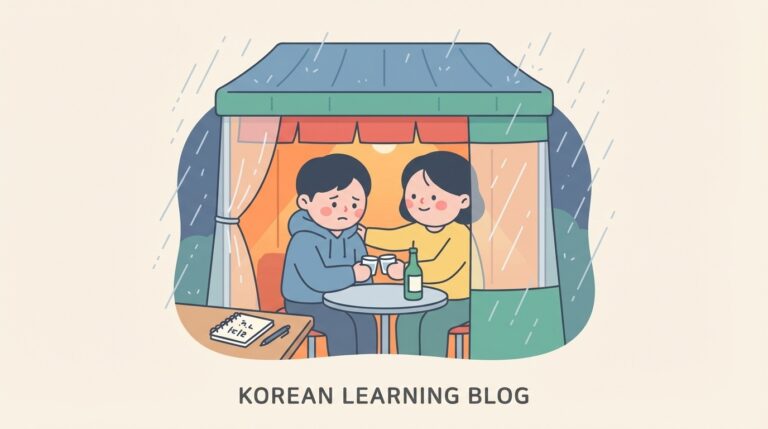
Picture this: It’s episode 12 of a K-Drama. The main character has just failed an important audition or lost a business deal. They are sitting in a Pojangmacha (street food tent), staring at a glass of soju. The rain is pouring outside. Their best friend (or the hidden chaebol heir) sighs, clinks glasses, and drops a single sentence. Suddenly, the mood shifts. The protagonist’s eyes light up with determination.
That sentence wasn’t just “cheer up.” It was likely a proverb (Sokdam).
In Korea, giving advice is an art form. If you be too direct, you sound rude. If you are too vague, you seem indifferent. Proverbs are the perfect cheat codes—they carry the weight of ancient wisdom, making your advice sound profound, warm, and distinctly Korean.
Today, we aren’t just memorizing phrases. We are learning how to be the friend who knows exactly what to say when life gets tough. Ready to become the wise protagonist of your own story? Let’s dive in.
Phase 2: Core Expressions (Deep Dive)
Here are the three heavy-hitters you’ll hear from K-Pop idols to office mentors.
1. 시작이 반이다 (Sijagi banida)
- Pronunciation: [Shi-ja-gi ba-ni-da] Sounds like: She-jag-ee bah-knee-da
- Meaning: “Well begun is half done” (Literal: The start is half).
- K-Culture Moment: You’ll hear this on reality shows like I Live Alone when a celebrity finally starts a diet or a hobby they’ve been procrastinating on. It’s the ultimate encouragement for hesitators.
- Editor’s Insight: This is perfect for B2 learners. Use this when your Korean friend says, “Ah, I want to learn English/coding/yoga, but it seems so hard.” You drop this line, and you instantly become their motivator.
- Situation Spectrum:
[🚫 Formal Boss] ———— [⚠️ Senior Colleague] ———— [✅ Friends/Juniors]- 🤔 Think About It: Why does Korean culture emphasize the start so much? Perhaps because in a high-pressure society, the fear of failure often prevents people from even taking the first step.
2. 고생 끝에 낙이 온다 (Gosaeng kkeute nagi onda)
- Pronunciation: [Go-saeng kkeu-te na-gi on-da]
- Meaning: “No pain, no gain” or “Pleasure follows pain.”
- K-Culture Moment: This is practically the motto of every K-Pop trainee documentary. When they are crying in the practice room, sweating and exhausted, someone will whisper this. It’s about resilience.
- Editor’s Insight: Use this when someone is going through a specifically long period of hardship (like studying for the CSAT or working overtime). It implies a guarantee of a happy ending.
- Situation Spectrum:
[🚫 Formal Boss] ———— [⚠️ Senior Colleague] ———— [✅ Friends/Juniors]- 🤔 Think About It: Does this phrase validate suffering as a necessary ingredient for success? How does this compare to the Western concept of “Work smarter, not harder”?
3. 말 한마디로 천 냥 빚을 갚는다 (Mal han madiro cheon nyang bijeul gamneunda)
- Pronunciation: [Mal han-ma-di-ro cheon-nyang bi-jeul gam-neun-da]
- Meaning: “One word pays off a debt of a thousand nyang (old currency).” (Meaning: A soft answer turns away wrath).
- K-Culture Moment: Often cited in variety shows when an MC smooths over an awkward situation with a witty compliment. It emphasizes the power of eloquence and politeness.
- Editor’s Insight: This isn’t usually advice you give to a friend who is sad. It’s advice you give to someone who is angry or in a conflict. It means “Hey, apologize nicely/speak sweetly, and the problem will vanish.”
- Situation Spectrum:
[🚫 Elders] ———— [⚠️ Co-workers] ———— [✅ Anyone (Self-reflection)]
Phase 3: Textbook vs. Real Life
| Situation | 📖 Textbook Korean | 🗣️ Real Korean (Slang/Vibe) | 💡 Why is it different? |
|---|---|---|---|
| Encouraging a tired friend | 포기하지 마세요. (Don’t give up.) | 존버해! (Jon-beo hae!) / 화이팅! (Hwaiting!) | ‘Jon-beo’ is slang for ‘enduring intensely.’ It feels more like camaraderie than a lecture. |
| Starting something new | 시작이 반입니다. (Well begun is half done.) | 일단 저지민러! (Just commit to it/spill the water!) | Textbooks focus on wisdom; real life focuses on action. |
| Comforting a mistake | 실수할 수도 있어요. (You can make mistakes.) | 구름 위에도 비가 오는데… (Even above clouds, it rains…) / 원숭이도 나무에서 떨어져. | Indirect metaphors are less embarrassing for the listener than direct comfort. |
Bottom Note: Be careful with 존버 (Jon-beo). It is very common slang, but it comes from a slightly vulgar root. Use it only with close friends, never at work!
Phase 4: Cultural Context — The ‘Kkondae’ Trap
4-1. Non-verbal: The Art of ‘Nunchi’ (Read the Room)
Giving advice in Korea is tricky. If you use too many proverbs, you might be called a 꼰대 (Kkondae)—an older person who lectures others.
– Eye Contact: Don’t stare too intensely while giving advice. Look at your drink or the side occasionally to reduce pressure.
– The Drink Pour: In a drinking setting, pour their drink before giving the advice. It signals, “I’m on your side.”
4-2. K-Drama Connection: The ‘Rooftop’ Trope
You know the scene. The rooftop of a semi-basement apartment. Green tape on the floor. A small table.
– The Vibe: Advice given here is raw and honest. Unlike the office where hierarchy rules, the rooftop is for 정 (Jeong – deep affection).
– Critical View: Dramas make advice look poetic. In reality, unsolicited advice (known as 잔소리 / Jan-so-ri) is the #1 reason for stress during holidays. Ask yourself: Is this person asking for advice, or just venting?
Phase 5: Immersive Roleplay
Setting: Friday night, a loud Chimaek (Chicken & Beer) restaurant in Hongdae. You are with Minji (28, your Korean study buddy). She looks exhausted and is picking at her pickled radish.
Character: You (The supportive foreign friend).
Minji: (😔 Sighs deeply) 하… 이번 면접도 망한 것 같아. 왜 나는 항상 시작도 제대로 못하지?
(Ha… I think I messed up this interview too. Why can’t I ever even start properly?)
YOU (Select your response):
🔀 Option A: “원숭이도 나무에서 떨어져. 그냥 잊어.”
(Even monkeys fall from trees. Just forget it.)🔀 Option B: “야, 시작이 반이라잖아. 면접까지 간 게 어디야!”
(Hey, well begun is half done. Even getting to the interview is huge!)🔀 Option C: “고생 트에 낙이 온대. 쥠 괜찮아질 거야.”
(Pleasure follows pain. It will get better soon.)
✅ Best Choice: Option B
Analysis: Minji feels like a failure for not “starting” properly. Option B directly addresses her insecurity by reframing her effort (getting to the interview) as a success. It’s active encouragement.
⚠️ Why not C?
While true, “Pleasure follows pain” can sound dismissive when the pain is fresh. It might feel like a cliche parent saying “Just study harder.”
Phase 6: 10-Second Shadowing Drill
Practice these with the emotion tags to sound natural, not robotic.
- ✨ Encouraging a friend starting a YouTube channel:
야 / 시작이 반이야! / 걱정하지 마!
(Ya / Shi-ja-gi ba-ni-ya! / Geok-jeong-ha-ji ma!)Note: Drop the ‘다’ (da) to ‘야’ (ya) for casual friends.
- 💪 Firmly comforting a colleague:
조금만 참아요. / 고생 트에 / 낙이 온다잖아요.
(Jo-geum-man cha-ma-yo. / Go-saeng kkeu-te / na-gi on-da-ja-na-yo.)Tip: Adding ‘-잖아요’ (-jan-a-yo) adds a nuance of “You know this is true, right?”
Phase 7: K-Culture Mini Glossary
| Korean | Romanization | English | Context |
|---|---|---|---|
| 꼰대 | Kkondae | Boomer / Old-school | Someone (usually older) who forces their outdated values or unwanted advice on others. |
| 잔소리 | Jan-so-ri | Nagging | Advice that is repeated too often or unwanted. Often disguised as “worry.” |
| 답정너 | Dap-jeong-neo | Answer is set, you just reply | When someone asks for advice but actually just wants you to agree with them. (Ex: “Do I look fat?” -> “No!”) |
| 힐링 | Healing | Healing | The feeling of emotional relief. Koreans often seek “healing” trips or food when stressed. |
Phase 8: Traveler’s Survival Kit (Advice Edition)
You might not give advice to a taxi driver, but you might need to ask for it or understand it.
🆘 Survival Phrases
- “사장님, 추천 좀 해주세요?”
(Sajang-nim, chu-cheon jom hae-ju-se-yo?)
→ “Boss, can you give me some recommendations?” (Asking for advice on food/items).“조언 감사합니다.”
(Jo-eon gam-sa-ham-ni-da.)
→ “Thank you for your advice.” (Formal polite).“그런 뜻이 아니에요.”
(Geu-reon tteu-si a-ni-e-yo.)
→ “That’s not what I meant.” (Use this if your advice is misunderstood!).📌 Editor’s Travel Note:
If a hiking ajusshi (middle-aged man) on a mountain trail gives you unsolicited advice like “Walk slower!” or offers you a cucumber, just smile and say “감사합니다!”. It’s Korean Jeong (affection), not criticism!
Phase 9: Think Deeper — Language & Power
Why are Korean proverbs so focused on “Endurance” and “Silence”?
Historically, Korea has faced numerous invasions, wars, and rapid economic rebuilding. Proverbs like “Go-saeng kkeute nagi onda” (Pleasure follows suffering) aren’t just empty words; they are the survival mechanism of a nation. They teach that suffering is a temporary state that leads to a reward.
Also, expressions like “Mal han madiro…” (One word pays off debt) reflect the high-context, Confucian society where maintaining social harmony (Kibun) is more important than being brutally honest.
💬 Your Turn: In your culture, do you value “Honesty” or “Harmony” more when giving advice? Does your language have proverbs that tell you to shut up or speak up? Share in the comments!
Phase 10: FAQ & Troubleshooting
Q: Can I use “시작이 반이다” to my boss if he is hesitant about a project?
A: ❌ NO. Absolutely not. Using a proverb to a superior can sound like you are trying to teach them. Instead, use: “저희가 잘 준비해보겠습니다!” (We will prepare well!).
Q: My K-Pop idol said “Jon-beo” (Endure) on a live stream. Can I write that in a fan letter?
A: ▶️ MAYBE. If the idol uses it often and has a casual image, yes. But generally, “힘내세요!” (Cheer up/Strength!) or “항상 응원해요” (Always cheering for you) is safer and prettier.
❌ Common Mistake Alert:
Do not translate English proverbs directly. Saying “The early bird catches the worm” literally in Korean might just make people think about biology. Stick to Korean equivalents!
Phase 11: Wrap-up & Action Mission
Today, we learned that advice in Korea is about timing, tone, and empathy, not just words.
🚀 Mission: Become the ‘Wise Friend’
- 🥉 Bronze: Look in the mirror and say “시작이 반이다” regarding your Korean studies.
- 🥈 Silver: Go to a K-Pop music video on YouTube and leave a comment: “[Artist Name], 고생 트에 낙이 올 거에요! 화이팅!”
- 🥇 Gold: The next time a friend hesitates to order spicy food, tell them: “야, 시작이 반이야. 먹어봐!” (Hey, starting is half the battle. Eat it!)
Phase 12: Interactive Quiz
1. Situation: Your friend broke a glass at a restaurant and is panicking. What is the culturally best thing to say?
– A) 고생 트에 낙이 온다. (Pleasure follows pain.)
– B) 시작이 반이다. (Well begun is half done.)
– C) 다치지 않았으니 다행이야. (Thank goodness you aren’t hurt.)
2. True or False: It is considered polite to give advice to an older stranger if they look confused.
– (True / False)
3. Fill in the blank:
To resolve a fight, you might say: “___ 한 마디로 천 냥 뱢을 갖는다.”
🔑 Answers:
1. C (Proverbs are for life advice, not accidents. Caring for safety first is the Korean way!)
2. False (Unless they ask, giving advice to an elder is rude. Just ask if they need help: “도와드릴까요?”)
3. 말 (Mal) – Word/Speech.
Frequently Asked Questions (FAQ)
Q: What does "시작이 반이다 (Sijagi banida)" mean in Korean and how do you pronounce it?
A: In Korean, "시작이 반이다 (Sijagi banida)" is pronounced [Shi-ja-gi ba-ni-da] and means: “Well begun is half done” (Literal: The start is half).
Q: What does "고생 끝에 낙이 온다 (Gosaeng kkeute nagi onda)" mean in Korean and how do you pronounce it?
A: In Korean, "고생 끝에 낙이 온다 (Gosaeng kkeute nagi onda)" is pronounced [Go-saeng kkeu-te na-gi on-da] and means: “No pain, no gain” or “Pleasure follows pain.”
Q: What does "말 한마디로 천 냥 빚을 갚는다 (Mal han madiro cheon nyang bijeul gamneunda)" mean in Korean and how do you pronounce it?
A: In Korean, "말 한마디로 천 냥 빚을 갚는다 (Mal han madiro cheon nyang bijeul gamneunda)" is pronounced [Mal han-ma-di-ro cheon-nyang bi-jeul gam-neun-da] and means: “One word pays off a debt of a thousand nyang (old currency).” (Meaning: A soft answer turns away wrath).







