

Advanced Korean: The Great Health Insurance Debate 🏥💸
Phase 1: Immersive Hook
Greeting: 안녕하세요! This is your Daily Hangul Senior Editor. 👋
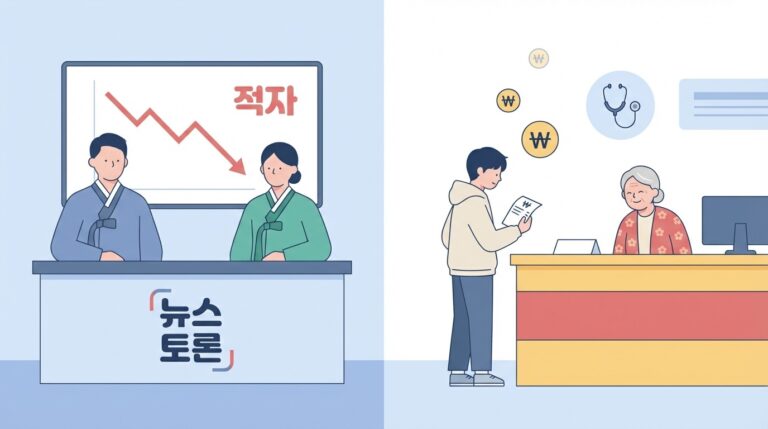
The Scene: Imagine you are watching a tense scene in a medical K-Drama like Life or Hospital Playlist. The hospital director slams a report on the desk. He’s not angry about a failed surgery; he’s shouting about the “fiscal deficit” (재정 적자). Meanwhile, on the news in the background, politicians are arguing whether to raise insurance premiums or cut coverage for MRI scans.
The ‘Why’: As a C2 learner, you’ve moved past “My stomach hurts.” If you live in Korea long-term, you are likely paying into the National Health Insurance (NHIS). Knowing how to discuss the “financial integrity” (재정 건전성) of this system doesn’t just make you fluent; it makes you a sophisticated resident who understands the social and political heartbeat of modern Korea. You aren’t just a guest anymore; you’re a stakeholder.
Transparency: This guide compiles actual debates found in Korean editorials and news discussions, simplified for linguistic analysis but keeping the intellectual weight intact.
Phase 2: Deep Dive into Core Expressions
1. 재정 건전성 (Jaejeong Geonjeonseong)
- Pronunciation: [Jae-jeong Geon-jeon-seong] (Think of ‘Jae’ like ‘Jazz’, ‘Jeong’ like ‘Jung’le. ‘Geon’ sounds like ‘Gun’.)
- Meaning: Fiscal Soundness / Financial Integrity
- K-Culture Moment: You will hear this in every election season news debate. It’s the magic word that makes politicians look responsible. “We must secure the financial integrity of the NHIS!”
- Editor’s Insight: This is a high-level compound noun. Jaejeong (Finance) + Geonjeon (Healthy/Sound) + Seong (Nature). It implies the system is healthy enough to not go bankrupt despite the aging population.
- Situation Spectrum:
[🚫 Casual Friends] ———— [⚠️ Semi-Formal] ———— [✅ News/Debate/Biz] - 🤔 Think About It: Why does Korea use the word “Health” (Geonjeon) to describe money? It reflects the view that the economy is a living organism that needs to be kept ‘healthy.’
2. 수익자 부담 원칙 (Su-ik-ja Bu-dam Won-chik)
- Pronunciation: [Su-ik-ja Bu-dam Won-chik]
- Meaning: The user-pays principle (Beneficiary pays principle)
- K-Culture Moment: Often cited in debates about “Medical Shopping” (people visiting multiple doctors for the same minor ailment). Conservative critics often argue, “We need to reinforce the user-pays principle to stop waste!”
- Editor’s Insight: This is a cold, administrative term. Using it signals that you understand the mechanics of policy-making. It counters the concept of “Universal Welfare” (보편적 복지).
- Situation Spectrum:
[🚫 Casual Friends] ———— [✅ Policy Discussion/Essay] ———— [✅ Formal] - 🤔 Think About It: How does this concept clash with the Korean cultural value of Jeong (warmth/sharing)? Is healthcare a right or a service in the Korean mindset?
3. 필수의료 (Pilsu Uiryo)
- Pronunciation: [Pil-su Ui-ryo]
- Meaning: Essential Medical Care (Critical Care)
- K-Culture Moment: In dramas, when a patient dies because no thoracic surgeon was available, the news cycle screams about the “collapse of Essential Medical Care.” It refers to vital fields (surgery, pediatrics, OB/GYN) that are currently understaffed.
- Editor’s Insight: This is the emotional core of the current healthcare crisis in Korea. It’s not just a vocabulary word; it’s a social cry for help.
- Situation Spectrum:
[⚠️ Casual] ———— [✅ News/Current Events] ———— [✅ Formal]
Phase 3: Textbook vs. Real Life
| Situation | 📖 Textbook Korean | 🗣️ Real Korean (Debate/News) | 💡 Why the difference? |
|---|---|---|---|
| Describing a Deficit | 돈이 부족해요. (Money is lacking.) | 적자 폭이 확대되고 있습니다. (The deficit gap is widening.) | C2 level requires precision. ‘Lacking’ is vague; ‘Deficit gap’ implies a systemic trend. |
| Rising Costs | 병원비가 비싸졌어요. (Hospital bills got expensive.) | 본인 부담률이 상향 조정될 수 있습니다. (The copayment rate may be adjusted upward.) | Politicians use passive, technical terms to soften the blow of price hikes. |
| Aging Society | 노인들이 많아요. (There are many old people.) | 초고령 사회 진입에 따른 재정 압박… (Fiscal pressure due to entering a super-aged society…) | Using academic terms (Super-aged society) elevates the seriousness of the demographic crisis. |
Bottom Note: When discussing politics or economy, using “Textbook Korean” makes you sound like a child. Using “Real Korean” terms like Jeokja (Deficit) makes people listen to your opinion seriously.
Phase 4: Cultural Context — The “K-Insurance” Pride & Anxiety
4-1. The “Medical Shopping” Phenomenon
Koreans visit outpatient clinics 17 times a year on average (highest in OECD). Because it’s cheap and accessible, people go for minor colds. This leads to the debate: “Is this efficiency or abuse?” When you use terms like 과잉 진료 (Gwa-ing Jin-ryo – Overtreatment), you touch upon this cultural habit.
4-2. K-Drama Connection: The “VIP Ward” vs. “General Ward”
In dramas like Yong-pal or Hospital Playlist, there is often tension between the lucrative VIP wards and the money-losing ER. This reflects the real-world struggle of hospitals trying to stay profitable while the government tries to control costs (Sugga – Medical Fee Schedule). Understanding the word 수가 (Sugga) allows you to understand 50% of the conflicts in medical dramas.
Phase 5: Immersive Roleplay Scenario
Setting: A Friday night dinner with Korean colleagues. The TV in the restaurant shows a news report about the depletion of the National Health Insurance fund by 2028. Everyone is a bit tipsy but the conversation turns serious.
Characters:
* YOU: An expat who has lived in Korea for 5 years, pays taxes, and reads the news.
* Min-ji (34): A colleague who is worried about her parents’ healthcare.
* Manager Kim (50): A bit cynical, thinks the younger generation (and foreigners) use the system too freely.
Dialogue:
Manager Kim: (Clicking tongue) 쯧쯧… 저러다 건보료 또 오르겠네. 요즘 병원 쇼핑하는 사람들 때문에 재정이 남아나질 않아.
(Tsk tsk… Premiums will go up again. The finances can’t survive because of people ‘medical shopping’ these days.)
Min-ji: 부장님, 그래도 고령화가 제일 큰 원인 아닐까요? 노인 진료비가 전체의 40%가 넘는다던데…
(Manager, but isn’t the aging population the biggest cause? I heard elderly medical costs are over 40% of the total…)
🔀 Decision Point: How do you jump in?
- A) “Right. I go to the hospital often too, it’s so cheap!” (Too honest, might annoy Manager Kim)
- B) “Still, compared to the US, the Korean system is amazing. We need to protect its sustainability.”
- C) “I think raising the copayment (Bonin budamgeum) is inevitable to solve the structural problem.”
✅ Best Choice: B or C.
* Option B establishes you as an ally who values the Korean system. Use the word 지속 가능성 (Jisok ganeungseong – Sustainability).
* Option C shows C2 level insight. Using 구조적 문제 (Gujo-jeok Munje – Structural problem) will impress everyone.
You (Option C): 맞아요. 사실 구조적인 문제를 해결하려면, 싫더라도 본인 부담금 조정이 불가피해 보여요. 단순히 보험료만 올리는 건 한계가 있으니까요.
(Majayo. Sasil gujo-jeok-in munje-reul haegyeol-haryeomyeon, sil-deorado bonin budamgeum jojeong-i bulgapihae boyeoyo. Dan-sunhi boheomryo-man ollineun geon hangye-ga isseu-nikkayo.)
(🎭 Stage Direction: Manager Kim looks at you with wide eyes, surprised by your deep understanding of the policy.)
Phase 6: 10-Second Shadowing Drill
Let’s practice a sentence you can use in a formal discussion or presentation.
Sentences:
“건강보험의 / 지속 가능성을 위해서는 / 재정 건전성 확보가 / 시급합니다.”
(Geongang-boheom-ui / jisok ganeungseong-eul wihaeseoneun / jaejeong geonjeonseong hwakboga / sigeuphamnida.)Translation: “To ensure the sustainability of health insurance, securing financial integrity is urgent.”
Emotion: 😤 Serious & Professional (Low pitch, clear enunciation)
Tip: Pause slightly after ‘wihaeseoneun’ to emphasize the purpose.
Phase 7: K-Culture Mini Glossary
| Korean | Romanization | English | Context |
|---|---|---|---|
| 건보료 | Geon-bo-ryo | Health Insurance Premium | Short for 국민건강보험료. Everyone complains about this rising every year. |
| 비급여 | Bi-geup-yeo | Non-covered items | Treatments not covered by insurance (e.g., certain MRIs, plastic surgery). Expensive! |
| 문케어 | Moon-Care | Moon Care | A policy by the previous administration to expand coverage drastically. Still a hot debate topic regarding the deficit. |
| 실비 보험 | Silbi Boheom | Private Indemnity Insurance | The private insurance 80% of Koreans have to cover the ‘copayment’ gap. |
Phase 8: Traveler’s Survival Kit (Medical Edition)
Even if you are here for a short trip, medical issues happen.
🆘 Survival Phrase
* 🇰🇷 “여행자 보험 적용 되나요?” (Yeohaengja boheom jeokyong doenayo?)
* Meaning: “Is travel insurance applicable? / Can I use travel insurance?”
* 📍 Where: At the reception desk (Wonnae-wonsu-gwa).
* 💡 Pro Tip: Most Korean clinics will ask you to pay upfront and give you a receipt (Yeong-su-jeung) and a detailed statement (Jin-ryo-bi Se-bu Nae-yeok-seo) to claim later.📌 Editor’s Note:
If you are a long-term resident (ARC holder), you are automatically enrolled in the NHIS. Don’t be surprised if a bill arrives at your house!
Phase 9: Think Deeper — Aging & The Burden
Topic: Demographics vs. Policy
Korea is becoming a “Super-Aged Society” faster than any country in history. The logic of the Health Insurance system is that the working young pay for the retired elderly. But what happens when the young population shrinks drastically?
🧠 Think Deeper:
Is it fair for the younger generation to shoulder rising premiums for an elderly population that holds most of the real estate wealth? This is a fierce generational conflict (Se-dae Gal-deung) in Korea right now. How does your country handle this balance?
Phase 10: FAQ & Troubleshooting
- Q: Can I use these terms (Deficit, Integrity) with my doctor?
- Answer: No. Keep these for debates or discussions about society. With a doctor, focus on your symptoms. Talking about “Fiscal Integrity” while getting a flu shot will make you look like a crazy person.
- Q: My Korean friends complain about the insurance. Should I agree?
- Answer: It’s safe to listen. If you want to chime in, praising the access and speed of Korean healthcare is always a winner. Criticizing the cost as a foreigner might be seen as ungrateful because it is still much cheaper than in the US or Europe.
❌ Common Mistake: confusing 보험료 (Premium – what you pay monthly) with 보험금 (Benefit – the money you receive/coverage). Don’t say “I want to raise my benefit (Boheomgeum)” when you mean “My premium (Boheomryo) went up.”
Phase 11: Wrap-up & Action Mission
Summary: Today we moved beyond basic symptoms to discussing the financial heartbeat (Jaejeong) of the Korean medical system.
🚀 Action Missions:
* 🥉 Bronze: Practice saying “Geon-bo-ryo” (Health Insurance Premium) naturally.
* 🥈 Silver: Watch a Korean news clip on YouTube searching for “건보 재정” (Health Insurance Finances) and try to catch the word “적자” (Deficit).
* 🥇 Gold: Ask a Korean friend carefully: “Do you think the current insurance system is sustainable?” (Jigeum boheom system-i jisok ganeung-hadago saeng-gakae?)
Phase 12: Interactive Quiz
Situation: You are reading a newspaper headline: “건보 재정 적자, 본인 부담금 상향 조정 논의”
Q1. What does this headline mean?
* A) Health insurance has a surplus, so treatments will be free.
* B) Health insurance has a deficit, so patients might have to pay more out-of-pocket.
* C) The government is canceling all health insurance.
Q2. True or False?
* “In Korea, ‘Medical Shopping’ refers to buying medical equipment at a mall.”
Answers:
1. B. (Jeokja = Deficit, Bonin budamgeum = Copayment/Out-of-pocket, Sanghyang = Upward adjustment)
2. False. It refers to patients visiting multiple hospitals for the same minor illness, wasting resources.
Frequently Asked Questions (FAQ)
Q: What does "재정 건전성 (Jaejeong Geonjeonseong)" mean in Korean and how do you pronounce it?
A: In Korean, "재정 건전성 (Jaejeong Geonjeonseong)" is pronounced [Jae-jeong Geon-jeon-seong] and means: Fiscal Soundness / Financial Integrity
Q: What does "수익자 부담 원칙 (Su-ik-ja Bu-dam Won-chik)" mean in Korean and how do you pronounce it?
A: In Korean, "수익자 부담 원칙 (Su-ik-ja Bu-dam Won-chik)" is pronounced [Su-ik-ja Bu-dam Won-chik] and means: The user-pays principle (Beneficiary pays principle)
Q: What does "필수의료 (Pilsu Uiryo)" mean in Korean and how do you pronounce it?
A: In Korean, "필수의료 (Pilsu Uiryo)" is pronounced [Pil-su Ui-ryo] and means: Essential Medical Care (Critical Care)







