

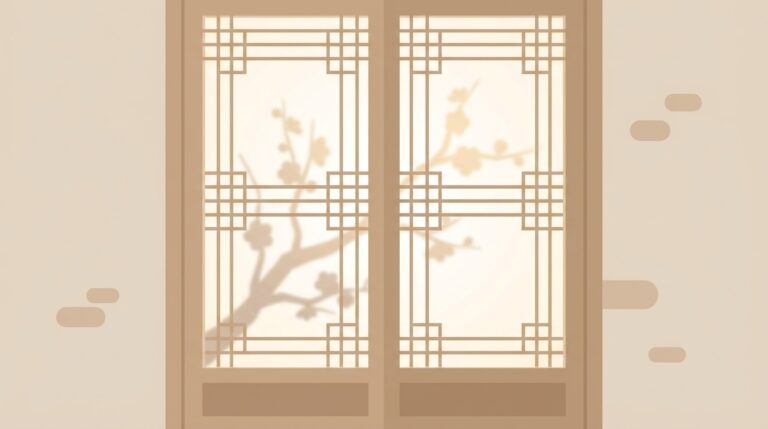
Secrets Behind the Paper Door: The Aesthetics of Changhoji & Munsal
Phase 1: Immersive Hook
Greeting: 안녕하세요! Welcome back to Daily Hangul. I’m your editor, ready to guide you through the nuanced world of Korean culture.
The K-Drama Moment:
Picture this: You’re watching a historical K-Drama (Sageuk), perhaps The Red Sleeve or Mr. Sunshine. It’s late at night. The Crown Prince visits the heroine’s room. He doesn’t knock on wood; he stands before a glowing white rectangle. You see his silhouette cast upon the paper door. He hesitates. The light is soft, diff used, and incredibly romantic.
Or, think of a thriller scene. A mysterious assassin licks their finger and silently pokes a hole through the paper to spy inside. Ppuk. That distinct sound sends shivers down your spine.
The ‘Why’:
To an outsider, a paper window (Changhoji) might seem fragile and impractical. But in the Korean language, this paper and the lattice frame (Munsal) holding it are sources of profound poetic expression. At the C1 level, understanding these aesthetics unlocks advanced vocabulary related to atmosphere, lighting, and subtle emotions—words that distinguish a fluent speaker from a native-like communicator.
Transparency:
This guide isn’t just about architecture; it’s about the vocabulary of “ambiguity” and “softness” that Koreans love. Let’s dive into the beauty of the gap.
Phase 2: Deep Dive Expressions
Here are three high-level expressions derived from the aesthetics of Hanok windows.
1. 은은하다 (Euneunhada)
- Pronunciation: [eun-eun-ha-da] (Think of a soft humming sound ‘mm-mm’ -> eun-eun)
- Meaning: (Literal) Faint, indistinct / (Nuance) Soft, subtle, delicate, subdued (in a classy way).
- K-Culture Moment: In interior design shows or vlogs visiting a Hanok cafe, the YouTuber will almost always describe the lighting as “은은하다.” It’s the opposite of the harsh fluorescent lights in a convenience store.
- Editor’s Insight: This is a crucial C1 adjective. You don’t just use it for light. A perfume can be 은은한 향기 (a subtle scent), and a smile can be 은은한 미소 (a gentle smile). It implies elegance through restraint.
- Situation Spectrum:
[🚫 Slangy/Rough] ———— [✅ Standard/Formal] ———— [✅ Poetic]
(Usage: Universal ✅)- 🤔 Think About It: Why does Korean culture value ‘subtlety’ (은은함) over ‘directness’ (강렬함) in traditional aesthetics? How does this reflect in Korean communication styles?
2. 비치다 (Bichida)
- Pronunciation: [bi-chi-da]
- Meaning: (Literal) To shine through, to be reflected / (Nuance) To show through (translucency), to hint at something.
- K-Culture Moment: K-Pop lyrics often use this. “네 마음이 얼굴에 비쳐” (Your feelings show on your face). Just like the lamp light shines through the Changhoji, your inner thoughts shine through your expression.
- Editor’s Insight: Changhoji is semi-transparent. It doesn’t block, nor does it reveal everything. 비치다 captures this state of being “visible but covered.” Use this when clothes are see-through or when someone’s intentions are slightly visible.
- Situation Spectrum:
[🚫 Casual only] ———— [✅ General] ———— [✅ Formal]
(Usage: Universal ✅)3. 여백의 미 (Yeobaegui mi)
- Pronunciation: [yeo-bae-ge-mi]
- Meaning: The beauty of empty space (The beauty of the margin).
- K-Culture Moment: When looking at the Munsal (lattice patterns), they aren’t cluttered. They frame the sky. In Korean art and even modern web design, if things are too crowded, people complain. If it’s clean and spacious, they praise the 여백의 미.
- Editor’s Insight: This is a high-level idiom. Use this when praising a minimalist PowerPoint presentation, a clean room, or a paused moment in a conversation.
- 🤔 Think About It: In a hyper-competitive, crowded city like Seoul, why is the concept of “empty space” idealized as beauty?
Phase 3: Textbook vs. Real Life
| Situation | 📖 Textbook Korean | 🗣️ Real Korean (C1/Native) | 💡 Why different? |
|---|---|---|---|
| Describing the light | 불빛이 약해요. (The light is weak.) | 조명이 은은하니 분위기 있네요. (The lighting is subtle and atmospheric.) | ‘Weak’ sounds negative; ‘Subtle’ sounds aesthetic. |
| Looking at the view | 창밖 풍경이 보여요. (I see the scenery outside.) | 문살 사이로 풍경이 한 폭의 그림 같아요. (The scenery through the lattice is like a painting.) | Koreans love metaphorical comparisons to art when viewing nature. |
| Feeling cold wind | 바람이 들어와요. (Wind is coming in.) | 외풍이 좀 있네요. / 황소바람이 들어오네! (There’s a draft / A bull-strong wind is coming in!) | Hanoks are notoriously drafty; specific words for ‘draft’ exist. |
Phase 4: Cultural Deep Dive
4-1. Non-verbal: The “Silhouette” Sensitivity
Because Changhoji (paper) is semi-transparent, privacy in a Hanok is visual but not auditory. You can see shadows. This developed a culture of coughing (헛기침) before approaching a room to alert the person inside, rather than knocking. Knocking on paper would tear it!
4-2. K-Drama Connection: The “Finger Poke”
In Sageuk dramas, spies poke a hole in the paper door with a wet finger. This is a classic trope.
Critical Insight: While romanticized in media, in reality, Changhoji is quite durable (it can last for years). However, the metaphor of “paper-thin walls” represents the Korean communal living style—there are no secrets in a traditional home.
Phase 5: Immersive Roleplay Scenario
Setting: It is a rainy Saturday afternoon in Bukchon Hanok Village. You are staying at a high-end Hanok guesthouse. You are drinking tea with the owner, Ms. Park (50s, elegant, wearing modified Hanbok), looking out at the rain falling in the courtyard.
Characters:
– YOU: An architecture enthusiast visiting Korea.
– Ms. Park: Proud owner of the Hanok, speaks refined Korean.
Dialogue:
Ms. Park: 비 오는 날 한옥 처마 밑에서 차 마시는 게 운치 있지요?
(Bi oneun nal hanok cheoma mit-eseo cha masineun ge unchi itjiyo?)
(Drinking tea under the Hanok eaves on a rainy day has a certain charm, doesn’t it?)
YOU: 네, 정말요. 빗소리도 좋고… 조명도 너무 밝지 않아서 좋아요.
(Ne, jeongmalyo. Bitsorido joko… jomyeongdo neomu balji anaseo joayo.)
(Yes, truly. The sound of rain is nice… and the lighting isn’t too bright, which I like.)
Ms. Park: 호호, 그렇죠? 창호지 문이 빛을 부드럽게 만들어주거든요.
(Hoho, geureochyo? Changhoji muni bicheul budeureopge mandeureojugeodeunyo.)
(Hoho, right? The paper door softens the light.)
🔀 Decision Point! How do you respond with C1 vocabulary?
- A) “맞아요. 빛이 약해서 눈이 안 아파요.” (Correct, but sounds like a medical observation.)
- B) “네, 창호지 너머로 비치는 빛이 참 은은해서 마음이 편해져요.” (Poetic, precise, and culturally attuned.)
- C) “이 종이는 정말 튼튼하네요!” (A bit random, breaks the mood.)
✅ Best Choice: B
Analysis: You used 비치다 (shine through) and 은은하다 (subtle) in one sentence. This perfectly captures the Hanok atmosphere and shows deep appreciation to the owner.
Ms. Park: 어머, 한국어 표현력이 정말 대단하시네요! ‘은은하다’는 말을 아시다니.
(Oh my, your Korean expressiveness is amazing! To think you know the word ‘euneunhada’.)
Phase 6: 10-Second Shadowing Drill
Capture the mood of a quiet morning in a Hanok.
Context: Describing the sunlight coming through the paper door.
😊 Softly & Dreamily:
아침 햇살이 / 문살 사이로 / 은은하게 비쳐요.
(Achim haetsari / munsal sairo / eun-eun-ha-ge bichyeoyo.)
The morning sunlight / through the lattice / shines softly.
Phase 7: K-Culture Mini Glossary
| Korean | Romanization | Meaning | Context |
|---|---|---|---|
| 창호지 | Changhoji | Traditional window paper | Made from mulberry bark, it breathes and controls humidity. |
| 문살 | Munsal | Lattice frame | The wooden grid pattern on doors; represents structural beauty. |
| 차경 | Chagyeong | Borrowing scenery | Traditional architectural concept: the window frames nature like a picture. |
| 온돌 | Ondol | Floor heating system | Often paired with Hanok; explains why we sit on the floor. |
Phase 8: Traveler’s Survival Kit (Hanok Stay Edition)
Staying in a Hanok is a bucket list item, but it comes with challenges.
🆘 Survival Expression #1
– 🇰🇷 “방음이 잘 되나요?” (Bangeumi jal doenayo?)
– 🗣️ Meaning: Is the soundproofing good?
– 📍 Where: When booking a Hanok guesthouse.
– 💡 Pro Tip: Real Hanoks have poor soundproofing because of the paper and wood structure. If you are a light sleeper, ask for a detached room (독채 – Dokchae).📌 Editor’s Travel Note
– Drafts (Woe-pung): Even luxury Hanoks can be chilly in winter. Look for places with modern windows installed outside the traditional paper ones (double glazing).
– Shoes: Always take them off on the Maru (wooden porch) before stepping on the room floor.
Phase 9: Critical Thinking — “Think Deeper”
Topic: Impermanence vs. Durability
Western architecture often focuses on stone and glass—materials meant to last forever and block nature out. Korean Hanok uses paper (Changhoji) and wood—materials that decay, breathe, and need replacing. The paper turns yellow with time and tears easily, yet it allows air and sound to pass through.
🧠 Think Deeper:
Does this architectural choice reflect a Korean worldview that accepts nature and aging as part of life, rather than trying to conquer it? How does the concept of a house that “breathes” compare to the insulated, sealed homes of modern cities?💬 Your Turn: In your country, do you prefer homes that are sealed tight for privacy, or open to the environment? Why?
Phase 10: FAQ & Troubleshooting
Q: Can I poke a hole in the paper door like in the dramas?
A: ABSOLUTELY NOT. In dramas, it’s a plot device. In real life, it’s vandalism. Changhoji is difficult to paste perfectly. If you poke it, the owner will be furious. You might have to pay for the entire door re-papering.
Q: Is ‘Euneunhada’ only for light?
A: No! You can use it for flavors too. “This tea has a subtle flavor” (차 맛이 은은하네요). It is a very complimentary word in Korea, implying sophistication.
❌ Common Mistake:
Don’t call a Hanok door a “Curtain.” Some learners say “Open the curtain” because it blocks light. It is a Door (문) or Window (창문).
Phase 11: Wrap-up & Action Items
One-Liner: Hanok aesthetics are defined by softness (은은함) and the beauty of empty space (여백의 미).
Action Missions:
– 🥉 Bronze: Say “조명이 은은하네요” next time you are in a cafe with nice lighting.
– 🥈 Silver: Search #한옥카페 (Hanok Cafe) on Instagram and comment “분위기가 참 은은해요” on a post.
– 🥇 Gold: Visit a Hanok village (Bukchon, Jeonju, or Gyeongju) and take a photo of the sky through the Munsal, captioning it with “Yeobaegui mi.”
K-Culture Mission: Watch the opening sequence of the drama Kingdom (Netflix) or Mr. Sunshine. Look closely at how the light hits the paper doors and how it sets the mood. Spot the Munsal patterns!
Phase 12: Interactive Quiz
- Situational Judgment: You are eating a very spicy stew. Your friend asks how it tastes. You want to say it has a “subtle” scent of ginseng, not a strong one. What do you say?
- a) 인삼 냄새가 강력해. (Ginseng smell is powerful.)
- b) 인삼 향이 은은해. (The ginseng scent is subtle.)
- c) 인삼 냄새가 희미해. (The ginseng smell is dim/weak – negative nuance.)
- True or False: In a traditional Hanok, it is considered polite to knock loudly on the paper door to announce your presence.
- (True / False)
Answers:
1. b) Euneunhada is positive and refined. Huimi-hada (c) implies it’s too weak to detect properly.
2. False. You should cough gently (called Heot-gichim) or speak out (“Is anyone inside?”). Knocking might damage the paper frames.
Frequently Asked Questions (FAQ)
Q: What does "은은하다 (Euneunhada)" mean in Korean and how do you pronounce it?
A: In Korean, "은은하다 (Euneunhada)" is pronounced [eun-eun-ha-da] and means: (Literal) Faint, indistinct / (Nuance) Soft, subtle, delicate, subdued (in a classy way).
Q: What does "비치다 (Bichida)" mean in Korean and how do you pronounce it?
A: In Korean, "비치다 (Bichida)" is pronounced [bi-chi-da] and means: (Literal) To shine through, to be reflected / (Nuance) To show through (translucency), to hint at something.
Q: What does "여백의 미 (Yeobaegui mi)" mean in Korean and how do you pronounce it?
A: In Korean, "여백의 미 (Yeobaegui mi)" is pronounced [yeo-bae-ge-mi] and means: The beauty of empty space (The beauty of the margin).







