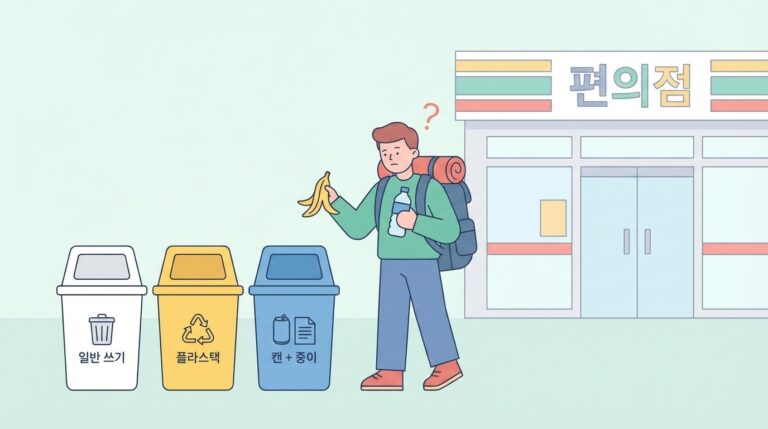
Phase 1: The “Where is the Trash Can?” Panic (Immersive Hook)
Greeting: Hello! Welcome to Daily Hangul. I’m your editor, your local guide to surviving and thriving in Korea.
The Scene: Picture this. You are walking through the trendy streets of Hongdae, holding an empty cup of iced Americano (the fuel of Seoul). You look left. You look right. You walk for two blocks. There are no trash cans. None. Zero.
Suddenly, you spot a convenience store. You rush in, thinking you can just buy a plastic bag to throw your stuff away later. But when you ask for a bag, the clerk looks at you and asks a rapid-fire question about “liters” and “districts.”
The ‘Why’: In Korea, throwing away trash is an art form. You can’t just use any black plastic bag. You need the Standard Garbage Bag (Jongnyangje Bongtu). If you put your trash in a random bag, the garbage collectors won’t take it, and you might even get fined!
Transparency: This guide answers the #1 question I get from students who just moved to Seoul: “How do I throw things away without getting yelled at?”
Phase 2: Deep Dive into Key Expressions
1. 쓰레기 봉투 (Sseuregi bongtu)
- Pronunciation: [Sseu-re-gi bong-tu]
- Sound analogy: ‘Sseu’ sounds like the hiss of a snake ‘ss’ + the ‘u’ in put. ‘Re-gi’ sounds like ‘Reggae’ music.
- Meaning: Trash bag (specifically the official government one).
- K-Culture Moment: In K-Dramas like Reply 1988 or modern slice-of-life shows, you’ll see families meticulously tying up these specific white or pink bags before the garbage truck arrives.
- Editor’s Insight: You can’t just say “bag” (bongtu). If you just say “bongtu,” they might give you a plastic carrier bag for your groceries. You must specify Sseuregi (trash).
- Situation Spectrum:
[🚫 Formal/Boss] ——— [✅ Convenience Store Clerk] ——— [✅ Casual] - 🤔 Think About It: Why does Korea charge for these specific bags instead of a monthly tax bill? It’s to make people feel the “cost” of their waste directly!
2. 일반 쓰레기 (Ilban sseuregi)
- Pronunciation: [Il-ban sseu-re-gi]
- Meaning: General waste (Non-recyclable, non-food).
- K-Culture Moment: You’ve finished your cup ramyeon at the Han River park. You are standing in front of 3 bins. One says “General,” one says “Recycle,” one says “Food.” This word saves your life.
- Editor’s Insight: This is the category for “everything dirty that isn’t food.” Dirty tissues, used wet wipes, broken pens.
- Situation Spectrum: Essential for reading signs and asking questions.
3. 몇 리터요? (Myeot riteo-yo?)
- Pronunciation: [Myeot ri-teo-yo?]
- Meaning: How many liters? (What size?)
- K-Culture Moment: When you buy the bag, the clerk will ask this. It’s the “Tall, Grande, Venti” question of the garbage world.
- Editor’s Insight: Common sizes are 10L (sip-riteo) and 20L (i-sip-riteo). 20L is the standard “big family” size. 10L is good for singles.
Phase 3: Textbook vs. Real Life
| Situation | 📖 Textbook Korean | 🗣️ Real Life Korean | 💡 Why different? |
|---|---|---|---|
| Buying a bag | 쓰레기 봉투를 사고 싶습니다. (I would like to buy a trash bag.) | 일반 쓰레기 봉투 있어요? (Do you have general trash bags?) | “Sago sipseumnida” is too formal for a $0.50 purchase. |
| Specifying size | 20리터짜리 봉투를 주세요. (Please give me a 20-liter bag.) | 20리터 하나 주세요. (Give me one 20-liter.) | Koreans love speed (Palli-palli). We drop the particles. |
| Asking price | 이것은 얼마입니까? (How much is this?) | 얼마예요? (How much?) | Universal survival phrase. |
Bottom Note: In a busy convenience store, shorter is better!
Phase 4: Cultural Deep Dive — The “Mapo-gu” Trap
4-1. The “District” Rule (Non-verbal/System)
Here is the most important rule that trips up every foreigner: Trash bags are local.
If you live in Gangnam-gu (Gangnam District), you cannot use a trash bag from Mapo-gu (Hongdae area). The garbage collectors will look at the bag, see the wrong district name printed on it, and leave it there. It’s their way of saying, “You’re not from around here, are you?”
4-2. K-Drama Connection: The Rooftop
In dramas, the poor heroine often lives in a Oktapbang (Rooftop room). You often see her flattening cardboard boxes and tying up white bags tight. Why? Because volume = money. If you stuff the bag effectively, you save money. It’s a sign of a frugal, hardworking character!
Phase 5: Immersive Roleplay — Convenience Store Mission
Setting: A bright GS25 convenience store near your Airbnb in Seoul. It is 11 PM. You have a pile of trash in your room and need a bag desperately.
Characters:
* YOU: A hungry traveler who needs a trash bag.
* Min-su: Part-time clerk (Alba), wearing a vest, looking at his phone.
Dialogue:
Min-su: (Looking up briefly) 어서 오세요. (Eoseo oseyo / Welcome.)
YOU: (Approaching the counter) 안녕하세요. (Annyeong-haseyo / Hello.)
Min-su: 네, 봉투 필요하세요? (Ne, bongtu piryohaseyo? / Do you need a [plastic shopping] bag?)
YOU: 아, 아니요. 쓰레기 봉투 있어요? (Ah, aniyo. Sseuregi bongtu isseoyo? / No. Do you have trash bags?)
Min-su: 네, 몇 리터 드릴까요? (Ne, myeot riteo deurilkkayo? / Yes, how many liters should I give you?)
🔀 Decision Point! How do you answer?
* A) “Big one!” (English + Hand gestures)
* B) “10리터(Sip-riteo) 주세요.” (Specific and polite)
* C) “쓰레기!” (Just shouting “Trash!”)
✅ Best Choice: B — Clear and polite. 10L is perfect for a week’s stay.
⚠️ Choice A Analysis: He might give you the huge 100L bag used for moving out.
Min-su: (Scans the bag code) 490원입니다. (490 won-imnida.)
YOU: 여기요. 감사합니다. (Yeogiyo. Kamsahamnida. / Here you go. Thank you.)
Phase 6: 10-Second Shadowing Drill
Let’s practice the “Golden Sentence” to get your bag.
😊 Imagine you are smiling politely at the clerk.
Korean: 일반 / 쓰레기 봉투 / 있어요?
Romanization: Ilban / sseuregi bongtu / isseoyo?
Meaning: General / trash bag / do you have?
- Point: Put a slight rising intonation on “yo?” to make it a soft question.
Phase 7: K-Culture Mini Glossary
| Korean | Romanization | Meaning | Context |
|---|---|---|---|
| 종량제 | Jongnyangje | Volume-rate system | The official name for the “Pay as you throw” system. |
| 분리수거 | Bunri-sugeo | Recycling | Separating trash (Paper, Plastic, Cans, Glass). Vital in Korea! |
| 음식물 | Eumsikmul | Food waste | Never put food in the general trash bag. It goes in a special yellow bag or bin. |
| 편의점 | Pyeonuijeom | Convenience Store | The hub of Korean life (and where you buy trash bags). |
Phase 8: Traveler’s Survival Kit
Since you are traveling, you will generate trash. Here is how to survive without a fine.
🆘 Survival Phrases
1. “쓰레기통 어디예요?” (Sseuregitong eodiyeyo?)
* Meaning: Where is the trash can?
* Note: Public trash cans are rare. Look for them in subway stations or toilets.
2. “이거 버려도 돼요?” (Igeo beoryeodo dwaeyo?)
* Meaning: Can I throw this away (here)?
* Use: When asking a staff member at a cafe if you can leave your cup on the counter.📌 Editor’s Travel Note
* Don’t Walk and Eat: Since there are no trash cans on the street, if you buy street food, eat it at the stall and give the stick/cup back to the owner (Ahjumma). She will throw it away for you. Walking with trash is a rookie mistake!
Phase 9: Think Deeper — “Why so strict?”
Topic: Space and Responsibility
Have you noticed how strict Korea is about recycling? It connects to the geography. South Korea is a small peninsula with a high population density and very limited land for landfills. The complicated trash system forces everyone to think: “Do I really need to create this trash?” every time they have to pay for a bag.
💬 Your Turn: Does your country charge for trash bags, or is it hidden in taxes? How does that change your behavior?
Phase 10: FAQ & Troubleshooting
Q: I bought a trash bag in Gangnam, but I moved to Hongdae. Can I use it?
A: NO. Technically, you can buy a “transfer sticker” from the community center, but for a traveler? Just buy a new bag in Hongdae. It’s not worth the hassle.
Q: Can I put chicken bones in the “Food Waste” (Yellow) bag?
A: Warning! NO. This is a classic trap. Food waste is mostly turned into animal feed. If an animal can’t eat it (hard bones, clam shells, tea bags), it goes in the General Trash (White) bag.
Q: I can’t speak Korean well. Can I just point?
A: Yes! Go to the counter, point at the trash bags behind the clerk (usually under the cigarette display), and show “1” finger. They will understand.
Phase 11: Wrap-up & Action Mission
Summary: To throw away trash in Korea, buy a specific “Jongnyangje” bag (usually white) at a convenience store in your specific district. Separating food waste is mandatory!
🚀 Action Missions:
* 🥉 Bronze: Say “Sseuregi bongtu isseoyo?” out loud 3 times right now.
* 🥈 Silver: Go to a Korean convenience store (or look at photos online) and try to spot where the trash bags are kept behind the counter.
* 🥇 Gold: Buy a 10L trash bag (10-riteo) at a convenience store in Korea using only Korean!
K-Culture Mission: Next time you watch a K-Drama scene inside a house, look at the kitchen. Can you spot the separate bins for recycling?
Phase 12: Interactive Quiz
- Situation Judgment: You are eating a corn dog (hot dog) at a street stall in Myeongdong. You finish it. What do you do?
- A) Throw the stick on the ground. (Bad!)
- B) Carry the stick for 1 hour looking for a trash can.
- C) Give the stick back to the stall owner.
- True or False: You can put a banana peel in the General Trash (White) bag.
- (True / False)
- Fill in the Blank: “Excuse me, do you have a trash bag?” -> “Jeogiyo, ______ bongtu isseoyo?”
🔑 Answers:
1. C) The owner will dispose of it. Walking with trash is painful in Seoul.
2. False! Banana peels are soft and animals can eat them. They go in Food Waste (Yellow).
3. Sseuregi (Trash).
Frequently Asked Questions (FAQ)
Q: What does "쓰레기 봉투 (Sseuregi bongtu)" mean in Korean and how do you pronounce it?
A: In Korean, "쓰레기 봉투 (Sseuregi bongtu)" is pronounced [Sseu-re-gi bong-tu] and means: a key conversational Korean expression covered in this lesson.
Q: What does "일반 쓰레기 (Ilban sseuregi)" mean in Korean and how do you pronounce it?
A: In Korean, "일반 쓰레기 (Ilban sseuregi)" is pronounced [Il-ban sseu-re-gi] and means: General waste (Non-recyclable, non-food).
Q: What does "몇 리터요? (Myeot riteo-yo?)" mean in Korean and how do you pronounce it?
A: In Korean, "몇 리터요? (Myeot riteo-yo?)" is pronounced [Myeot ri-teo-yo?] and means: How many liters? (What size?)