

Beyond ‘Safety First’: Decoding Korea’s Serious Accidents Punishment Act for C2 Learners
Phase 1: Immersive Hook
Greeting: 안녕하세요! This is your Daily Hangul Editor, reporting from the dynamic streets of Seoul.
K-Culture Cold Open: Picture this typical K-Drama scene: A chaebol construction company CEO is shouting at his subordinates to finish the building ahead of schedule. “Time is money!” he yells. In the past, the protagonist might have gritted their teeth and worked through the night. But in 2024? The script has flipped. Now, you’ll see scenes where a safety manager boldly declares, “We are stopping work.” Why? Because the CEO doesn’t want to go to jail.
The ‘Why’: If you are working in Korea, doing business here, or even just watching the news, you cannot ignore the massive paradigm shift caused by the ‘Serious Accidents Punishment Act’. It has changed everything from how factories operate to how K-Pop concert venues are managed. Knowing these terms isn’t just about safety; it’s about understanding the current corporate anxiety and the transformation of the ‘Palli-palli’ (Hurry, hurry) culture.
Transparency: This guide dives deep into C2-level professional vocabulary and the subtle cultural nuances of responsibility and liability in modern Korea.
Phase 2: Deep Dive into Key Expressions
1. 중대재해처벌법 (Jungdae-jaehae-cheobeol-beop)
- Pronunciation: [jung-dae-jae-hae-cheo-beol-beop] (Think: Jungle + Daeily + Jaez + Haeir + Cheorry + Beolt + Beop)
- Meaning:
- Literal: Serious (Major) Disaster Punishment Law
- Real Nuance: The “CEO Accountability Act.” It implies that if a fatal accident occurs, the top decision-maker is personally liable, not just the on-site manager.
- K-Culture Moment: In recent news or legal dramas like Juvenile Justice (applied to corporate context), you might hear anchors say, “중대재해처벌법 적용 1호 사건” (The first case applying the SAPA), signaling a massive societal spotlight.
- Editor’s Insight: This word is a tongue-twister even for Koreans. Often shortened to ‘중대재해법’ in headlines. It represents fear for employers and protection for employees.
- Situation Spectrum:
[🚫 Friends/Casual] ———— [⚠️ Colleagues] ———— [✅ Business/News] - 🤔 Think About It: Why does Korean law focus on punishing the top person (CEO) rather than just the company as an entity? What does this say about the Korean view of hierarchy and ultimate responsibility?
2. 안전불감증 (Anjeon-bulgam-jeung)
- Pronunciation: [an-jeon-bul-gam-jeung]
- Meaning:
- Literal: Safety Insensitivity Syndrome
- Real Nuance: A collective numbness to danger. It refers to the mindset of “It won’t happen to me” or “We’ve always done it this way, so it’s fine.”
- K-Culture Moment: Whenever a bridge collapses or a fire breaks out in a drama (or real life), critics cite this word. It’s the villain in the story of Korea’s rapid modernization.
- Editor’s Insight: This is a high-level C2 concept. Using this shows you understand the social critique behind accidents, not just the physical cause.
- Situation Spectrum:
[✅ Friends/Debate] ———— [✅ Work Meetings] ———— [✅ Formal Writings]
3. 작업 중지권 (Jageop Jungji-gwon)
- Pronunciation: [ja-geop jung-ji-gwon]
- Meaning:
- Literal: Right to Stop Work
- Real Nuance: The legal authority of a worker to halt operations immediately if they perceive imminent danger, without fear of retaliation.
- K-Culture Moment: Think of the underdog protagonist in an office drama standing up to a corrupt manager: “I am exercising my right to stop work!” (저는 작업 중지권을 행사하겠습니다!)
- Editor’s Insight: Before the law, this was a nominal right. Now, it’s a powerful tool. Using this phrase commands immense professional respect (and tension).
- Situation Spectrum:
[🚫 Casual Chat] ———— [⚠️ General Office] ———— [✅ Industrial Sites]
Phase 3: Textbook vs. Real Life
| Situation | 📖 Textbook Korean | 🗣️ Real Korean (Business/Site) | 💡 Why the difference? |
|---|---|---|---|
| Emphasizing Safety | 안전 규정을 준수하십시오. (Please follow safety regulations.) | “안전이 최우선입니다.” or “타협은 없습니다.” (Safety is the top priority / No compromises.) | ‘Compliance’ sounds passive. ‘Priority’ and ‘No compromise’ reflect the CEO’s fear of the new law. |
| Reporting a Hazard | 여기 위험한 것이 있습니다. (There is something dangerous here.) | “여기 리스크가 너무 큽니다.” or “즉시 조치 바랍니다.” (The risk is too high here / Immediate action required.) | Using English loanwords like ‘Risk’ makes it sound more analytical and urgent in corporate Korea. |
| Scolding Negligence | 조심하지 않으면 다칩니다. (If you aren’t careful, you get hurt.) | “이러다 다 죽습니다!” or “누가 책임질 겁니까?” (We’re all going to die like this! / Who is going to take responsibility?) | Korean work culture relies heavily on shame and collective responsibility to enforce rules. |
💡 Editor’s Note: At a C2 level, you don’t just describe the danger; you describe the liability. Instead of saying “It’s dangerous” (위험해요), try “This could be a legal liability” (법적 책임 소지가 있습니다).
Phase 4: Cultural Context — The End of ‘Palli-Palli’?
4-1. Non-verbal Communication: The “X” Sign
In Korean industrial sites, crossing your arms in an “X” shape overhead is a universal sign for “Stop” or “Danger.” If you see a safety manager doing this, do not smile or wave. Freeze immediately. It is not a greeting; it is an emergency signal.
4-2. K-Culture Connection: The “Disaster” Trope
K-Drama Connection: In dramas like Descendants of the Sun (earthquake scene) or The Penthouse (construction collapse), the tragedy is often foreshadowed by a corrupt official ignoring a safety warning. The ‘Whistleblower’ (내부고발자) character is a staple trope. The new laws are essentially trying to make sure that the ‘Whistleblower’ becomes the standard employee.
Critical Perspective: While the law is strict, there is a cultural clash. The older generation, who built the ‘Miracle on the Han River’ through speed and grit, often feels the new regulations are ‘suffocating’ (숨 막힌다). As a foreigner, you might witness this generational tension in meetings.
Phase 5: Immersive Roleplay
Scenario A: The Safety Inspection
Setting: A semiconductor factory construction site in Pyeongtaek. Monday morning. Tense atmosphere. You are the Global Safety Officer inspecting the site with a Korean subcontractor.
Characters:
* YOU (Global Safety Officer): Strict, knowledgeable about the new Korean law.
* Manager Kim (50s, Subcontractor): Experienced but used to the old “quick” ways. Trying to meet a deadline.
Dialogue:
Manager Kim: (Wiping sweat) 이번 주까지 끝내려면 야간 작업이 필수입니다. 일정 맞추기가 너무 빡빡해요.
(Ibeon ju-kkaji kkeunnaeryeomyeon yagan jageobi pilsu-imnida. Iljeong matchugiga neomu ppakppakaeyo.)
(To finish by this week, night work is essential. The schedule is too tight.)
YOU: (Looking at the unguarded scaffolding)
🔀 Decision Point: How do you respond?
- Option A: “안 됩니다. 너무 위험해요.” (No. It’s too dangerous.) – Too basic.
- Option B: “경영책임자처벌법 아시죠? 우리가 작업 중지권을 발동할 수도 있습니다.” (You know the Executive Punishment Act, right? We might invoke the right to stop work.) – Powerful & C2 Level.
- Option C: “빨리 하세요, 하지만 조심하세요.” (Do it quickly, but be careful.) – Illegal & culturally tone-deaf to the current trend.
✅ Best Choice: Option B.
(Romanization) Gyeongyeong-chaegimja-cheobeol-beop asijyo? Uriga jageop jungji-gwoneul baldonghal sudo itseumnida.
(Translation) You are aware of the Executive Punishment Act, right? We could exercise our right to stop work.
(🎭 Stage Direction: Manager Kim turns pale and immediately calls his foreman to halt the plan.)
Manager Kim: 아… 알겠습니다. 안전이 제일이죠. 시정하겠습니다.
(Ah… Algetseumnida. Anjeoni jeirijyo. Sijeonghagetseumnida.)
(Ah… I understand. Safety is number one. We will correct it.)
Phase 6: 10-Second Shadowing Drill
Master the intonation of a leader. Speak clearly and firmly.
😤 Serious & Authoritative:
안전은 / 타협의 대상이 / 아닙니다. / 원칙대로 / 진행하세요.
(Anjeoneun / tahyeobui daesangi / animnida. / Wonchikdaero / jinhaenghaseyo.)
“Safety is / not a subject / for compromise. / Proceed / according to principle.”
Phase 7: K-Culture Mini Glossary
| Korean | Romanization | English | Context |
|---|---|---|---|
| 골든타임 | Golden Time | Critical Window | The crucial first few minutes after an accident/disaster to save lives. Used heavily in news. |
| 무관용 원칙 | Mugwanyong Wonchik | Zero Tolerance Principle | A phrase often found in company safety mottos now. |
| 안전모 | Anjeonmo | Hard Hat | Symbol of the working site. K-Pop idols often wear these cute versions on construction-themed variety shows. |
| 산재 (산업재해) | Sanjae | Industrial Accident | Short for ‘Industrial Accident Compensation’. Workers often ask, “Is this processed as Sanjae?” |
Phase 8: Traveler’s Survival Kit (Safety Edition)
Even if you are just traveling, safety signals are everywhere in Korea.
🆘 Survival Phrases
* “비상구가 어디죠?” (Bisangguga eodijyo?) – Where is the emergency exit?
* “소화기 있어요?” (Sohwagi isseoyo?) – Do you have a fire extinguisher?
* “대피하세요!” (Daepihaseyo!) – Evacuate! (If you hear this, RUN.)📌 Editor’s Travel Note
Since the Itaewon tragedy, crowd control (인파 관리) has become very strict. If a police officer or staff says “밀지 마세요” (Do not push) or restricts entry to a subway station/festival area, please comply immediately. It is part of the heightened national safety awareness.
Phase 9: Think Deeper — Language & Power
Topic: The Shift from ‘We’ to ‘Legal Liability’
Traditionally, Korean culture emphasizes “Uri” (We/Us)—we work together, we suffer together. However, the introduction of the Serious Accidents Punishment Act has introduced a colder, more Western concept of individual legal liability into the language. Now, instead of hearing “Let’s do our best together” (우리 같이 열심히 하자), you often hear “Who is the responsible person?” (책임자가 누구입니까?).
🧠 Think Deeper: Does this shift towards legal accountability erode the traditional Korean sense of ‘Jeong’ (affection/bond) in the workplace, or is it a necessary evolution for a developed nation? How does your country balance efficiency and safety in language?
Phase 10: FAQ & Troubleshooting
- Q: Can I report safety issues even if I’m a foreigner/guest?
- A: YES. In fact, under the new laws, ignoring a report is a crime for the company. You can use the phrase: “안전 신문고에 신고하겠습니다.” (I will report this to the Safety e-People portal.)
- Q: Is it rude to refuse a task because it seems unsafe?
- A: In the past? Maybe. Today? No. It is your legal right (권리). Use the phrase: “안전 확보가 우선입니다.” (Securing safety comes first.)
- ❌ Common Mistake: confusing ‘사고’ (Accident) with ‘사건’ (Incident/Case).
- Sago usually refers to unintentional physical accidents (car crash, fall).
- Sageon implies a complex event, often with legal or criminal implications.
- Correction: A fall at a site is a Sago, but the ensuing investigation is a Sageon.
Phase 11: Wrap-up & Action Items
One-Liner Summary: In modern Korea, “Safety” (안전) is no longer just a slogan; it is the most powerful language of authority and legal responsibility.
🚀 Action Missions:
* 🥉 Bronze: Look at a Korean news site (Naver/Daum) and search for ‘중대재해’. Try to read just the headlines.
* 🥈 Silver: Practice the “Right to Stop Work” phrase with the authoritative tone from the Shadowing Drill.
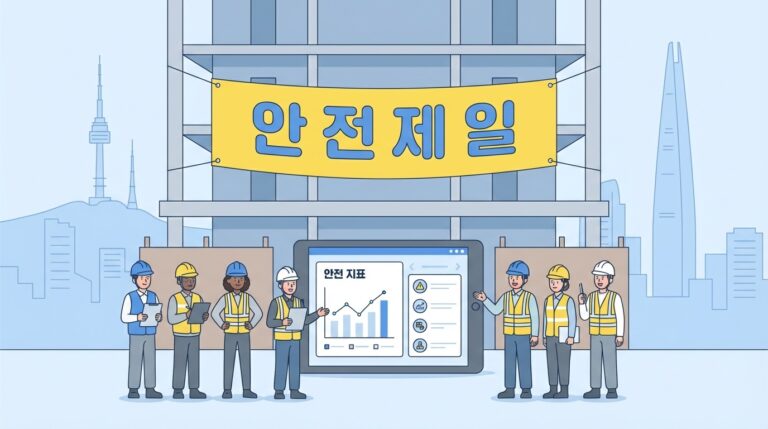
* 🥇 Gold: Next time you see a construction site in Korea (or a Korean company abroad), look for the safety slogan banner. It usually says “안전제일” (Safety First). Take a photo!
K-Culture Mission: Watch the K-Movie “Tunnel” (터널) or “Pandora” (판도라). Pay attention to how the characters criticize the government or company’s Safety Insensitivity.
Phase 12: Interactive Quiz
Scenario: You are a manager. A worker says, “Boss, the machine sounds strange, but we can finish the quota if we ignore it.” What is the appropriate C2-level response?
- “그래? 그럼 빨리 하고 퇴근하자.” (Really? Then let’s finish quick and go home.)
- “안전불감증이네요. 작업 중지하고 점검하세요.” (That is safety insensitivity. Stop work and inspect it.)
- “괜찮아, 안 죽어.” (It’s fine, you won’t die.)
⬇️ Toggle Answer
Correct Answer: 2.
Why? Options 1 and 3 reflect the old Safety Insensitivity mindset that the new law punishes. Option 2 uses the correct terminology and enforces the legal protocol.
Frequently Asked Questions (FAQ)
Q: What does "중대재해처벌법 (Jungdae-jaehae-cheobeol-beop)" mean in Korean and how do you pronounce it?
A: In Korean, "중대재해처벌법 (Jungdae-jaehae-cheobeol-beop)" is pronounced [jung-dae-jae-hae-cheo-beol-beop] and means: Literal: Serious (Major) Disaster Punishment Law
Q: What does "안전불감증 (Anjeon-bulgam-jeung)" mean in Korean and how do you pronounce it?
A: In Korean, "안전불감증 (Anjeon-bulgam-jeung)" is pronounced [an-jeon-bul-gam-jeung] and means: Literal: Safety Insensitivity Syndrome
Q: What does "작업 중지권 (Jageop Jungji-gwon)" mean in Korean and how do you pronounce it?
A: In Korean, "작업 중지권 (Jageop Jungji-gwon)" is pronounced [ja-geop jung-ji-gwon] and means: Literal: Right to Stop Work







