

Don’t Panic! How to Handle Broken Glass Like a K-Drama Protagonist 🍷💥
Phase 1: The Immersive Hook
Greeting: 안녕하세요! It’s your Daily Hangul editor.
The Scene: You know that classic K-Drama moment? The camera zooms in on a trembling hand holding a glass of water. Suddenly—CRASH! 💥 The glass shatters in slow motion. The music stops. This usually means something terrible is about to happen to the main couple.
But in real life, when you break a glass in your Seoul Airbnb or dorm, the drama isn’t about “destiny.” It’s about Recycling Rules.
Korea has one of the strictest recycling systems in the world. If you just sweep that glass into any random bin, you might hurt a sanitation worker or get fined. Today, we’re going to learn how to handle this “shattering” situation safely and speak like a considerate local.
Phase 2: Deep Dive into Core Expressions
Here are the top 3 phrases you need when disaster strikes.
1. 유리가 깨졌어요 (The glass broke)
- Pronunciation: [Yu-ri-ga kkae-jyeo-sseo-yo]
- Sound-alike: Yu-ri (like the name Yuri) + ga + Kkae (sounds like ‘Ca’ in Cat) + jyeo + sseo (saw) + yo.
- Meaning: The glass is broken. (Literal: Glass was broken.)
- K-Culture Moment: In dramas, when the protagonist drops a cup, someone always rushes over. You need to explain immediately: “유리가 깨졌어요!” so they don’t step on it.
- Editor’s Insight: We use the passive voice here. It’s not “I broke the glass” (focus on blame), but “The glass broke” (focus on the situation). It sounds softer and less guilty!
- Situation Spectrum:
[🚫 Boss/Elders] ———— [✅ Standard Polite] ———— [✅ Strangers]
(Note: This standard polite form works for almost everyone.)- 🤔 Think About It: Why do Koreans often use passive voice (“It broke”) instead of active voice (“I broke it”) in accidents? Does it help save face?
2. 다치지 않았어요? (Are you okay? / Did you not get hurt?)
- Pronunciation: [Da-chi-ji a-na-sseo-yo?]
- Sound-alike: Da-chi-ji + Ah-na (frozen princess Anna) + sseo-yo?
- Meaning: You aren’t hurt? (Asking to confirm safety).
- K-Culture Moment: This is the Golden Sentence in K-Pop fan meetings or reality shows. If an idol trips, 10,000 fans scream this.
- Editor’s Insight: In Korea, showing concern for the person before worrying about the object is a sign of good Nunchi (social sense).
3. 신문지 있어요? (Do you have newspaper?)
- Pronunciation: [Sin-mun-ji i-sseo-yo?]
- Meaning: Do you have any newspaper?
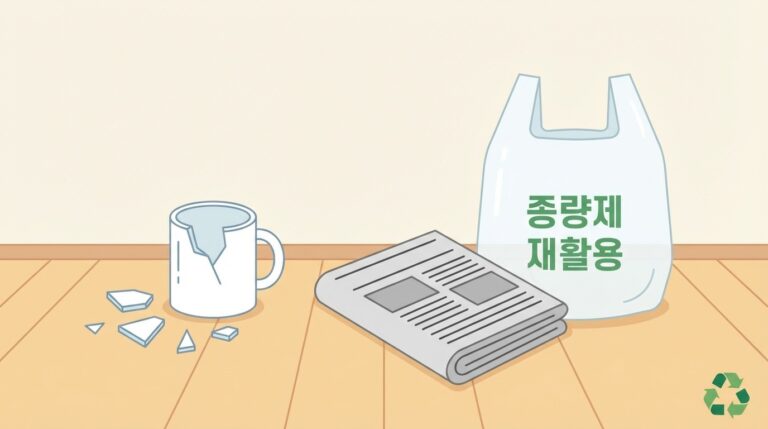
- Why this phrase? You cannot just throw broken glass in a plastic bag—it will tear. You must wrap it in newspaper first. This phrase is your survival tool.
Phase 3: Textbook vs. Real Life
| Situation | 📖 Textbook Korean | 🗣️ Real Korean (Daily Life) | 💡 Why the difference? |
|---|---|---|---|
| Reporting the accident | 컵을 깨뜨렸습니다. (I broke the cup.) | 아! 컵 깼어! (Ah! Broke a cup!) | The real version is a reflex. Short, fast, and expresses shock. |
| Warning others | 접근하지 마세요. (Do not approach.) | 오지 마! 위험해! (Don’t come! It’s dangerous!) | In emergencies, grammatical politeness drops to ensure immediate safety. |
| Disposal | 이것을 어디에 버립니까? (Where do I discard this?) | 이거 일반 쓰레기죠? (This is general waste, right?) | Locals know broken glass isn’t recyclable, so we confirm if it’s “General Waste.” |
Phase 4: Cultural Deep Dive & Non-verbal Cues
4-1. The “Don’t Touch” Dance
If you are with Koreans and glass breaks, do not immediately try to pick it up with your hands. A Korean friend will almost certainly shout, “Don’t touch it!” (만지지 마!).
* Action: Stand still. Wait for a broom or vacuum. Trying to pick it up shows you are “sorry,” but it makes others worry about you getting hurt.
4-2. The “Bad Omen” Myth (K-Drama Trope)
In K-Dramas, a breaking glass often means a character’s lover is in danger. In reality? It just means you have to clean up. But if you say “액땜했다” (Aek-ddaem-haet-da), it means “I used up my bad luck with this small accident, so bigger bad luck won’t happen.” It’s a positive spin!
Phase 5: Immersive Roleplay (Scenario: The Guesthouse Kitchen)
Setting: A cozy guesthouse kitchen in Hongdae. You dropped a mug while washing dishes. Crash! The kind owner, Minji (30s), runs in.
Minji: 어머! 무슨 소리예요? 괜찮아요? 😨
(Omo! Museun soriyeyo? Gwaenchannayo?)
(Translation: Oh my! What’s that sound? Are you okay?)
YOU: ______________________. (Choose your response!)
🔀 Your Turn! How do you reply?
- A) 죄송합니다. 유리가 깨졌어요. (Sorry. The glass broke.)
- B) 몰라요. (I don’t know.)
- C) 컵이 죽었어요. (The cup died.)
✅ Best Choice: A. It admits the mistake politely and explains the situation.
❌ Choice B: Very rude. It avoids responsibility.
⚠️ Choice C: Funny poetic expression, but Minji might think you are drunk!
(Continuing from Choice A)
Minji: 다친 데는 없어요? 가만히 계세요. 제가 치울게요.
(Dachin deneun eopseoyo? Gamanhi gyeseyo. Jega chiulgeyo.)
(Translation: Are you unhurt? Stay still. I will clean it up.)
YOU: 아니에요! 신문지 있어요? 제가 할게요.
(Anieyo! Sinmunji isseoyo? Jega halgeyo.)
(Translation: No! Do you have newspaper? I’ll do it.)
Phase 6: 10-Second Shadowing Drill
Let’s practice the most important safety warning. Say this with a worried/cautious tone 😟.
“깨진 유리가 / 있으니까 / 조심하세요!”
(Kkae-jin yu-ri-ga / i-sseu-ni-kka / jo-sim-ha-se-yo!)Translation: There is / broken glass / so / please be careful!
Phase 7: K-Culture Mini Glossary
| Korean | Romanization | Meaning | Context |
|---|---|---|---|
| 종량제 봉투 | Jongnyangje Bongtu | Standard Garbage Bag | The specific paid bags you MUST use for general waste in Korea. |
| 분리수거 | Bunlisugeo | Recycling | The act of separating trash. Broken glass is NOT recycling! |
| 액땜 | Aek-ddaem | Averting bad luck | Framing a small accident as preventing a bigger disaster. |
Phase 8: Traveler’s Survival Kit 🆘
Did you break something in your hotel or Airbnb? Don’t hide it!
🆘 Survival Card: Disposing of Glass
- Wrap it: Use newspaper or thick paper. (Do not put raw glass in the bag!)
- Tape it: Secure the paper so shards don’t fall out.
- Bag it: Put it in the Standard Garbage Bag (General Waste). DO NOT put it in the glass recycling bin.
- Say it: Tell the host, “죄송해요, 컵을 깼어요” (Sorry, I broke a cup).
💡 Pro Tip: If the glass is large (like a window or full mirror), you need a special PP Sack (PP 마대). You can buy these at the district office or some convenience stores, but for a simple cup, the Standard Bag + Newspaper method is fine.
Phase 9: Think Deeper — “Why is it so complicated?”
🧠 Community vs. Convenience:
In many countries, you just throw glass in the bin. In Korea, the strict rule to wrap broken glass protects the sanitation workers and neighbors. It reflects a high level of “civic consciousness” (citizenship). The system forces us to think: “Will my trash hurt someone else?” It’s annoying, yes, but it’s a small act of care for the community workers.
💬 Your Turn: How do you dispose of broken glass in your country? Is it strict or casual? Tell us in the comments!
Phase 10: FAQ & Troubleshooting
Q: Can I put broken glass in the “Glass” (유리) recycling bin?
A: ABSOLUTELY NO! ❌ The recycling bins are for intact bottles and jars that can be washed and reused. Broken glass melts differently and ruins the recycling batch. It is General Waste (일반 쓰레기).
❌ Common Mistake:
Thinking “It’s glass, so I’ll recycle it.” This is the #1 mistake foreigners make. If it’s broken, it’s trash.
Phase 11: Wrap-up & Mission
Summary: Broken glass = General Waste (wrapped in newspaper). Always ask “Are you okay?” first!
🚀 Action Missions:
* 🥉 Bronze: Stand in front of a mirror and practice saying “유리가 깨졌어요!” with a shocked face.
* 🥈 Silver: Look at the trash bags in your Korean street. Can you spot the difference between General Waste bags and Food Waste bags?
* 🥇 Gold: Watch a K-Drama episode. If something breaks, shout “액땜했다!” at the screen!
See you next time! Don’t forget to watch your step! 🦶✨
Frequently Asked Questions (FAQ)
Q: What does "유리가 깨졌어요 (The glass broke)" mean in Korean and how do you pronounce it?
A: In Korean, "유리가 깨졌어요 (The glass broke)" is pronounced [Yu-ri-ga kkae-jyeo-sseo-yo] and means: The glass is broken. (Literal: Glass was broken.)
Q: What does "다치지 않았어요? (Are you okay? / Did you not get hurt?)" mean in Korean and how do you pronounce it?
A: In Korean, "다치지 않았어요? (Are you okay? / Did you not get hurt?)" is pronounced [Da-chi-ji a-na-sseo-yo?] and means: You aren't hurt? (Asking to confirm safety).
Q: What does "신문지 있어요? (Do you have newspaper?)" mean in Korean and how do you pronounce it?
A: In Korean, "신문지 있어요? (Do you have newspaper?)" is pronounced [Sin-mun-ji i-sseo-yo?] and means: Do you have any newspaper?







