

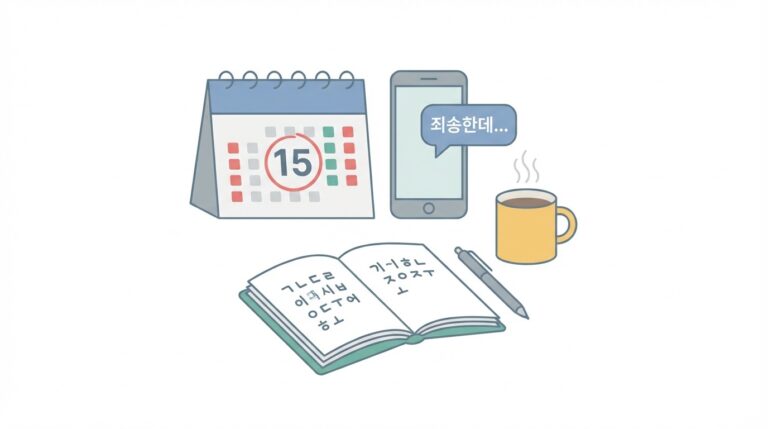
Phase 1: The Panic Moment 😱
Hello, Daily Hangul family! This is your editor, back with another survival guide.
Picture this: You are the main character in a K-Drama. You’re working hard at a convenience store (pyeonuijeom), wiping tables just like Park Seo-joon in Itaewon Class. Suddenly, your phone buzzes. It’s your friend—they got extra tickets to a BLACKPINK concert… for tomorrow night.
But wait. You have a shift tomorrow night.
The background music stops. The camera zooms in on your sweating face. You need to ask your boss (Sajang-nim) to change your schedule. In English, you might just say, “Hey, can I swap shifts?” But in Korea? If you say it wrong, the genre of your drama might switch from ‘Rom-Com’ to ‘Horror.’
Don’t worry. Today, we’ll learn the art of the polite request. Knowing these phrases won’t just save your job; it will make your boss think, “Wow, they have such good nunchi (social sense)!”
Phase 2: Deep Dive into Core Expressions 🧠
Here are the 3 lifesaver phrases you need when your calendar gets messy.
1. 죄송한데… (Joesonghande…)
- Pronunciation: [Joe-song-han-de]
- Sound Analogy: ‘Joe’ sounds like ‘Jo’ in Joseph + ‘song’ like a song you sing + ‘han-de’ like Hon-da (the car).
- Meaning: I’m sorry, but… (The Magic Buffer)
- K-Culture Moment: You hear this in every episode of a K-Drama. Before asking for a favor, interrupting someone, or delivering bad news, characters always start with this. It softens the blow.
- Editor’s Insight: This isn’t just an apology. It’s a signal. It tells the listener, “I am about to ask for something that might inconvenience you, and I respect your time.”
- Situation Spectrum:
[🚫 Boss] ———— [⚠️ Co-worker] ———— [✅ Stranger]
Wait! Actually, this is ✅ Safe Everywhere. It is the ultimate polite opener.- 🤔 Think About It: In many Western cultures, we get straight to the point (“Can I switch shifts?”). Why do Koreans apologize before even stating the problem? It reflects the cultural value of harmony—disturbing the flow requires an apology.
2. 혹시 스케줄 변경 가능할까요? (Hoksi schedule byeongyeong ganeunghalkkayo?)
- Pronunciation: [Hok-si … ga-neung-hal-kka-yo?]
- Tip: ‘Hoksi’ is the key here. It means “By any chance.”
- Meaning: Is it possible to change the schedule (by any chance)?
- K-Culture Moment: Think of a fan meeting an idol. They don’t demand a photo. They say, “Hoksi… sajineul…?” (By any chance… a photo…?). It lowers your status and raises theirs.
- Editor’s Insight: Adding “Hoksi” makes you sound 200% more polite. It turns a demand into a tentative question.
- Situation Spectrum:
[🚫 Casual Friends] ———— [⚠️ Close Colleagues] ———— [✅ Boss/Manager]
- Use this with your boss!
3. 대타 구할게요. (Daeta guhal-geyo.)
- Pronunciation: [Dae-ta gu-hal-ge-yo]
- Sound Analogy: ‘Dae’ like Day + ‘ta’ like Taco.
- Meaning: I will find a substitute/cover.
- K-Culture Moment: In college dramas, when a student has a blind date (sogeting), they beg their friend to be their “daeta” for their part-time job. “Ya, just this once! I’ll buy you chicken!”
- Editor’s Insight: This is the Game Changer. In Korea, if you can’t work, it’s often your responsibility to find a replacement. Saying this before the boss asks shows you are responsible.
Phase 3: Textbook vs. Real Life 🥊
| Situation | 📖 Textbook Korean | 🗣️ Real Korean (Alba Mode) | 💡 Why the difference? |
|---|---|---|---|
| Asking to change time | 시간을 바꾸고 싶습니다. (I want to change the time.) |
저… 혹시 시간 좀 바꿀 수 있을까요? (Uh… by any chance, could I change the time a little?) |
The textbook is too direct/robotic. Real Korean uses “cushion words” like Jeo… (Uh…) and Jom (a little) to sound softer. |
| Saying you can’t go | 내일 못 갑니다. (I cannot go tomorrow.) |
내일 일이 좀 생겨서요… ㅠㅠ (Something came up for tomorrow… sad face) |
Direct rejection sounds cold. Koreans often end sentences vaguely to let the other person infer the “no.” |
Bottom Note: As an A1 learner, simple is good, but soft is better. Don’t just say “No.” Say “Sorry…” and look sad!
Phase 4: Cultural Deep Dive — The Art of “Daeta” (대타) 🎭
4-1. Non-verbal: The “I’m Dying of Guilt” Face
When you ask to change a schedule, your face must match your words. Do not smile brightly! 🚫😊
* Eye Contact: Look down slightly, then up at the boss.
* Posture: Shoulders slightly slumped, hands clasped together.
* This is part of Nunchi (Eye-measure). You are showing that you know you are causing trouble.
4-2. K-Culture Connection: The “Team” Mentality
In Western part-time jobs, the schedule is the manager’s problem. In Korea, the team is a collective body. If you are missing, the team suffers.
- K-Drama Trope: Remember the scene in Coffee Prince? The staff act like brothers. If one is missing, the others have to work double time. That’s why offering to find your own Daeta (substitute) is the ultimate power move. It shows you care about the “brotherhood,” not just your paycheck.
Phase 5: Immersive Roleplay 🎬
Setting: It’s Tuesday afternoon at a busy cafe in Hongdae. The espresso machine is hissing. You need to change your Friday shift to go to that concert.
Characters:
* YOU: A hardworking foreign part-timer.
* Sajang-nim (Boss): A middle-aged owner who is kind but stressed about the weekend rush.
(Scene Start)
YOU: (Approaching cautiously) 사장님, 바쁘세요?
(Sajang-nim, bappeuseyo?)
(English: Boss, are you busy?)
Sajang-nim: 어, 괜찮아. 무슨 일이야? ☕
(Eo, gwaenchana. Museun iriya?)
(English: Oh, I’m okay. What’s up?)
YOU: 저… 죄송한데, 금요일 스케줄 때문에요…
(Jeo… joesonghande, geumyoil schedule ttaemuneyo…)
(English: Um… I’m sorry, but it’s about Friday’s schedule…)
🔀 DECISION POINT: How do you finish the request?
- A) 금요일에 콘서트 가요. 못 와요. (I’m going to a concert on Friday. I can’t come.)
- B) 혹시 시간 좀 바꿀 수 있을까요? 대타 구할게요! (By any chance, can I change the time? I’ll find a sub!)
- C) 금요일에 쉬고 싶어요. (I want to rest on Friday.)
✅ Best Choice: B
* Why? You used the magic word “Hoksi” and offered a solution (“Daeta”). Perfect score! 💯⚠️ Choice A Analysis: Too honest! In Korea, personal enjoyment (concert) isn’t always seen as a valid excuse to drop a shift during a rush. It’s better to say “personal matter” (gaein sajeong).
(Continued with Choice B)
Sajang-nim: 그래? 대타 구하면 괜찮아. 누구한테 물어봤어?
(Geurae? Daeta guhamyeon gwaenchana. Nugu-hante mureobwasseo?)
(English: Really? If you find a sub, it’s fine. Did you ask anyone?)
YOU: 네! 민수 씨가 도와준대요. 감사합니다!
(Ne! Minsu-ssi-ga dowajundaeyo. Kamsahamnida!)
(English: Yes! Minsu said he would help. Thank you!)
Phase 6: 10-Second Shadowing Drill 🗣️
Practice these lines to get the rhythm right. Focus on the emotion!
- 🥺 The Soft Opener:
저… / 죄송한데… / 할 말이 있어요.
(Jeo… / joesonghande… / hal mari isseoyo.)
(Um… / I’m sorry but… / I have something to say.) -
😟 The Careful Ask:
혹시 / 스케줄 변경 / 가능할까요?
(Hoksi / schedule byeongyeong / ganeunghalkkayo?)
(By any chance / schedule change / is it possible?) -
😤 The Responsible Promise:
제가 / 꼭 / 대타 구할게요!
(Jega / kkok / daeta guhal-geyo!)
(I / absolutely / will find a substitute!)
Phase 7: K-Culture Mini Glossary 📘
| Korean | Romanization | Meaning | Context |
|---|---|---|---|
| 알바 | Alba | Part-time Job | Short for Arbeit (German). Used for any temporary job. |
| 사장님 | Sajang-nim | Boss/Owner | Even if it’s a small shop, always call the owner Sajang-nim. |
| 대타 | Daeta | Substitute | A crucial word for schedule swapping. “Pinch hitter” (baseball term). |
| 빵꾸 | Ppangku | No-show / Hole | Slang (from ‘Puncture’). “Schedule-e ppangku nasseo” means someone didn’t show up. Avoid causing this! |
Phase 8: Traveler’s Survival Kit 🧳
Wait, you’re not working, just traveling? You still need “Schedule Adjustment” phrases! Used for hair salons, restaurants, or tours.
🆘 Survival Phrase: Changing a Reservation
* 🇰🇷 “예약 시간 좀 바꿀 수 있을까요?”
* 🗣️ Pronunciation: [Yeyak sigan jom bakkul su isseulkkayo?]
* 📍 Where: Hair salons in Gangnam, Restaurants in Itaewon.
* 💡 Pro Tip: If you are late, message/call IMMEDIATELY. “Korean Time” exists for friends, but Reservation Time is strict.📌 Editor’s Travel Note
* Naver Map usually has a “Call” button for restaurants. Don’t be afraid to use simple English or Papago if your Korean fails. “Reservation Change, please!” works 90% of the time if you say it politely.
Phase 9: Think Deeper — “Indirectness is Kindness” 💭
Topic: Language & Harmony
In many Western cultures, “Efficiency” is polite. We don’t want to waste the boss’s time, so we ask directly. But in Korea, “Indirectness” is polite. Why?
Because directness feels like a confrontation. By using words like “Hoksi” (by any chance) or “Jom” (a little), you are creating a soft buffer zone. It gives the listener space to say “No” without feeling attacked. It’s not about being weak; it’s about preserving the relationship harmony (Kibun).
💬 Your Turn: In your country, if you want to change a shift, do you give a detailed reason or just ask? Let me know in the comments!
Phase 10: FAQ & Troubleshooting 🛠️
Q: Can I just text my boss to change the schedule?
A: ⚠️ Caution! For a small change (10 mins late), text is okay. But for a whole shift change, it is much more respectful to call or ask in person. Texting can seem like you are avoiding them.
Q: What if I don’t have a reason? Can I just say “personal matter”?
A: Yes! “개인 사정이 있어서요” (Gaein sajeong-i isseoseoyo) is the magic phrase. It means “I have a personal matter.” Most bosses will accept this and won’t ask for details if you are usually a good worker.
❌ Common Mistake #1: Saying “Why?” (Waeyo?) when the boss says no.
✅ Fix: Don’t challenge the boss directly. Just say “Ah, algesseumnida” (Ah, I understand) and look disappointed. They might change their mind later seeing your dedication.
Phase 11: Wrap-up & Mission 🚀
One-Liner Summary: When changing schedules, always start with an apology, use “Hoksi,” and offer to find a “Daeta”!
🎯 Action Mission:
* 🥉 Bronze: Look in the mirror and practice your “Sorry face” while saying “Joesonghande…”
* 🥈 Silver: Watch a K-Drama episode involving a part-timer (like Record of Youth or Squid Game Ep 2) and listen for “Sajang-nim.”
* 🥇 Gold: Next time you are late to meet a friend, try saying “Hoksi… 10 minutes late okay?” (Mix it with English!)
Phase 12: Quiz — Are You Ready for Alba? 📝
- Situation: You want to ask your boss a favor. What is the best first word?
- A) 야! (Ya!)
- B) 죄송한데… (Joesonghande…)
- C) 싫어. (Sireo.)
- True or False (K-Culture): In Korea, it is polite to stare straight into your boss’s eyes and smile widely when canceling a shift to show confidence.
- (True / False)
- Fill in the Blank: “I will find a substitute!” = “_____ guhal-geyo!”
🔑 Answers:
1. B (The magic buffer!)
2. False (Look slightly down and apologetic!)
3. Daeta (The pinch hitter!)
Frequently Asked Questions (FAQ)
Q: What does "죄송한데... (Joesonghande...)" mean in Korean and how do you pronounce it?
A: In Korean, "죄송한데... (Joesonghande...)" is pronounced [Joe-song-han-de] and means: a key conversational Korean expression covered in this lesson.
Q: What does "혹시 스케줄 변경 가능할까요? (Hoksi schedule byeongyeong ganeunghalkkayo?)" mean in Korean and how do you pronounce it?
A: In Korean, "혹시 스케줄 변경 가능할까요? (Hoksi schedule byeongyeong ganeunghalkkayo?)" is pronounced [Hok-si ... ga-neung-hal-kka-yo?] and means: a key conversational Korean expression covered in this lesson.
Q: What does "대타 구할게요. (Daeta guhal-geyo.)" mean in Korean and how do you pronounce it?
A: In Korean, "대타 구할게요. (Daeta guhal-geyo.)" is pronounced [Dae-ta gu-hal-ge-yo] and means: a key conversational Korean expression covered in this lesson.







