Phase 1: The Immersive Hook
Hello! This is your Senior Editor at Daily Hangul.
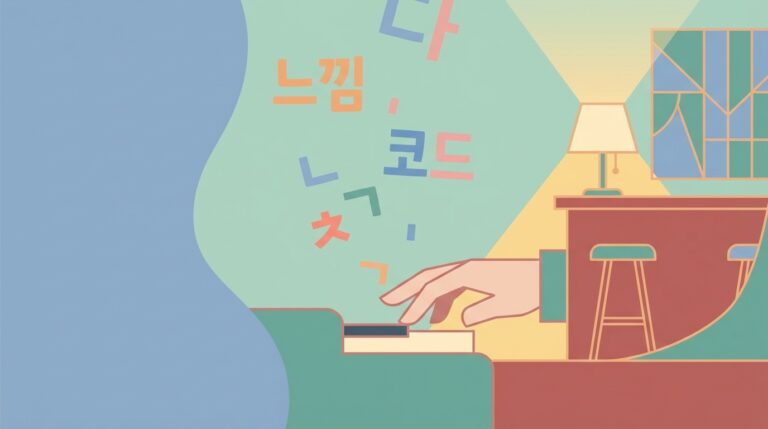
Picture this: You are watching a popular K-Drama. The male lead sits at a grand piano in a dimly lit jazz bar. He isn’t reading sheet music. He closes his eyes, strikes a chord, and begins to sing a heartfelt ballad to the protagonist. The subtitles say “(Playing Piano),” but what he’s actually doing is ‘코드 반주’ (Chord Accompaniment).
In Korea, learning piano isn’t just for children forced by their parents anymore. ‘성인 피아노 학원’ (Adult Piano Academies) have become massive social hubs—think of them as hobby clubs where people learn to play their favorite K-Pop OSTs while sipping coffee (or sometimes beer!).
As a C1 learner, simply saying “I play piano” isn’t enough. You need to discuss how you play, the feeling of the music, and navigate the specific lingo used by Korean hobbyists. Today, we bridge the gap between classical sheet music and the ‘feeling’ of K-Pop.
Phase 2: Deep Dive into Key Expressions
Here are the three expressions that will make you sound like a seasoned musician in Hongdae.
1. 느낌을 살리다 (Neukkimeul sallida)
- Pronunciation: [neu-kki-meul sal-li-da] Sounds like ‘New-Kim-eul Sal-lee-da’
- Meaning: Literal: “To revive the feeling” / Real Nuance: “To play with groove/emotion,” “To bring out the vibe.”
- K-Culture Moment: You’re at a karaoke (Noraebang) or a piano lesson. You hit the right notes, but it sounds robotic. Your Korean friend might say, “더 느낌을 살려봐!” (Put more soul into it!)
- Editor’s Insight: This is the ultimate compliment and the ultimate critique in Korean arts. It implies that technical accuracy is secondary to emotional delivery. In K-Pop covers, ‘feeling’ is king.
- Situation Spectrum:
[🚫 Formal Report] ———— [⚠️ Music Class] ———— [✅ Casual/Jamming]- 🤔 Think About It: Why does Korean culture value ‘Han’ (deep resentment/sorrow) or ‘Heung’ (excitement)? ‘느낌을 살리다’ is often about tapping into these collective cultural emotions.
2. 코드 따다 / 귀 카피하다 (Kodeu ttada / Gwi copy-hada)
- Pronunciation: [ko-deu tta-da] / [gwi ka-pi-ha-da]
- Meaning: Literal: “To pick chords” or “Ear copy” / Real Nuance: “To transcribe by ear,” “To figure out the chords by listening.”
- K-Culture Moment: Musicians in a band discussing a new K-Pop release. “악보 아직 안 나왔어. 그냥 귀 카피해서 치자.” (The sheet music isn’t out yet. Let’s just play by ear.)
- Editor’s Insight: ‘따다’ (to pick/pluck) is used for unlocking something difficult. ‘귀 카피’ is Konglish (Korean-English) at its finest—efficient and intuitive.
- Situation Spectrum:
[🚫 Academic Paper] ———— [⚠️ Professional] ———— [✅ Casual/Musicians]- 🤔 Think About It: ‘Copying’ often has a negative connotation in Western academics (plagiarism). In Korean practice culture, ‘copying’ is the respectful first step to mastery.
3. 반주 깔아주다 (Banju kkara-juda)
- Pronunciation: [ban-ju kka-ra-ju-da]
- Meaning: Literal: “To spread out accompaniment” / Real Nuance: “To provide background music,” “To lay down a track for someone.”
- K-Culture Moment: A friend starts singing at a party. You sit at the piano. They shout, “야, 반주 좀 깔아봐!” (Hey, lay down some accompaniment!)
- Editor’s Insight: The verb ‘깔다’ (to spread/lay) suggests creating a foundation. It implies you are supporting the main act (the singer), reflecting a humble supporting role.
- Situation Spectrum:
[🚫 Elders/Formal] ———— [⚠️ Colleagues] ———— [✅ Friends]
Phase 3: Textbook vs. Real Life
| Situation | 📖 Textbook Korean | 🗣️ Real Korean | 💡 Why the difference? |
|---|---|---|---|
| asking for sheet music | 악보 있어요? (Do you have the score?) | 콩나물 좀 볼 수 있을까요? (Can I see the bean sprouts?) | ‘Bean sprouts’ (notes) is musician slang for complex sheet music. Shows expertise. |
| Improvising | 즉흥 연주를 해보세요. (Please perform an improvisation.) | 필(Feel) 꽂히는 대로 쳐봐. (Play however the feel strikes you.) | ‘Improvisation’ sounds academic. ‘Feel’ is the standard slang for artistic impulse. |
| Making a mistake | 실수를 했습니다. (I made a mistake.) | 삑사리 났어요. (I made a squeak/error.) | ‘Bbigsari’ is the universal Korean slang for a voice crack or a wrong note. |
Phase 4: Cultural Context — K-Culture Deep Dive
4-1. The Art of “Hagwon” Socializing
In Western culture, piano lessons are often solitary. In Korea, adult piano academies are social venues. They often have a central lounge with coffee machines and sometimes organize “chicken & beer parties” (Chimaek parties) after practice.
* Non-verbal Tip: When someone finishes playing a piece in the practice room lounge, it is customary to give a small applause, even if you don’t know them. It’s called ‘매너 박수’ (Manner Applause).
4-2. The “Propose” Trope
Why do so many Korean men learn just one song on the piano? It’s the “Propose Event.” K-Dramas have solidified the image that a romantic proposal requires a rented venue, candles, and the man playing (usually Yiruma’s ‘River Flows in You’ or a ballad) while singing. Knowing this context explains why ‘Event Piano’ is a specific category in some academies.
Phase 5: Immersive Roleplay
Setting: A Friday evening at an adult piano academy in Gangnam. You are chatting with Ji-eun (29, piano instructor, trendy & friendly) in the lounge.
Characters:
* YOU: An advanced learner who loves K-Pop R&B.
* Ji-eun: Your instructor who thinks you rely too much on sheet music.
(Dialogue Start)
Ji-eun: 회원님, 이번 곡은 악보 없이 가보는 거 어때요? 너무 악보만 보시는 것 같아요. 🎼
(Hoewonnim, ibeon gogeun akbo eopsi gaboneun geo eottaeyo? Neomu akboman bosineun geo gatayo.)
(Member [Client], how about going without sheet music for this song? You seem to look at the score too much.)
YOU: 아, 도전해보고 싶은데… 코드를 외우는 게 아직 익숙하지 않아서요.
(Ah, dojeonhaebogo sipeunde… kodeureul oeuneun ge ajik iksukaji anaseoyo.)
(Ah, I want to try… but I’m not used to memorizing chords yet.)
Ji-eun: 에이, 머리로 외우지 말고 손이 기억하게 해야죠! 그냥 노래 들으면서 귀 카피 한번 해보실래요?
(Ei, meoriro oeuji malgo soni gieokhage haeyajyo! Geunyang norae deureumyeonseo gwi-copy hanbeon haebosillaeyo?)
(Ey, don’t memorize with your head, let your hands remember! Want to try transcribing by ear while listening?)
🔀 Decision Point: How do you respond?
A) “귀 카피요? 제가 절대음감도 아닌데 무리예요.” (Ear copy? I don’t have perfect pitch, it’s impossible.)
B) “좋아요! 대신 멜로디 라인은 선생님이 좀 도와주세요.” (Great! But please help me with the melody line, Teacher.)
C) “그럼 선생님이 먼저 시범 보여주시면 안 돼요?” (Then can’t you show me a demo first?)
✅ Best Choice: B — It shows a willingness to learn (highly valued in Korean culture) while humbly acknowledging your limit and asking for guidance (building rapport).
⚠️ Choice A Analysis: Too defensive. In a hobby setting, ‘trying’ is more important than ‘succeeding’.
(Roleplay Continues with Choice B)
YOU: 좋아요! 대신 멜로디 라인은 선생님이 좀 도와주세요. 제가 박치라서요.
(Joayo! Daesin mellodi raineun seonsaengnimi jom dowajuseyo. Jega bakchiraseoyo.)
(Great! But please help me with the melody line. I’m tone-deaf/rhythm-deaf.)
Note: ‘Bakchi’ means someone with no sense of rhythm.
Ji-eun: (Laughing) 박치라뇨~ 저번에 보니까 리듬감 좋으시던데! 그럼 제가 반주 깔아드릴 테니까 멜로디만 쳐보세요.
(Bakchiranyo~ Jeobeone bonikka rideumgam joeusideonde! Geureom jega banju kkaradeuril tenikka mellodiman chyeoboseyo.)
(Rhythm-deaf? No way~ I saw you last time, your rhythm was good! Then I’ll lay down the accompaniment, you just play the melody.)
Phase 6: 10-Second Shadowing Drill
Let’s practice requesting a specific “vibe” for a song. Practice breathing with the pauses.
Emotion: 🥺 Earnest & Slightly Artistic
“악보 그대로 / 치는 것보다, / 제 스타일대로 / 느낌을 살려서 / 연주하고 싶어요.”
(Akbo geudaero / chineun geotboda, / je setaildaero / neukkimeul sallyeoseo / yeonjuhago sipeoyo.)
Translation: Rather than playing exactly like the sheet music, I want to play bringing out the vibe in my own style.
Phase 7: K-Culture Mini Glossary (Musician Edition)
| Korean | Romanization | Meaning | Context |
|---|---|---|---|
| 버스킹 | Beoseuking | Busking | Street performances. Hongdae and Han River parks are the holy lands for this. |
| 떼창 | Ttechang | Sing-along | When the audience sings the entire song together loudly. Essential for K-Pop concerts. |
| 합주 | Hapju | Ensemble/Jam | Playing together. “합주실” (Hapjusil) is a band practice room. |
| 커버 | Keobeo | Cover | K-Pop covers. “피아노 커버” (Piano cover) is a huge category on Korean YouTube. |
| 완곡 | Wangok | Full Song | Playing a song from start to finish (opposed to just the chorus/highlight). |
Phase 8: Traveler’s Survival Kit — The “Practice Room” Run
If you are a musician traveling in Korea, you might want to rent a piano practice room. Korea has excellent rental systems.
🆘 Survival Expression #1
– 🇰🇷 “시간당 대여료가 얼마예요?” (Sigandang daeyeoryoga eolmayeyo?)
– 🗣️ Meaning: “How much is the rental fee per hour?”
– 📍 Where: Practice rooms (연습실), Karaoke (노래방)
– 💡 Pro Tip: Many practice rooms in Korea are unmanned (무인). You book via apps like ‘Space Cloud’ (스페이스클라우드) and get a door code.📌 Editor’s Note: Buying Sheet Music
– Don’t look for physical books for the newest K-Pop. Koreans use “Mapianist” (마피아니스트) or “Akbo Bada” (악보바다) online. You buy a PDF and print it at a ‘PC Bang’ or convenience store.
Phase 9: Think Deeper — “The Republic of Examination Music”
Topic: Enjoyment vs. Perfection
In Korea, learning an instrument was traditionally linked to “educational specs” (specifications/qualifications) for college entrance. Many Koreans have memories of being hit on the knuckles with a ruler if they played a wrong note at piano academies in the 90s and 00s. This created a generation that is technically brilliant but terrified of making mistakes.
However, the recent boom of “Adult Hobby Piano” is a direct rebellion against this. It focuses on healing, socializing, and playing what you want (K-Pop/OSTs) rather than Czerny or Hanon exercises. It marks a shift in Korean society from “striving for perfection” to “seeking personal happiness (So-hwak-haeng).”
💬 Your Turn: In your country, is music education strict and academic, or is it seen more as a creative hobby? Tell us in the comments!
Phase 10: FAQ & Troubleshooting
Q: I want to play piano at a Korean church to make friends. Is that okay?
A: Yes, but be careful! Korean church music (CCM) culture is huge and competitive. If you say you can “play accompaniment” (반주), they might expect professional-level improvisation. Start by saying “I’m learning” (배우고 있어요) rather than “I can play” (칠 줄 알아요).
Q: Can I use ‘Banju’ for drinking?
A: Sharp eye! Yes, 반주 (Banju) has two meanings:
1. Musical Accompaniment (what we learned today).
2. Drinking alcohol with a meal (飯酒).
Context is everything. “반주 하자” at a piano academy means “Let’s jam.” “반주 하자” at a scorched rice soup (Gukbap) restaurant means “Let’s have Soju with lunch.”
❌ Common Mistake: Asking for “Piano Notes.”
Don’t say “피아노 노트 주세요.” ‘Note’ in Korean usually refers to a notebook for writing.
✅ Say this: “악보 (Akbo)” is sheet music. “계이름 (Gye-ireum)” are the note names (Do-Re-Mi).
Phase 11: Wrap-up & Mission
One-Liner Summary: To sound like a pro in Korea, focus on the ‘Feeling’ (느낌) and use slang like ‘Codes’ (코드) and ‘Ear Copy’ (귀 카피) instead of academic terms.
🚀 Action Mission:
- 🥉 Bronze: Go to YouTube, search for a K-Pop piano cover (e.g., “BTS Spring Day Piano Cover”), and comment in Korean: “느낌이 정말 좋네요!” (The vibe is really good!)
- 🥈 Silver: Find the chord sheet for your favorite K-Pop song on Google (search “[Song Name] 코드 악보”) and try to read the Korean lyrics while humming.
- 🥇 Gold: Visit a coin karaoke (Coin Noraebang) in Korea or your town, and while your friend selects a song, say: “내가 탬버린으로 반주 깔아줄게!” (I’ll lay down the accompaniment with the tambourine!)
Phase 12: Interactive Quiz
1. Which phrase is MOST natural when you want to praise a friend’s emotional piano performance?
– A) 기술이 완벽하네요. (Your technique is perfect.)
– B) 느낌을 잘 살렸네요! (You really brought out the feeling!)
– C) 악보를 잘 읽으시네요. (You read the sheet music well.)
2. True or False (K-Culture):
– “In Korea, ‘Adult Piano Academies’ are strictly for silent practice and have no social element.”
– (True / False)
3. Fill in the blank:
– “I don’t have the sheet music, so I will just _______ it.”
– “악보가 없어서 그냥 ( ) 할게요.”
[Answers below]
.
.
.
.
Answers:
1. B (A and C sound like a teacher evaluating a student. B is a genuine compliment among peers.)
2. False (They are major social hubs for adults!)
3. 귀 카피 (Ear Copy) or 즉흥 연주 (Improvisation)
Frequently Asked Questions (FAQ)
Q: What does "느낌을 살리다 (Neukkimeul sallida)" mean in Korean and how do you pronounce it?
A: In Korean, "느낌을 살리다 (Neukkimeul sallida)" is pronounced [neu-kki-meul sal-li-da] and means: Literal: "To revive the feeling" / Real Nuance: "To play with groove/emotion," "To bring out the vibe."
Q: What does "코드 따다 / 귀 카피하다 (Kodeu ttada / Gwi copy-hada)" mean in Korean and how do you pronounce it?
A: In Korean, "코드 따다 / 귀 카피하다 (Kodeu ttada / Gwi copy-hada)" is pronounced [ko-deu tta-da] and means: Literal: "To pick chords" or "Ear copy" / Real Nuance: "To transcribe by ear," "To figure out the chords by listening."
Q: What does "반주 깔아주다 (Banju kkara-juda)" mean in Korean and how do you pronounce it?
A: In Korean, "반주 깔아주다 (Banju kkara-juda)" is pronounced [ban-ju kka-ra-ju-da] and means: Literal: "To spread out accompaniment" / Real Nuance: "To provide background music," "To lay down a track for someone."